Hot Off The Press – New Titles This Week
Published on 9 September 2025 by Rose Staveley-Wadham
This week at The Archive we are celebrating reaching a landmark 95 million pages all now available to search, as we welcome another wonderful host of new titles, including communist title Workers’ Weekly and historic Irish newspaper the Dublin Journal. Overall, we’ve added five brand new titles this week, alongside updates to 32 of our existing titles, covering a range of interests, from sport to industrial democracy, and range of locations from across the United Kingdom. In all, we’ve added 288,936 brand new pages over the past seven days.
So read on to discover more about all of our new and updated titles of the week, and also to learn about the ‘militant women‘ who were at the forefront of industrial action during 1926.
Register now and explore The Archive
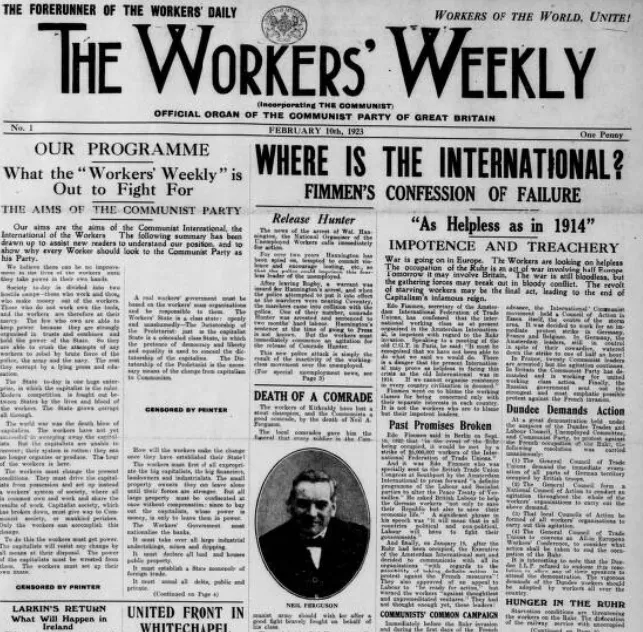
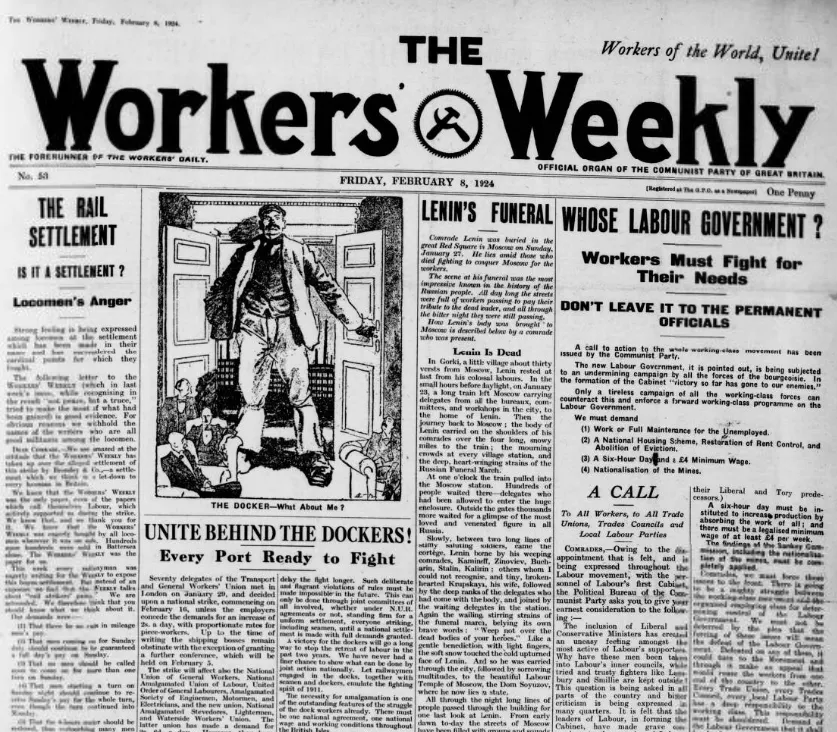
The Workers Weekly
We start our survey of this week’s new titles with Workers’ Weekly, which was once the official newspaper of the Communist Party of Great Britain. The Communist Party of Great Britain was founded in August 1920 following the Congress of London, and was formed of two main constituent parties, the British Socialist Party and the Workers’ Socialist Federation. The British Socialist Party already had its own newspaper, The Call, but when the new political party was founded, a new newspaper was needed. This paper was the Communist, and it made its debut on 5 August 1920.
However, three years later, in 1923, the Communist Party of Great Britain identified the need for change, and for greater engagement with its target audience, the workers. And so, the publication of a new organ followed, namely the Workers’ Weekly, which was launched on 10 February 1923. This new publication incorporated the Communist, and appeared every Saturday.
As journalist and Communist Party of Great Britain member Andrew Rothstein (1898-1994) put it:
How can we extend our influence in the workshops? By means of the ‘Workers’ Weekly:’ by making it interesting to those in the workshops; by reflecting in it the daily life of the workshops; by building it up, in short, around letters from the workshops, because they constitute the first link in the chain, the first like that we must take hold of and hold on to with all our might, knowing that only in that way we shall arrive at what we desire.
In short then, the Workers’ Weekly would be expressly for the workers, with a concentration on normal working daily life, and the concerns of the working classes. Edited by journalist and theorist Rajani Palme Dutt (1896-1974), the new formula, of being ‘made by the workers for the workers’ proved to be a runaway success. The first issue of Workers’ Weekly sold out, whilst following editions sold some 50,000 copies on a regular basis.
So what sort of content did Workers’ Weekly contain? A key part of the title was its letters from worker correspondents, of which it published 2,500 in the first year. These letters were published in a section which was entitled ‘Workers’ Life.’ Meanwhile the paper, across its four pages, printed news about leading communist figures in Britain, as well as updates from communist groups across the country and beyond.
The success of Workers’ Weekly peaked in August 1926 following the Great Strike. 80,000 copies of the publication were sold that month. However, Workers’ Weekly was not set to last. It was succeeded by Workers’ Life in January 1927, which was itself replaced by the Daily Worker in January 1930. The Daily Worker is published today as the Morning Star.
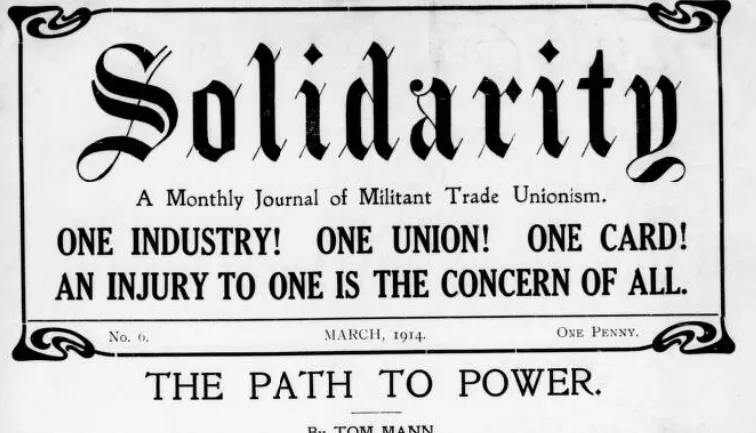
Solidarity
In a similar sort of vein is our next new newspaper of the week, Solidarity. ‘The Paper for Rebels,’ it was published by Industrial Democracy League secretary Jack Vesey Wills, from Rotherhithe, from 1913 onwards. Jack Vesey Wills (1877-1933) was a prominent trade unionist, and his publication, Solidarity, was set to be a ‘Monthly Journal of Militant Trade Unionism.’
Eschewing tactics of mediation and discussion, the militant trade unionist movement instead focussed on direct action, incorporating strikes and boycotts. With the motto ‘One Industry! One Union! One Card!,’ Solidarity supported these endeavours through a range of articles on militant trade unionism. Authored by Jack Vesey Wills himself, a range of contributors also wrote for Solidarity, including trade unionist Tom Mann (1856-1941).
Meanwhile, Solidarity also included articles on the Industrial Democracy League, of which Wills was a part.
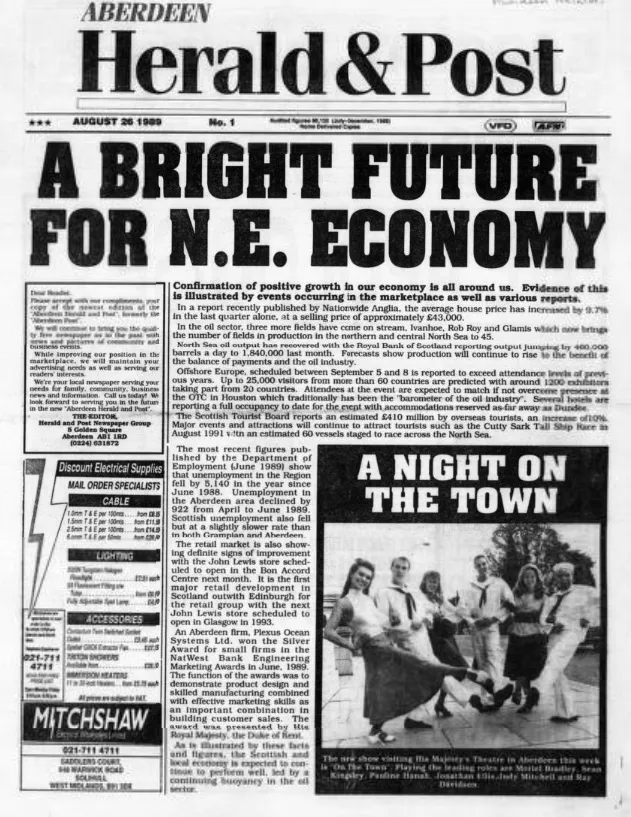
The Aberdeen Herald & Post
We travel now to Scotland for our next new title of the week, which is the Aberdeen Herald & Post. Launched in 1989 as a freely distributed newspaper for the city of Aberdeen, this title provided a roundup of the week’s news, sports, and local events. Indeed, the Aberdeen Herald & Post was distributed to 75,000 households across Aberdeen and the surrounding area every Saturday.
A one time winner of the ‘Best Free Newspaper in Scotland’ award, in 2002 the newspaper changed its name to the Aberdeen Citizen. Sadly, this title ceased publication on 23 May 2018.
The Dublin Journal
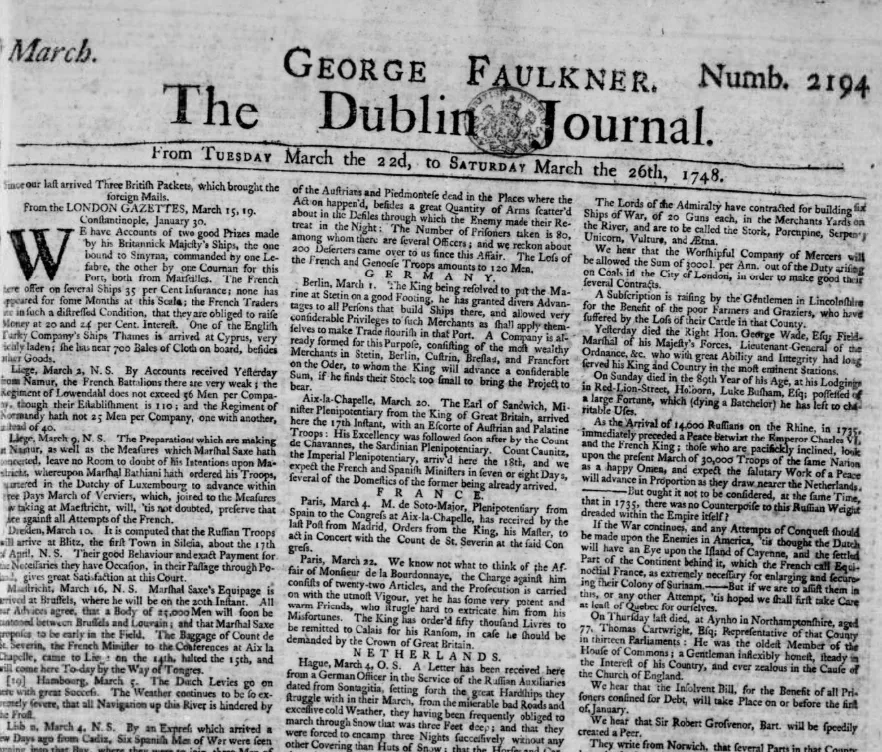
Our penultimate new title of the week is an eminently historical one, which was founded by Dublin printer and publisher George Faulkner (c.1700 – 1775) in 1725. A colourful character, Faulkner was apprenticed to printer Thomas Hume on Dame Street, Dublin. He continued his apprenticeship in London, before coming back to Dublin to start his own printing concern with James Hoey, with whom he would set up the Dublin Journal.
It was during this time, and Faulkner’s regular trips to London, that he forged a close relationship with pioneering Anglo-Irish satirist Jonathan Swift (1667-1745). Indeed, Faulkner would become Swift’s publisher in Ireland, his publishing of Swift’s Drapier’s Letters, a series of pamphlets intended to rile up the Irish public about changes to currency, led to him being ordered into custody by the Irish House of Lords. Thankfully, for Faulkner, nothing came of this.
Whilst enjoying a long and lucrative publishing relationship with Jonathan Swift, Faulkner’s newspaper venture, the Dublin Journal, enjoyed success too. Known also as Faulkner’s Journal, it gained popularity with its broadly non-partisan approach. Meanwhile, Faulkner used the paper as a vehicle to advertise the books he printed, including those by Jonathan Swift.
However, upon Faulkner’s death, according to the Dictionary of Irish Biography, the Dublin Journal would eventually become a ‘violent Tory organ.’ Edited by accountant and sometime acting Grand Master of the Orange Order John Giffard (1746-1798), a frequent contributor to the title was his wife’s nephew Daniel Ryan (1762-1798). A passionate loyalist, Ryan was sent to arrest United Irishman Lord Edward Fitzgerald during the Irish Rebellion on 1798. Ryan was wounded during the arrest, later dying of his wounds.
Meanwhile, the Dublin Journal ran until 1825.
The Picture World
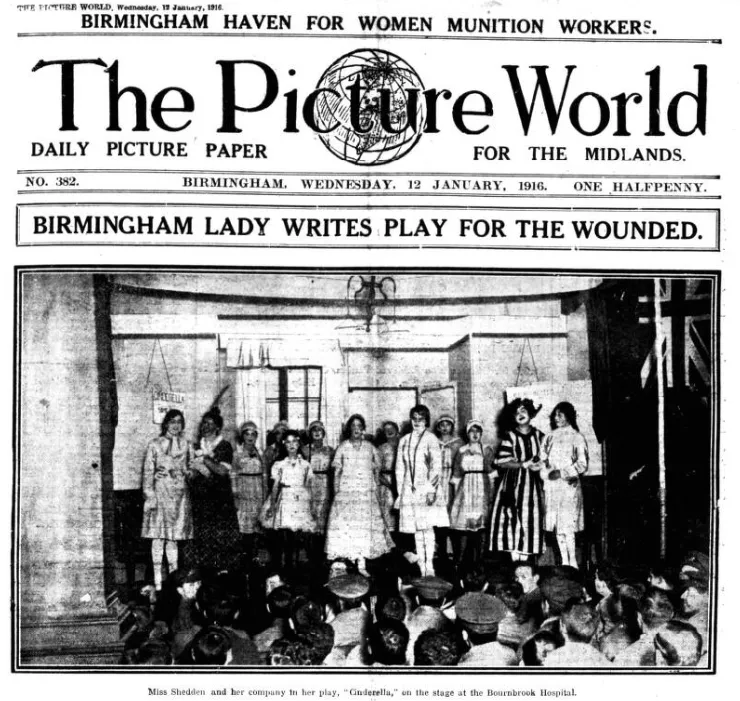
‘The Picture Paper for the Midlands,’ the Picture World was published in Birmingham. Featuring photographs of a range of Midlands matters, Picture World provided ‘photographs of Midland happenings daily.’ Costing just one halfpenny, the publication filled an expansive 12 pages with photographs of news.
Published during the First World War, it printed photos of Midlands soldiers, providing a fascinating insight into pictorial reporting at the this time.
Meanwhile, if you were ‘interested in the doings of your neighbours you must be a daily reader of the Picture World.’ Not isolating itself to purely photography, Picture World also featured ‘Gossip of the Midlands,’ ‘Fashion Notes for Women,’ ‘Recipes for the Housewife,’ and the ‘World’s Latest News.’ There was also a dedicated children’s section.
Furthermore, the publication also stated how it held ‘premier place in the Midlands.’ The title was later in 1916 absorbed into the Birmingham Daily Gazette, as a daily features page, which also incorporated ‘topical cartoons.’
Our updated titles
Leading this week’s charge of new titles is the Wigan Evening Post, to which we have added over 56,000 brand new pages. Meanwhile, we’ve added new pages to five of our Scottish titles, including the Banffshire Advertiser, the Forres Elgin and Nairn Gazette, Northern Review and Advertiser, and the Kirkcaldy Times. Furthermore, we’ve updated a quartet of titles from Northern Ireland, the Armagh Guardian, the Dromore Weekly Times and West Down Herald, the Lisburn Herald and Antrim and Down Advertiser and the Newry Reporter, as well as two titles from the Republic of Ireland, the Gorey Correspondent and the Leinster Leader.
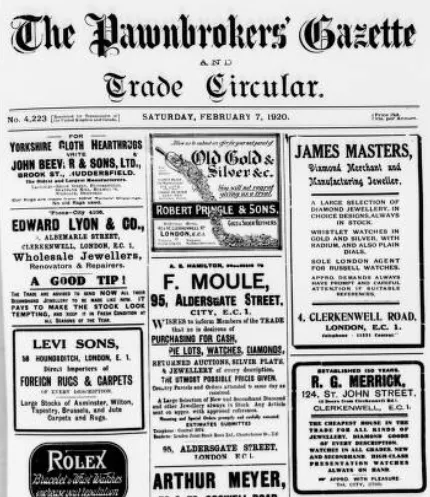
With regards to our special interest titles, we’ve updated the African Aid Society’s African Times, land nationalisation publication Land & Labor, occupational title Pawnbrokers’ Gazette and sport’s The Referee.
‘Militant Women’ – Women and Industrial Action
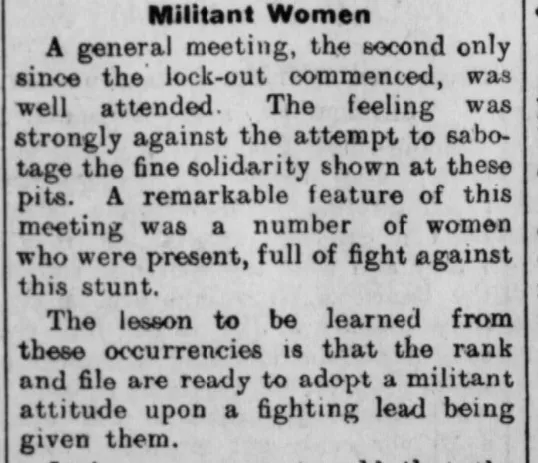
On 24 September 1926 our new title the Workers’ Weekly published a paragraph headed ‘Militant Women’ in piece about industrial action at Trelewis, Wales. Additional workers, known as strikebreakers, or more pejoratively, ‘scabs,’ had been brought in to work the mine at Trelewis. Workers’ Weekly described how:
A general meeting, the second only since the lock-out commenced, was well attended… A remarkable feature of this meeting was a number of women who were present, full of fight against this stunt.
We were intrigued to learn more about such ‘militant women’ and their fight. We found more evidence of women standing in solidarity with strikers in the pages of the Workers’ Weekly, this time from December 1926. 1926 of course was a year of huge industrial unrest, being the year of the Great Strike, and in October 1926 miners in the Chester-le-Street area of County Durham were out on strike.
Again, mine owners had brought in strikebreakers, and on 7 October 1926 the women of the area organised a demonstration against such ‘scabs,’ with tragic results. The Workers’ Weekly reported how a ‘scab lorry’ had killed one of the bandsman participating in the demonstration, which resulted in a libel case against the communist newspaper. The paper also highlighted ‘police brutality’ during the strike.
On 17 December 1926 Workers’ Weekly gave accounts from three women who participated in the 7 October 1926 demonstration. The first came from Mrs. Garnham, of Fatfield, part of Sunderland. She was carrying one of the poles of the Fatfield’s Women’s Banner during the demonstration. The Workers’ Weekly told of how the demonstration were forming up, and ‘turning the corner, when a policeman came upon her, pushed her aside, and knocked the banner aside so that it broke away from the pole and fell onto the ground.’
The paper also included testimony from Mrs. Strangroom, who was holding the banner with Mrs. Garnham. Workers’ Weekly tells of how:
…she was holding the cord of the banner, when a policeman caught her arm and pushed her on to the drum being held carried by another woman. At the same time the policeman caught hold of the banner, and the cord was pulled from her hand. She could see no reason why the police should do this. Her arm ached all the next day from the grip.
Mrs. Clennen, also from Fatfield, confirmed Mrs. Strangroom’s story, being the woman who was holding the drum. However, when she was asked if she was pushed, the Workers’ Weekly quoted her as saying:
‘I wouldn’t let any man push me like that, let alone the police.’
Discover more about militant women, industrial demonstrations and strikes, and much more besides, in the pages of our Archive today.
New Titles
Title | Years Added |
1989, 1994-2000, 2002 | |
1748-1749, 1755-1764, 1766-1768, 1803 | |
1916 | |
1914, 1917-1921 | |
1923-1927 |
Updated Titles
This week we have updated 32 of our existing titles.
You can learn more about each of the titles we add to every week by clicking on their names. On each paper’s title page, you can read a free sample issue, learn more about our current holdings, and our plans for digitisation.
Title | Years Added |
1862, 1875-1879, 1890-1899 | |
1991-1992 | |
1890-1899, 1917, 1932-1939, 1951, 1953 | |
1918-1919, 1924, 1930-1939, 1950-1952, 1954-1955, 1957, 1959, 1970-1979, 1981 | |
1883, 1886 | |
1908-1910, 1912-1913 | |
1900-1909, 1921-1922, 1924 | |
1869, 1872, 1880-1918 | |
1950 | |
1920-1929, 1931, 1940-1949, 1952 | |
1763-1779 | |
Forres Elgin and Nairn Gazette, Northern Review and Advertiser | 1980-1986, 1988-1989 |
1885-1892 | |
1991, 2001, 2004 | |
1888 | |
1889-1914, 1916-1917, 1919-1921 | |
1900, 2000-2001 | |
1957-1965 | |
1859, 1879 | |
1915-1921 | |
1888, 1896 | |
1911-1912, 1915, 1918 | |
1925-1926, 1996 | |
1864-1869, 1909 | |
1900-1902, 1904-1909, 1920-1928, 1930-1931 | |
1966-1969 | |
1900 | |
1915-1918 | |
1963-1965 | |
1860-1862, 1867, 1872-1879, 1896-1897 | |
1993, 1997 | |
1987, 1993-1994, 1997, 2000-2004 |
You can keep up to date with all the latest additions by visiting the recently added page. You can even look ahead to see what we’re going to add tomorrow.
More on this topic:
Share this article
About the author

Rose Staveley-Wadham
Newspaper Licensing Manager
Published on Tue, 9 September 2025.