
Hot Off The Press – New Titles This Week
Published on 1 September 2025 by Rose Staveley-Wadham
This week at The Archive we have a smorgasbord of historical Shropshire newspapers for you to enjoy, with the addition of eight brand new titles from the West Midlands county, alongside updates to eight of our existing Shropshire titles. We are delighted to be spoiling you with new pages this week, which number 288,672 in all, as we welcome a total of fifteen brand new titles, alongside updates to 43 of our existing titles.
So read on to discover more about our new Shropshire newspapers, our updated pages, which hail from all over the United Kingdom and beyond, as well as to learn about Dr William Penny Brookes, whose Wenlock Olympian Games in Shropshire inspired the modern Olympic Games movement.
Register now and explore The Archive
A Shropshire sensation
We are delighted to welcome our new Shropshire newspapers thanks to our partnership with Shropshire Council, and their Archive and Libraries services. Before moving on to welcome our new Shropshire newspapers this week, and our other new titles, we wanted to highlight the newspapers we have updated thanks to this partnership.
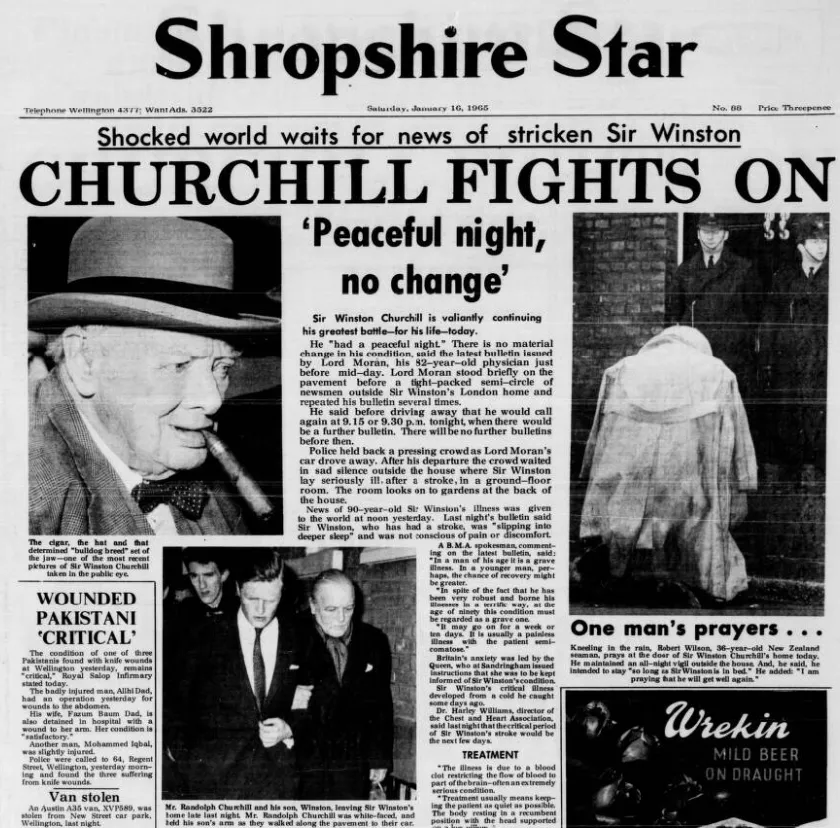
We’re very excited to bring over 200,000 brand new pages to one of the country’s most popular regional newspapers, the Shropshire Star. These pages cover three decades of news, spanning the years 1965 to 1985.
Our second biggest update is to the Newport & Market Drayton Advertiser, the newspaper for the market town of Newport. We have added over 42,000 brand new pages to this title, with updates spanning three centuries, from 1864 through to 2004.
Meanwhile, we’ve also added, in partnership with Shropshire Council, new pages to the Bridgnorth Journal, Eddowes’s Shrewsbury Journal, the Oswestry Advertiser, and the Shrewsbury Chronicle. Furthermore, thanks to our ongoing partnership with the British Library, we have updated further Shropshire newspapers in the shape of the Ludlow Advertiser and the Wellington Journal.
The Shropshire and Montgomeryshire Times and the Shropshire Mercury
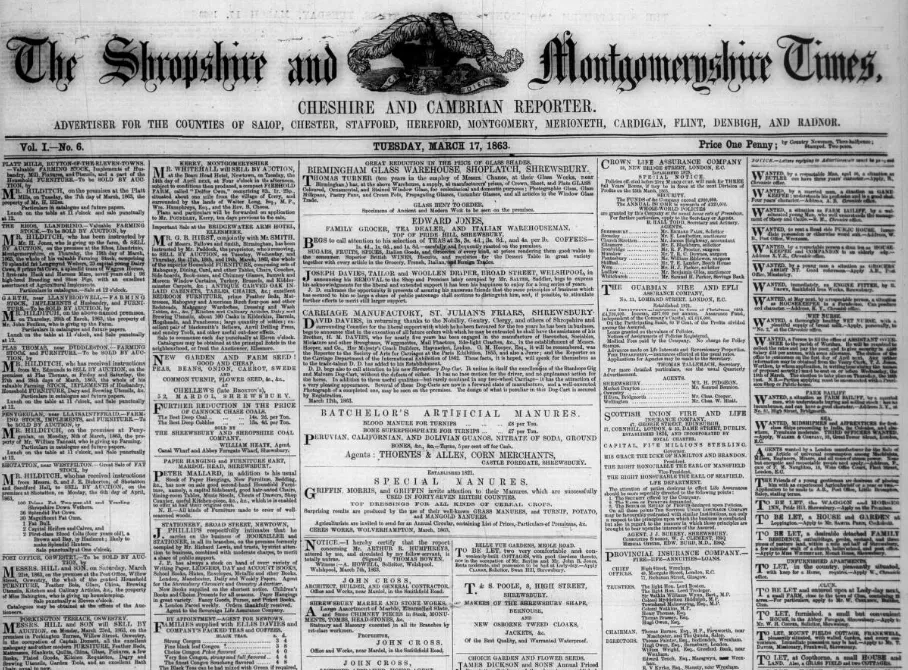
The first of our duo of new Shropshire titles hail from Shropshire’s county town of Shrewsbury. First up is the Shropshire and Montgomeryshire Times, which was first published on 10 February 1863. Aiming to carry the news for the ‘Counties of Salop, Chester, Stafford, Hereford, Montgomery, Merioneth, Cardigan, Flint, Denbigh, and Radnor,’ this title filled four pages and was published every Tuesday.
‘Whilst sedulously avoiding all political or sectarian bias,’ the Shropshire and Montgomeryshire Times, in its first edition, promised to ‘honestly and fearlessly support those principles of civil and religious liberty and social and political progress which have already raised this county to its present pinnacle of prosperity.’
Later incorporated into the Shrewsbury Chronicle, this publication printed agricultural news, news from across both Shropshire and Wales, notices of births, marriages and deaths, alongside sporting intelligence and more general news.
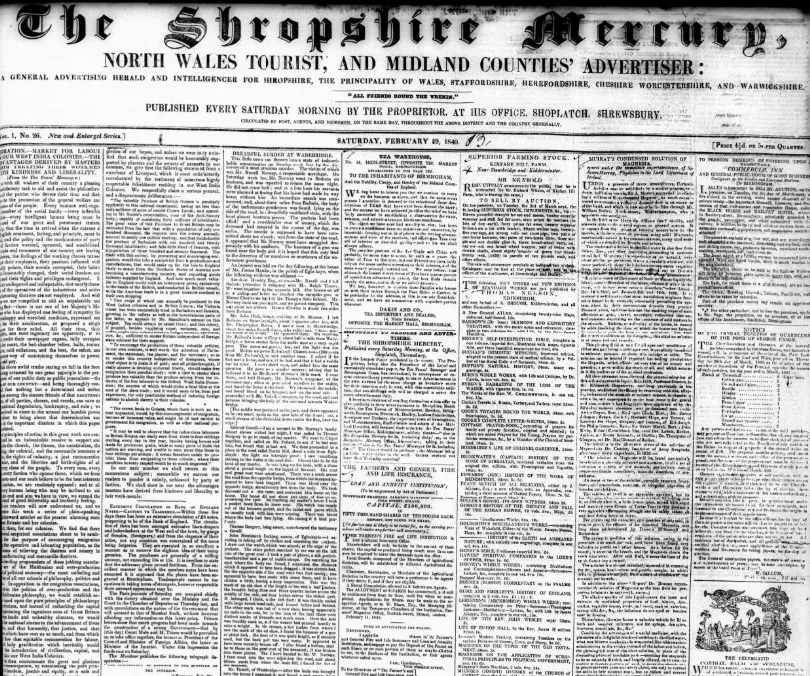
Meanwhile, the Shropshire Mercury, for which we have digitised the year 1840, was published in Shrewsbury with the full title of the Shropshire Mercury, North Wales Tourist, and Midland Counties’ Advertiser. Appearing every Saturday and filling four pages, it described itself as being a ‘journal connecting the principality of Wales with Shropshire, Staffordshire, Warwickshire, Worcestershire, Herefordshire, and the Midland Counties generally, and forming a weekly guide to their news and advertisements.’
Published by T.J. Ouseley in Shrewsbury, the newspaper printed the news from the likes of the Shropshire Quarter Sessions and Wellington Petty Sessions, alongside sections on literature and fashion, more general news, poetry, and notices of births, marriages and deaths.
The Oswestry Herald and the Ironbridge Weekly Journal and Borough of Wenlock Advertiser
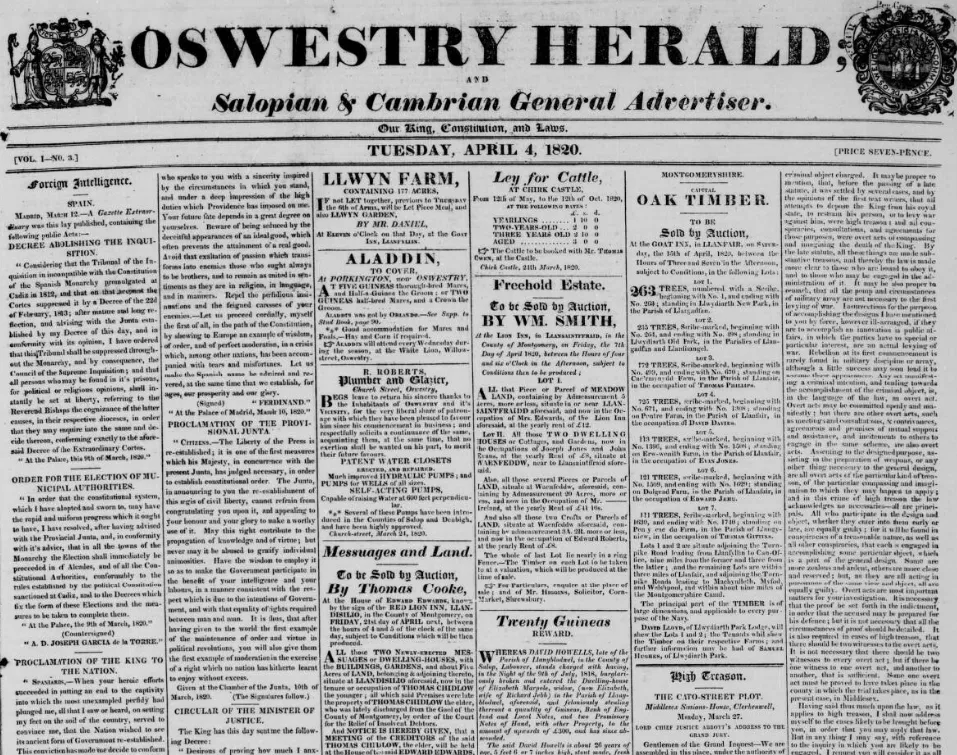
The next of our Shropshire newspapers is the Oswestry Herald, which was first published on 21 March 1820 with the full title of the Oswestry Herald and Salopian and Cambrian General Advertiser. Costing some seven pence, this historical title, which was published in the Shropshire market town of Oswestry, declared in its debut edition how it was in opposition to ‘that class of dangerous characters, who, under the specious pretext of effecting a Reform of our present unrivalled Constitution, have long been endeavouring to destroy that fair fabric, and to raise upon it’s ruins, the Temple of Democracy.’
Meanwhile, the Oswestry Herald printed foreign intelligence, general news, news of bankrupts, agricultural updates, poetry, and correspondence.
We hop now to the market town of Much Wenlock for our next new title of the week, the Ironbridge Weekly Journal and Borough of Wenlock Advertiser. Appearing every Saturday and costing one penny, this title was printed at Joseph Slater’s steam printing office. Filling eight pages, the local-focussed newspaper printed the latest from the likes of Madeley, Dawley, Much Wenlock, Bridgnorth, Apley, Lawley Bank, Coalbrookdale, and Shrewsbury, as well as printing more general news, sporting updates, poetry, and notices of births, marriages and deaths.
The Bridgnorth Beacon and South Shropshire Advertiser and the Bridgnorth Weekly News
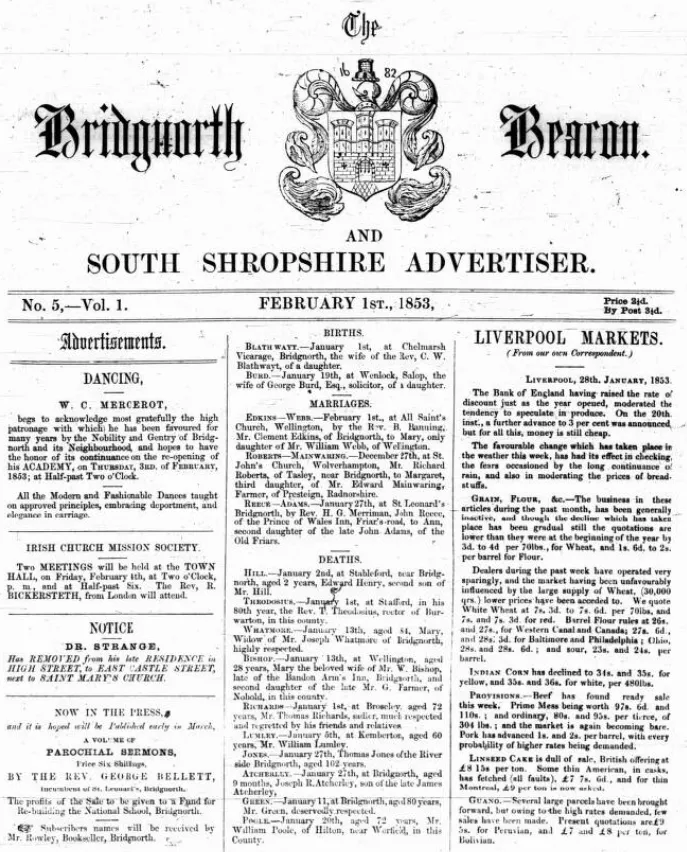
These next two Shropshire newspapers both come from the market town of Bridgnorth, and we begin with the older title, which is the Bridgnorth Beacon and South Shropshire Advertiser. First published on 1 October 1852, this was a monthly title, which intended to be ‘a monthly repertory of local and general information.’
Filling some eight pages, the Bridgnorth Beacon and South Shropshire Advertiser had a penchant for ‘local and literary topics,’ and covered items like local fetes, news from the local militia, and police intelligence, as well as printing literary extracts, more general news, and notices of births, marriages and deaths.
Following along some three years later was the Bridgnorth Weekly News, which first appeared on 31 May 1856 at the cost of three halfpence. Printed and published by the newspaper’s proprietor William Henry Boaz from his premises on Bridgnorth’s High Street, this paper was published every Saturday with the ‘view to meet the wishes and wants of all classes of the community.’
Indeed, intending to ‘blend instruction with amusement,’ the Bridgnorth Weekly News printed news from London, more local news, poetry, and notices of births, marriages and deaths, across its four pages.
The Bishop’s Castle Advertiser and Clun News and the Bishop’s Castle Chronicle & Clun Valley Times
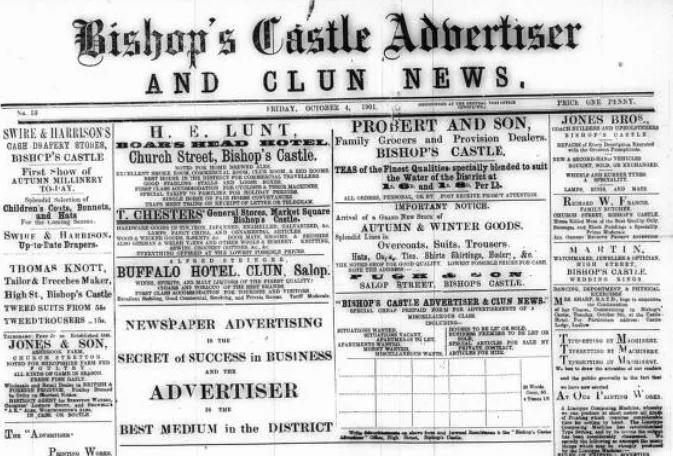
We finish our survey of our new Shropshire newspapers in the market town of Bishop’s Castle with a duo of titles, and as with our previous pair, we start with the elder publication. Established in 1900, the politically independent Bishop’s Castle Advertiser and Clun News appeared every Friday at the cost of just one penny.
Filling the eight pages of the Bishop’s Castle Advertiser and Clun News were a range of special interest columns, which incorporated topics like the ‘Ladies’ Home,’ agricultural and gardening notes, and society gossip. As well as printing poetry and serialised fiction, this title printed local news, sporting updates, and railway timetables.
Meanwhile, our final new Shropshire title of the week is the Bishop’s Castle Chronicle & Clun Valley Times. This title was established in 1911, and appeared every Saturday at the price of one penny. Its eight pages were mainly occupied with agricultural matters, with news from the likes of the Shrewsbury District Farmers’ Union and the South Shropshire Farmer’s Association.
Accompanying a robust fare of local and district intelligence, and sporting news, the Bishop’s Castle Chronicle & Clun Valley Times also featured serialised fiction, detailed profiles of Shropshire personalities, correspondence, and notices of births, marriages and deaths. It was later merged with the Shrewsbury Chronicle.
The Belfast Linen Trade Circular
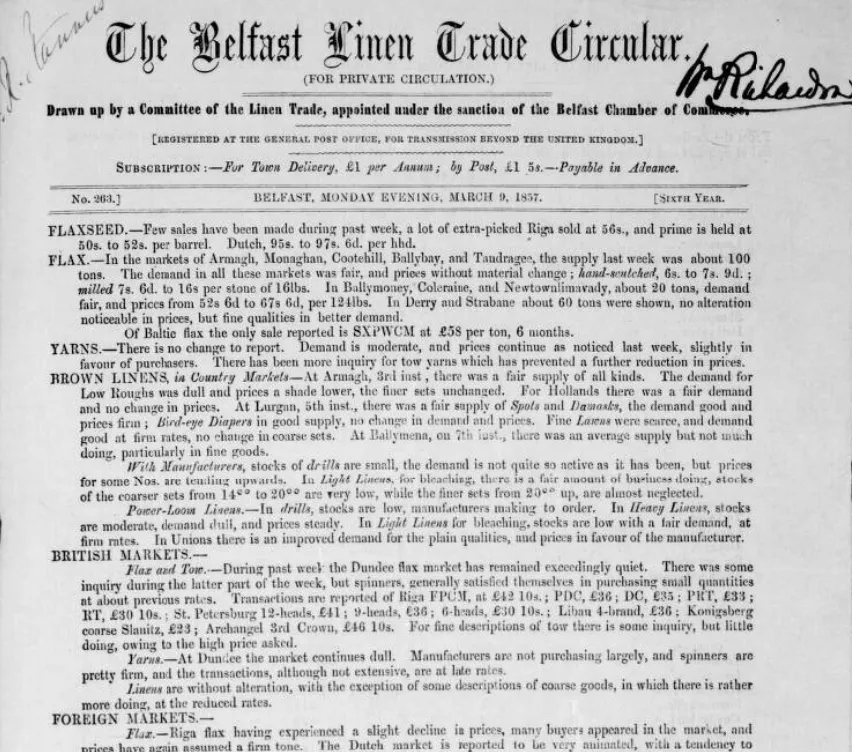
Stepping briefly away from our Shropshire newspapers now to welcome our other new titles of the week, and we begin with the Belfast Linen Trade Circular. ‘Drawn up by a Committee of the Linen Trade, appointed under the sanction of the Belfast Chamber of Commerce,’ the Belfast Linen Trade Circular was founded in 1861 and appeared every Monday.
By 1861 the linen trade had become of paramount importance to the city of Belfast. Linen production had long been a staple cottage industry in Ireland, with flax being harvested especially in the country’s north. Thanks to mechanisation, the linen trade had become the lifeblood of Belfast. Dubbed the ‘linen capital of the world,’ in 1850 the city had 62 linen mills, whilst by 1871 there were 78 mills. During this time, the Irish city saw a huge increase in population, and despite the eventual decline in the trade, this key part of Belfast’s heritage is remembered in Belfast’s Linen Quarter.
It is no surprise, then, that the linen trade in Belfast had its own publication. Filling four pages, the title gave the prices of linen yarns, recorded sales of flaxseed across Europe, detailed imports and exports of flax, tow, yarn, thread and linens, as well as printing linen-related articles, like the ‘Extension of the Linen Manufacture in Dundee.’
Bladud
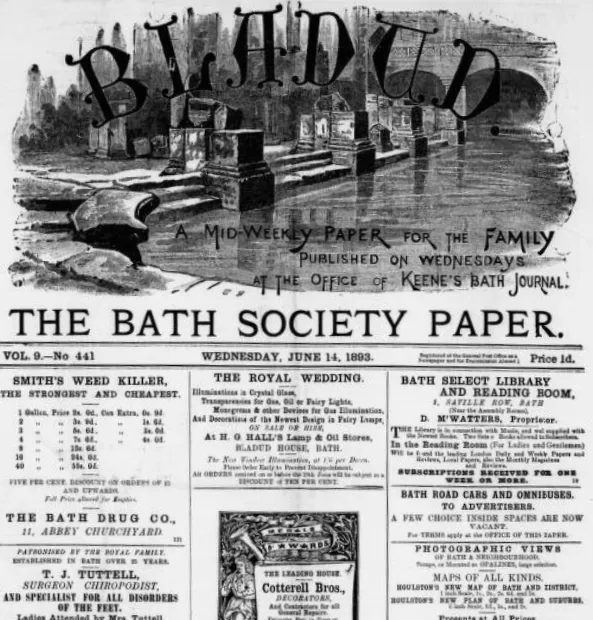
Next is the wonderfully named Bladud. Named after the Bladud, or Blaiddyd, the legendary king of the Britons who supposedly founded the city of Bath, this title was unsurprisingly established in the spa city of Bath in 1885.
Published at the offices of the Bath Journal, Bladud first appeared on 7 January 1885 priced at one pence. Appearing weekly on a Wednesday, Bladud was both known as a ‘Mid-Weekly Paper for the Family,’ and as ‘The Bath Society Paper.’ Indeed, Bladud was devoted ‘to the fashionable news of the day,’ with a ‘principle feature’ of the publication being its visitors lists.
Both a fashionable and a family paper then, Bladud aimed to supply both the ‘paterfamilias’ and ‘his wife and family’ with a publication that could be read by the entire household. General news would then accompany sermons, anecdotes and stories, and the paper featured serialised fiction by the likes of Lady Audley’s Secret author Mary Elizabeth Braddon. Bladud also featured a children’s corner.
The Cashel Sentinel and the Devon Post
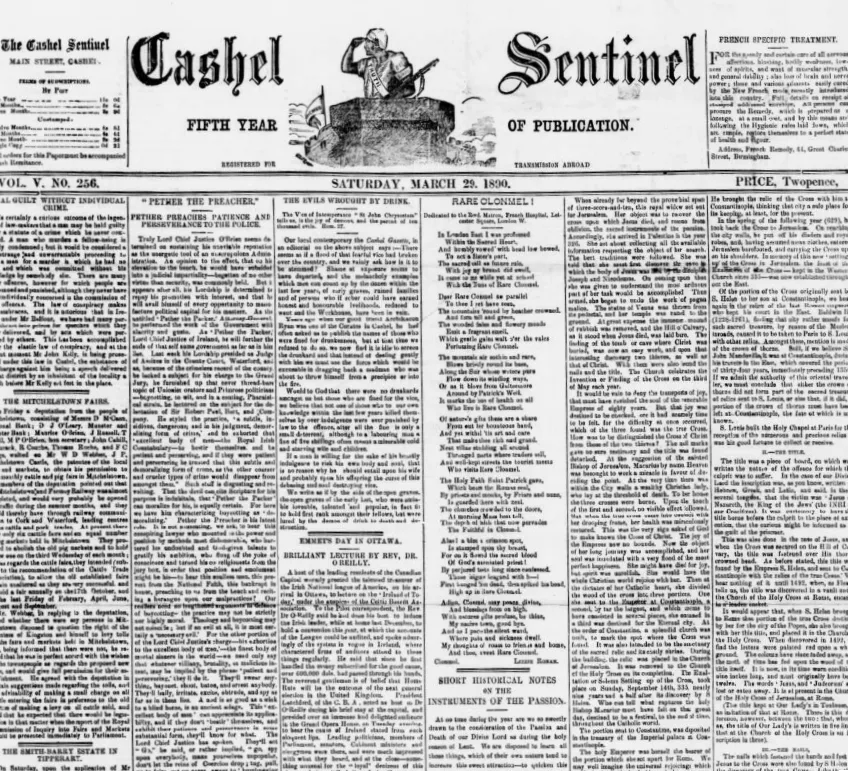
Our next new title hails from the Republic of Ireland, and it is the Nationalist Cashel Sentinel. Published in the small County Tipperary town of Cashel in Ireland’s south, this publication appeared every Saturday priced at two pence. Founded in 1885, it printed news from across Ireland, as well as local news, relaying the latest from the Cashel Town Commissioners, the Cashel Board of Guardians, and the Cashel branch of the Irish National League.
Heading back across the Irish Sea, we find ourselves in Devon, in the riverport town of Barnstaple. Barnstaple was the home of the Devon Post, which was first published on 30 December 1872 in connection with the North Devon Advertiser and the Barnstaple Times.
Costing only one halfpenny, the Devon Post circulated throughout Devon, Cornwall and Somerset. It concentrated on the news from the area, with updates from the likes of the Barnstaple Town Council and the Ilfracombe Highway Board. It also printed notices of births, marriages, and deaths.
The Midland Sporting News and the Whitehaven Herald and Cumberland Advertiser
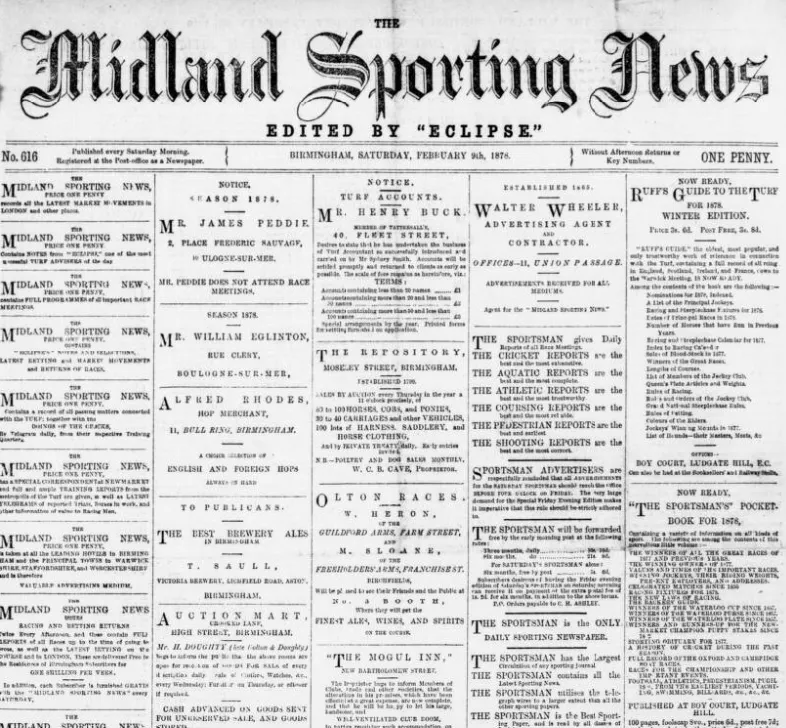
We’re in Birmingham now as we welcome the Midland Sporting News to our collection. ‘Devoted to the sporting classes of the United Kingdom,’ this publication was founded in 1872. The Midland Sporting News contained ‘a full and complete record of all racing of the week, a lengthy Article by that able writer, ‘Eclipse,’ and reports of all other descriptions of sporting.’
Indeed, the Midland Sporting News was devoted to horse racing, with other sports struggling to find representation within its four pages. Appearing every Saturday at the cost of one penny, this title contained articles like ‘Newmarket Trading Intelligence’ and ‘Horses in Training.’ It listed all upcoming fixtures, and offered detailed racing results.
Our penultimate new title of the week is the Whitehaven Herald and Cumberland Advertiser, which first appeared on 30 August 1831. This Liberal title was published in the Cumberland town of Whitehaven, a port on the north-west coast of England. It is, therefore, unsurprising that this title was mainly focused on shipping intelligence, although the Tuesday title did print more general news, alongside poetry, and notices of births, marriages and deaths.
The World
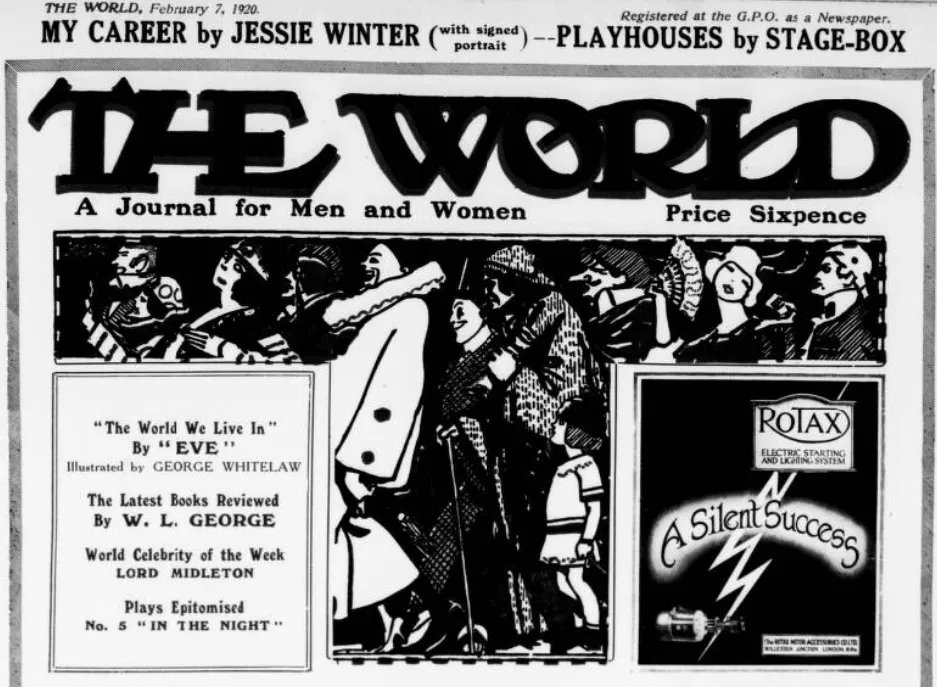
What better way to end this week’s list of new titles than with The World. ‘A Journal for Men and Women,’ The World was established by novelist and journalist Edmund Hodgson Yates (1831-1894) and fellow journalist Eustace Clare Grenville Murray (1824-1881) in 1874. The venture came off the back of Yates’s hugely successful speaking tour in the United States, and after six months, Yates was able to buy his business partner Grenville Murray out of the concern.
The World was proving a runaway success; Grenville Murray made a profit of almost 1,000 per cent on the project. So what was the winning formula of The World? A society paper, it included investigative reports alongside gossip items, all wrapped together with an intimate style of journalism that was pioneered by owner and editor Yates. Indeed, by 1888 it was said to have ‘a larger circulation than any other first-class weekly journal.’ With ‘many imitations,’ the publication still held ‘its own for originality, courage, and talent.’
With contributors numbering the likes of William Archer, Wilkie Collins, and George Bernard Shaw, as P.D. Edwards put it, The World appealed:
…to men and women of the world: clubmen, sportsmen, hangers-on of the literary, theatrical, and artistic worlds, fashionable and would-be fashionable ladies. After a few months it became a conspicuous and continuing success, generating hosts of imitators and inaugurating, it is generally agreed, the most distinctive twentieth-century style of journalism.
Upon Edmund Hodgson Yates’s death in 1894, his two sons ran the paper. However, in 1904 publishing magnate Alfred Harmsworth bought the title, hoping to turn The World into a rival to Country Life. The popularity of The World began to sadly fizzle, and it fell out of print during the 1920s.
Our updated titles
Alongside our updated Shropshire newspaper titles, we’ve updated a raft of our other existing titles. Of particular interest are the updates to the Pawnbrokers’ Gazette, as well as updates to Aberystwyth’s Welsh Gazette and the Isle of Man Times.
Meanwhile, we’ve updated ten of our Scottish newspaper titles, with updates also to Northern Ireland’s Armagh Guardian and the Republic of Ireland’s Farmer’s Gazette and Journal of Practical Horticulture and the Munster Express.
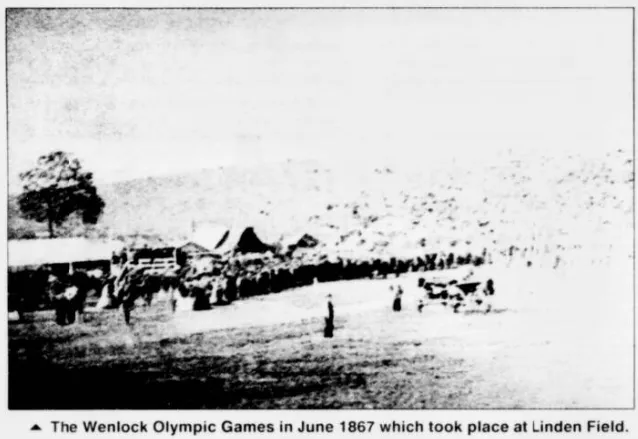
The Wenlock Olympian Games
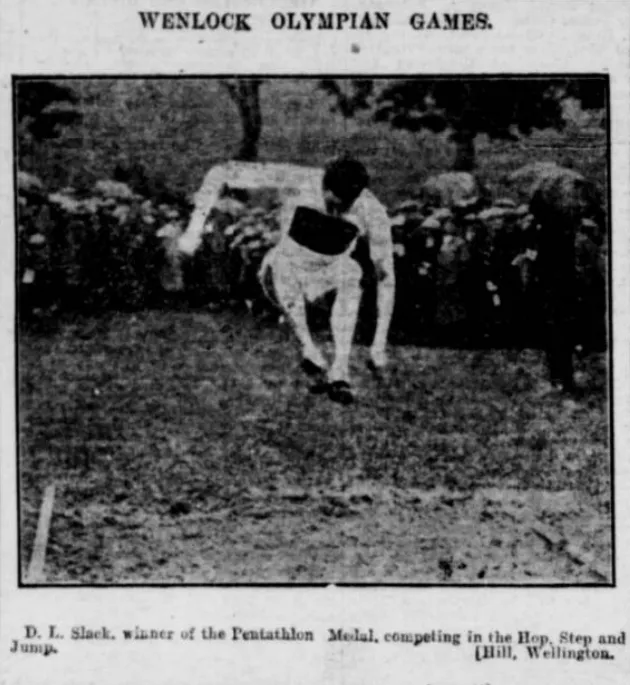
In 1850 Dr William Penny Brookes founded the Wenlock Olympian Class, later the Wenlock Olympian Society, which held sporting evens in the Shropshire market town of Much Wenlock. Founded to promote physical and intellectual improvement in the community, the first Wenlock Olympian Games were held in October 1850 and featured football, cricket, and athletics, alongside more obscure sports like the old woman’s race and a blindfolded wheelbarrow race. Most importantly, these games were open to everybody.
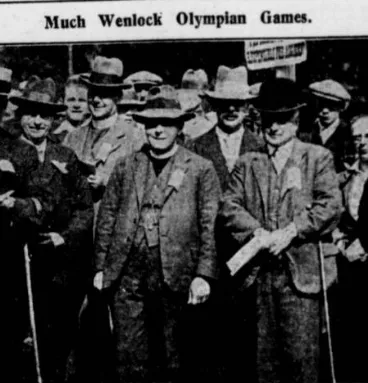
Our new title the Ironbridge Weekly Journal and Borough of Wenlock Advertiser on 7 June 1873 looked back at nearly a quarter of a century of the Wenlock Olympian Games. The article described the objects of the games, which were:
…to promote the moral, intellectual, and physical improvement of the people by the encouragement of out-door recreation, and the distribution of prizes annually for literary and fine arts attainments, and for skill and strength in gymnastic and athletic exercises.
The piece also looked back at the ancient Greek origins of the enterprise, with the Ironbridge Weekly Journal and Borough of Wenlock Advertiser noting how ‘that thirteen or fourteen years ago the King of Greece applied, through the English ambassador, to Mr. Brookes for advice and assistance in re-establishing’ the Olympic Games ‘in that country of those games after which the society is named.’
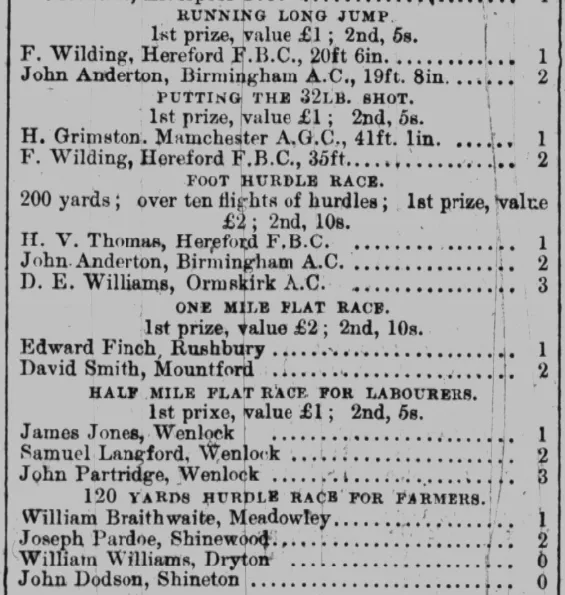
Furthermore, the paper described the Wenlock Olympian Games of 1873, which took place on a wet Tuesday. ‘Large numbers of passengers’ travelled by train to the event, and thankfully the weather began to clear. Competitors, meanwhile, travelled from London, Birmingham, Wolverhampton, Hereford, Ormskirk, Manchester, ‘and other large towns’ to attend the day.
Events at the Wenlock Olympian Games of 1873 included ‘flat tilting at the ring on horses,’ the 200 yards race, the running high jump, ’tilting at the ring on horses, over two flights of hurdles,’ the running long jump, the shotput, and the one mile race. Other more unusual events were the ‘half mile flat race for labourers’ and the ‘120 yards hurdle race for farmers.’
The Ironbridge Weekly Journal and Borough of Wenlock Advertiser even included the top three placements for these events. After the competition ended, ‘dancing was kept up on the green till eight o’clock, and shortly afterwards the vast assemblage dispersed, without the slightest signs of disorder, and without the appearance of a single case of intoxication.’
Born in the small Shropshire town of Much Wenlock, the Wenlock Olympian Games would go on to help inspire the modern Olympic movement. In 1890 Baron Pierre de Coubertin visited the Wenlock Olympian Society, which helped to inspire his establishment of the International Olympic Committee, and eventually the first modern Olympic Games in 1896.
In 2012 one of the mascots at the London 2012 Summer Olympics was named ‘Wenlock’ after the Wenlock Olympian Society, which played such an important role in sport history, and continues to hold its own Olympic Games to this day.
New Titles
Title | Years Added |
1857, 1885 | |
1901-1918 | |
1911 | |
1885-1887, 1893 | |
1852-1854 | |
1856 | |
1889-1896 | |
1872-1874, 1878, 1880, 1882-1899, 1901-1910 | |
1869-1875, 1877-1882 | |
1878, 1882 | |
1820, 1822 | |
1863-1864 | |
1840 | |
1917-1922 | |
1831-1872 |
Updated Titles
This week we have updated 45 of our existing titles.
You can learn more about each of the titles we add to every week by clicking on their names. On each paper’s title page, you can read a free sample issue, learn more about our current holdings, and our plans for digitisation.
Title | Years Added |
1880, 1882-1886, 1910-1916, 1918-1919, 1931, 1940, 1943, 1945-1946, 1954-1959 | |
1920-1923, 1925-1929, 1939-1949, 1960-1969, 1980 | |
1919-1969 | |
1905-1909, 1920-1928, 1940-1949 | |
1854-1855, 1857-1863, 1901-1909, 1911-1949, 1951-1952 | |
1878, 1880-1881, 1886, 1888-1889 | |
1878-1893, 1897, 1920, 1951-1955 | |
1918-1949, 1952-1961 | |
1881, 1885, 1892 | |
1993 | |
1849-1859, 1872 | |
1845, 1850-1855, 1857 | |
1872, 1874-1876, 1878-1883 | |
1888-1889 | |
1963-1965 | |
1899 | |
1846, 1849-1854, 1856-1857, 1859 | |
1844, 1846-1848, 1850-1851, 1854 | |
1853, 1855-1857, 1860, 1862 | |
1880, 1883-1884, 1887-1891 | |
1880, 1910, 1912-1918 | |
1863, 1885, 1888, 1892, 1910, 1915 | |
1879-1880 | |
1896, 1938, 1970-1974 | |
1853-1870 | |
1961-1965 | |
1990, 1994-1999 | |
1893 | |
1916-1917 | |
1860-1868 | |
1864-1868, 1911, 1927, 1941-1952, 1986-2002, 2004 | |
1882-1883, 1898, 1912 | |
1838, 1840-1849, 1860-1868, 1870-1894, 1929 | |
1950 | |
1965-1985 | |
1920-1925, 1927-1929, 1940-1949 | |
1876-1877, 1881, 1889, 1892, 1913-1918 | |
1883-1895, 1898-1903 | |
1911, 1965-1966 | |
1953, 1960-1964 | |
1999 | |
1998 | |
2004 |
You can keep up to date with all the latest additions by visiting the recently added page. You can even look ahead to see what we’re going to add tomorrow.
More on this topic:
Share this article
About the author

Rose Staveley-Wadham
Newspaper Licensing Manager
Published on Mon, 1 September 2025.