
Hot Off The Press – New Titles This Week
Published on 15 September 2025 by Rose Staveley-Wadham
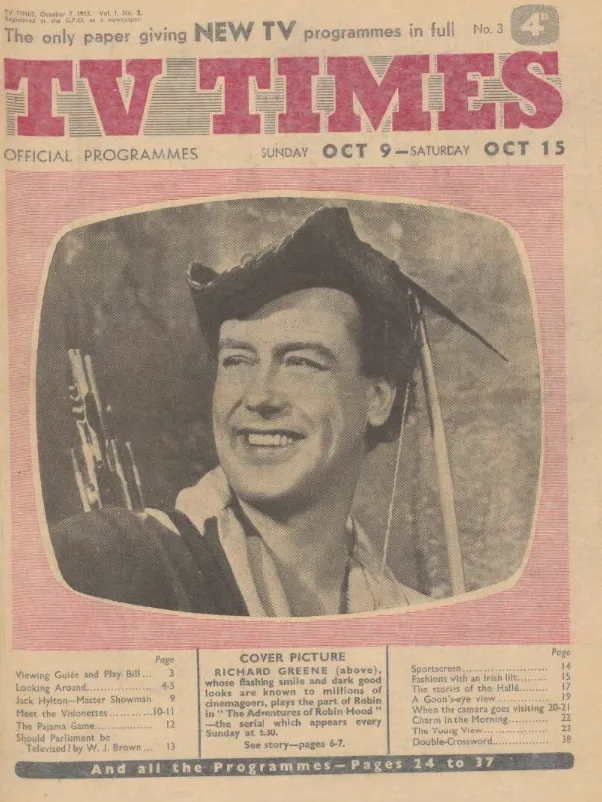
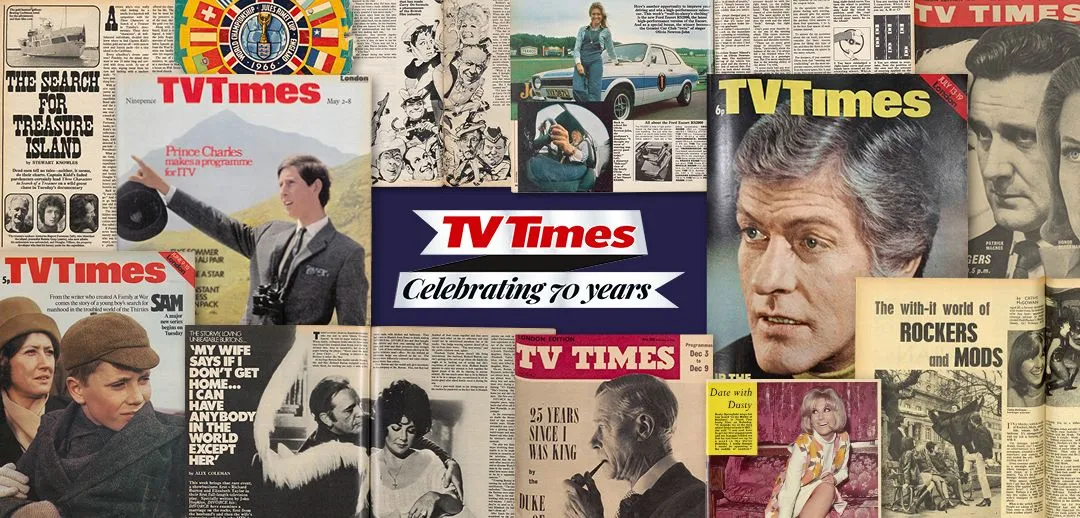
This week at The Archive we are delighted to welcome a legend of the television world to our collection, the TV Times. Made possible thanks to our partnership with publishing powerhouse Future, the TV Times provides a wonderful window into television history, with this release covering the years 1955 to 1980. In all, we’ve added 72,160 brand new pages to our Archive over the last seven days, whilst this week, we shine a very special light onto the TV Times, exploring the history of this iconic magazine and looking at its first ever edition.
Register now and explore The Archive
The Launch of the TV Times
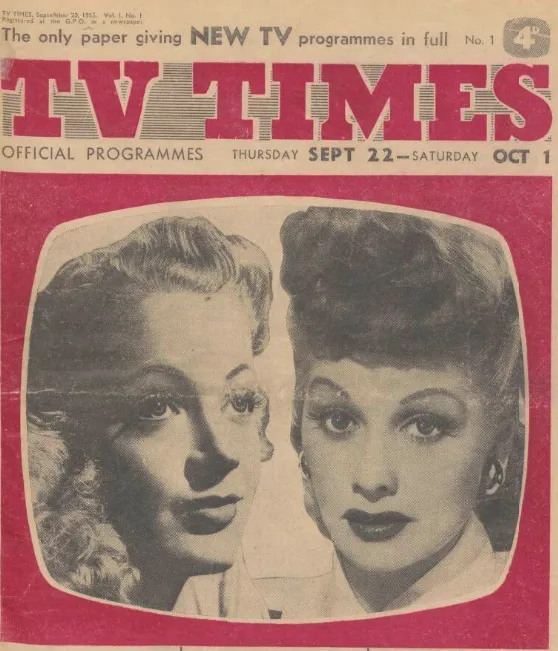
We are delighted to welcome the TV Times to our holdings this week. The debut edition of the TV Times appeared on 22 September 1955, 70 years ago next week, to time with the launch of a brand new television channel, ITV. Prior to that, British audiences could only enjoy one channel, the BBC. To learn what was being broadcast every week by the BBC, they would need to purchase the Radio Times. So, with the launch of a new channel, audiences needed a new source of television listings, and the TV Times was born.
Costing 4d, the new TV Times magazine filled 40 pages. Much more than simply a guide to what was on the television, the magazine printed interviews with and photographs of the leading stars of the era, articles about advances in television technology, and special peaks behind the scenes of the television world.
Moreover, the history of the TV Times is inextricably linked with the history of the ground-breaking new channel, ITV. For example, ITV made history in its very early days when Barbara Mandell became Britain’s first woman newsreader on 23 September 1955. On 14 October 1955 the TV Times praised her ‘black velvet voice’ and her joy at becoming the ‘first woman news reader in this country,’ although she wondered how ‘she’ll ever find time to do her shopping and household chores.’
The first ever edition
Meanwhile, the first ever edition of the TV Times, which filled some 40 pages, featured actresses Patricia Dainton, then star of weekly serial Sixpenny Corner, and Lucille Ball, star of the classic American sitcom I Love Lucy, which was set to be aired on ITV every Saturday evening, on the front cover.
In a rousing introduction, ‘a new paper heralding the opening of a sparkling new era in home entertainment’ was introduced. Keen to highlight the democratisation of television and its freeing from the grips of the BBC’s monopoly, the TV Times described how television had at last ‘been given the real freedom of the air.’
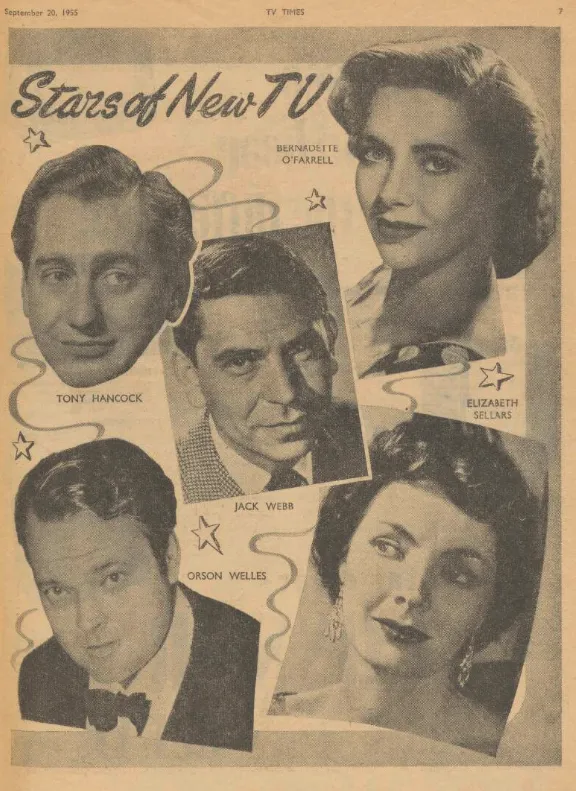
This rush of enthusiasm was reflected in an article entitled ‘Greetings to the New TV,’ which included quotes from the likes of Sir Kenneth Clark, the chairman of the Independent Television Authority, and Scottish writer Sir Compton Mackenzie. Meanwhile, the TV Times teased the range of stars to be seen on the ‘new TV,’ publishing photographs of the likes of Gracie Fields, Norman Wisdom, Tony Hancock and Orson Welles.
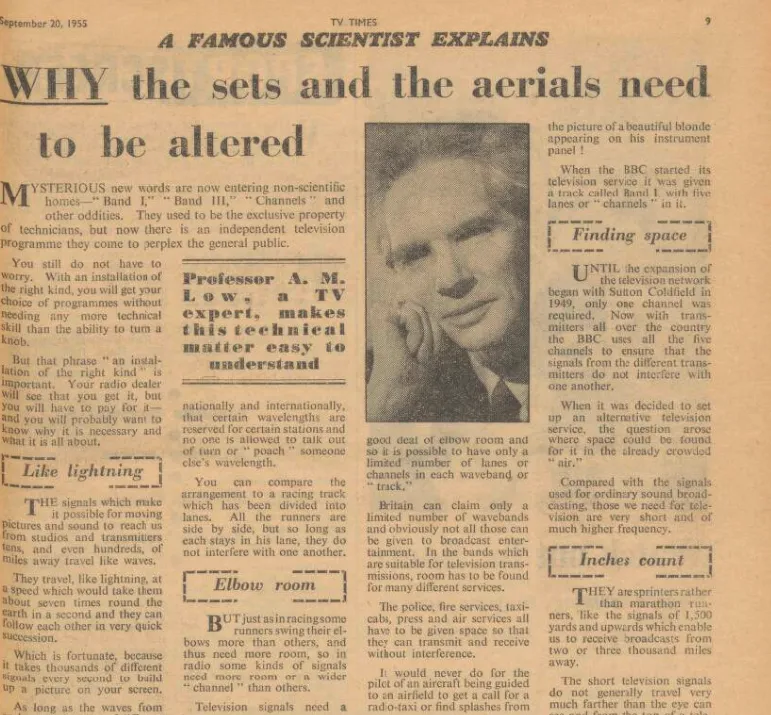
The educational element of the TV Times was evidenced in a piece by Professor A.M. Low, who explained to readers ‘why aerials need to be changed in the wake of the release of ITV.’ Indeed, the first issue of the TV Times appears keen to cater for all, with surveys of the different sports to be screened, with the first match televised by ITV being a rugby league game between Wigan and Huddersfield, and its offering for younger viewers.
And, of course, there were the listings. First up was the grand opening on the 22nd September, which included a ceremony at the Guildhall. ITV’s first broadcast, it would feature variety acts, a drama performance, professional boxing, the news, and a star cabaret. From 23rd September, normal daily coverage began, from 10.45 am through to 11 pm, with some gaps throughout the day.
The TV Times and Coronation Street
Initially covering the London area, more editions of the TV Times appeared as ITV launched further regional stations. The edition that appears on The Archive is the London edition. By 1960 the TV Times was selling some four million copies a week, with its opposite number the Radio Times selling some seven million copies a week. This circulation is quite remarkable, given that television viewers would have to buy both publications in order to read about both the BBC’s and ITV’s listings for the week.
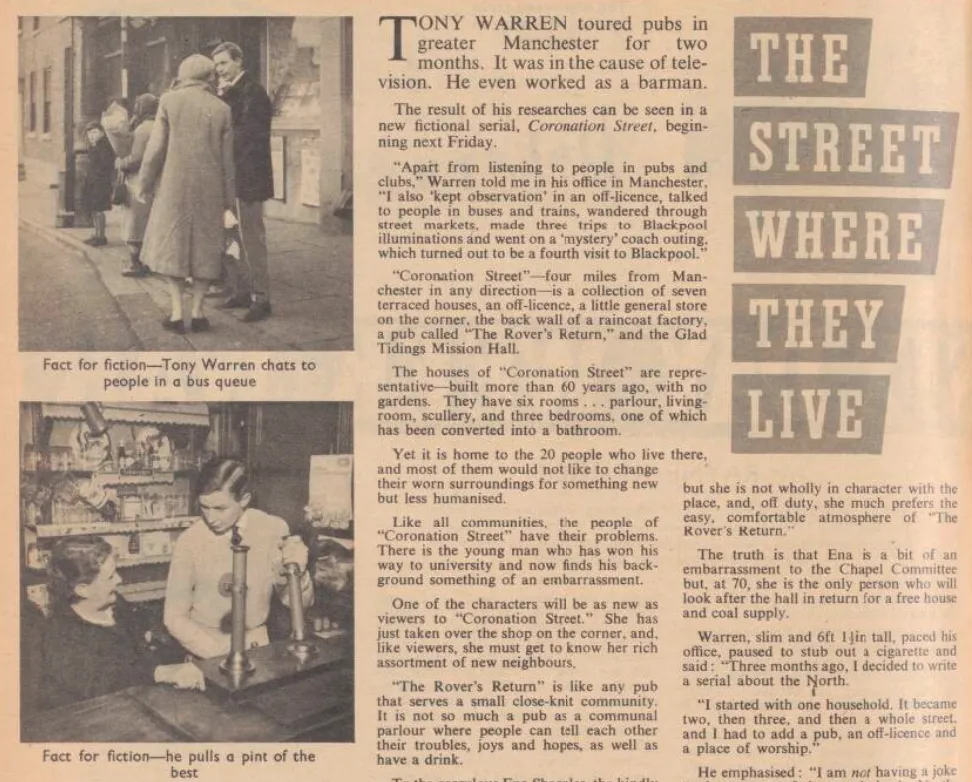
On 9 December 1960 ITV aired what would become British television’s longest-running soap opera, Coronation Street. With its revolutionary depiction of ordinary working-class people from the north of England, Coronation Street truly broke the mould. On 2 December 1960 the TV Times described writer Tony Warren’s research journey into the series, which saw him touring ‘pubs in greater Manchester for two months.’
In the same edition, the first ever TV Times listing for Coronation Street appeared, describing how ‘every front door hides a story. In this new twice-weekly serial there are seven front doors and more than 20 interesting people. Come down Coronation Street on Wednesdays and Fridays and join the neighbours.’
More ground-breaking TV moments
Just a few weeks later, in early 1961, and ITV aired the first episode of the incredibly popular spy series The Avengers. In an article in the TV Times on 10 March 1961, The Avengers producer Leonard White is quoted as saying how the emphasis of the series would be ‘on vigorous, fast-moving stories.’
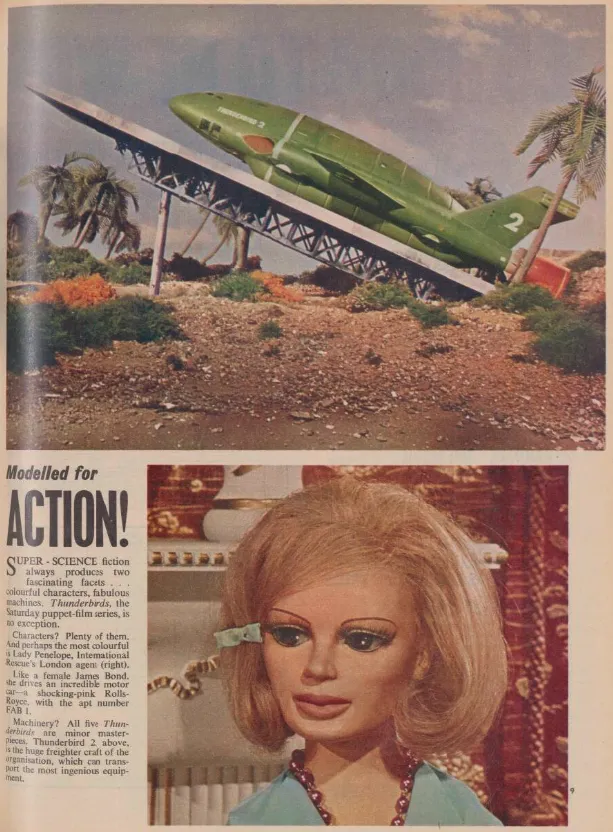
Another key moment in British television history was the release of animated series The Thunderbirds. The show made history for being one of the costliest TV shows ever made. However, on 2 September 1965 the TV Times quoted producer Gerry Anderson as saying that there was unlikely to be a ‘studio party celebration’ on the series’ release, as there was still so much work to be done.
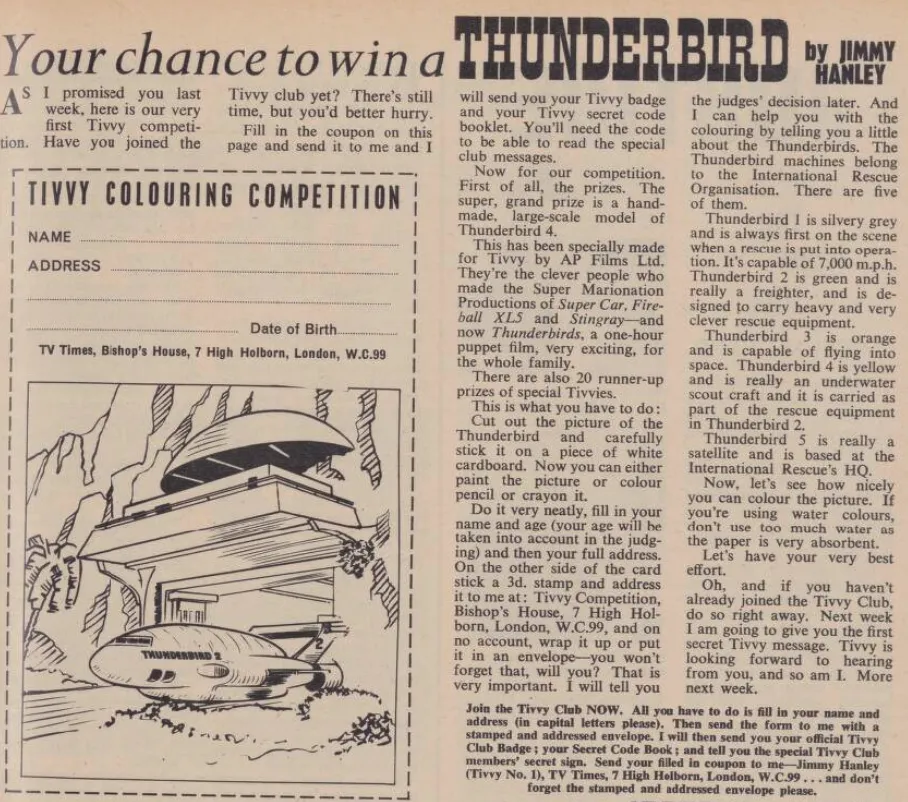
What is fascinating about the coverage of The Thunderbirds in the TV Times is its positioning towards the younger readers of the magazine. On 30 September 1965 Jimmy Hanley gave young readers the change to win their own Thunderbird. Children were invited to colour in a picture of Thunderbird 2 and submit it, as well as joining the ‘Tivvy Club.’
A national publication and sporting history is made
On 21 September 1968 the TV Times became a national publication. A year previously, it was on the frontlines of television history as in July 1967 the ITV News at Ten was launched, which was the UK’s first permanent 30 minute news broadcast. On 18 November 1967 TV Times journalist Anthony Davis described the success of the new venture:
It was not without trepidation that ITV launched ‘News at Ten.’ Although America had half-hour newscasts, no one was completely certain that British viewers would welcome a half-hour of news at peak time. But we did, ‘News at Ten’ has figured among the Top Ten programmes in popularity.
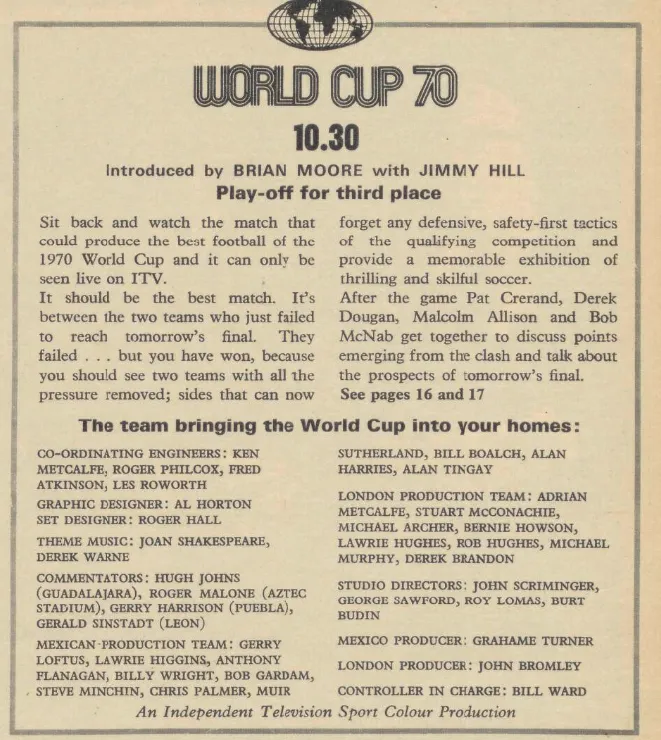
From making strides in the realms of children’s and news programming, ITV was also revolutionising sports coverage. The channel’s coverage of the 1970 FIFA World Cup was the first sporting broadcast to feature a panel of studio pundits. For example, on 18 June 1970, the TV Times advertised the World Cup ‘play-off for third place,’ where ‘after the game Pat Crerand, Derek Dougan, Malcolm Allison and Bob McNab’ would ‘get together to discuss points emerging from the clash and talk about the prospects of tomorrow’s final.’
A new soap is born, and technological advances follow
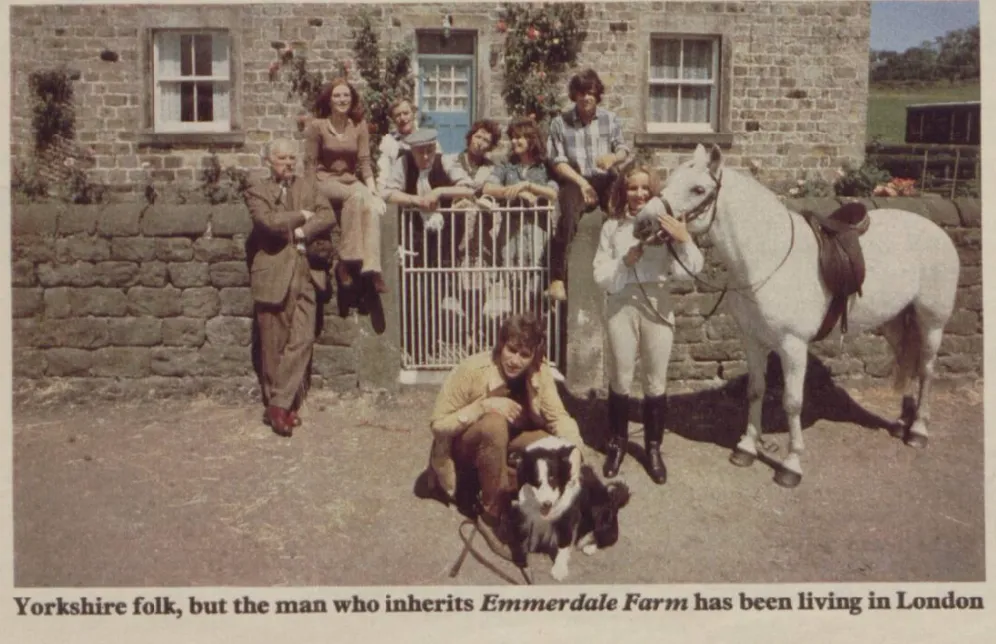
ITV’s second longest-running soap Emmerdale was launched in October 1972 as Emmerdale Farm. Initially pitched as a three month television series, the TV Times on 12 October 1972 described the new series as a ‘sort of rural Coronation Street.’
In 1978 ITV first broadcast its teletext service, ORACLE, or ‘Optional Reception of Announcements by Coded Line Electronics.’ The TV Times was on hand to help its readers understand the new technological advancement. For example, in an article on the TV Times’s ‘House of the Stars’ Ideal Home exhibition, published on 22 February 1979, the magazine describes how:
We selected one of the most advanced sets on the market – certainly a model for the 1980’s – a Philips 25in. which not only had the now popular facility for remote control channel-changing, but included a Teletext decoder. Push one of the the station buttons, and you can receive ITV’s Oracle service – pages of televised information at your fingertips, from weather reports to foreign exchange rates.
Deregulation and beyond
In March 1991, following the deregulation of TV listings, the TV Times began to carry information about BBC television programmes.
The TV Times, however, is so much more than simply a TV listings magazine. As Jonathan Bignell puts it in his 2013 work An Introduction to Television Studies:
For example, looking back the pages of the BBC’s listing magazine ‘Radio Times,’ or ITV’s ‘TV Times,’ can be instructive in understanding how programmes and programme schedules were offered and advertised to their audiences. These magazines also contain features such as interviews with actors and producers, and articles by journalistic commentators. They can reveal much about the attitudes to television that were assumed, and the balance between information, education and entertainment in the television of particular periods. These listings publications also contain letter pages with viewers’ questions, comments and evaluations of programmes.
The TV Times is not so much about what people watched, but how they watched it. It is a guide to how television transformed the nation, and how classic favourites like Coronation Street emerged. Moreover, it is a visual treat, with our digitisation incorporating its vivid colours, its photographs of the likes of Dusty Springfield and Dick van Dyke. Reading the TV Times, you can find interviews with controversial figures like the Duke and Duchess of Windsor, or other famous figures like Richard Burton and Elizabeth Taylor.
Later years of the TV Times, from 1981 to 2009, will be published in the future. For now, have a browse of this fantastic magazine and step down television’s memory lane.
New Titles
Title | Years Added |
1955-1980 |
You can keep up to date with all the latest additions by visiting the recently added page. You can even look ahead to see what we’re going to add tomorrow.
More on this topic:
Share this article
About the author

Rose Staveley-Wadham
Newspaper Licensing Manager
Published on Mon, 15 September 2025.