200 Years of the Railway – 20 Pioneering Firsts Uncovered
Published on 22 September 2025 by Rose Staveley-Wadham
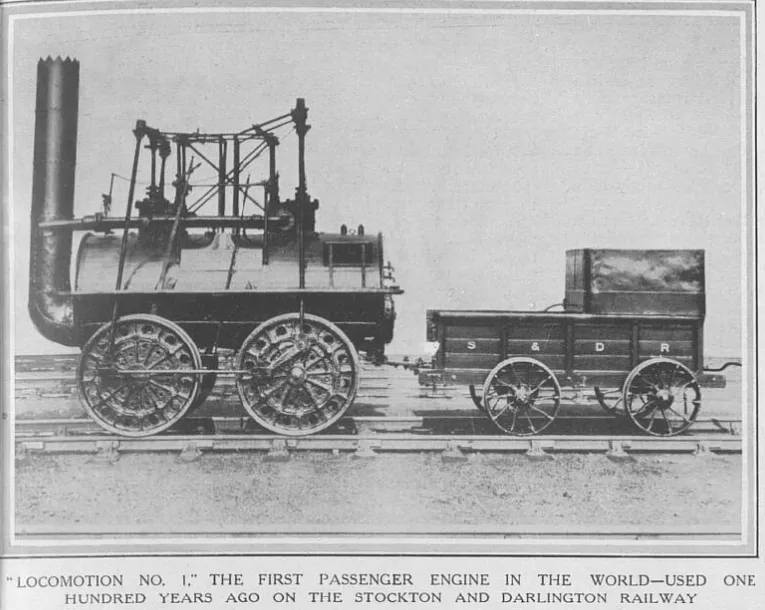
This September we are marking 200 years since the birth of the modern railway. On 27 September 1825 the first modern railway was opened, namely the Stockton and Darlington Railway, and what better way to celebrate this iconic transport first, than by uncovering 20 pioneering railway firsts from our Archive.
Register now and explore The Archive
1. The earliest mention of the word ‘railway’ in our Archive – March 1759
Well before the opening of the Stockton and Darlington Railway, railways, in the sense of tracks, were in use. Indeed, throughout the eighteenth century wooden tracks were used to haul coal carts across the country.
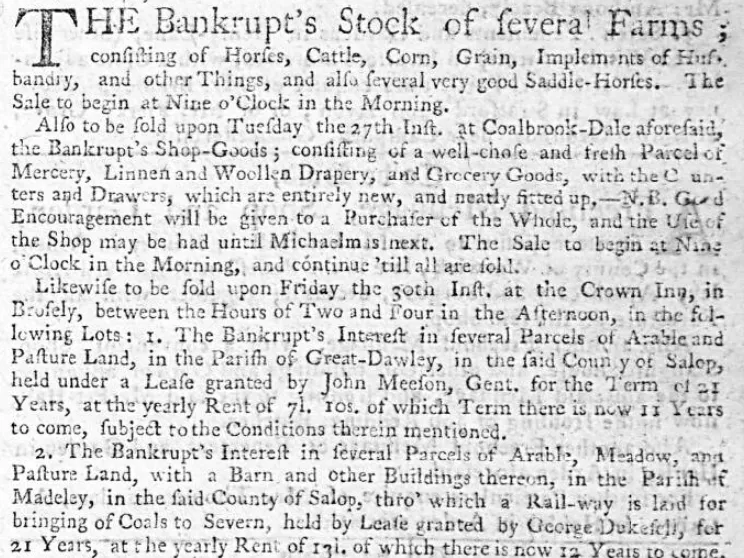
We were intrigued then to find the earliest mention of the world ‘railway’ in our Archive. We found it in Aris’s Birmingham Gazette, from 19 March 1759. The piece advertises the estate of bankrupt Richard Ford, which was coming up for auction, in Coalbrookdale, Shropshire.
The second item lists for sale:
The Bankrupt’s Interest in several Parcels of Arable, Meadow, and Pasture Land, with a Barn and other Buildings thereon, in the Parish of Madeley, in the said County of Salop, thro’ which a Rail-way is laid for the bringing of Coals to Severn, held by Lease granted by George Dukefell, for 21 Years, at the yearly Rent of 13l, of which there is now 12 Years to come.
It’s only fitting that this first mention of the railway in our newspapers comes from Shropshire, the birthplace of the industrial revolution.
2. The first railway meeting – February 1820
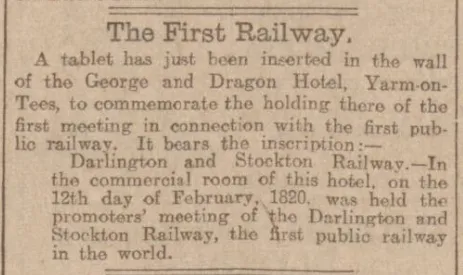
Ahead of the opening of the first steam hauled public railway, there needed to be first ever meeting about the railway. From the Dundee Evening Telegraph, 13 June 1905, we learn of how ‘a tablet has just been inserted in the wall of the George and Dragon Hotel, Yarm-on-Tees, to commemorate the holding there of the first meeting in connection with the first public railway.’
The inscription ran as follows:
Darlington and Stockton Railway. – In the commercial room of this hotel, on the 12th day of February, 1820, was held the promoters’ meeting of the Darlington and Stockton Railway, the first public railway in the world.
Whilst we couldn’t find an account of this particular meeting, we did find this notice which was placed in the Durham County Advertiser on 30 September 1820:
Notice is hereby given, that an application is intended to be made to Parliament in the next Session, for an Act for making and maintaining a RAIL-WAY or TRAM-ROAD, with all proper works and conveniences for the passages and other carriages properly constructed, from the river Tees, at or near Stockton, in the county of Durham, to Witton Park colliery, in the township of Witton-le-Wear, in the said county…
You can read the application in full here.
3. The official launch of the railway – September 1825
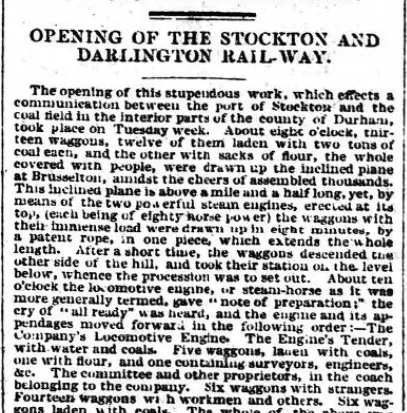
Five years later, and our newspapers are a buzz with the news of the official launch of the first modern railway, the Stockton and Darling Railway. The Leeds Intelligencer on 6 October 1825 described the ‘stupendous work’ that had gone into the building of the railway, which would ‘effect a communication between the port of Stockton and the coal field in the interior parts of the county of Durham.’
Furthermore, the Shrewsbury Chronicle described how the opening of the new County Durham railway, which was designed by engineer George Stephenson, would have a national impact, in its article of the 7 October 1825:
It is a single railway of twenty-five miles in length, and will open the London market to the collieries in the western part of the county of Durham, as well as facilitate the obtaining of fuel to the country along its line, and the northern parts of Yorkshire.
The opening of the Stockton and Darlington Railway, which saw the train leave Darlington to Stockton, was incredibly well attended. The Leeds Intelligencer describes how ‘not less than 40 or 50,000 persons were assembled to witness the proceedings of the day,’ with some ‘548 persons’ actually travelling by train, the carriages of which were decorated with inscriptions.
Meanwhile, the Shrewsbury Chronicle described the progress of the first journey along the railway:
In some parts the speed was frequently 12 miles per hour; and in one place, for a short distance, near Darlington, 15 miles per hour…The engine arrived at Stockton in three hours and seven minutes after leaving Darlington, including stops, the distance being nearly 12 miles, which is at the rate of four miles an hour…
After the excitement had worn off, some weeks later the Birmingham Journal printed this report on how the new railway was getting along:
A large quantity of coal is now daily moving along this railway, but the Company not having yet completed their establishment of waggons and locomotive engines, the supply is present not equal to the demand. On Monday week, the first regular supply to Yarm, consisting of 20 waggons, arrived at that place, and were immediately sold at about one-half of the price the inhabitants had been accustomed to pay.
4. Opening of the oldest continually in use railway bridge – September 1825
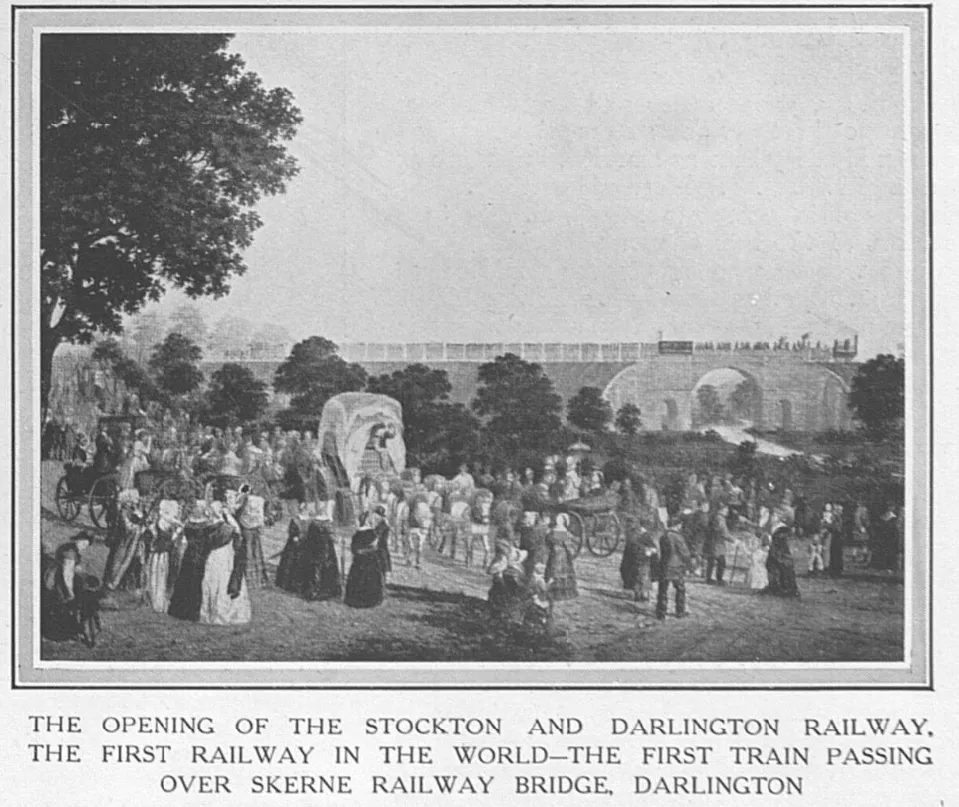
Unsurprisingly, alongside the official opening of the first ever railway, came a flurry of other firsts. Take, for example, the opening of the Skerne Bridge. On the Stockton and Darlington Railway, it was crossed on the railway’s very first day, and it remains the oldest surviving continually in use railway bridge in the country.
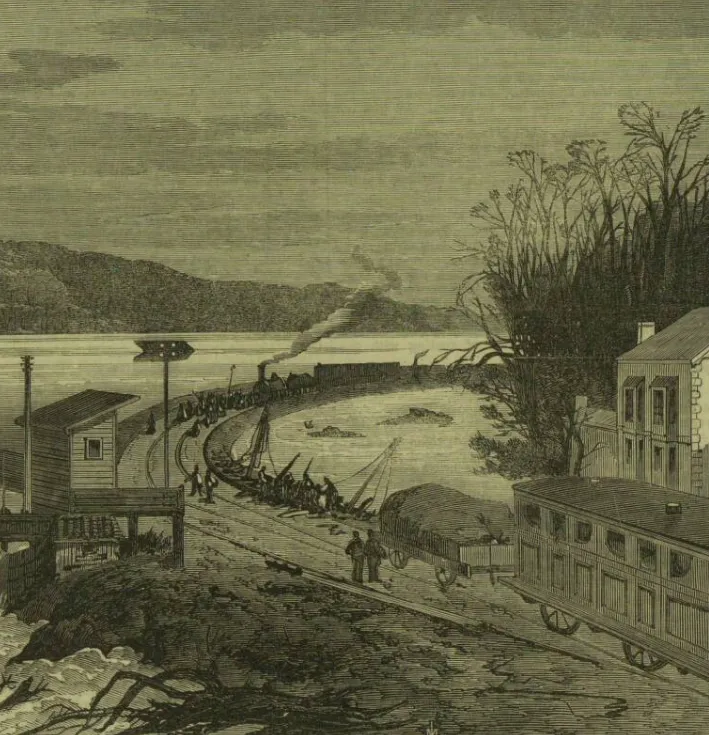
Wonderfully, it is captured in this illustration of the opening of the Stockton and Darlington railway, which shows the ‘first train passing over the Skerne Railway Bridge, Darlington.’
5. The first railway station – 1827
However, the opening of the first railway station did not coincide with the opening of the Stockton and Darlington Railway. The world would need to wait until 1827, when a public house at Heighington and Aycliffe began serving as a passenger stop and shelter.
We found evidence of this station in our Archive from the York Herald, in an advertisement for a ‘desirable family residence’ that was to let in Heighington. The advert, which was published on 28 October 1837, described how:
The village of Heighington is situate in a pleasant and healthful part of the County of Durham, and within a short distance of a Station on the Stockton and Darlington Railway, which affords a cheap and ready communication with the neighbouring Market Towns.
6. The first railway fatality – September 1830
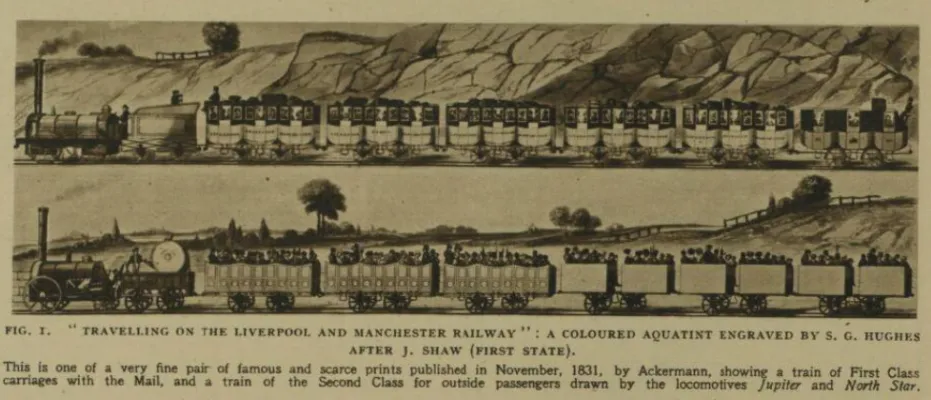
Along with advancements with the railway, came the dangers associated with the new form of technology. At the opening of the world’s first ever steam intercity railway line, the Liverpool and Manchester Railway, on 15 September 1830, M.P. William Huskisson was accidentally killed by Robert Stephenson’s pioneering Rocket locomotive.
You can read more here in one of our weekly blogs about the tragic death of William Huskisson, but here is an account from Liverpool Saturday’s Advertiser, 18 September 1830, of the moment the unfortunate politician was struck by the locomotive as he stood on the train tracks:
An alarm being given, most of the gentlemen sprang the carriage; but Mr. Huskisson seemed flurried, and from some cause, not clearly ascertained, he fell under the engine of the approaching carriages, the wheel of which shattered his leg in the most dreadful manner.
On being raised from the ground by the Earl of Wilton, Mr. Holmes, and other gentlemen, his only exclamations were- ‘Where is Mrs Huskisson? I have met my death. God forgive me.’ Immediately afterwards he swooned.
Known to be clumsy and in bad health, poor William Huskisson passed away that very evening.
7. The first Prime Minister to travel by train – September 1830
As M.P. William Huskisson became the first railway fatality, his fellow politician, the Duke of Wellington, made history on the very same day by becoming the first Prime Minister to travel by train.
Liverpool Saturday’s Advertiser on 18 September 1830 describes the Duke’s arrival at the opening of the Liverpool and Manchester Railway:
He was greeted with the warmest regards, and ascended the car amid the general and enthusiastic salutations of the company, which he most gracefully acknowledged. He took his station in the front of the carriage and looked remarkably well… He anxiously watched the different engines, and seemed to take a lively interest in the scene. In the car along with his Grace, we observed Prince Esterhazy, the Russian Ambassador, Lord Stanley, the Right Hon. W. Huskisson, General Gascoyne, Sir George Murray, Lord Fitzroy Somerset…
8. The first London railway terminus – 1836
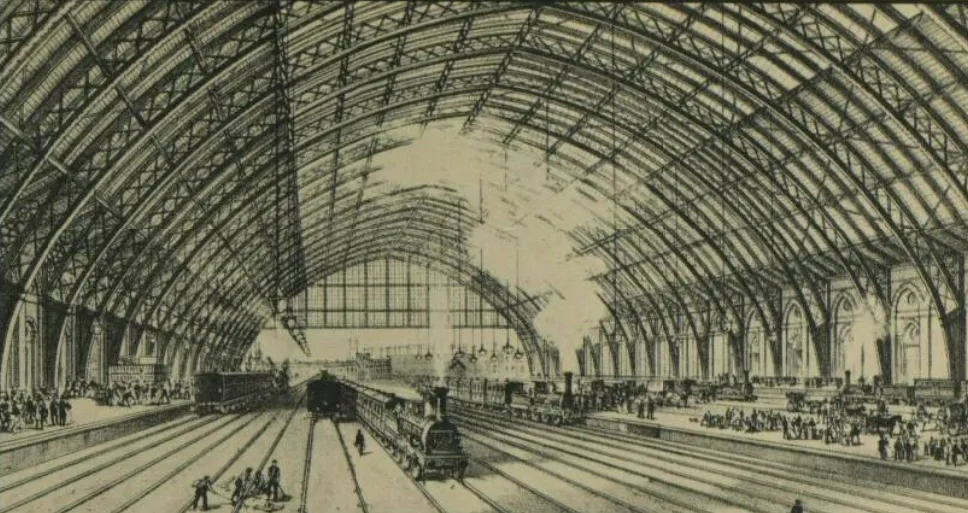
You might have noticed that our list of railway firsts have been confined to the more northern parts of England, but we travel south now for our next railway first. London is home to its famed railway termini, including the likes of Waterloo, Victoria, and St. Pancras, but London’s first railway terminus is worlds away from these celebrated railway stations.
London’s first railway terminus was opened in 1836, and it was at Spa Road, Bermondsey, near the site of today’s terminus London Bridge. The Exeter and Plymouth Gazette, 20 February 1836, described the new London railway:
London and Greenwich Railway – about two miles and a half of this splendid undertaking are now completed, and a train of seven of the Company’s carriages are making experimental trips ten miles each way daily; starting from the Spa Road, Bermondsey, and ending at Deptford, which is performed in six minutes.
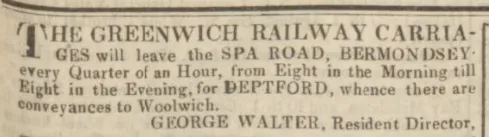
A few months later, and the West Kent Guardian on 18 June 1836, outlined this nascent London railway service:
The Greenwich railway carriages will leave the Spa Road, Bermondsey, every quarter of an hour, from eight in the morning till eight in the evening, for Deptford, whence there are conveyances to Woolwich.
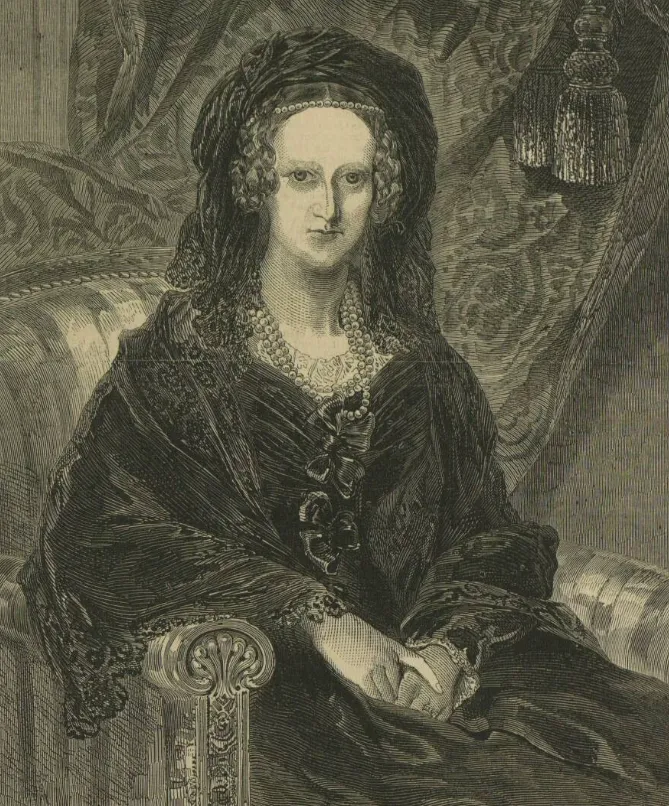
9. The first royal carriage – 1840
In 1840 Dowager Queen Adelaide, the widow of King William IV, made history by being the first person to be conveyed by a royal railway carriage. Reporting on this occasion was the English Chronicle and Whitehall Evening Post on 6 August 1840, which related how:
On Wednesday last, on the occasion of the return of the Queen Dowager from Lancaster, a special train was provided for the conveyance of her Majesty and suite, from Lancaster to Parkside, by the Lancaster and Preston and North Union Railway Companies, and thence to Stafford, being the nearest point to Alton Towers, the seat of the Earl of Shrewsbury, which was her Majesty’s destination.
The paper described how one of the eight carriages travelling from Lancaster had been ‘handsomely fitted up by the London and Birmingham Company for her Majesty’s use.’ It seems that the Dowager Queen enjoyed her journey, as she expressed to the manager of the Grand Junction Company, Captain Cleather, ‘her satisfaction at the rapidity of the passage, and the uncommon smoothness of the line.’
10. The first monarch to travel by train – June 1842
Although the Dowager Queen Adelaide was the first royal to enjoy the luxury of a royal train, her niece Queen Victoria would become the first monarch to travel by train.
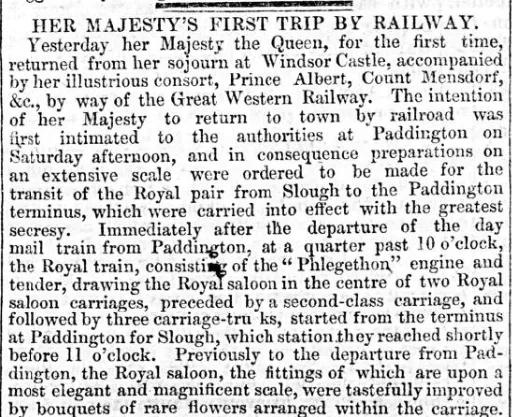
However, her trip, which she made from Slough to Paddington, was quite an unexpected one, as the St James’s Chronicle related on 14 June 1842:
The intention of her Majesty to return to town by railroad was first intimated to the authorities at Paddington on Saturday afternoon, and in consequence preparations on an extensive scale were ordered to be made for the transit of the Royal pair from Slough to the Paddington terminus, which were carried into effect with the greatest secrecy.
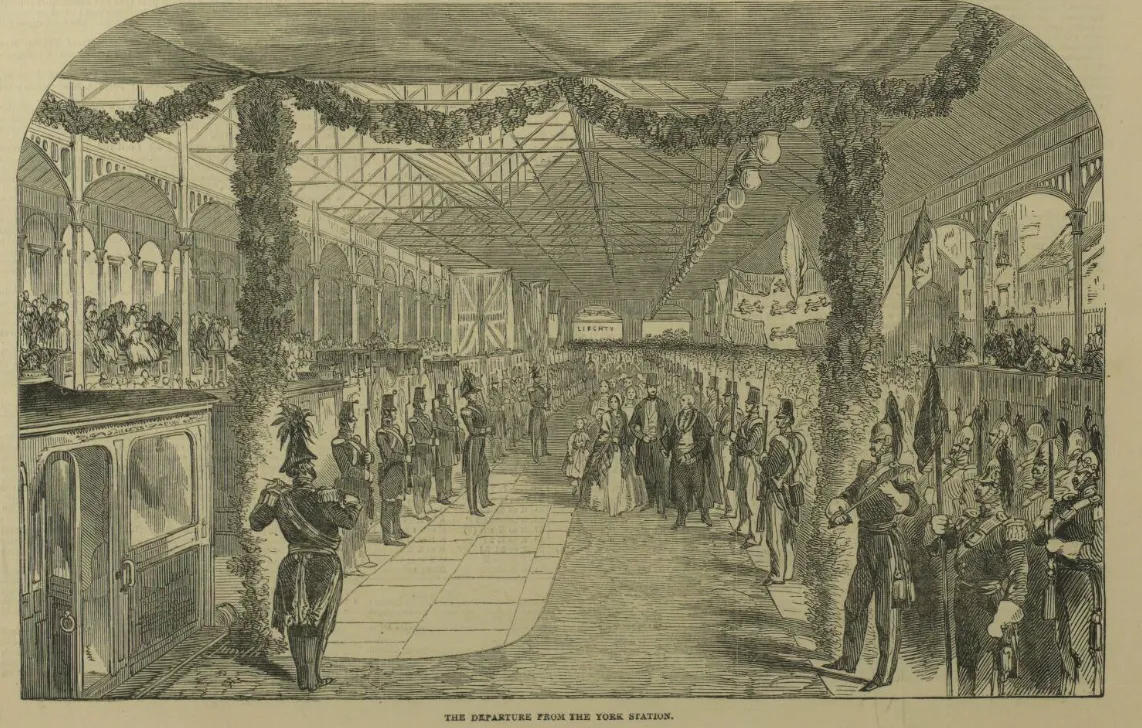
The St James’s Chronicle reports how the royal saloon carriages were dispatched from Paddington at 10.15 am, being pulled by the Phlegethon engine. It arrived at Slough, near to where Queen Victoria had been staying at Windsor Castle, just before 11 o’clock. Meanwhile, back in Paddington, preparations were being made for the ‘reception of the royal and illustrious visitors,’ which included the laying out of a ‘crimson carpet.’
At ‘precisely 12 o’clock’ the royal train left Slough for Paddington. The journey only took some 25 minutes, and when the Queen alighted at Paddington, she ‘was received with the most deafening demonstrations of loyalty and affection we have ever experienced.’
11. Launch of the first pre-printed railway tickets – 1842
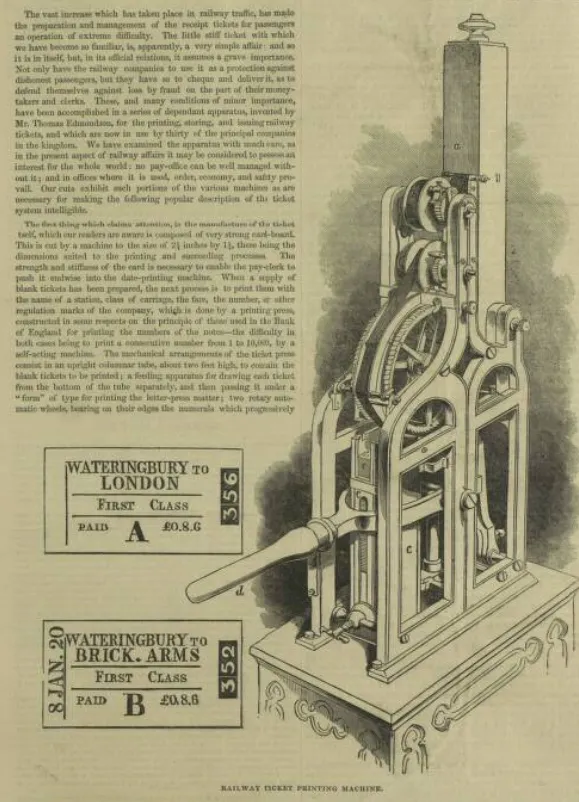
Prior to 1842, railway companies had relied on handwritten tickets, but former cabinet maker turned station master Thomas Edmondson changed all of this when he invented pre-printed tickets. Known as the ‘Edmondson ticket’ after its inventor, on 29 January 1842 the Bristol Mirror described how:
We are informed, that the London and Birmingham and twelve other Companies have adopted the system of railway passenger tickets, invented by Mr. Edmondson, and first introduced on the Manchester and Leeds line; a decent proof of the utility of the invention.
The piece went on to relate how the new tickets worked:
The tickets are printed on cards with consecutive numbers by a self-acting machine which will work off many thousands in one day, by one individual, the tickets having the name of the station they are issued at, where to, and the fare.
Indeed, Edmonson tickets were to have a lasting impact on railway travel, being in use well over a century after their invention. On 14 June 1968, the Stapleford & Sandiacre News described how the Edmondson tickets were to be phased out at the paper’s local stations of Beeston, Attenborough, and Long Eaton:
The changeover from the traditional ‘Edmondson’ card-type ticket, which has been in operation for many years, will enable economies to be made and will simplify accountancy methods. Passengers will in future receive a paper ticket for their journey but it will still be possible to book all types of tickets to most destinations.
12. The first major railway robbery – May 1855
As the railway developed, so did opportunities for it to become the locus of crimes, which gradually became more serious.
On 26 May 1855 Herapath’s Railway Journal, one of several railway-focussed titles that sprang up as the railway continued to develop, reported on a ‘gold robbery.’ A forerunner of 1963’s Great Train Robbery, the piece related how:
On the 15th, one of those ingenious and daring robberies was committed on a quantity of gold being conveyed via the South-Eastern Railway, which we occasionally hear of. It would appear, that between £12,000 and £14,000 of gold had somehow been abstracted from a box, and its place supplied by an equal weight of shot, leaving some £7,000 of gold still in one box.
Adjusted for inflation, the South Eastern Railway gold robbers had got away with some £650,000, a fortune.
13. First known woman railway worker – 1858
During the 1850s, reports began to emerge about a young woman, Elizabeth Ann Holman, who was working on the railways in the West Country. Elizabeth Ann Holman is, therefore, regarded as one of the first known, if not the first known, woman railway worker.
A prelude to her foray into the railways, on 4 August 1855 the Berkshire Chronicle related how:
At the Plymouth Guildhall, on Thursday, Elizabeth Ann Holman, a young woman twenty-two years of age, dressed in man’s clothes, was brought up charged with being a suspicious person. She stated that she had been employed as a road and field labourer in Devonshire and Cornwall, and had also worked as a miner without any suspicions as to her sex.
Elizabeth’s reason for dressing as a man to work? It is one that will resonate even today, for she could ‘earn much higher wages as man as she could have done otherwise.’ Meanwhile, thankfully for Elizabeth, her case was dismissed.
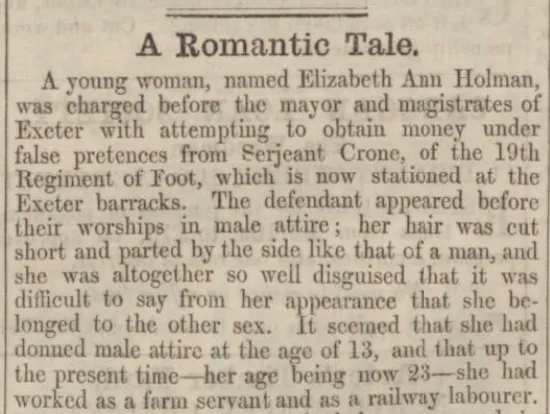
However, she made headlines three years later in August 1858, as she was charged with trying to obtain money by false pretences in Exeter. The West Middlesex Advertiser and Family Journal reported how Elizabeth appeared before the magistrates in ‘male attire, her hair was cut short and parted at the side like that of a man, and she was altogether so well disguised that it was difficult to say from her appearance that she belonged to the other sex.’
It is in this article that we can read an account of her railway work. Employed, as a railway labourer, she ‘had been engaged in wheeling and filling barrows with earth, and her average earnings were 12s to 14s a week.’
Again, Elizabeth was not charged, and she was allowed to take money from the poor box when she left the court. However, she stated that ‘she had got employment on the Exeter and Yeovil Railway, and should at once proceed to work.’
14. The beginning of mail order – 1861
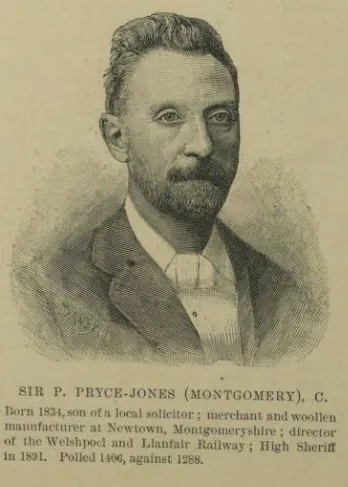
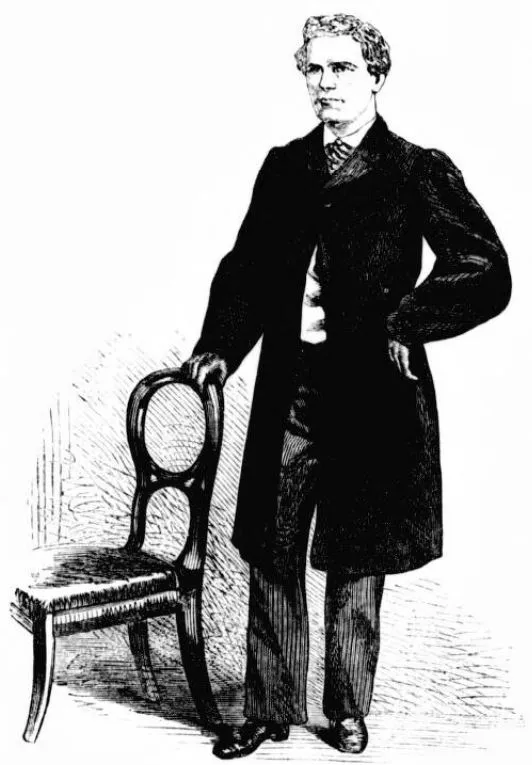
Whilst Elizabeth Ann Holman went against the grain to take advantage of the opportunities afforded to her by the railway, Welsh businessman Pryce Pryce-Jones in the early 1860s was also taking advantage of the lucrativeness afforded by train travel. A woollen manufacturer, during this time Pryce-Jones developed the concept of mail order. Customers could send off for his brochure, and instead of having to go to the shops themselves, they could order items, made possible through the railway, transforming shopping and creating a billion dollar industry that is still booming to this day.
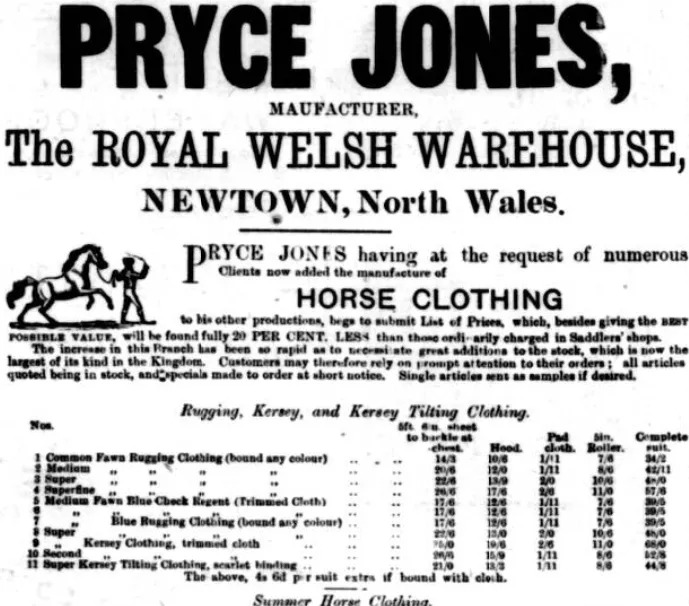
The Shrewsbury Chronicle in 1884 featured an advertisement for Pryce-Jones’s Royal Welsh Warehouse. This advertisement advised readers that Pryce-Jones had expanded his holdings to include the ‘manufacture of horse clothing.’ Meanwhile, in 1892 the Illustrated London News featured an illustration of the now knighted entrepreneur, who had recently been elected as the Conservative M.P. for Montgomery.
15. The first railway murder – July 1864
Some railway firsts, however, are tragic ones, like the death of William Huskisson. On 9 July 1864 Thomas Briggs, a 70-year-old Chief Bank Clerk, became the victim of the first railway murder in Britain. Having spent time with friends near London’s Old Kent Road, Thomas Briggs had travelled by omnibus to Fenchurch Street, where it was his intention to take the train home to Hackney. But he would not make it.
As the Glossop Record on 16 July 1864 explained:
An atrocious crime was perpetrated late on Sunday evening, in a first-class carriage on the North London Railway, when a Mr. Thomas Briggs, engaged in the banking establishment of Messrs. Robarts, Curtis, and Co., of Lombard-street, was murderously assailed, plundered, and thrown out of the train.
German man Franz Muller was later arrested for the crime, and was publicly executed for perpetrating the first railway murder. Read more about the murder of Thomas Briggs and other tales of mayhem and murder on British railways here.
16. The first dedicated sleeping service – 1873
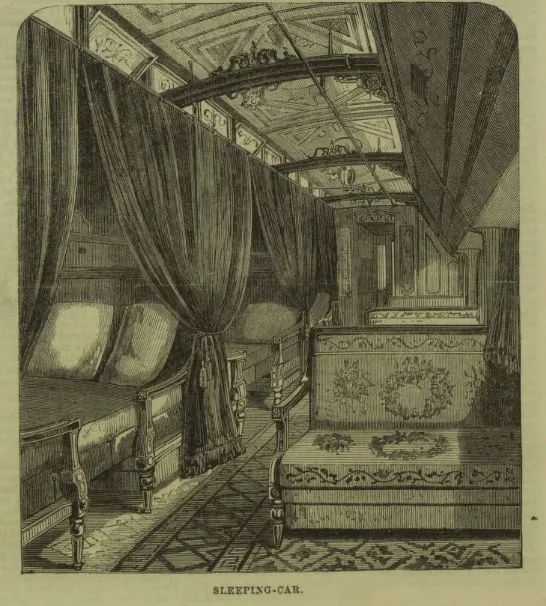
Moving on from murder and mayhem by looking at one of the more unique ways to travel: by sleeper train. Britain’s first dedicated sleeping service was introduced by the North British Railway on the East Coast Main Line in 1873.
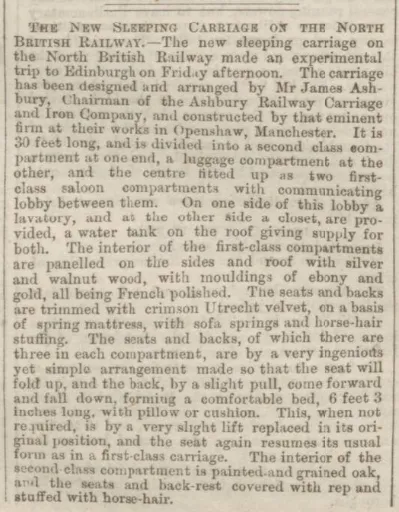
The Dundee Courier on 11 February 1873 described how the ‘new sleeping carriage…made an experimental trip to Edinburgh,’ relating how the carriage:
…is 30 feet long, and is divided into a second class compartment at one end, a luggage compartment at the other, and the centre fitted up as two first-class saloon compartments with communicating lobby between them. On one side of this lobby a lavatory, and at the other side a closet, are provided, a water tank on the roof giving supply for both.
First class passengers, meanwhile, could enjoy compartments panelled with ‘silver and walnut wood, with mouldings of ebony and gold,’ whilst the seating was trimmed ‘with crimson Utrecht velvet.’
However, the new sleeping carriage’s first journey from Edinburgh to London did not go smoothly. The Grantham Journal on 15 February 1873 reported how:
Unfortunately, on the road to Berwick the hindmost axle of the carriage became greatly heated, and on reaching Berwick the smell of burning being very strong, it was considered unsafe for the carriage to proceed further. The occupants, including an invalid lady, and their luggage had therefore to be transferred to another carriage, and the sleeping carriage was left behind at Berwick.
17. The first dining car – November 1879
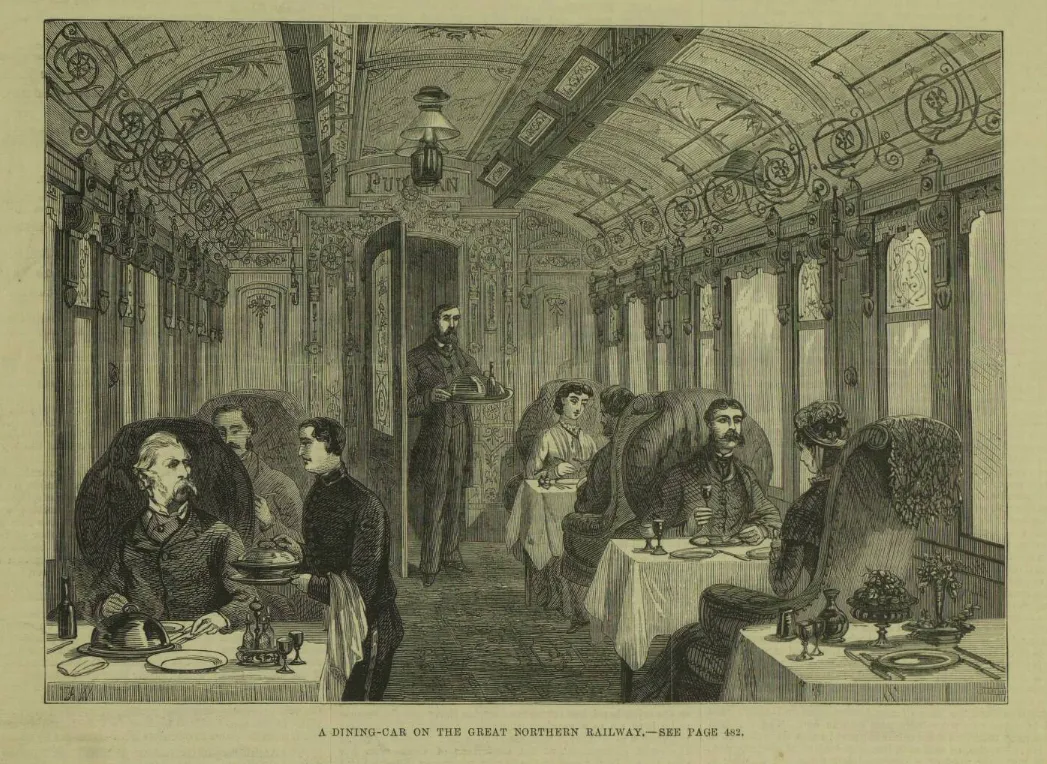
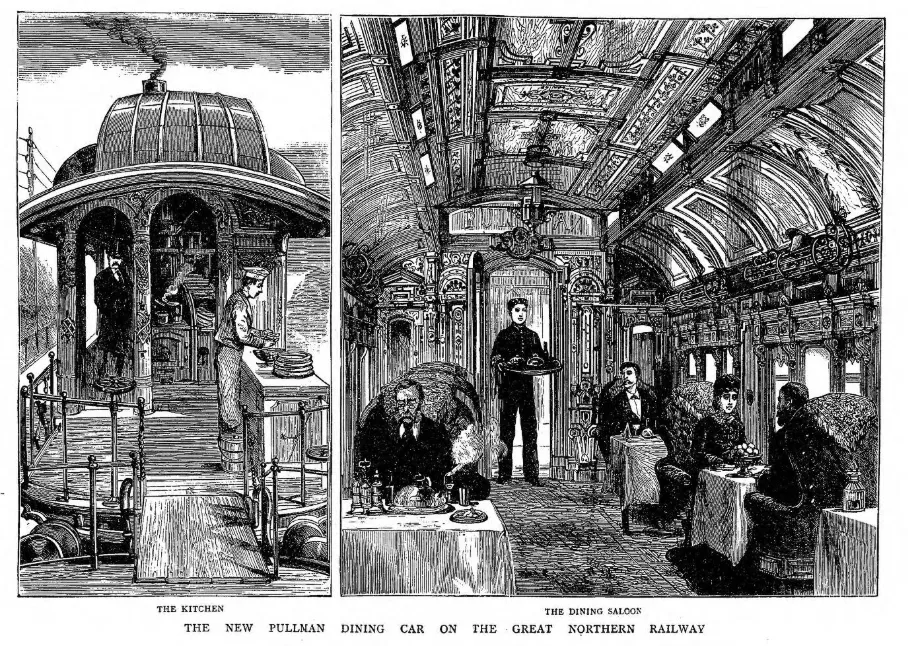
It was the Great Northern Railway this time that was at the forefront of innovation in 1879, when it became the first railway company in England to adopt the ‘comfortable American system’ of the dining car. As per the Illustrated London News, the Great Northern Railway had introduced a new Pullman dining car to their rolling stock, which from the 1 November 1879, was running between Leeds and London.
Built in Detroit at the cost of £3,000 (£325,000 in today’s money), the ‘handsome and convenient new carriage’ was:
…fifty-two feet in length, eight feet in breadth, and runs upon eight wheels. It comprises a dining-saloon, in the middle, a kitchen behind, and a smoking-room in front, with steward’s pantry, ladies’ dressing-room, gentlemen’s lavatory, cupboards, and stoves.
According to the Illustrated London News, refreshments, ‘including wines,’ were supplied at ‘ordinary hotel dinner charges.’
18. The first electric railway – 1883
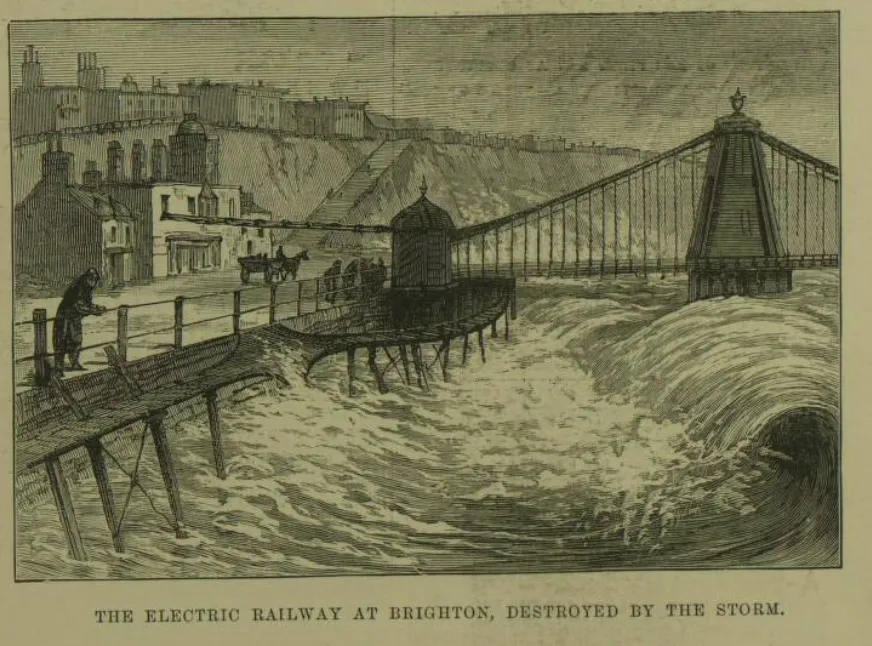
More innovation was happening, this time on the south coast, in 1883. On 8 August 1883 the Western Daily Press reported on the ‘Electric Railway at Brighton,’ which happened to be the country’s first electric railway. The newspaper related how:
The electric railway formed on the beach opposite the Brighton Aquarium started work on Saturday, and excited much interest, amongst those who visited it being the mayor. The railway is laid on wooden sleepers, placed on an embankment of shingle, which has been thrown up and levelled just in front of the massive sea wall which was built to protect the Aquarium…
A week later, and the Kirkcaldy Times was reporting on the new railway, which ran from ‘the entrance of the Aquarium to the Chain Pier.’ Ten people could travel in the car, which ran at a rate of six miles per hour, meaning the whole journey took some ‘four or five minutes.’
The brainchild of British-German inventor Magnus Volk, the Central Somerset Gazette on 8 September 1883 described how ‘the electric railway at Brighton has proved so much of a success as a popular attraction that it is proposed to extend it along the whole length of the Esplanade wall – about two miles.’ Indeed, the paper was so enthused by the success of the electric railway, that it mused how ‘Mr. Magnus Volk’s experiment at Brighton is sufficiently promising to encourage the belief that some day we may travel by the aid of electricity.’
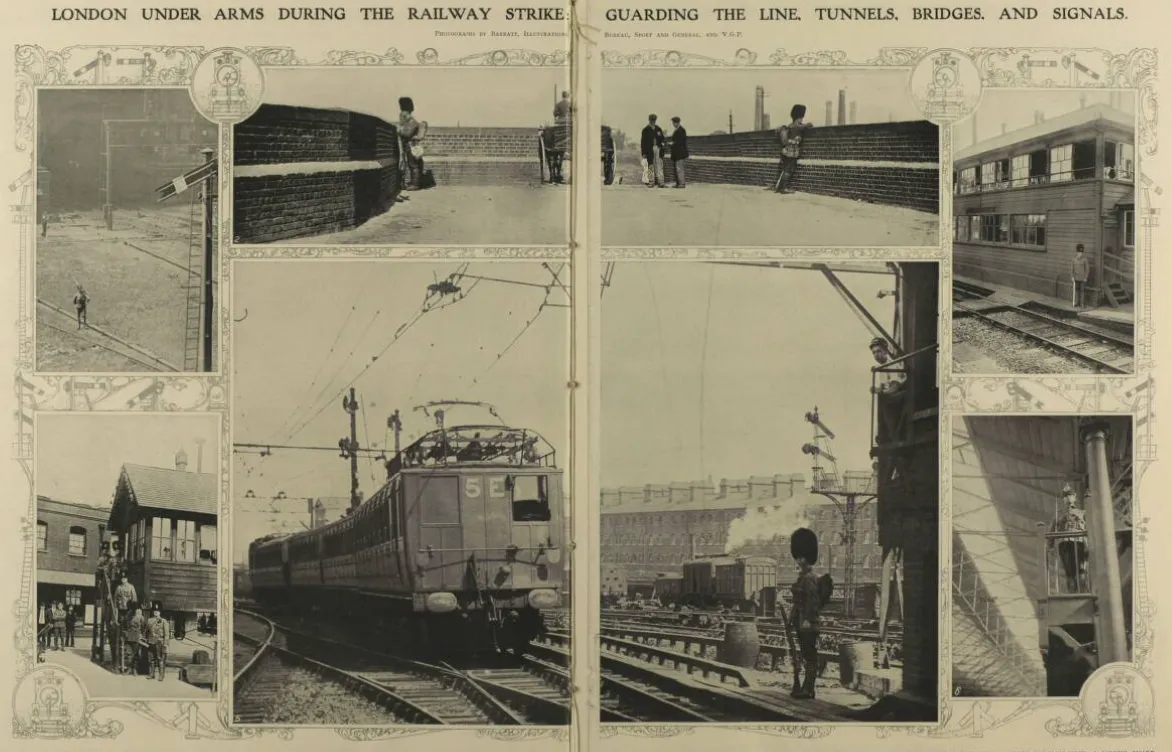
19. The first national railway strike – August 1911
As advances were made with railway technology, so too were strides made in the Labour and trade union movement. Railway workers pushed for greater rights, and in August 1911, the first ever ‘national strike of railway workers’ began.
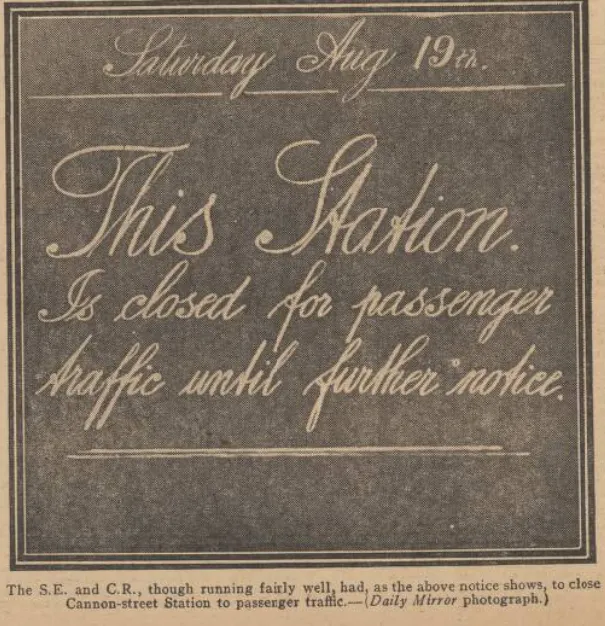
On 18 August 1911 the Pall Mall Gazette reported how ‘service is being provided on most lines, though incalculable loss and inconvenience to the public is undoubtedly being caused by the men’s action.’
Meanwhile, ‘London was under arms.’ In dramatic scenes, troops were occupying the railway stations, and were ‘guarding the lines for a distance of many miles out.’
Although the strike would only last a few days, it was a seminal moment in railway history, and provoked the government to conduct an enquiry into the issues raised by the strikers.
20. The first Black guard at Euston Station – 1966
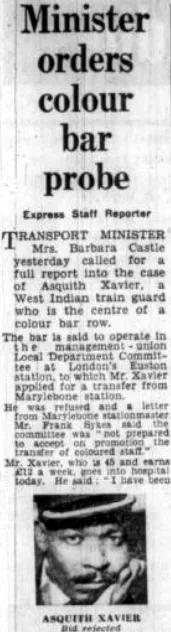
Fast forward to 1966 and one particular railway worker was fighting for his rights. In 1966, 46-year-old Asquith Xavier fought for the removal of the colour bar, which prevented him from becoming a passenger guard at Euston Station. Please do be aware that this coverage features language of the time that is outmoded and may cause offence.
As the Daily Express on 13 July 1966 related:
The bar is said to operate in the management-union Local Department Committee at London’s Euston station to which Mr. Xavier applied for a transfer from Marylebone station. He was refused and a letter from Marylebone stationmaster Mr. Frank Sykes said the committee was ‘not prepared to accept on promotion the transfer of coloured staff.’
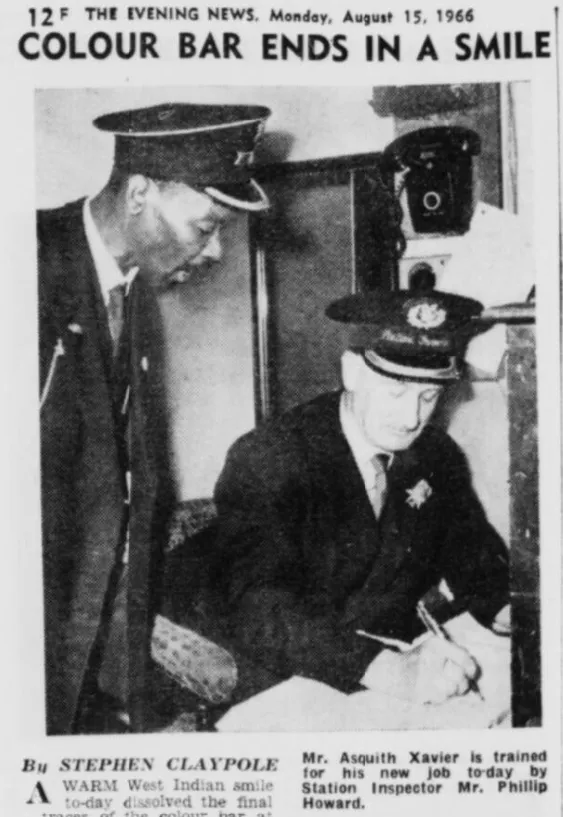
However, a month later on 15 August 1966, Dominica-born Asquith Xavier’s challenging of the colour bar ended in success as he ‘began work as Euston’s first coloured passenger guard.’ Backed by the National Union of Railwaymen, as reported by the Evening News (London), Xavier won his ‘right to a transfer,’ which gave him a pay rise from £14 a week to £50 a week.
Beaming, Asquith Xavier arrived for work at Euston ‘an hour before clocking on time.’ Proclaiming himself to be ‘not a bit nervous,’ he was excited to be participating in some ‘more interesting work.’ Sadly, Xavier explained how he had been the victim of ‘three threatening letters’ since he hit the headlines, with the writers not being caught.
However, Asquith Xavier managed to successfully and gracefully overcome institutional racism to gain his promotion.
We can’t think of a more inspiring note on which to end our list of 20 pioneering railway firsts, 200 years on since the birth of the modern railway. Discover more about the history of the railway through browsing the pages of our Archive, our special blog features, and our dedicated railway titles.
Our Railway Titles
Title | Years covered |
1838-1848,1852-1903 | |
1845 | |
1844-1846 | |
1864-1918 | |
1888-1898 | |
1881, 1886 | |
1837-1914 | |
1845, 1846 |
More on this topic:
Share this article
About the author

Rose Staveley-Wadham
Newspaper Licensing Manager
Published on Mon, 22 September 2025.