
Hot Off The Press – New Titles This Week
Published on 7 April 2026 by Rose Staveley-Wadham
This week at The Archive we are sounding a War Cry, as we welcome the main UK and Irish periodical of The Salvation Army, the worldwide Christian church and a registered charity, to our collection. And that’s not all, as we’re also delighted to host updates to another The Salvation Army title, the Social Gazette. In all, we have 71,299 brand new pages for you to enjoy this week.
In this week’s blog, we’ll take you through the fascinating history of both The Salvation Army and the War Cry, as we explore the organisation’s revolutionary approach to charity, which became a global phenomenon.
Register now and explore The Archive
1860s and 1870s: the early days of The Salvation Army and the War Cry
The Salvation Army traces its roots back to East London in 1865, when it was founded by William and Catherine Booth. In these poverty stricken streets, the Booths took the revolutionary approach of bringing the Christian message directly to the people, whilst setting up soup kitchens, helping those living in the slums, and providing aid to women fleeing prostitution.
Known as the East London Mission, in 1878 the organisation adopted what would become its distinctive military style, and its new name of The Salvation Army. The Salvation Army set up a quasi-military structure, with officers and members wearing a military-style uniform.
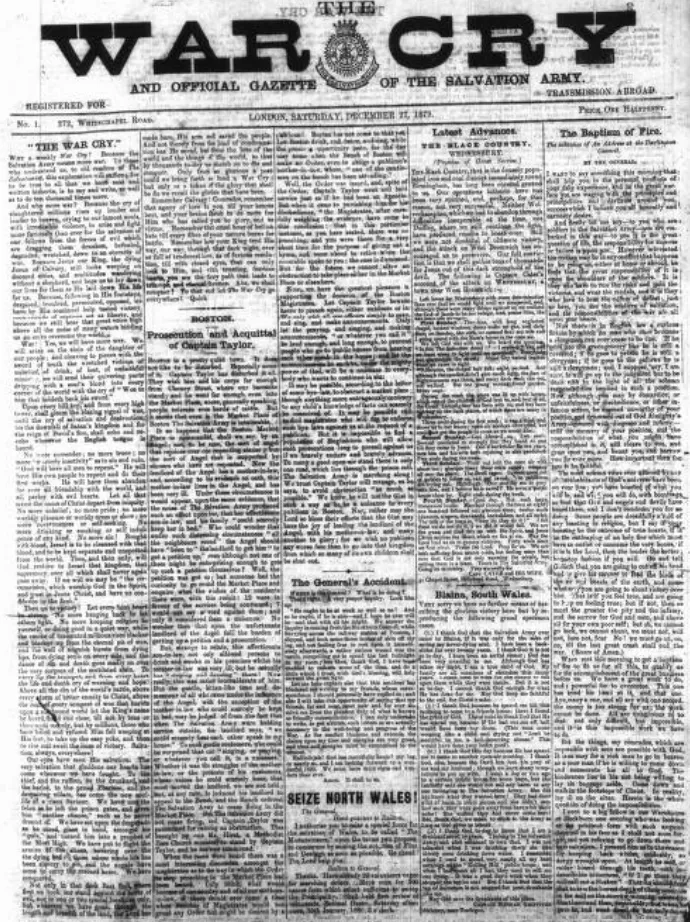
Just a year later, in 1879, and the first edition of the War Cry was released. The first copy of the periodical was published on 27 December 1879, and it was printed on a small printing press in Whitechapel. Filling four pages, and costing a modest halfpenny, the debut edition of the War Cry explained the new publication’s rallying title:
…the Salvation Army means more war…And why more war? Because the cry of slaughtered millions rises up louder and louder to heaven, crying to our inmost souls, with irresistible violence , to arise and fight more furiously than ever for the salvation of our fellows from the forces of evil which are dragging them drunken, befouled, degraded, down to an eternity of woe.
The War Cry would go on to include first-hand accounts from Salvationists, songs, sermons, and news from The Salvation Army, being sold by volunteers to fund the work of the church.
The 1880s: growth of the War Cry and hostility to The Salvation Army
In 1880, Major George Phippen Ewens took over as the first permanent editor of the War Cry, writing under the pseudonym of ‘Grace Peace Evermore.’ In the 1880s, under his editorship, the War Cry grew to include more illustrations, and from September 1882 to February 1886 it changed from a weekly title to a twice-weekly title. After this point, the War Cry reverted to its once a week publication schedule, only now it was published in tabloid format, filling sixteen pages and costing 1d.
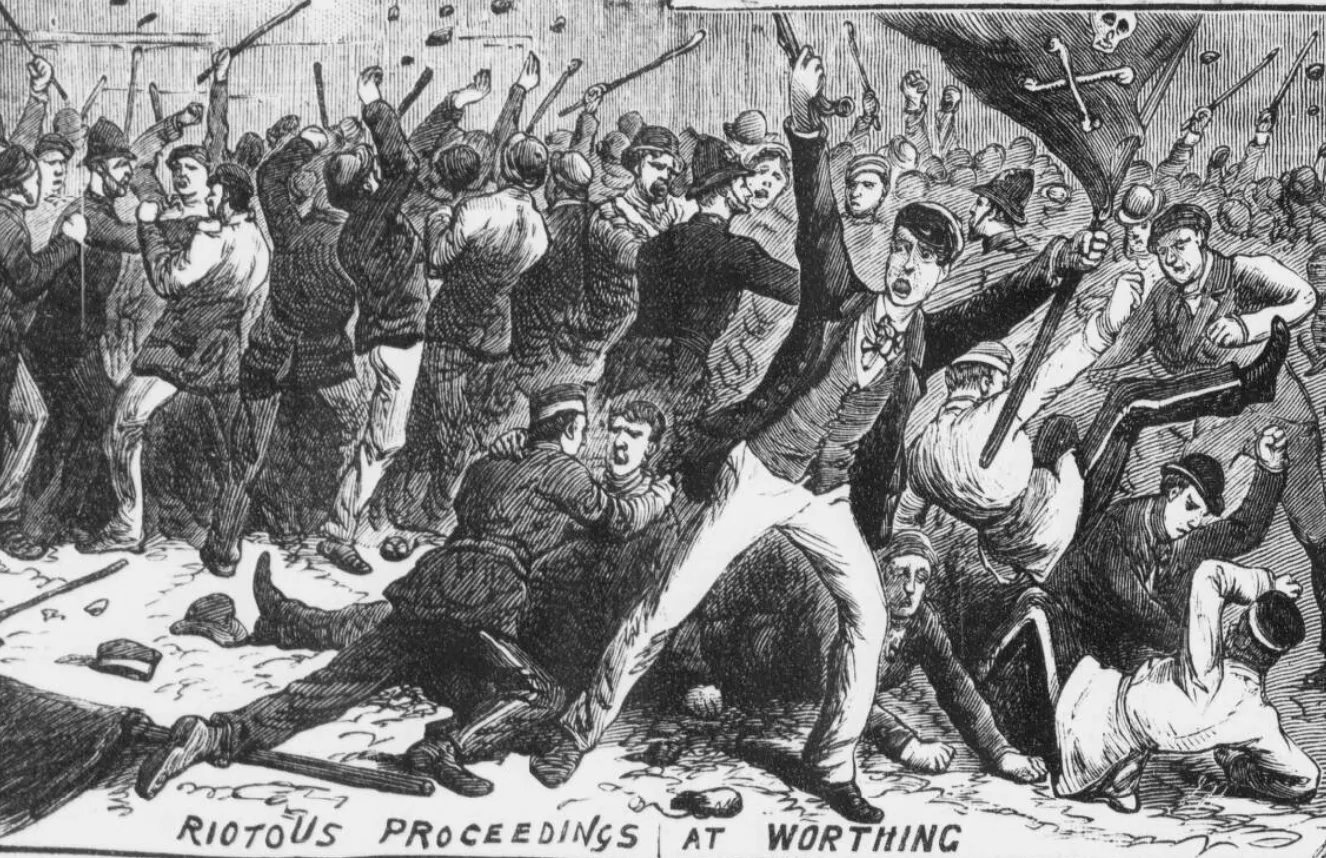
During the 1880s The Salvation Army faced some hostility from the public, all whilst Catherine Booth was working tirelessly in the fight to protect young girls from exploitation, her work contributing to the Criminal Law Amendment Act 1885. This hostility manifested in the form of the ‘Skeleton Army,’ whose members would attack Salvationists. One such attack in Worthing, Sussex, in 1884, is narrated by the War Cry here.
But what motivated such hostility? Often it was led by publicans, worried about the influence of The Salvation Army, and the organisation’s potential to deplete their customer base.
1880s continued: The Salvation Army Prison Gate Brigade
Despite such hostility, The Salvation Army marched on with its mission of spreading the Christian word and helping the less fortunate. By the 1880s it had become a global mission, with the American version of the War Cry beginning publication on 15 January 1881.
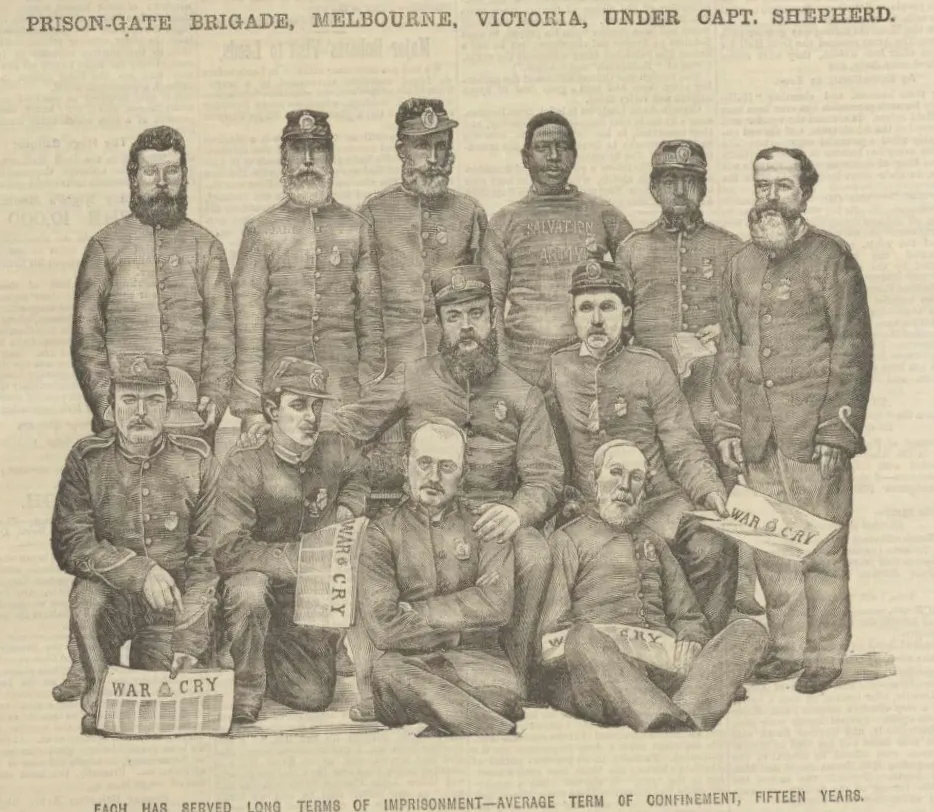
In 1883 an important branch of The Salvation Army’s work began, The Salvation Army Prison Gate Brigade. Originating in Melbourne, and soon spreading internationally, members of this wing of the church met prisoners as they left the prison gates. This support aimed to prevent the released prisoners from falling back into a life of crime.
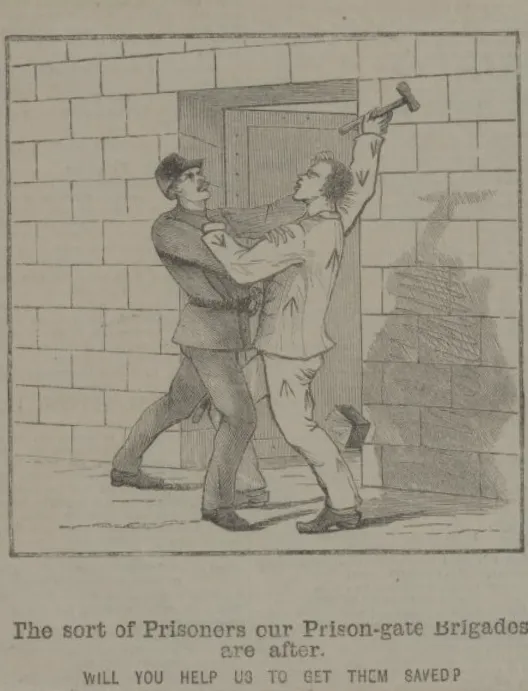
Indeed, as the below illustration indicates, these are ‘the sort of prisoners our Prison-gate Brigades are after.’
1890s: the publication of In Darkest England and the Way Out
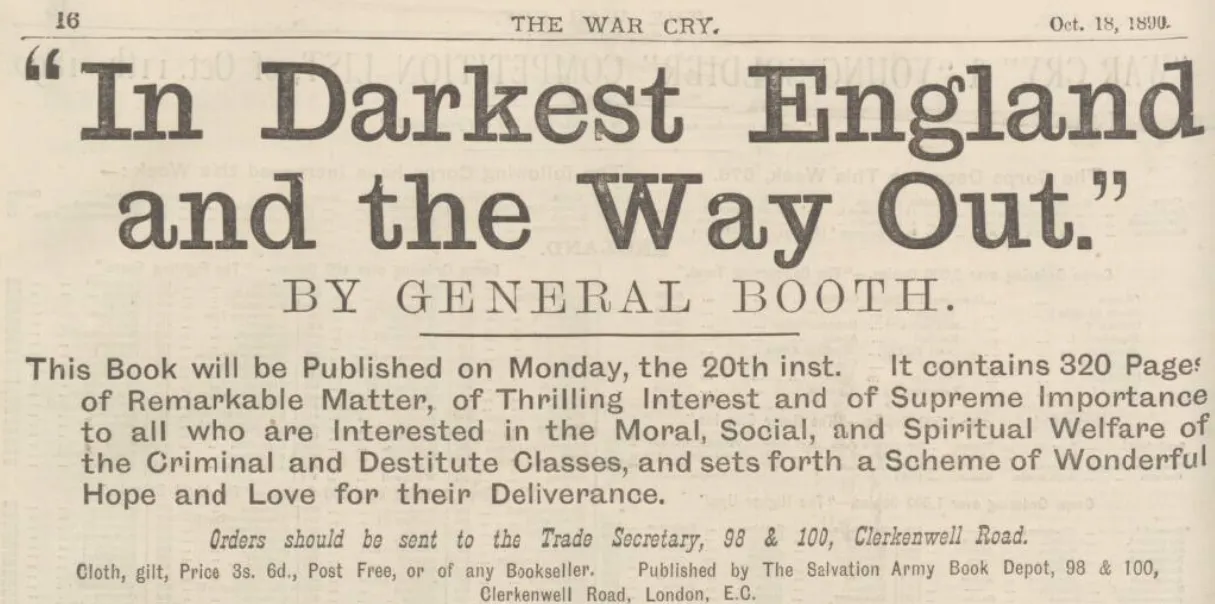
In 1890, founder and General of The Salvation Army William Booth published his seminal work In Darkest England and the Way Out. The War Cry provides special insight into this work, which put forward a variety of social proposals, themselves representing early models of the social services.
On 15 November 1890 the War Cry published a piece by William Booth himself about his book, which he described as ‘my scheme for the rescue of the three millions of men, women, and children who are at this moment helplessly floundering in the deep, dark, morass of poverty, or are alike the slaves and victims of some vice or crime.’
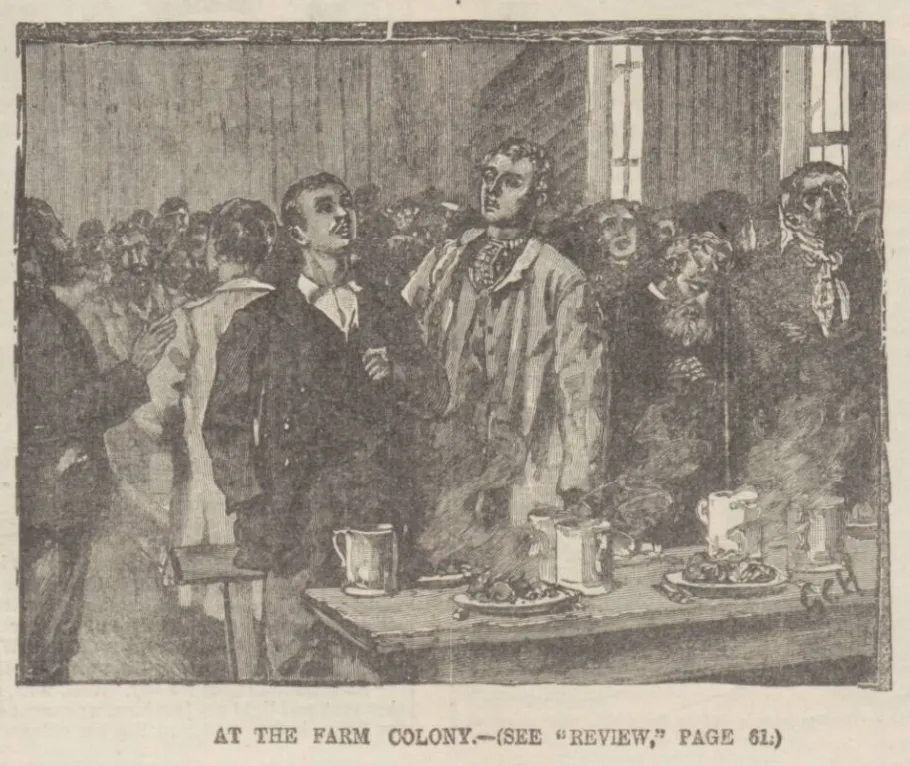
One such ‘scheme’ was the farm colony in Hadleigh, Essex, which allowed for people to escape the slums and to learn new skills. The pages of the War Cry contain fascinating adverts for this work, with one published on 11 July 1891 appealing ‘to Mechanics who are Salvationists.’ These mechanics, including plumbers and carpenters, were wanted to work at the colony and to take ‘charge of from a dozen to twenty colonists, and to teach and direct them in their work.’
1890s continued: international growth
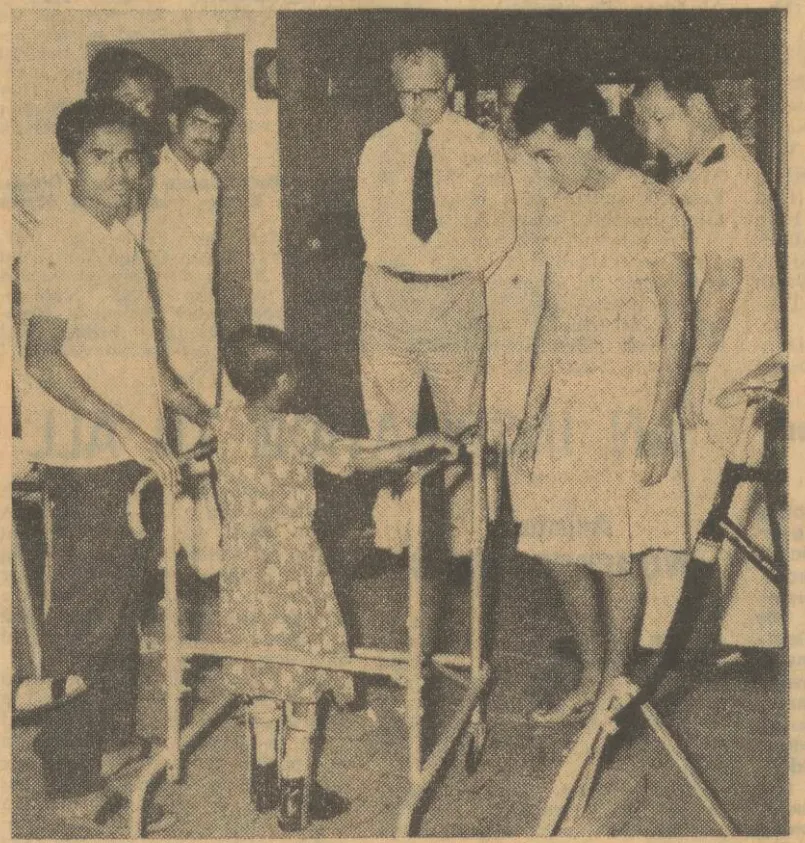
As The Salvation Army’s efforts grew in Britain, so they continued to grow across the world. The first Salvation Army hospital was established in Nagercoil, India, in 1893, The Salvation Army having been in India since 1882. Named the Catherine Booth Hospital, it was started by Captain Henry ‘Harry’ John Andrews. Beginning in a tiny room, it grew to a 300-bed general hospital.
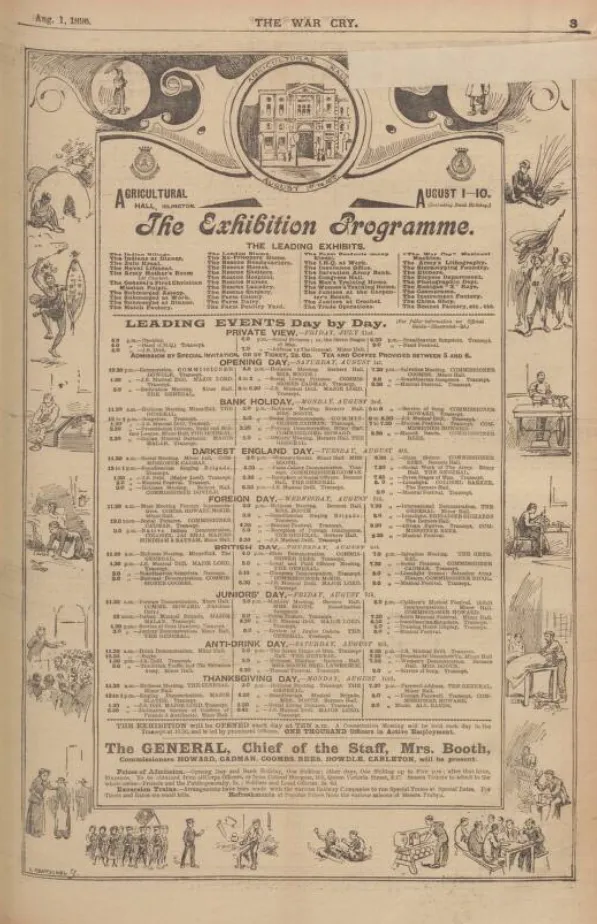
From 1 to the 10 August 1896 the World Salvation Army Exhibition was held at the Agricultural Hall in Islington, to present ‘A Living Picture of the World-Wide Salvation Army.’ On 1 August 1896 the War Cry published its ‘Exhibition Number.’ It printed the programme showcasing the exhibition’s leading events, which included a ‘Darkest England Day’ and a ‘Foreign Day.’
Meanwhile, the War Cry on 22 August 1896 published some fascinating information about the World Exhibition. According to the publication, over ‘100,000 persons visited the Exhibition,’ with 16,000 official guides being sold. Meanwhile, on 29 August 1896 the War Cry published a list of what had been left behind there: ‘8 umbrellas, 3 capes, 1 pair of spectacles, 1 purse containing railway ticket, 1 book of hymns, 2 brooches, 1 lady’s belt, 1 glove (lady’s) and 2 latchkeys.’ Readers were invited to apply to Major Stewart of Queen Street to have their items returned.
1890s continued and into the 1900s: Salvation Army midwives and women in the church
As well as providing revolutionary charitable aid, The Salvation Army was progressive in its treatment of women. Of course, Catherine Booth ranked as a co-founder of the organisation, but women from its earliest days were allowed to preach and hold leadership roles.
In the 1890s The Salvation Army expanded yet again to take in midwifery, dubbed by the War Cry as ‘Slum or District Maternity Work.’ Undertaken in the organisation’s native East London, on 11 August 1894 the War Cry advertised for Salvationists ‘to train as probationists for monthly nursing’ at the Maternity Hospital. Applicants should be ‘healthy, kind, and with a natural love for nursing.’ The maternity hospital was located at Ivy House, whilst by 1898, according to the War Cry, The Salvation Army’s midwives had attended to 141 ‘Slum District Maternity Cases’ between October 1897 and May 1898.
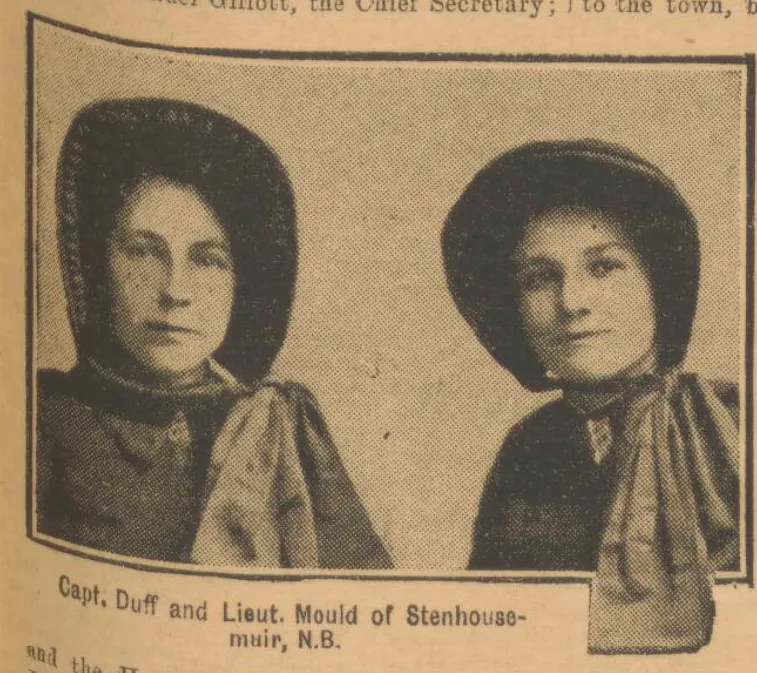
Where the War Cry is particularly fascinating is its accounts of women officers and their work. Beyond nursing, on 1 April 1905 the War Cry profiled a ‘Scotch Awakening’ and the work of Captain Duff and Lieutenant Mould, of Stenhousemuir. The two women had ‘led over two hundred men and women to God in a little over three months.’
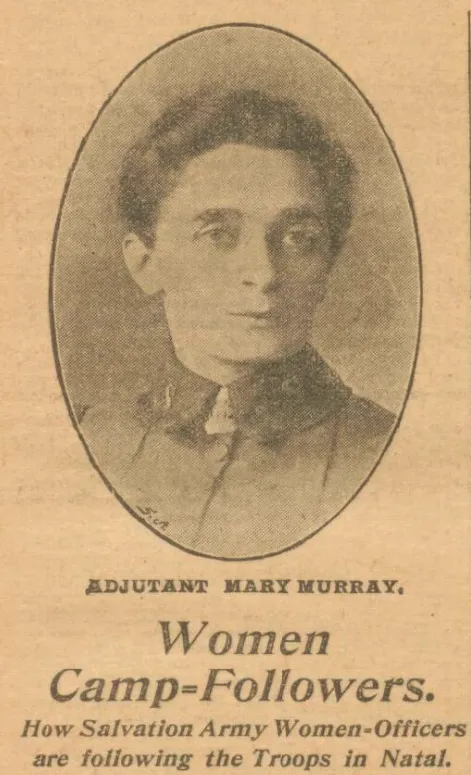
Meanwhile, on 19 May 1900 Adjutant Mary Murray published her own personal account in the War Cry of ‘following the troops’ in Natal, during the Boer War. Providing spiritual and practical support to the soldiers, Murray gives an extraordinary account of her life with the Army in South Africa.
1910s: the sinking of the RMS Empress of Ireland
On 29 May 1914 tragedy struck as the RMS Empress of Ireland, travelling from Canada to Britain, sunk in the St. Lawrence River, after colliding with another vessel only hours into her voyage. It was a tragedy that struck The Salvation Army hard, as out of the loss of 1,012 lives, it’s estimated that 171 of the dead were Salvationists.
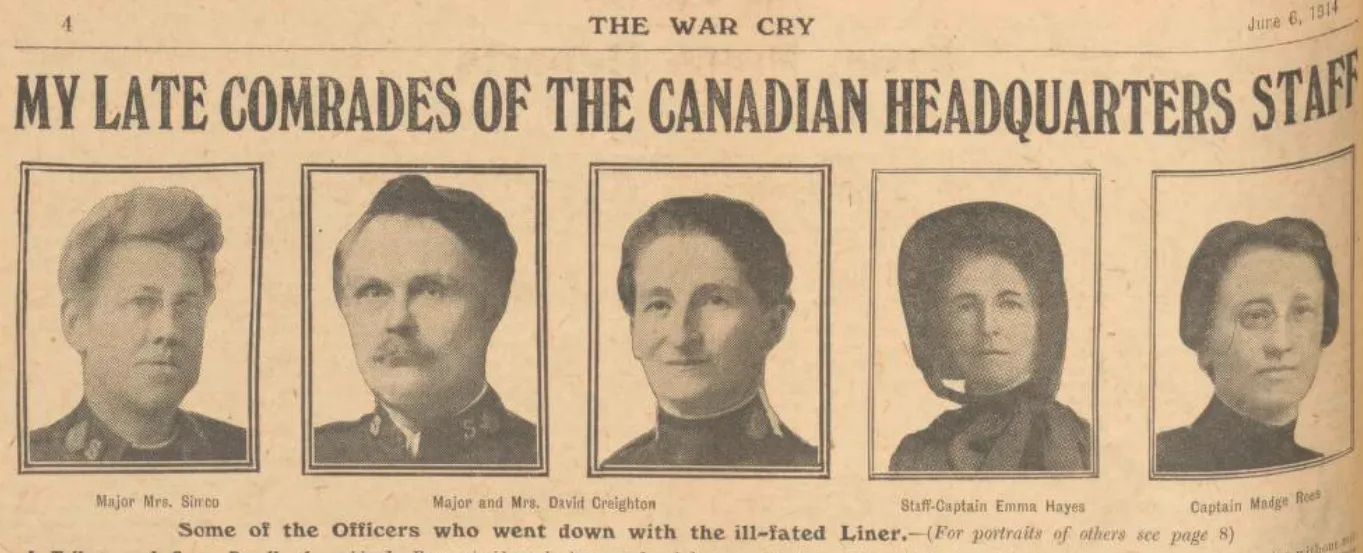
After the tragedy, the War Cry provided a mixture of mourning and practical support. The editor of the paper remembered ‘My late comrades of the Canadian Headquarters staff,’ in a piece on 6 June 1914 that pictured some of those who had lost their lives, as well as providing their obituaries. In the same edition of the paper, the War Cry advertises a ‘Memorial Service for the Dead of the ‘Empress of Ireland,” which was to be held at the Royal Albert Hall and conducted by General William Booth. William Booth, meanwhile, gave ‘special instructions that all possible assistance of a business character is to be rendered to relatives and friends of those who were taken in this great disaster,’ whilst information regarding the insurance settlement following the sinking was provided by the paper on 7 November 1914.
1910s continued: the First World War
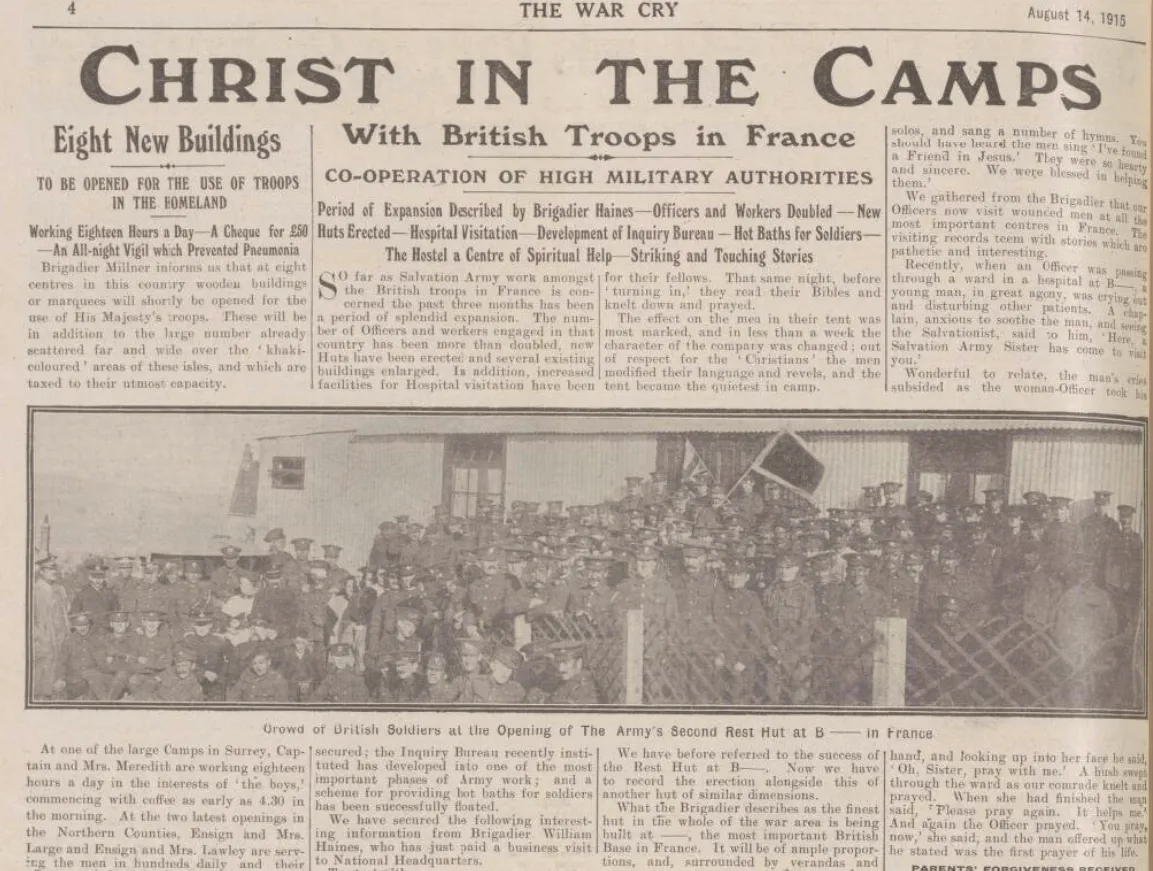
Soon after the sinking of the RMS Empress of India, the First World War broke out. The War Cry is an excellent chronicle of the work The Salvation Army undertook during this conflict to support soldiers and civilians. For example, on 9 June 1917, the War Cry published an article headed ‘Some Phases of the Salvation Army’s War Work.’ The Salvation Army, by this point in the war, had erected 153 ‘refreshment and recreation huts’ in military camps in Britain, France and beyond, opened 77 hostels and naval and military homes with 4,000 beds, supplied 80 motor ambulances in France, Russia and Egypt, catered for 300,000 soldiers and sailors on a weekly basis, sent 41,000 food and clothing parcels to prisoners of war and soldiers and sailors, and entertained 30,000 relatives of servicemen.
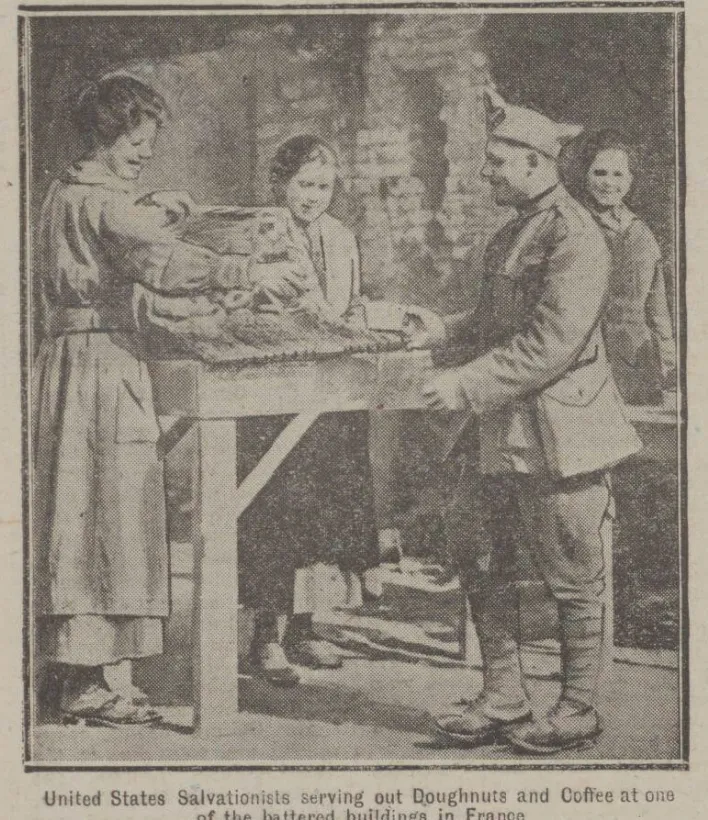
The stats really talk for themselves. During the First World War the American branch of The Salvation Army became known for their distribution of doughnuts throughout camps on the Western Front. Indeed, the women Salvationists became known as ‘doughnut lassies,’ and on 17 August 1918 the War Cry profiled the United States Salvationists in France who were ‘busy as beavers making new vats of coffee and cocoa, and mixing doughnuts.’
1940s: the Second World War
As during the Second World War, The Salvation Army provided support to servicemen, servicewomen and civilians across the globe, as well as on the home front. The War Cry documents these efforts, with extensive reports and photography.
In the weeks after the declaration of war, the War Cry on 23 September 1939 outlines the extra efforts being made for the war effort. The piece describes how ‘among the plans now completed are schemes for huts in big military centres, another hut opposite a railway station used by many troops, and station buffets.’
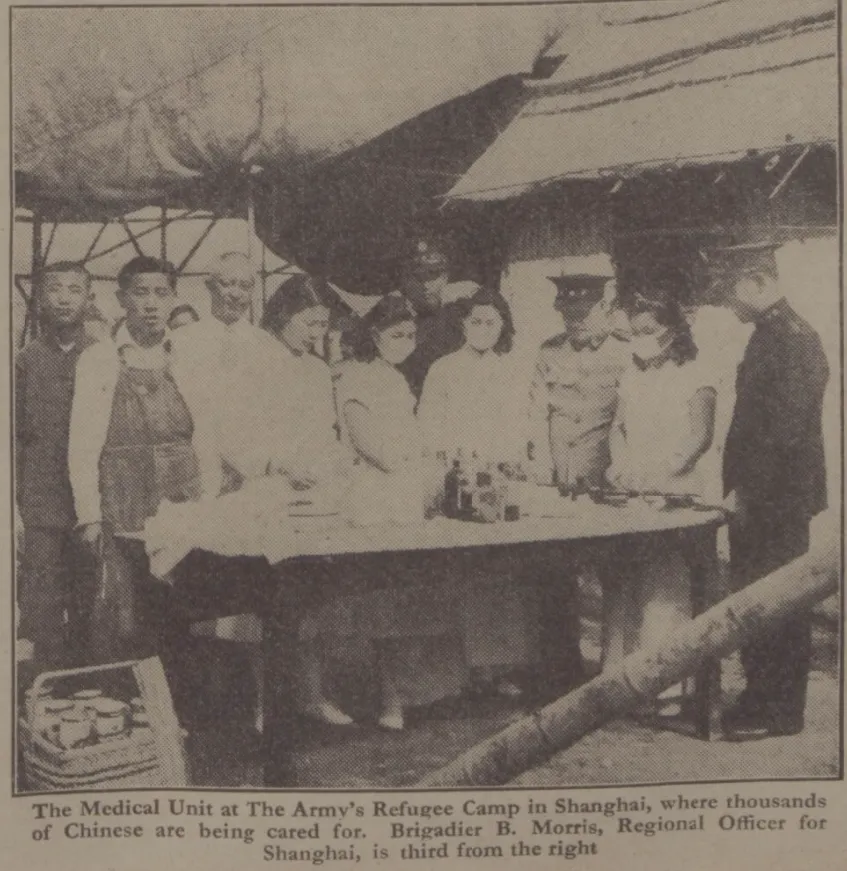
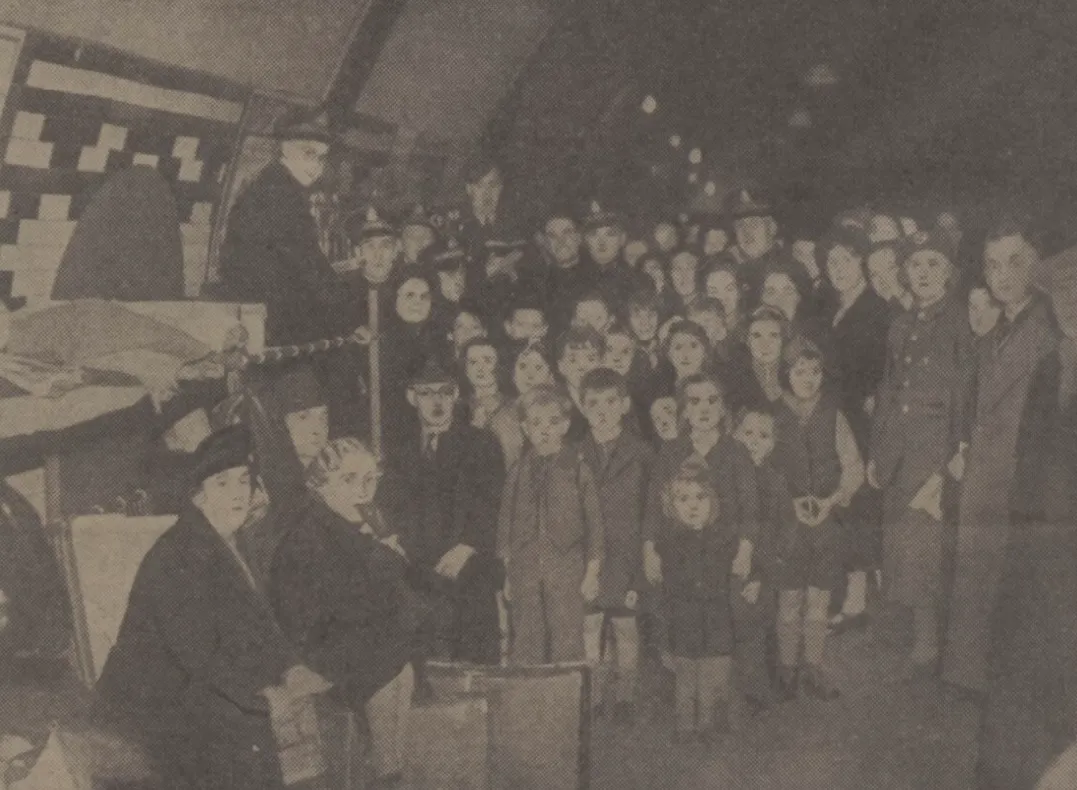
As the war intensified and worked its way around the world, the War Cry chronicles the work of The Salvation Army. For example, on 20 January 1940 the title pictured the Medical Unity of The Salvation Army’s Refugee Camp in Shanghai, whilst on 22 October 1941 it pictured a group sheltering from bombing raids at Chalk Farm tube station, where evening services were held.
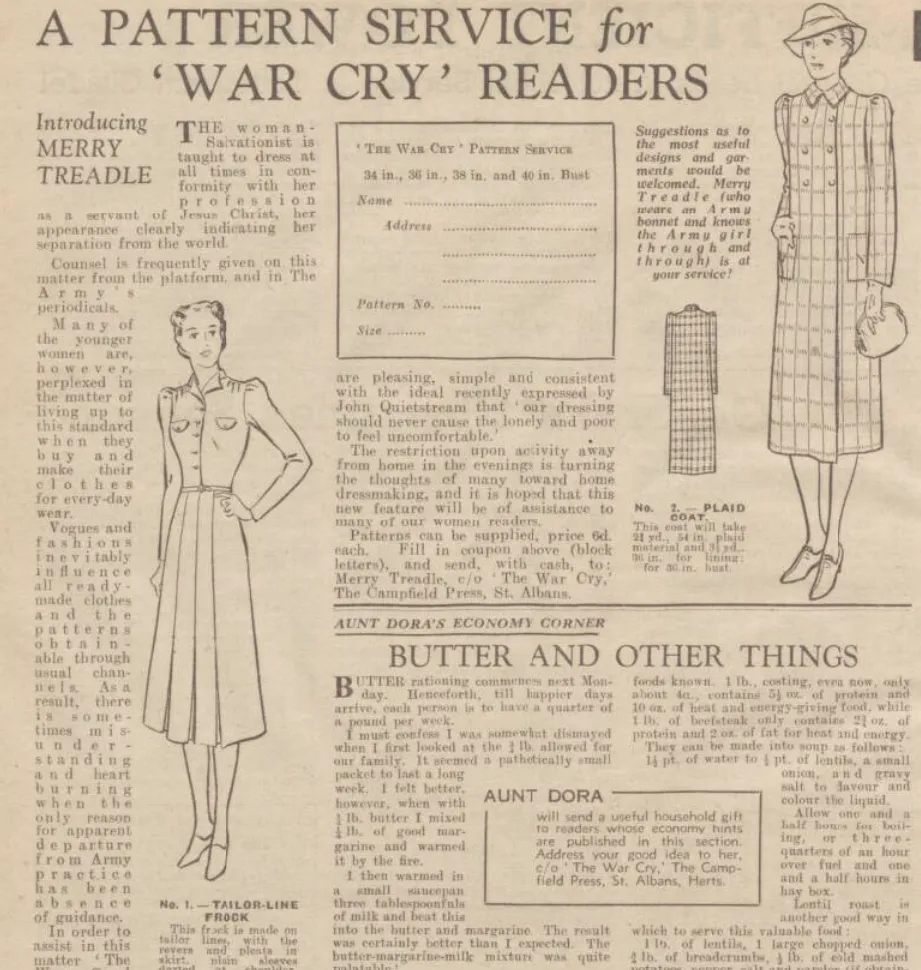
Alongside global humanitarian efforts, The Salvation Army, through the War Cry, introduced something for women on the home front in 1940, ‘a pattern service for War Cry readers.’ On 6 January 1940 the paper introduced Merry Treadle, providing simple, modest and affordable clothing patterns for women via mail order. Ahead of clothes rationing in 1941, this service offered a practical and reasonable way of dressing, demonstrating how the War Cry catered to the domestic side of life, as well as global events and spiritual needs.
The 20th century and beyond
We have published up to the year 1985 of the War Cry. Today, the War Cry is The Salvation Army’s principal evangelical newspaper. It remains in print as a weekly title, and is priced at 50p. A fantastic repository of the history of The Salvation Army, it also offers an unparalleled window on the social fabric of Britain and beyond, ‘darkest England’ and further afield, and the efforts to help the less fortunate members of society.
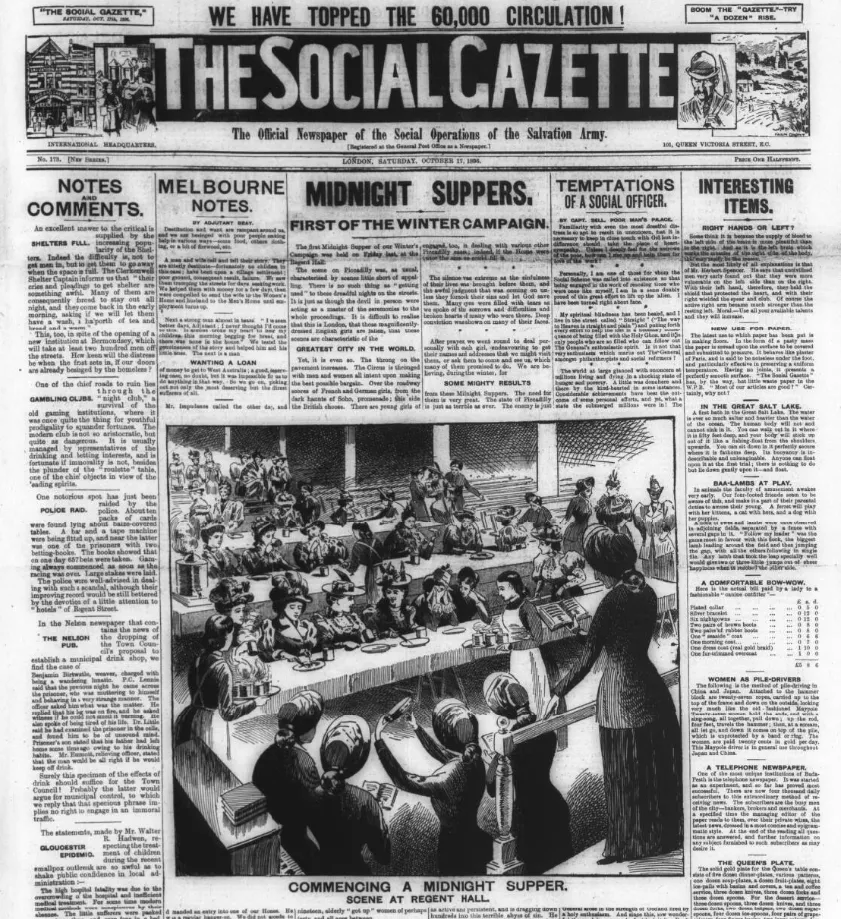
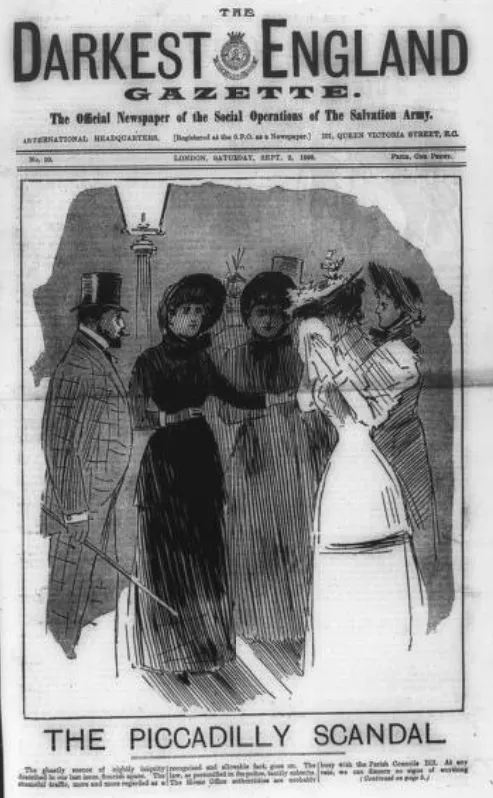
Alongside the War Cry, we’ve also added new pages to the Social Gazette this week. This title, also published by The Salvation Army, began life as a penny weekly in July 1893. Named the Darkest England Gazette, echoing William Booth’s work of the same name, it included a mix of reportage and fiction. In 1894 it was renamed to the Social Gazette, an its purpose was to report on The Salvation Army’s social work, as laid out by the ‘Darkest England Scheme’ in 1891. By October 1894 this publication had a circulation of some 42,000 copies, as it reported on social work in Britain and beyond, with articles focusing on societal conditions, like life in the slums and international famines.
Discover more about the work of The Salvation Army, the legacies of William and Catherine Booth, and much more besides, by searching the pages of our Archive today.
New Titles
Title | Years Added |
1879-1985 |
Updated Titles
This week we have updated one of our existing titles.
You can learn more about each of the titles we add to every week by clicking on their names. On each paper’s title page, you can read a free sample issue, learn more about our current holdings, and our plans for digitisation.
Title | Years Added |
1893-1909 |
You can keep up to date with all the latest additions by visiting the recently added page. You can even look ahead to see what we’re going to add tomorrow.
More on this topic:
Share this article
About the author

Rose Staveley-Wadham
Newspaper Licensing Manager
Published on Tue, 7 April 2026.