
Hot Off The Press – New Titles This Week
Published on 14 April 2026 by Rose Staveley-Wadham
We’re delighted this week to bring you an astonishing amount of new pages, over half a million in all, as we trace everything from music history through the pages of Sound Wave to workers’ history through Common Good. Here are the figures for you: we’ve added 526,032 brand new pages in all, alongside seven brand new titles, and we’ve updated 28 of our existing titles.
From Fife to Folkestone, from Llangollen to Liverpool, from Roscommon to Ripley, through our new pages this week you can travel the length and breadth of Britain and Ireland. Meanwhile, armed with Sound Wave, you can go on a trip through the charts, and discover what people were listening to over one hundred years ago. Read on to learn more.
Register now and explore The Archive
Common Good
But before we discover what Sound Wave has to offer, we’re delighted to welcome Common Good to our Archive. The arrival of Common Good on the publication scene was heralded by the Croydon Guardian and Surrey County Gazette on 12 June 1880. The Croydon newspaper was reporting on a meeting of the Workman’s Social Education League, which was founded in 1877 by social reformer Henry Solly (1813-1903), with Liberal historian John Robert Seely (1834-1895) taking over as president in 1879.
The object of the league, as described by the Croydon Guardian and Surrey County Gazette, was to ‘give lectures and promote discussions on political and social subjects in working men’s clubs.’ And during the league’s meeting in June, ‘it was stated in the course of the meeting that in September a weekly journal, to be called The Common Good, would be published, in which reprints of the lectures and discussions of the league would be inserted.’
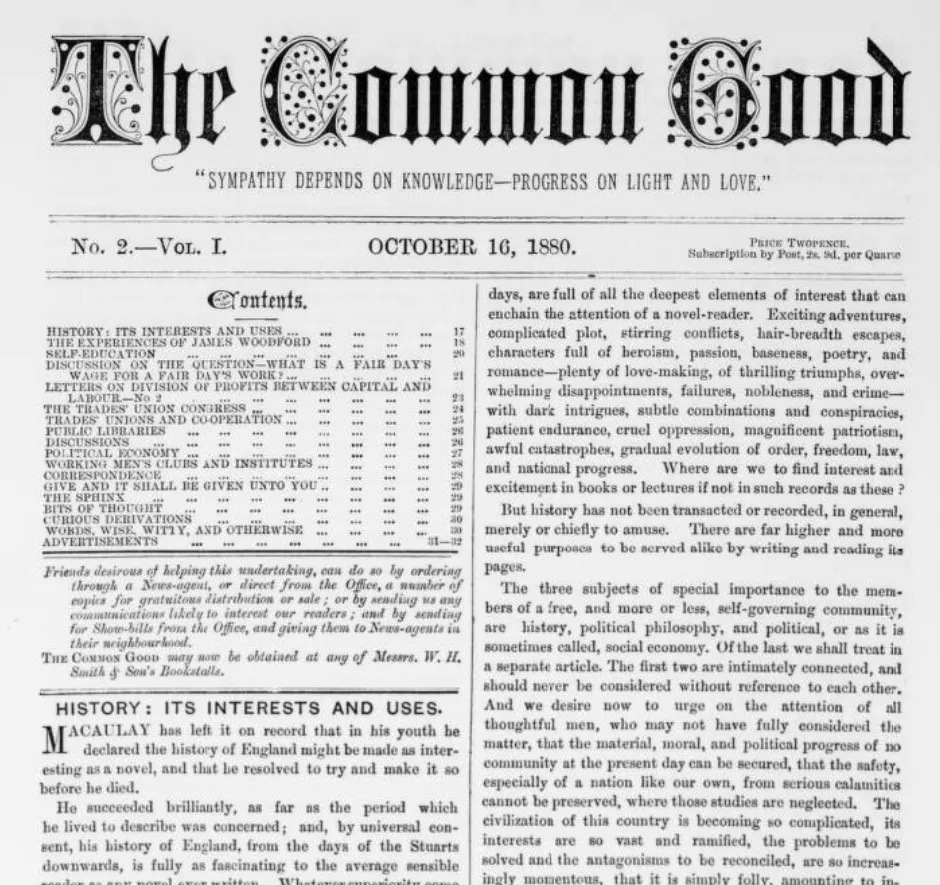
A little later than anticipated, and the first edition of Common Good was published on 9 October 1880 with the motto ‘Sympathy Depends on Knowledge – Progress on Light and Love.’ The debut edition of the publication cost 2d. and filled some sixteen pages. It laid out its objects, which included ‘the promotion of a better understanding and more mutually profitable relationship between Capital and Labour,’ the development of technical education amongst workers, ‘the political education of the people,’ and ‘the promotion and healthy development of sound working-class organisations, such as Working Men’s Clubs and Institutes, Trade Societies, Mutual Improvement and Discussion Societies.’
The pages of Common Good were filled with articles relating to its various aims. It featured columns entitled ‘The Political Education of the People’ and ‘Working Men’s Clubs and Institutions,’ with thought pieces like ‘What Is Fair Day’s Wage for a Fair Day’s Work?’ and details of experiences of working men like James Woodford, a carpenter, joiner and Chartist, making regular appearances. Common Good also contained news around the Workman’s Social Educational League, as well as poetry.
Fairplay
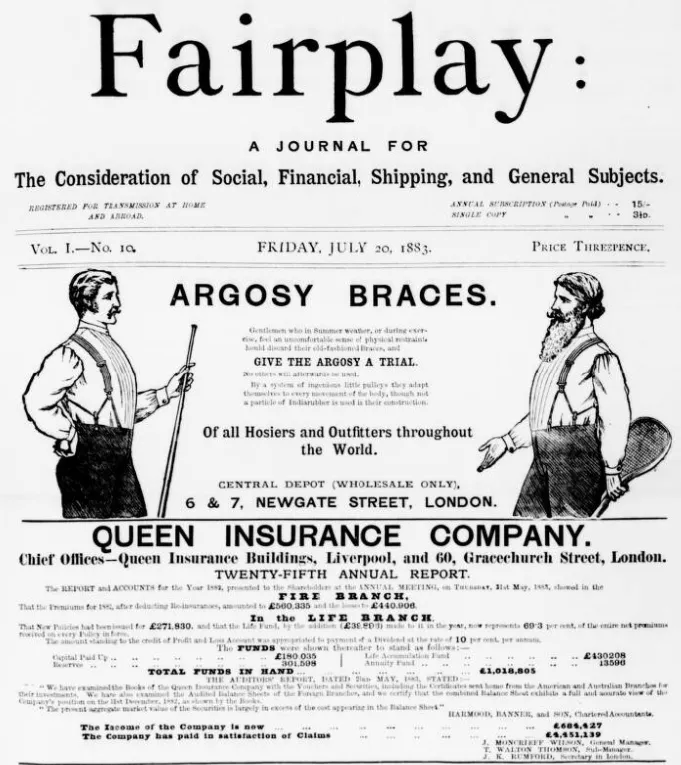
Next up in our new title lineup is Fairplay. Adopting quite a different tack to Common Good, Fairplay was a ‘journal for the consideration of financial, shipping and commercial subjects.’ Indeed, its first edition, which was published in London on 18 May 1883, described how:
There is so little fairplay in the world that it might at first sight appear that in choosing the term as a title for this journal we were in danger of leaving ourselves without subjects on which to write… Investors, taxpayers, ratepayers – and we are all one, if not all of the three; men of business, makers of money, or spenders of money; we can all do with a good more fairplay than we get.
Known as ‘a London paper of commerce and finance,’ Fairplay appeared every Friday priced at 3d. Filling some 24 pages, it reported on the news from parliament, as well as providing reviews on plays and operas. The bulk of Fairplay was, however, devoted to shipping news, with the paper printing ‘Shipping Notes,’ details of the ‘Shipping Exchange,’ and information on private ship-owning. With its financial focus, Fairplay also took a look at investment options, new companies and news from the finance world.
The Gourock Times
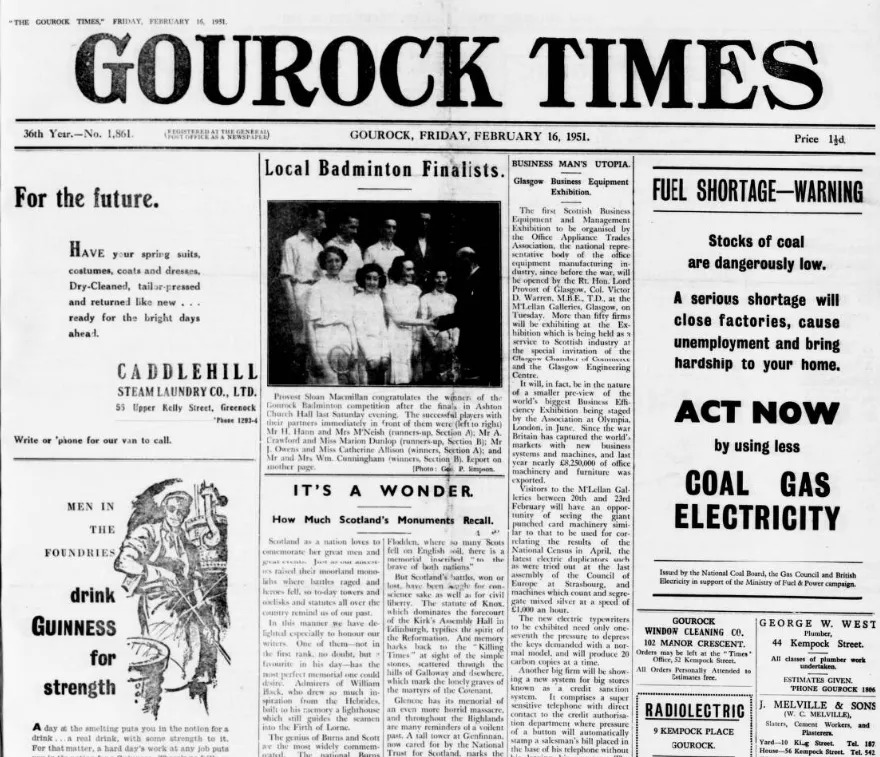
We’re off to Scotland with our next new title of the week, the Gourock Times. First published on 15 May 1915, and established by Richard Steele, the Gourock Times was ‘the weekly newspaper for Gourock and district.’
There are several interesting aspects surrounding the founding of the Gourock Times. The first, it made its debut during the First World War. The marks of the conflict are found across its pages, as it included a column entitled ‘Torpedo Topics,’ which was based on the work and workers at the local torpedo factory, and another called ‘Gourock’s Roll of Honour,’ which listed those local men serving in the armed forces. The second, that it was town’s first newspaper, which was unusual for this point in the twentieth century.
The first edition of the Gourock Times explained how:
Our principal aim will be to make the ‘Times’ a real newspaper – that is, to present the news of the district in a bright and interesting way; but we expect that on occasion we shall have space to spare to devote to other matters than the passing events of the day… We desire to be a local paper – one in which the local news is the important part whatever the others may be…In politics we shall take no side.
Indeed, the Gourock Times would become a thoroughly local paper. It printed all the news from the town, which sits on the east shore of Clyde, with photographs of local luminaries and the latest from organisations like Gourock Bowling Club.
The Llangollen Advertiser
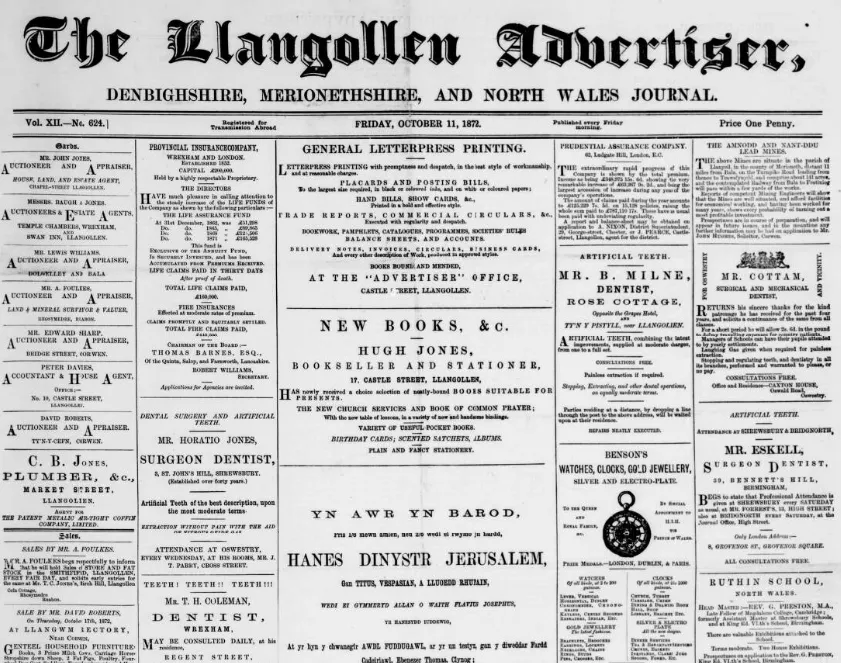
And now to Wales, as we welcome the Llangollen Advertiser to our collection. With the full name of the Llangollen Advertiser, Denbighshire, Merionethshire, and North Wales Journal, this title was first published on 2 November 1860. The Llangollen Advertiser, which appeared every Friday at the cost of 1d, circulated in ‘Llangollen, Denbighshire, Merionethshire, North Wales, and adjacent English counties.’
Neutral in its politics, this title printed the local news from the town of Llangollen, which lies on the River Dee, in Denbighshire, as well as from the surrounding district. Indeed, the Llangollen Advertiser reported on the latest from the likes of Corwen, Llandudno, Denbigh, and Llanrwst, as well as featuring more national and international news. Within its eight pages you’ll also find railway timetables, news on the markets, and notices of births, marriages and deaths.
The Rugby Observer
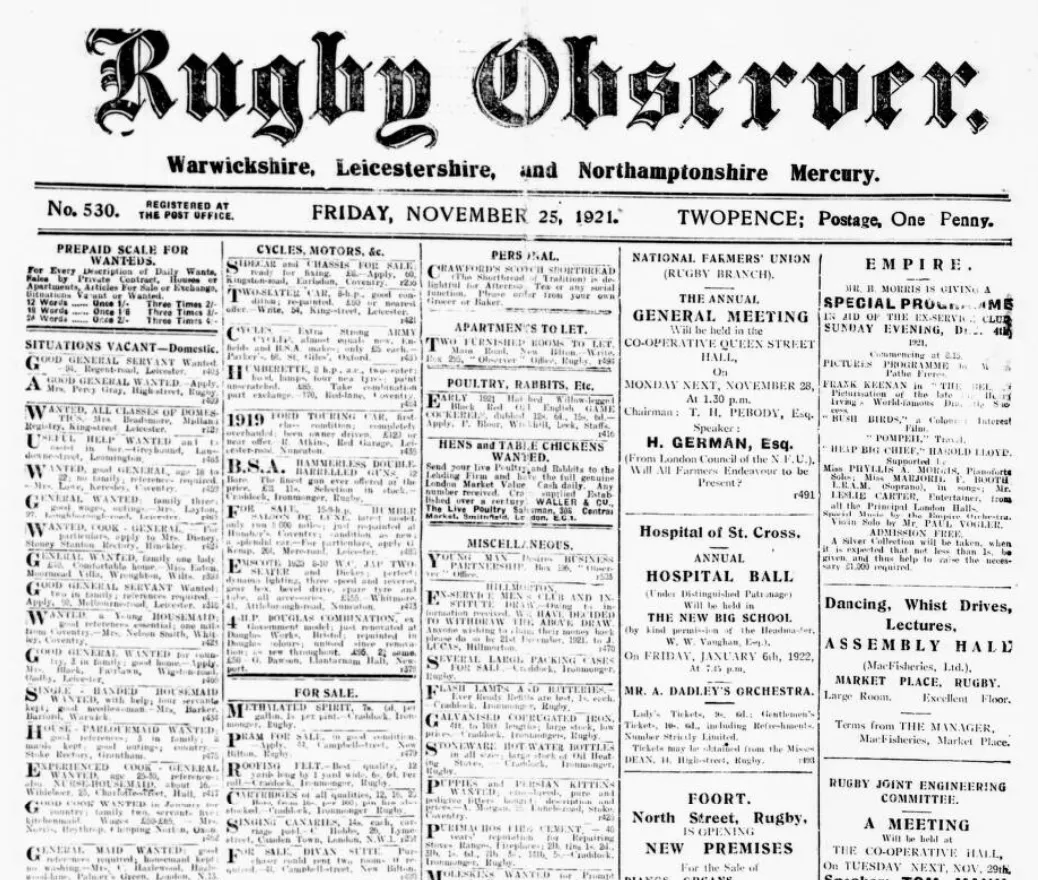
Our next title takes us to the Warwickshire market town of Rugby. First published on 6 October 1911 with the full title of the Rugby Observer, Warwickshire, Leicestershire & Northamptonshire Mercury, the Rugby Observer was neutral in its politics, appearing every Friday at the cost of 1d.
The first edition of the Rugby Observer stridently stated how it was published ‘because it is needed.’ It aimed to be a ‘clean paper,’ whilst attempting to report the news with ‘rigid impartiality.’
The paper, which filled eight pages and was Liberal in its politics, was a lively one. It published features on a range of subjects, from a chess column to a farmer’s letter, from cross country notes to a fashion and home column, which included illustrations. The town of Rugby, however, was the subject closest to the paper’s heart, with the Rugby Observer printing photographs of local groups and personalities, alongside the latest news from the area.
A particular highlight of the Rugby Observer was its ‘Village Talks’ section, which revealed ‘What ‘ole Tom thinks about things.’ Written in the area’s dialect, it provides an interesting view on early twentieth century Rugby.
The Sheffield Free Press
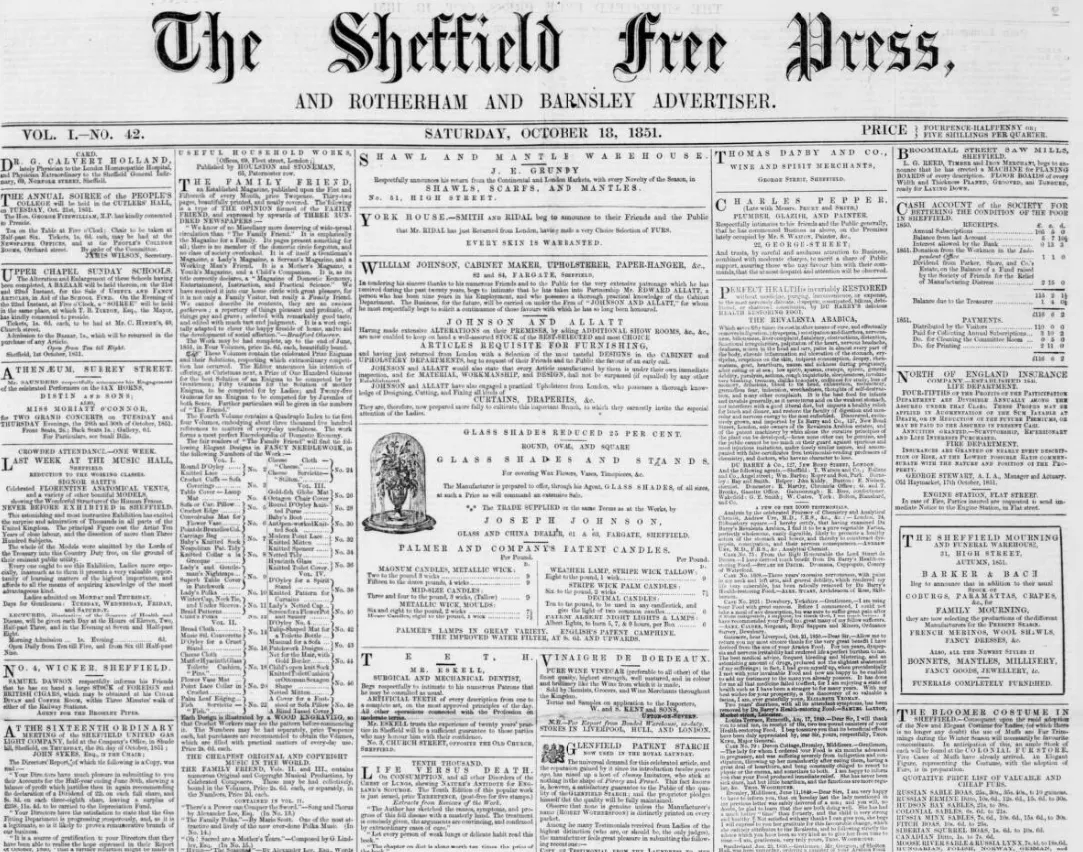
Our penultimate new title of the week is the Sheffield Free Press. This Radical title was first published on 4 January 1851. This publication, according to its first ever edition, set out to be ‘a newspaper free from all party bias: a fearless advocate of great truths and beneficial principles: recognising no distinctions betwixt men: and maintaining the great cardinal principles of religion, which stand before and above all sectarian differences and man-made creeds.’
Indeed, by October 1856 the Leeds Times was describing how the Sheffield Free Press:
…unflinchingly advocates the principles of constitutional liberty, and a repeal of those obnoxious statues and treaties by which the liberty of the subject is curtailed, and the commercial resources of the empire lost to the manufacturing community, for the special behoof of rival and hostile powers.
The fellow Yorkshire title went on to state how ‘the merchant, the manufacturer, the agriculturalist, and the artisan, may each derive much valuable knowledge by a perusal of and study of the Sheffield Free Press.’
So what did the eight pages of the Sheffield Free Press contain? Well, the paper published ‘copious reports of all matters of Local interest, Foreign News, Parliamentary Intelligence [and] Market Reports.’ Meanwhile, the Sheffield Free Press also published sporting intelligence, police news, and poetry. It appeared every Saturday priced at 3p.
Sound Wave
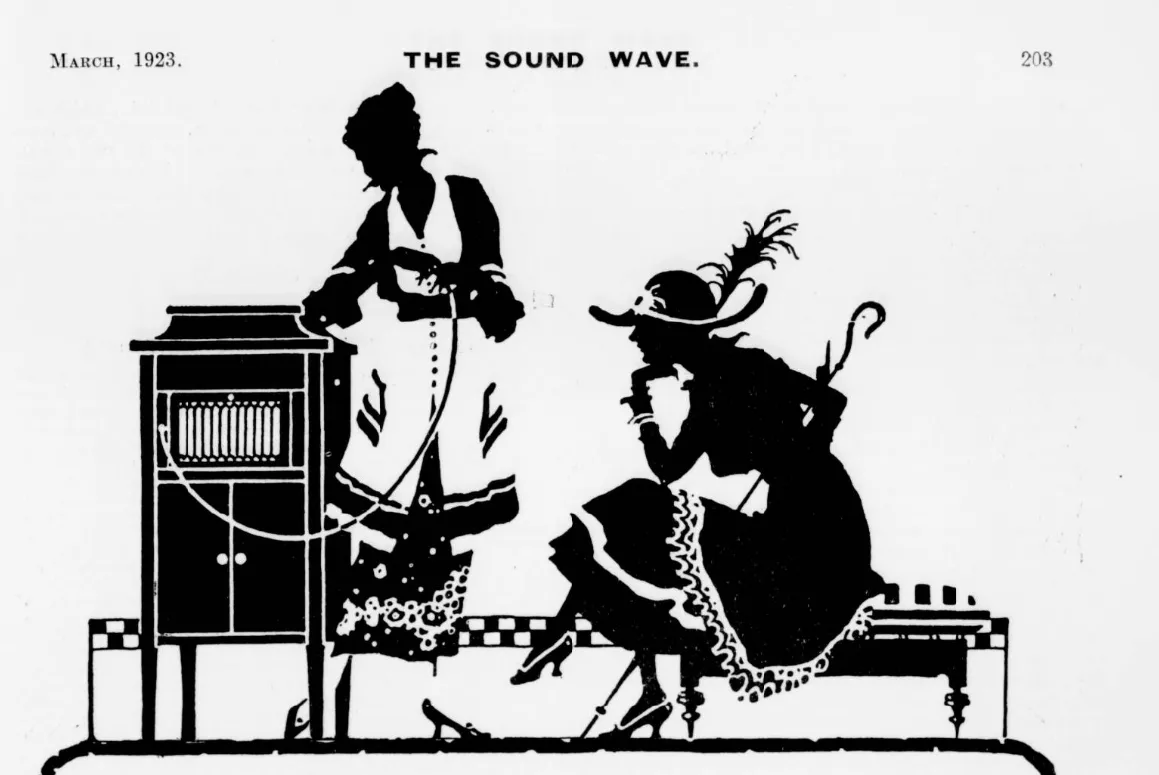
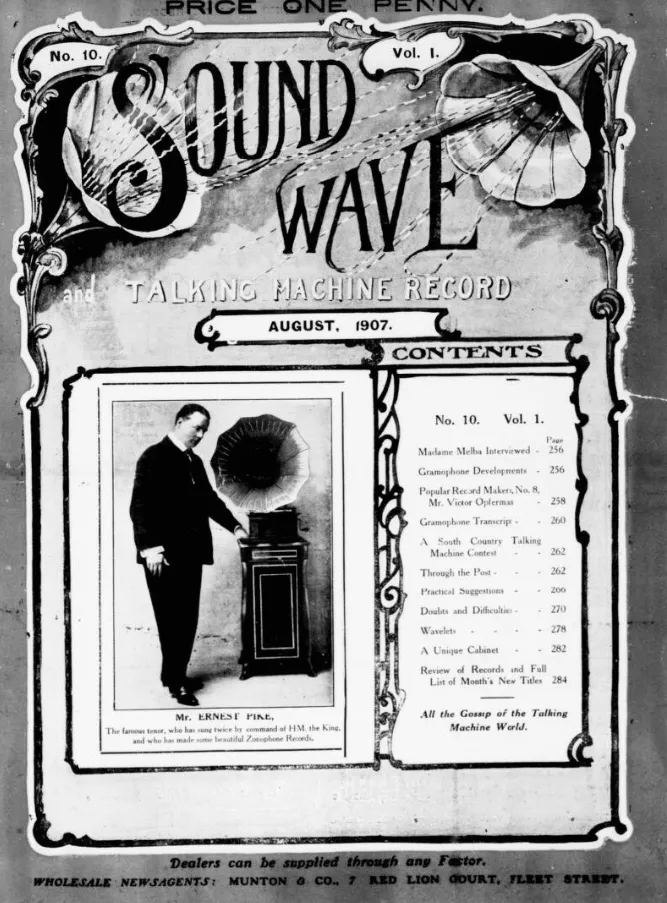
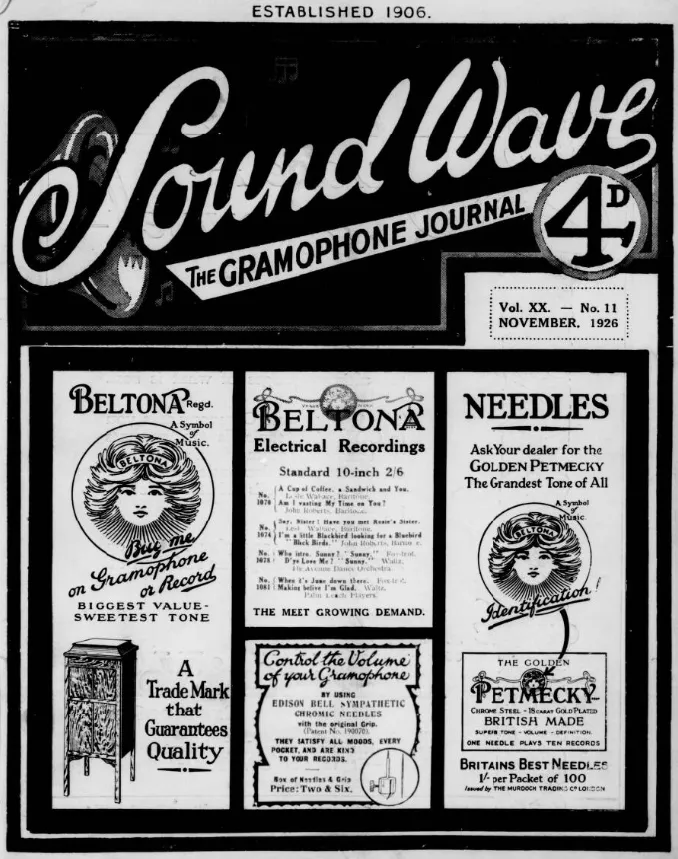
Our final new title of the week is the wonderfully named Sound Wave, which was first published in 1906 and was ‘full of interesting information for all talking machine owners.’ During the early twentieth century, so-called talking machines incorporated phonographs and gramophones, and would grow to include radios.
Bursting with ‘all the gossip of the talking machine world,’ the title began life with the full moniker of the Sound Wave and Talking Machine Record. Appearing on a monthly basis, it filled forty pages with a lively mix of all things talking machine related. It printed an array of wonderfully illustrated advertisements, showcasing different phonographs and gramophones, as well as printing technical articles. It moreover provided help for readers via its ‘Doubts and Difficulties’ column, where an expert answered questions, and looked at ‘Practical Suggestions’ for talking machine users.
Alongside detailed articles like ‘The History of the Talking Machine,’ Sound Wave presented a fascinating intersection between the technical world of the talking machine, with the sounds that the talking machine played. The title presented its ‘Records of the Month,’ incorporating instrumental and vocal tracks, as well as shining a light on ‘Popular Record Makers’ like Olly Oakley, a banjo player.
From 1921 the publication became known as the Sound Wave & Gramophone Journal, whilst by 1931 it became the Sound Wave and Wireless Times. This reflected the growth of commercial radio, and radio sets in the home. In the 1930s, Sound Wave branched out into reviewing ‘talkies,’ whilst continuing to keep abreast of changes within the talking machine world. It reported on the latest from record companies, and grew to fill some sixty pages, now costing some 4d.
Our updated titles
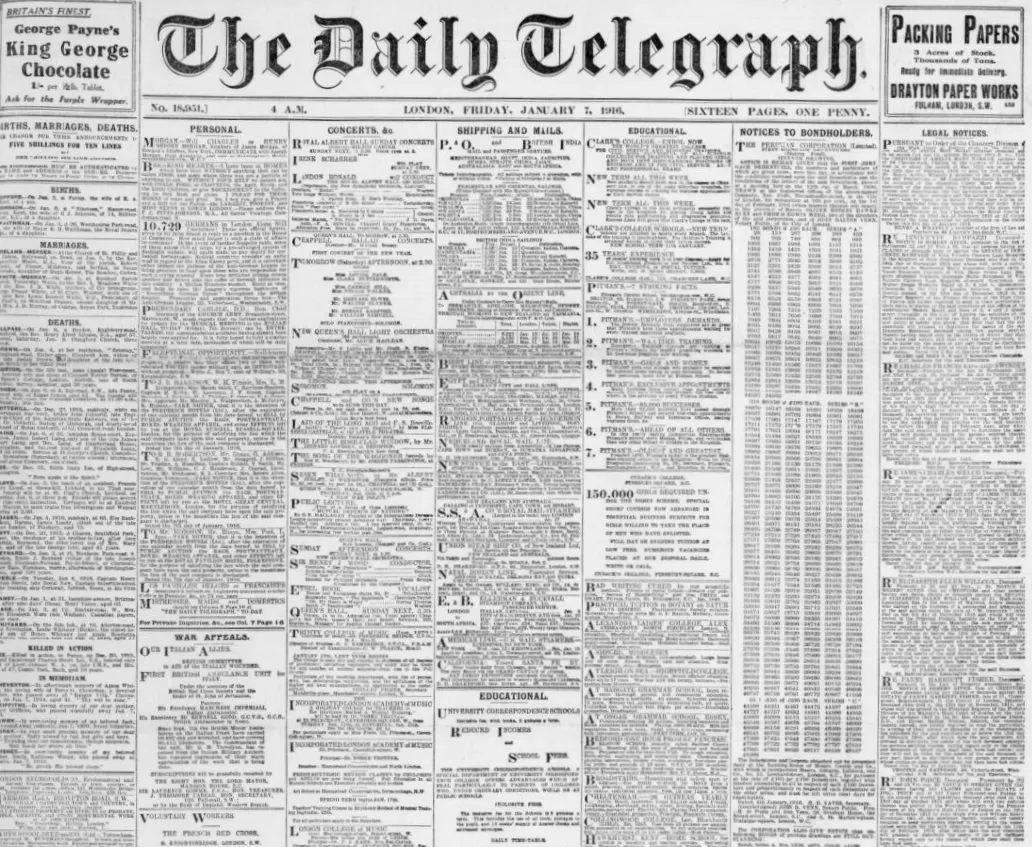
Now onto our updated titles, before we return to Sound Wave and look what was the pick of the record crop one hundred years ago, in April 1926. We’ve made significant updates to the Wakefield Express, with over 50,000 brand new pages joining its ranks, whilst over 40,000 brand new pages join London’sCommercial Daily List. You’re also sure to enjoy updates to iconic shipping title Lloyd’s List, and national favourite the Daily Telegraph, the latter of which sees nearly 50,000 brand new pages added this week.
Meanwhile, we’ve updated a duo of titles from the Republic of Ireland, namely the Dundalk Examiner and Louth Advertiser and the Roscommon Journal and Western Impartial Reporter. Our Scottish titles also see updates this week, with six being updated in all, including additions to the Kelso Chronicle, the Inverness Courier and the Fife Herald.
Sound Wave – record picks from 100 years ago
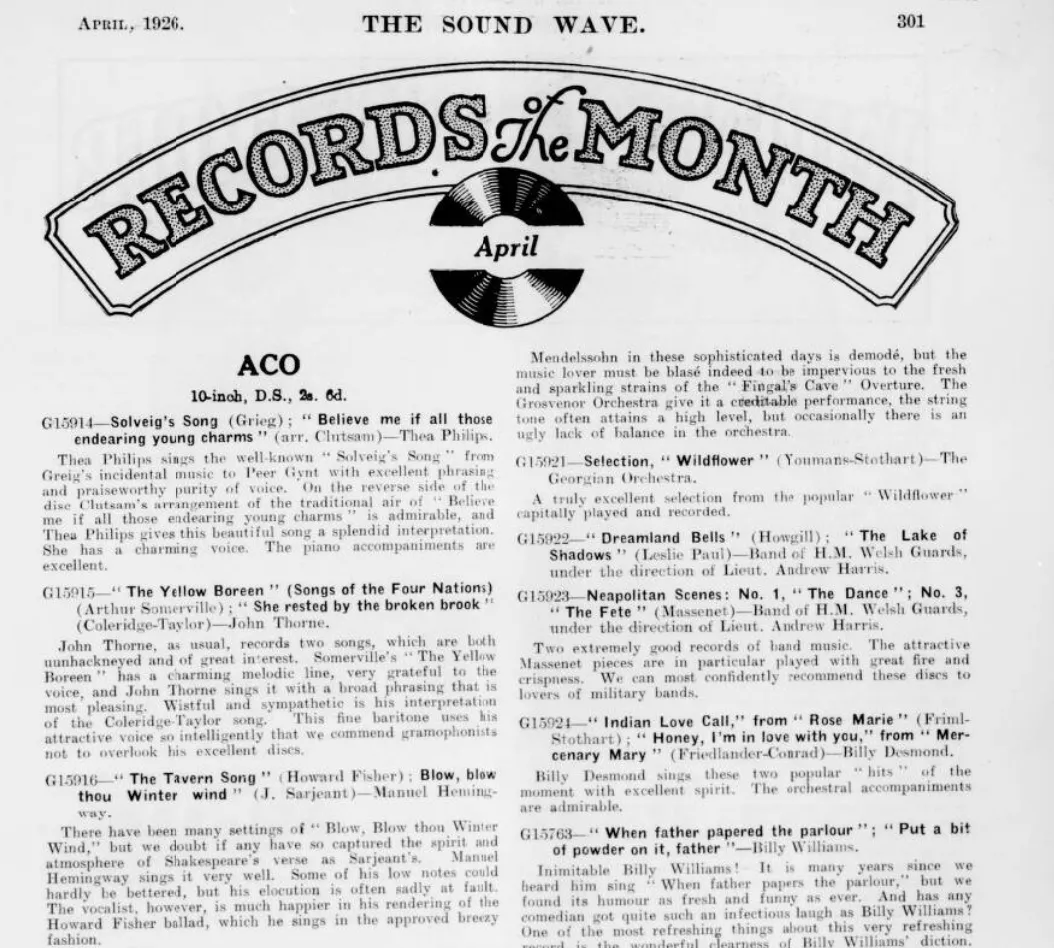
One of the recurring sections of Sound Wave was its ‘Records of the Month‘ page. From its early editions in the 1900s, through to the 1930s, this page selected picks from a range of different musical genres. We like to think of it as a kind of early Top of the Pops, or for our younger readers, the top ten in the charts.
And we thought it would be fun to look through Sound Wave’s ‘Records of the Month‘ picks for April 1926, 100 years ago. Not only does this page give us insight into what music was coming out at the time, it allows us to understand what was popular, and moreover, to learn what ordinary people might have been listening to at the time.
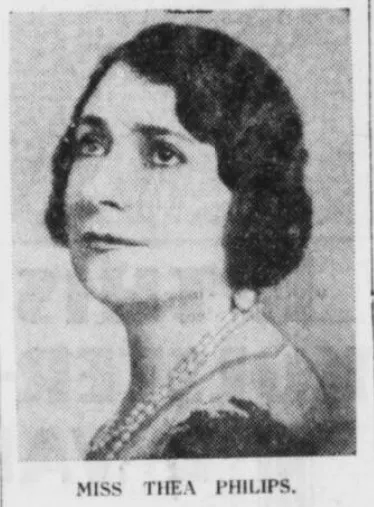
Let’s start with the first pick from Sound Wave. ‘Solveig’s Song,’ from Edvard Grieg’s incidental music to Peer Gynt, is the selection, and it is sung by English soprano Thea Philips. A piece of classical music, Sound Wave remarks how Philips sings the ‘well-known song’ with ‘excellent phrasing and praiseworthy purity of voice.’ On the other side is another Philips performance, Sound Wave praising her for her ‘charming voice.’
Sound Wave goes on to pick out a record by contemporary British composer Tony Fones. The title praises Fones’ ‘captivating arrangement’ of ‘Weymouth Chimes,’ and his ‘clever manipulation of syncopation’ in the appropriately named ‘Syncopated Moonbeams,’ which held the reviewer at Sound Wave for ‘just long enough to sustain our amusement and attention.’
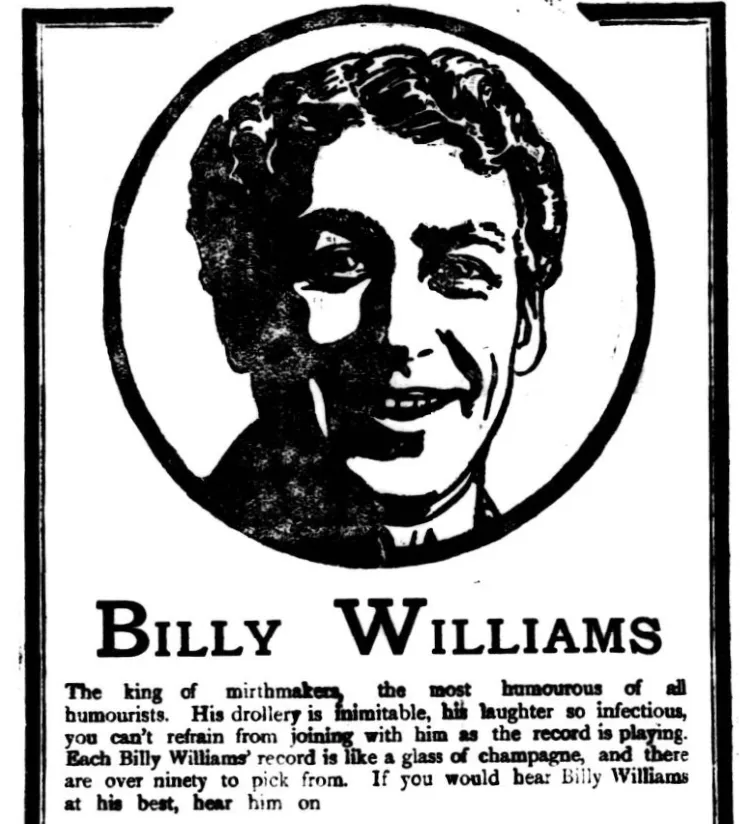
From classical pieces to experimental works, Sound Wave also featured records from the music hall tradition. One such record was ‘When father papered the parlour,’ also including ‘Put a bit of powder on it, father,’ by Billy Williams. Sound Wave remarks on this record:
Inimitable Billy Williams! It is many years since we heard him sing ‘When father papers the parlour,’ but we found its humour as fresh and funny as ever. And has any comedian got quite such an infectious laugh as Billy Williams? One of the most refreshing things about this very refreshing record is the wonderful clearness of Billy Williams’ diction. We had no doubt as to the meaning of any word he sang.
What is poignant about this review is that Billy Williams had passed away in 1915, some eleven years before. His voice, his ‘cleanness’ of diction, lived on through this record, which was clearly enjoyed by Sound Wave.
And what is remarkable about Sound Wave is the range of genres reviewed and appreciated. From the classicism embodied by Thea Phillips, to the experimentation of Tony Fones, to the lasting humour of Billy Williams, the newspaper takes in music in all forms, making it a wonderful repository for music historians.
New Titles
Title | Years Added |
1880-1881 | |
1883-1914 | |
1915-1966 | |
1869-1872, 1874-1886, 1889-1896 | |
1911-1939 | |
1851-1857 | |
1907-1933 |
Updated Titles
This week we have updated 28 of our existing titles.
You can learn more about each of the titles we add to every week by clicking on their names. On each paper’s title page, you can read a free sample issue, learn more about our current holdings, and our plans for digitisation.
Title | Years Added |
1904-1910, 1913-1917 | |
2003 | |
1908-1910, 1912-1943, 1951-1966 | |
1839, 1841-1868 | |
2000-2002 | |
2000, 2003 | |
1855-1868, 1916-1919 | |
1881-1883, 1885-1892, 1894-1901, 1916-1929 | |
1912-1918 | |
2002 | |
1996-2000 | |
1893-1896, 1898-1906 | |
1994 | |
1993-1994 | |
1985, 1995-1999 | |
1882 | |
1960-1964 | |
Liverpool Shipping Telegraph and Daily Commercial Advertiser | 1877-1879, 1881-1884 |
1914 | |
1986-1999 | |
1864-1872, 1875, 1879-1880, 1883-1884, 1886-1887, 1889, 1891-1892, 1894-1898, 1900-1912, 1916-1917 | |
1865-1925, 1927 | |
1913-1919 | |
1885-1902 | |
1986, 1988-1989, 1992-2004 | |
2001 | |
1996-2004 | |
1987-1989 |
You can keep up to date with all the latest additions by visiting the recently added page. You can even look ahead to see what we’re going to add tomorrow.
More on this topic:
Share this article
About the author

Rose Staveley-Wadham
Newspaper Licensing Manager
Published on Tue, 14 April 2026.