
Hot Off The Press – New Titles This Week
Published on 31 March 2026 by Molly Pearce
This week at The Archive, we’re stepping back in time to 1897, walking through the doors of Broadmoor Criminal Lunatic Asylum, thanks to an article featured in one of our fascinating new titles. We’ve been busy, welcoming six brand new titles, and sixteen updates to our pre-existing titles, leaving us with a total of 225,300 pages added this week.
Join us as we uncover a petty battle among East Anglian newspapers, dive into a pacifist paper created as an anti-war response to imperialist tensions, and reveal the daily activities of inmates at Broadmoor Asylum from almost 130 years ago.
Register now and explore The Archive
The Golden Penny
The first of our new titles now available on The Archive is the fascinating Golden Penny. This illustrated paper, based in London, was published every Saturday. On the cover of an issue from 23 January 1897, this title professed to cover stories of ‘adventures, yarns, sport, humour, travels, inventions, dress, cookery, health, garden & useful hints.’ Each page of The Golden Penny featured a detailed illustration, and was breaming with information on events occurring within, and far outside of, London.
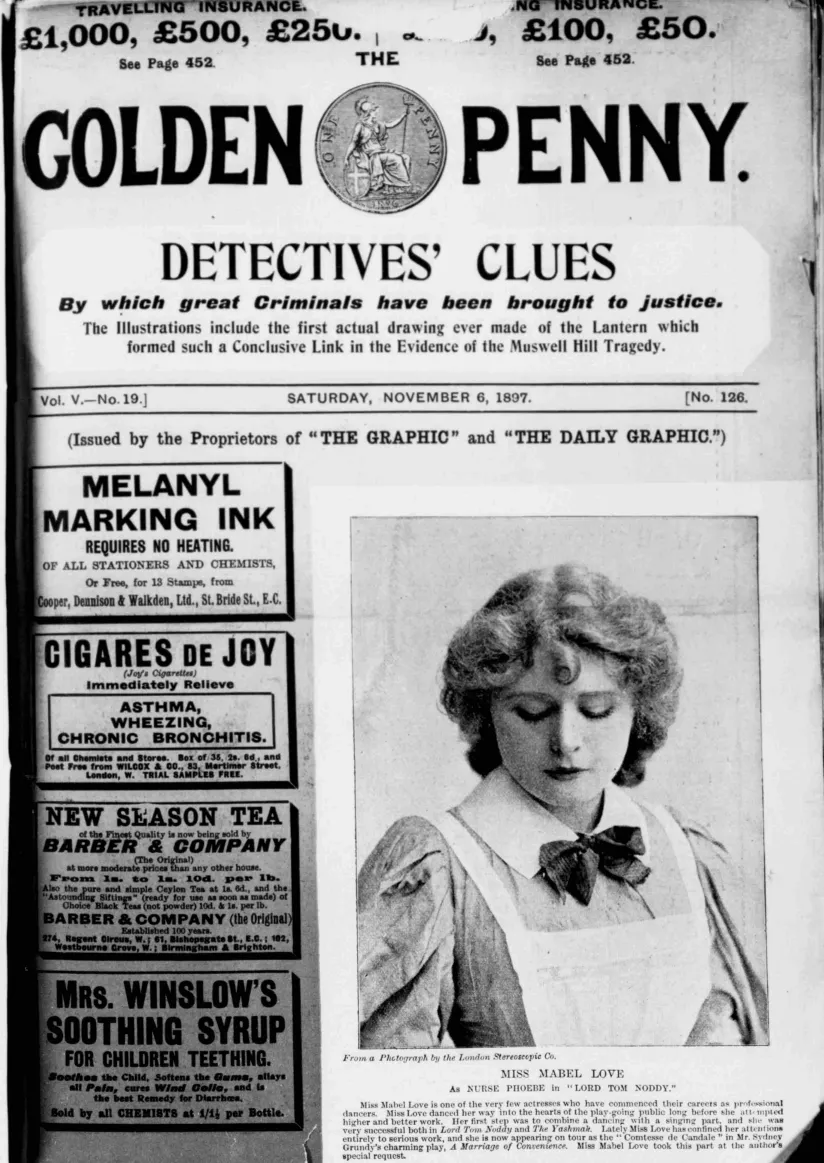
Golden Penny | 06 November 1897
Each issue was centred around a theme for that week, and featured a captivating heading aimed at drawing its readers in. Alongside this, The Golden Penny contained several advertisements, and every publication included a short piece of literature. Furthermore, many of its issues featured creative Bovril promotions, including this one from 07 November 1896, which centred around female cyclists.
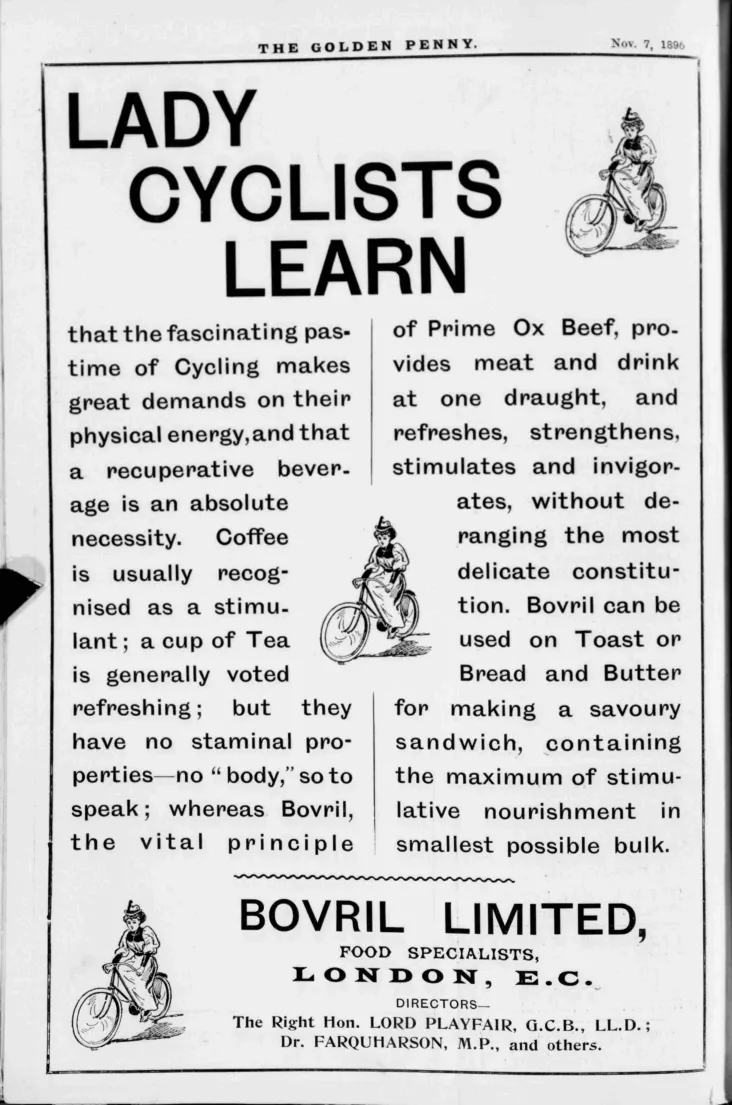
Golden Penny | 07 November 1896
Hythe Reporter
Next, we’re discussing the Hythe Reporter. This title was founded and edited by Mr Edward Palmer, and was financially backed by his family to assist its survival. It incorporated The Folkestone Visitors’ List, The Folkestone News, and Hythe and Sandgate Echo. The Hythe Reporter cost one penny and was released to its readers every Saturday. Each publication was short and sweet, containing local news and events occurring within the south-east English market town.
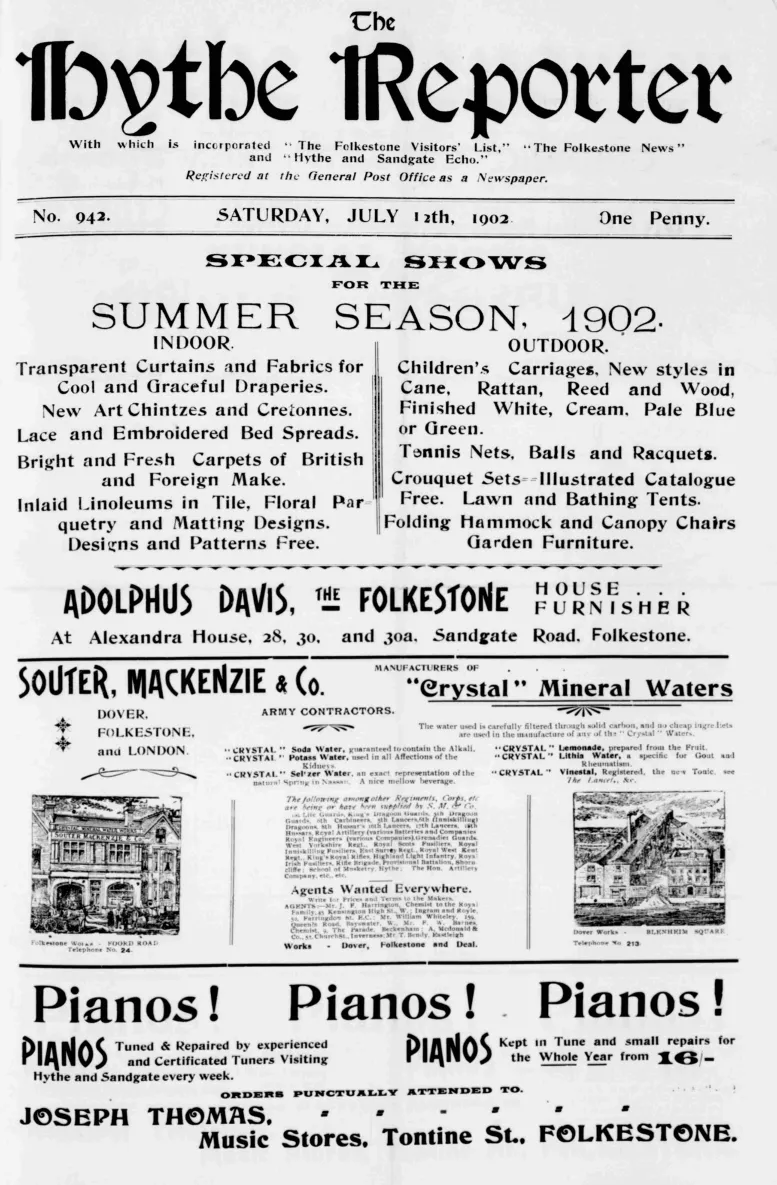
The Old English word, ‘Hythe’, meaning ‘haven’ or ‘landing place’, is reflected in the simplicity and efficiency of its newspaper. This title continued to be published until the restrictions of the Second World War led to an inevitable cease in production.
Moonraker
We remain in the East of England with our third new title this week, as we dive into the somewhat mysterious Moonraker. Based in Ipswich and purporting to incorporate the Essex Calf and the Norfolk Dumpling, this title has us questioning if its associated titles were nothing more than a humorous jibe at other local papers. Published every Tuesday and costing one penny, Moonraker contained poetry, chess advice, and interviews. The tone of this paper borders on ironic with a conversational style and comical headlines.
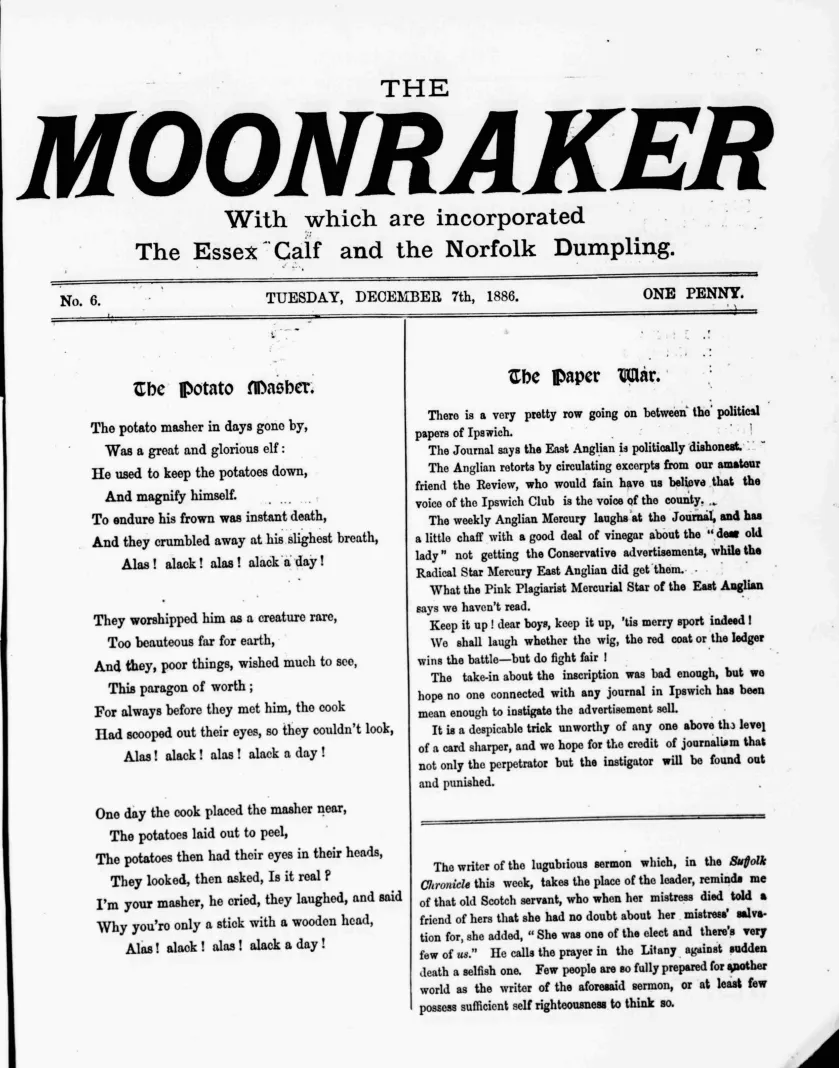
This issue from 07 December features a piece entitled, ‘The Paper War’, reprimanding the ‘petty’ political discourse occurring between several Ipswich newspapers at the time. Each title refused to let their rival paper speak for the county as a whole, and a long-standing moral battle ensued. Moonraker mocked this conflict, distancing themselves from any political affiliation;
Keep it up! dear boys, keep it up, ’tis a merry sport indeed! We shall laugh whether the wig. the red coat, or the ledger wins the battle – but do fight fair!
The paper continued to ridicule the ‘self righteousness’ of East Anglian papers, and frequently criticised the quality of writing or opinion in papers, such as the Suffolk Chronicle, while emphasising the ‘marvellous good taste’ of the East Anglian.
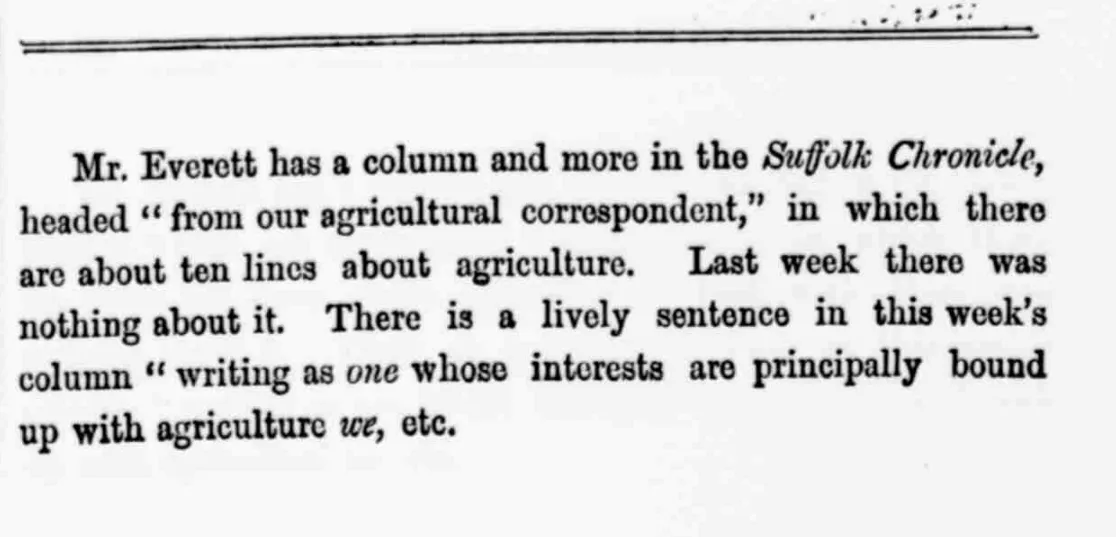
Record
The Record was based in London and began by publishing on Monday, Wednesday, and Friday evenings – although by 1900, this had changed to every Friday. It covered both religious and royal news, as well as foreign affairs.
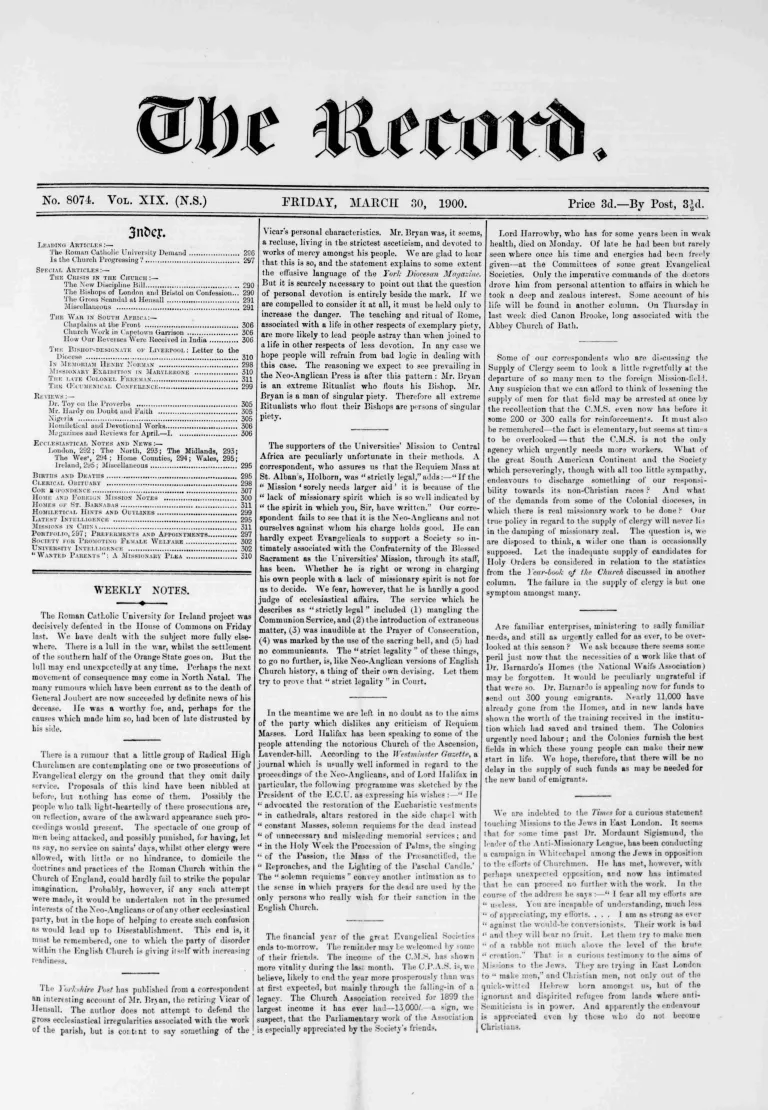
The Record developed a focus on religion and royal business as the years went on. Many of its issues delivered information on ecclesiastical proceedings and the political affairs of Queen Victoria. Overflowing with text, the Record left no room for blank space on its pages.
War Against War
Moving on from royal affairs, we arrive at our next title, War Against War. Established in January 1899 as a weekly paper, it was published by prominent London-based publisher, Horace Marshall and Son. This title began as an anti-war response to the Boer War and it’s aim was to starkly oppose the pro-war sentiment echoed in numerous other British newspapers of the time. War Against War acted as an organ for spreading anti-war beliefs, endeavouring to oppose rising imperialist tensions at the turn of the century.
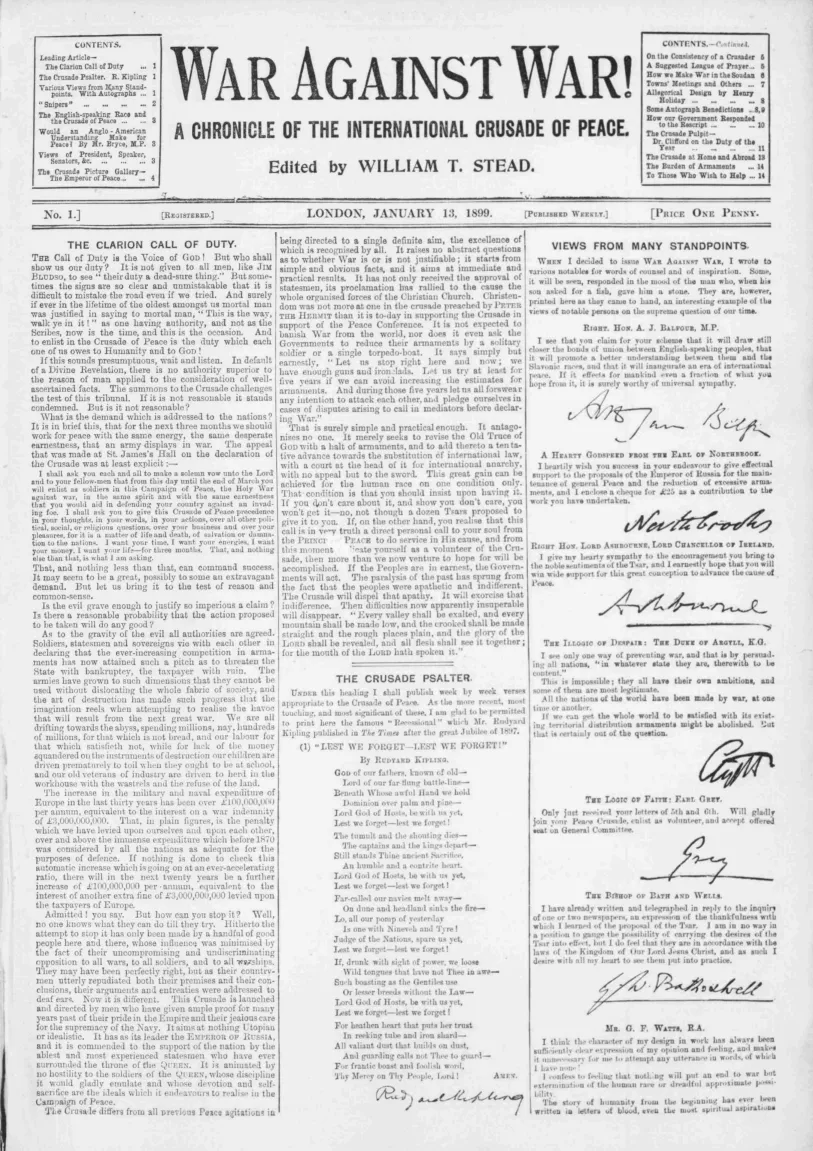
War Against War | 13 January 1899
This title was founded and edited by journalist and reformer, William T. Stead. Stead was a controversial figure, pioneering new journalistic techniques that remoulded traditional newspaper compositions and turned them into counter-attack weapons. This style of journalism did not overlook contentious or taboo subjects, rather facing them head on and with confidence. War Against War was not afraid of making bold political statements with the intention of preaching the Peace Crusade, following Stead’s visit to the Tsar in 1898.
Stead continued to pioneer adventurous techniques in journalism, advocating for political and social change, for the rest of his life. He would die in the sinking of the RMS Titanic on 15 April 1912, while on route to take part in a peace congress at Carnegie Hall.
In many of its issues, War Against War contained a page dedicated to sharing the lives of influential figures who support the anti-war sentiment preached in the paper. This page was usually biographical, detailing the spiritual or political journey of each individual and how their beliefs support those of Stead’s War Against War. However, in an issue dated 24 February 1899, this page contained a feature that looked slightly different from the rest;

War Against War | 24 February 1899
This week’s influential figure was distinguished author Leo Tolstoy, and instead of containing a biographical work, it instead featured passages written by Tolstoy himself about his own call to spiritualism.
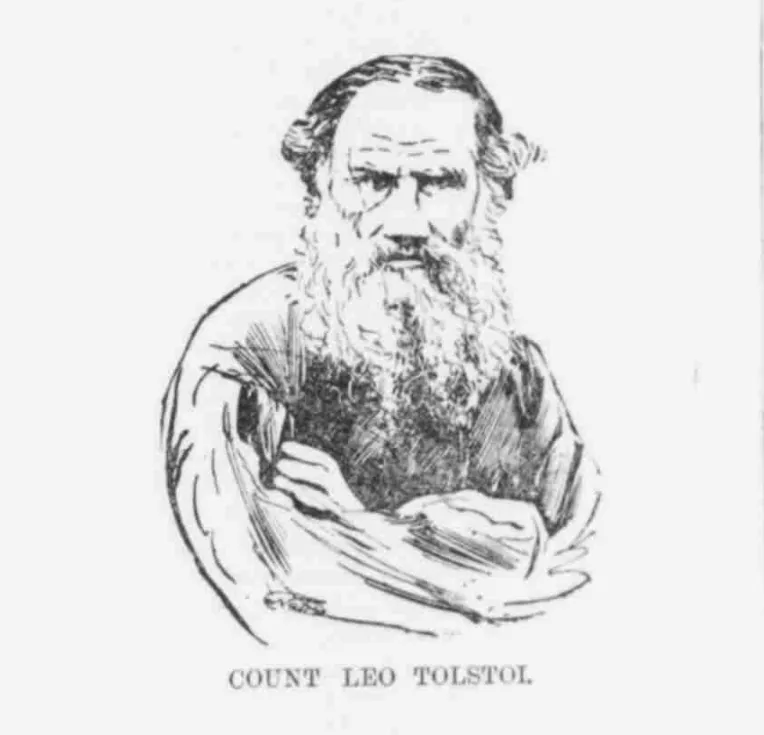
Illustration of Leo Tolstoy in War Against War | 24 February 1899
War Against War contained many pioneering journalistic techniques that sought to leave its mark on anti-war activism at the turn of the century. The title had many supporters, and shared its beliefs with several highly influential figures.
Westminster Mail
Last on our list of new titles for this week is the Westminster Mail. Costing one penny, this title was made available to its loyal readers every Saturday. Primarily covering West London, this paper contained several local advertisements, business proceedings, election details, and international affairs.
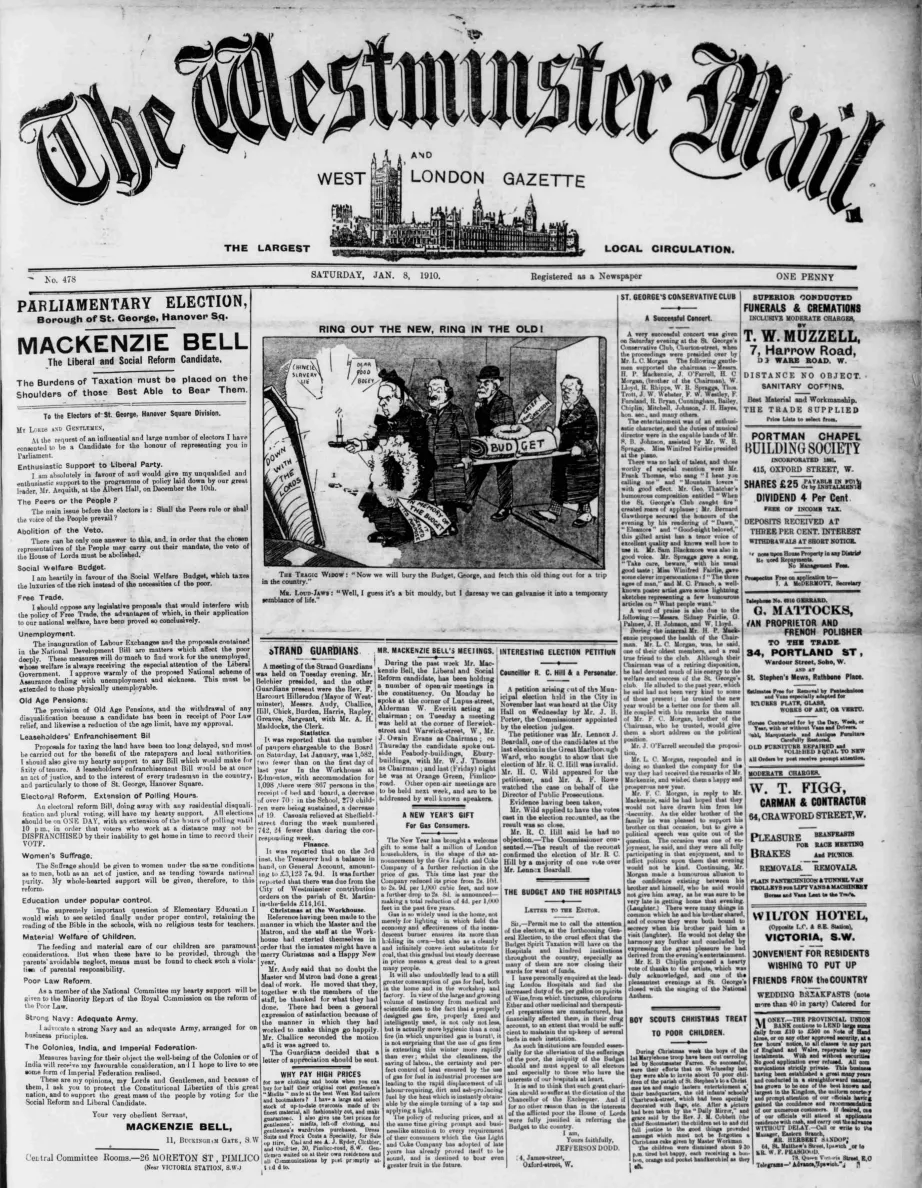
Westminster Mail | 08 January 1910
Notably, in 1918 this title changed its outlook on advertisements, with the top left-hand corner of each page featuring a text box containing the sentence, ‘Westminster Mail refuses all advertisements’. During this year, the page count reduced to four, and it focused much more on reporting international proceedings. Additionally, this title had, ‘circulation larger than any other paper’, making it an extremely popular choice for London-based readers during the war.
Our Updated Titles
We’ve been very busy updating sixteen of our pre-existing titles on The Archive. Taking the helm this week is Glasgow’s Sunday Mail, with a hefty 39,612 pages now available for you to devour. Some other notable mentions are the East Suffolk Gazette with 23,494 pages added, and Lloyd’s List coming in at third place with 21,104 pages.
Additionally, we’ve added pages from 1929 of one of our favourite titles, the People’s Friend. Alongside this, you can find updates for the Glasgow Herald, the Suffolk Chronicle, and the Freeman’s Journal. So whether you’re interested in news from East Anglia, or from across the water in Dublin, you’ve got plenty to choose from in this week’s updated titles.
A Visit to Broadmoor Asylum
While looking into one of our exciting new titles this week, The Golden Penny, we came across a gripping headline in an issue from 09 October 1897. Broadmoor Hospital, or Broadmoor Criminal Lunatic Asylum as it was originally known, has housed a large number of inmates since its establishment in 1863. Some of the hospital’s more infamous inmates include one half of the Kray twins, Ronnie Kray, as well as Charles Bronson and Peter Sutcliffe (otherwise known as The Yorkshire Ripper).
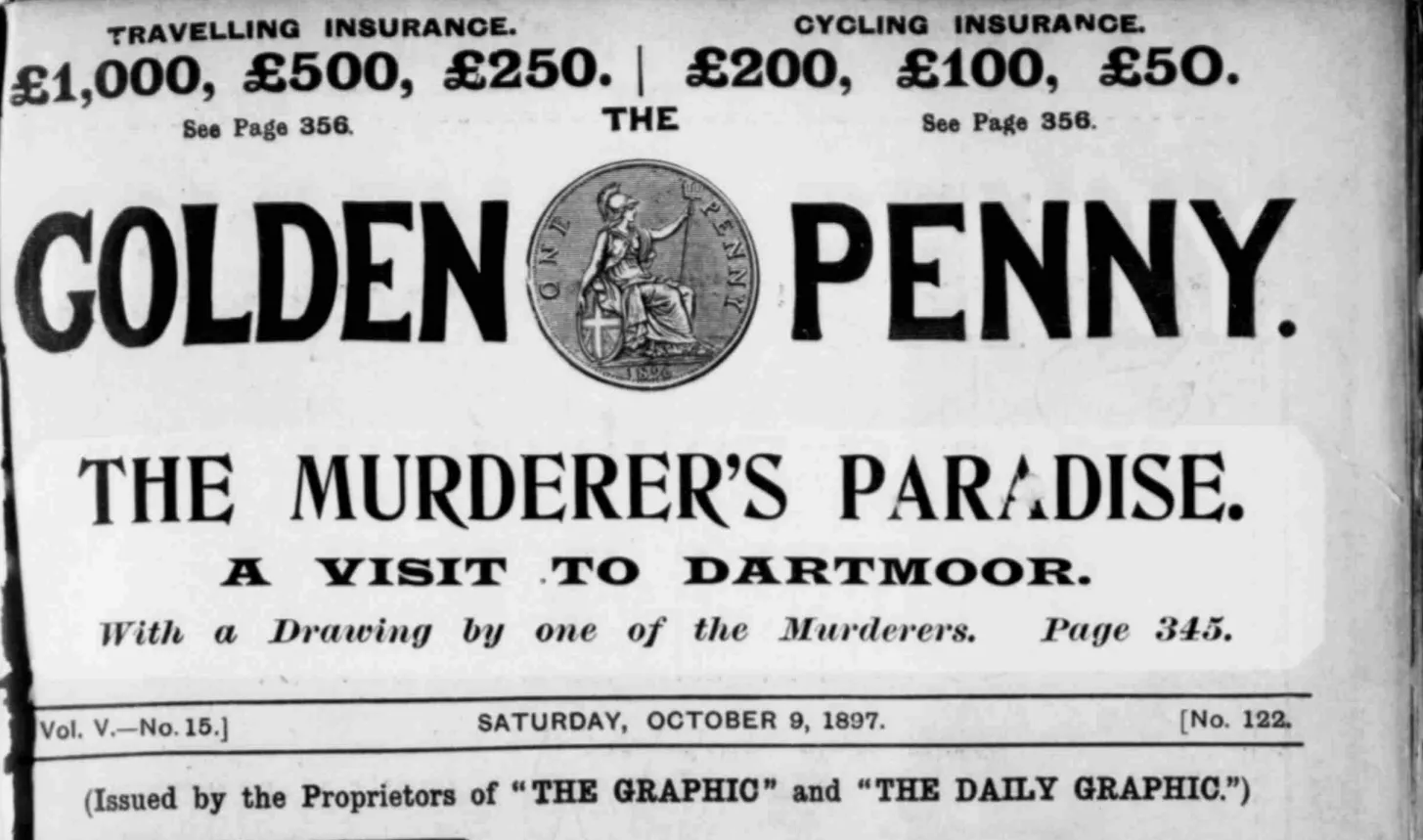
The Golden Penny | 09 October 1897
The article from The Golden Penny begins by stating the author’s intention prior to his visit to Broadmoor;
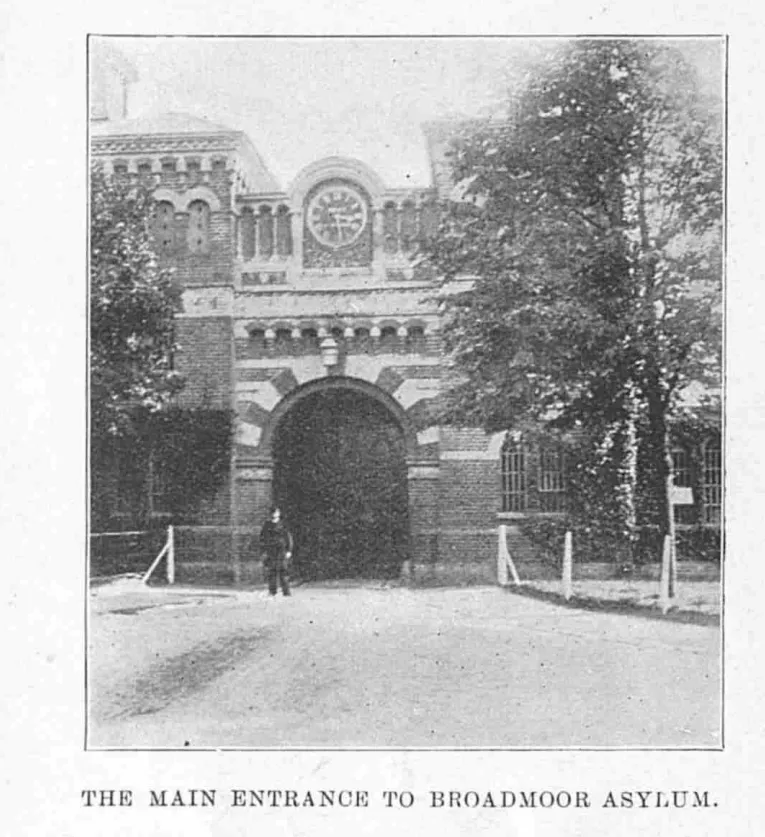
The article reports on the 350 male inmates residing in the hospital at the time. He refers to these individuals as ‘men of all classes’, continuing on to state;
Some have received their education at the great universities, and have moved in the highest society; many have occupied honourable positions in art, science, literature, law, commerce, in Her Majesty’s service, and even in the Church. In a moment of temporary aberration of intellect they have murdered, or attempted to murder. some fellow-creature, and for the majority there is no hope of release.
The author then proceeds to recount his experience as a ‘prisoner for a couple of hours’, writing of his interactions with the institution and its occupants. He praises the surroundings, stating that each prisoner is at liberty to do whatever he pleases at any given time, after he takes his morning walk.
The fashion at Broadmoor is vast, he writes, commenting on the variety of clothing choices among the prisoners. According to this report, individualism is not only respected, but openly encouraged. Each prisoner has his own private room, furnished and liveable, with high standards of cleanliness.
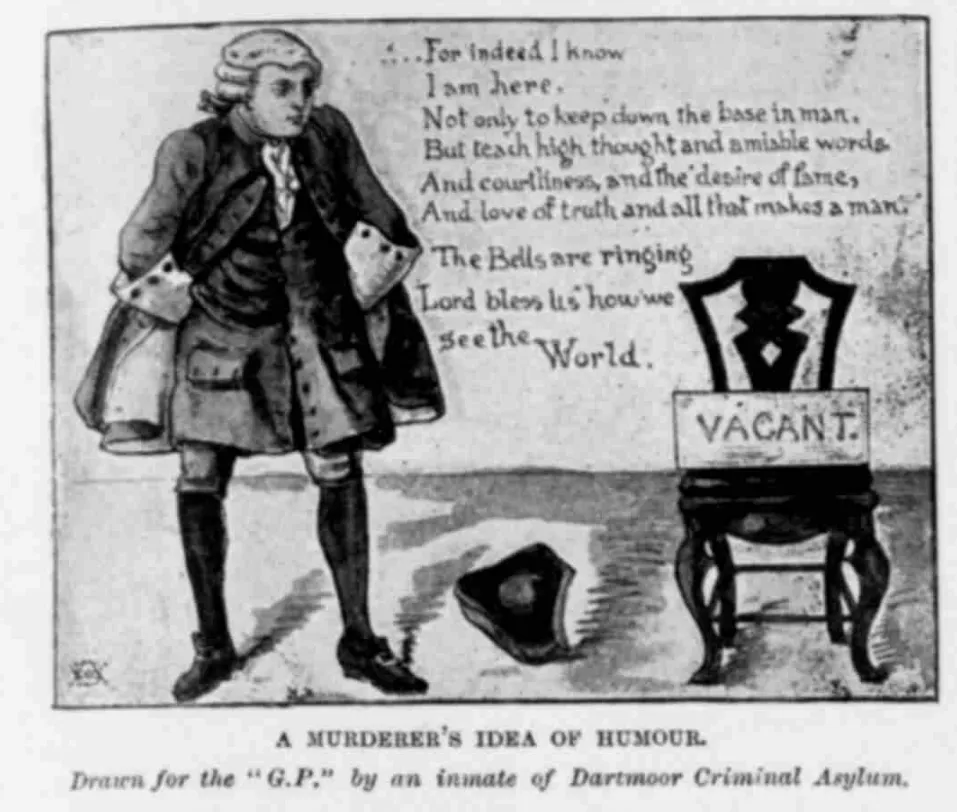
The Golden Penny | 09 October 1897
Interestingly, he comments that the prisoners ‘are for the greater part of their time as sane as any man walking the streets of London.’, and he did not pick up ‘the faintest evidence of mental derangement’ since these men committed their horrendous crimes. At various points throughout his visit, the representative for The Golden Penny found it difficult to determine who exactly was a patient and who was not.
The above sketch was sent to the author after his visit to Broadmoor. It features the illustration of a male figure, and was sent on the back of a postcard. The man is unnamed, and the meaning of the sketch is up to interpretation.
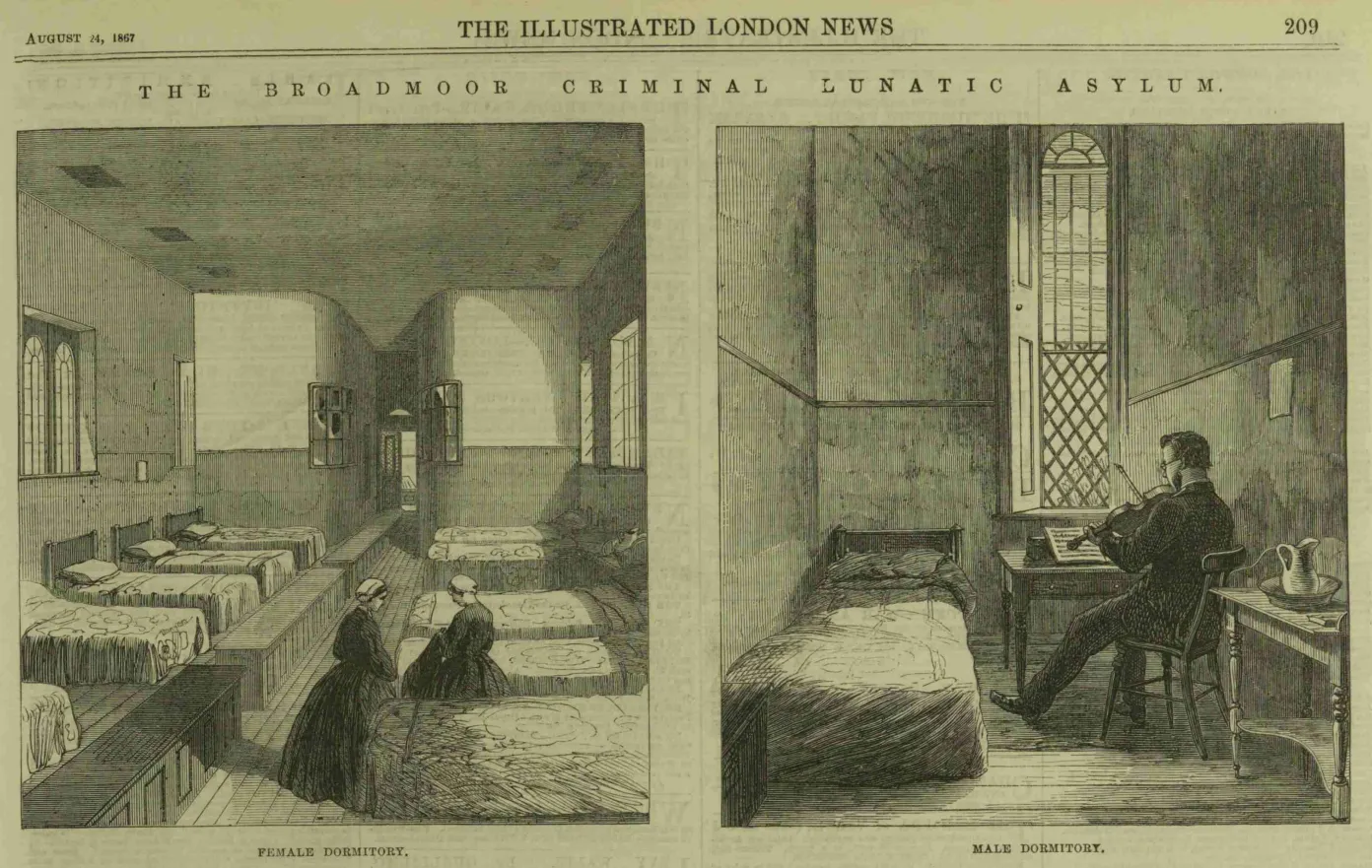
Illustrated London News | 24 August 1867
The 160 female inmates housed in the hospital are also briefly mentioned in the article. The author praises their treatment in the same way he does the male inmates. According to our writer, they ‘sew, crochet, knit, or do nothing at all.’
This portrayal of Broadmoor Criminal Lunatic Asylum paints a very different picture to other asylums we may have heard of. From his description, it would appear that Broadmoor focused on creating safety, security, and a harbouring of creativity and autonomy, rather than on strict routines and the suppressive medicalisation of insanity.
Discover more on the history of Broadmoor Hospital, uncover Leo Tolstoy’s call to spiritualism, or delve into the ironic issues of the comical Moonraker, in the pages of The Archive today.
New Titles
Title | Years Added |
1896-1903 | |
1900-1917, 1923-1924, 1929-1938 | |
1886 | |
1877-1880, 1900-1919 | |
1899 | |
1900-1918 |
Updated Titles
Title | Years Added |
1858, 1860-1868, 1871-1876, 1878-1888, 1890-1894, 1898-1925 | |
1918-1919 | |
1763-1765, 1771, 1775 | |
1909, 1917 | |
1918 | |
1900, 1965 | |
1915-1919 | |
1951-1966 | |
1919 | |
1929 | |
1924-1926, 1965-1966 | |
1890-1892 | |
1822-1823, 1873-1897, 1899-1911, 1913-1950, 1952-1965 | |
1986-1987, 1991, 1993-1999 | |
2002-2003 | |
1958-1966 |
You can keep up to date with all the latest additions by visiting the recently added page. You can even look ahead to see what we’re going to add tomorrow.
More on this topic:
Share this article
About the author

Molly Pearce
Data Operations Executive
Published on Tue, 31 March 2026.