
Hot Off The Press – New Titles This Week
Published on 16 June 2025 by Rose Staveley-Wadham
This week at The Archive we’re exploring the traditions surrounding Midsummer Eve and Midsummer Day, as we welcome a trio of brand new newspapers to our holdings. Furthermore, we’re delighted to be welcoming 151,872 brand new pages in all this week, whilst we have updated fourteen of our existing titles from across the United Kingdom and Ireland.
So read on to discover more about our new and updated newspapers this week, and also to learn more about the history of Midsummer Eve celebrations.
Register now and explore the Archive
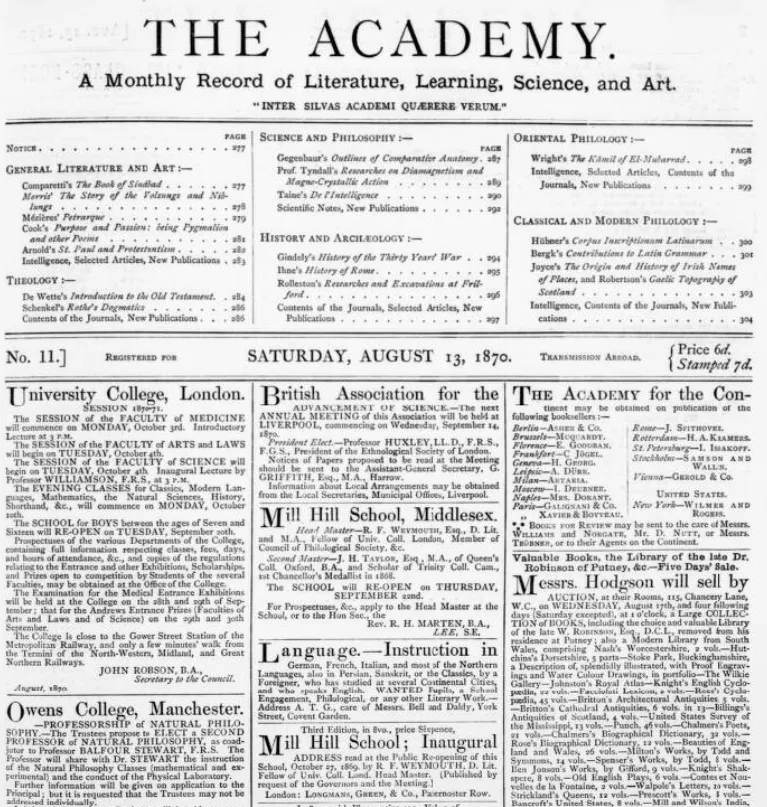
The Academy
But before we take a look at some Midsummer Eve traditions, let’s explore the first of our trio of new newspapers this week, Academy. First published on 9 October 1869 as a ‘Monthly Record of Literature, Learning, Science, And Art,’ this periodical was founded by Oxford don and entrepreneur Charles Appleton (1841-1879).
Appleton’s new venture was published with the Latin motto ‘Inter sylvas academi quaerere verum,’ which is a quote from Horace’s Epistles and translates as ‘And seek for truth in the groves of Academus.’ Indeed, Appleton’s aim was to form an ‘intellectual and cultural revival in the German style’ through the pages of Academy, which published reviews of works on a range of topics.
At the cost of six pence, readers could discover reviews and articles on literature, the arts, Biblical studies, science, philosophy, history, geography, philology and classical literature. Reviews were spread across two columns, and contributors included the likes of poet and author Edmund Gosse (1849-1928), literary critic and historian George Saintsbury (1845-1933) and philosopher and economist Henry Sidgwick (1838-1900).
By 1871 Academy had moved to a semi-monthly publication pattern, whilst from 1874 onwards the title became weekly.
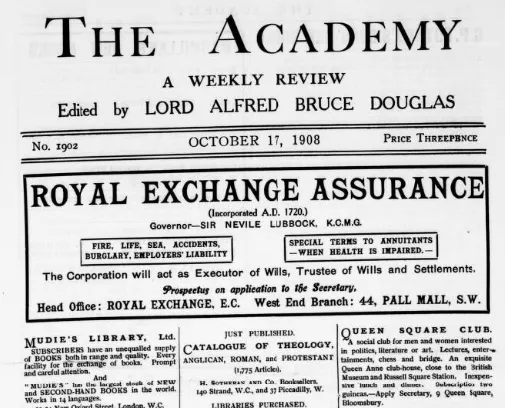
In 1896 Academy was purchased by American businessman John Morgan Richards (1841-1918), under whose ownership the title began to publish lighter fare, and was known as ‘A Weekly Review of Literature and Life.’ During Richards’s tenure Academy was merged with the periodical Literature in January 1902 to become The Academy and Literature, although this change was short lived and the publication reverted to its original title in 1905.
Another feature of Richards’s tenure was the high turnover of Academy editors. Perhaps its most well-known editor was Lord Alfred Douglas (1870-1945), of Oscar Wilde fame, who held the position from 1907 to 1910. Under Douglas’s editorship the politics of Academy shifted from Liberal to Conservative, whilst in 1915 the title closed for good.
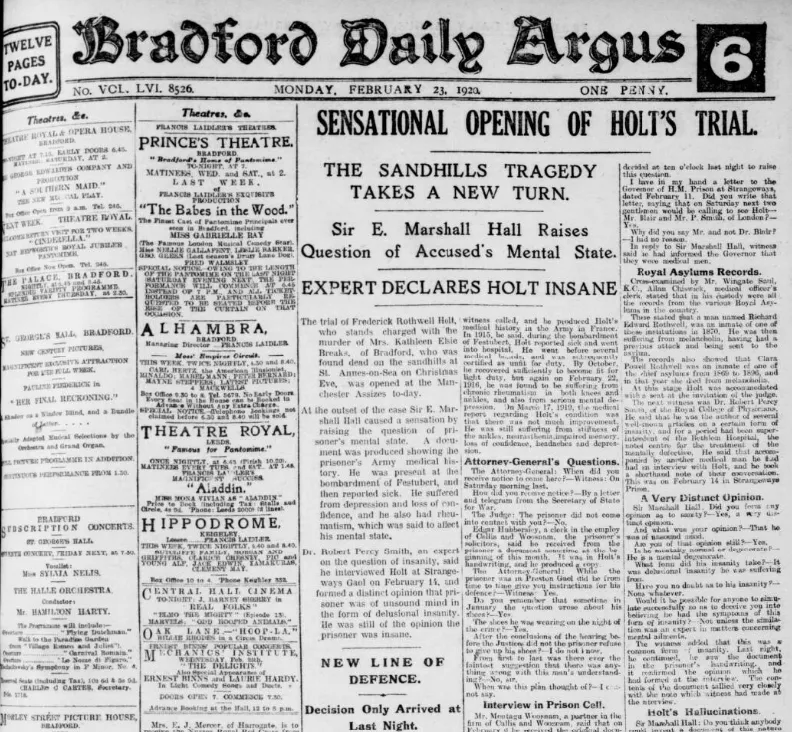
The Bradford Daily Argus
Our next new title of the week is the Bradford Daily Argus, which was established in the West Yorkshire city of Bradford in 1892. Costing just one halfpenny, and filling four pages, this title presented a mix of local, national, and international news.
Indeed, the pages of the Bradford Daily Argus featured sections entitled ‘Inland Wires’ and ‘Special Cables,’ which showcased the latest news, as well as a column called ‘Chat from the Capital.’ The newspaper covered news from the trade and finance sectors, whilst it also reported on ‘sport and play,’ with a particular focus on football, and ‘football gossip.’
Meanwhile, serialised fiction and news from the ‘labour world’ also found a home within the Bradford Daily Argus.
In 1923 the newspaper became known as the Yorkshire Evening Argus, and then in 1926 it merged with the Bradford Daily Telegraph to become the Bradford Telegraph and Argus, before becoming simply the Telegraph and Argus in 1930.
The Largs & Millport Herald
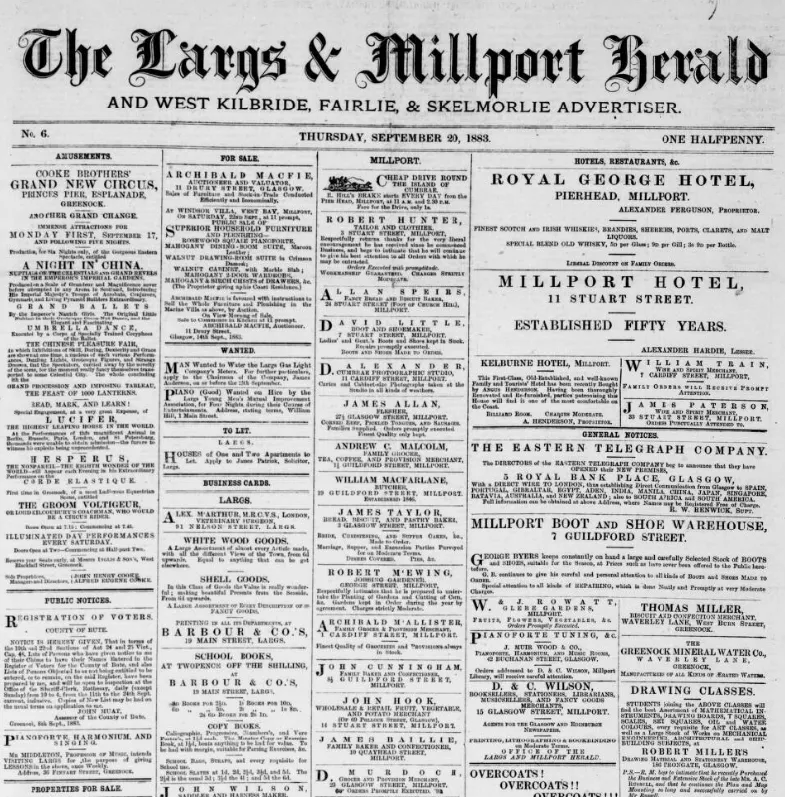
Our final new title of the week is a Scottish one, and it is the Largs & Millport Herald. The Largs & Millport Herald was first published on 16 August 1883 as the Largs & Millport Herald and West Kilbride, Fairlie, & Skelmorlie Advertiser in the seaside resort town of Largs, which sits on the Firth of Clyde.
The new newspaper, which appeared every Thursday, again at the modest cost of one halfpenny, would be ‘open to the free discussion of subjects of local or general importance.’ Meanwhile, the Largs & Millport Herald aimed to ‘report accurately and carefully all meetings and events of local and public importance in the districts in which the journal is to be circulated.’
Indeed, the Largs & Millport Herald was an incredibly local focussed paper, featuring paragraphs of local news across its four pages. It printed the latest from the Largs School Board, the meetings of the Police Commissioners, the Burgh Police Court, with news from the likes of Millport, Fairlie, Wemyss Bay, Skelmorlie and Dunoon featured in its pages.
With Largs being a popular resort town, the Largs & Millport Herald provided visitors’ lists, with names of those staying at the hotels in the area. The paper also catered to a range of interests, with columns devoted to yachting and to ornithology.
Our Updated Titles
Before moving on to look at some Midsummer Eve traditions, we wanted to highlight some of our updated titles of the week. For those with an interest in military and naval history, we’ve added new pages to the Aldershot Military Gazette, the Naval & Military Record and Royal Dockyards Gazette, and the Portsmouth Times and Naval Gazette.
Meanwhile, we’ve updated two of our Scottish titles, namely the Fifeshire Advertiser and the Shetland Times, whilst this week also sees new pages join County Tipperary title the Midland Counties Advertiser.
Curious Midsummer Eve Customs and Festivals
With both the Summer Solstice and Midsummer Day coming up, the Summer Solstice being on the 21 June and Midsummer Day being on the 24 June, we wanted to delve into the customs and celebrations that mark the midpoint of the year. We were delighted, therefore, when we found in the pages of our new title Academy, in an article published on 12 June 1909 entitled ‘June,’ descriptions of such traditions.
The Academy piece observes how ‘for many ages the worship of the sun lingered in curious customs and festivals held on Midsummer Eve, especially in the country districts.’ Note here how it is Midsummer Eve, the day before Midsummer Day, that is celebrated.
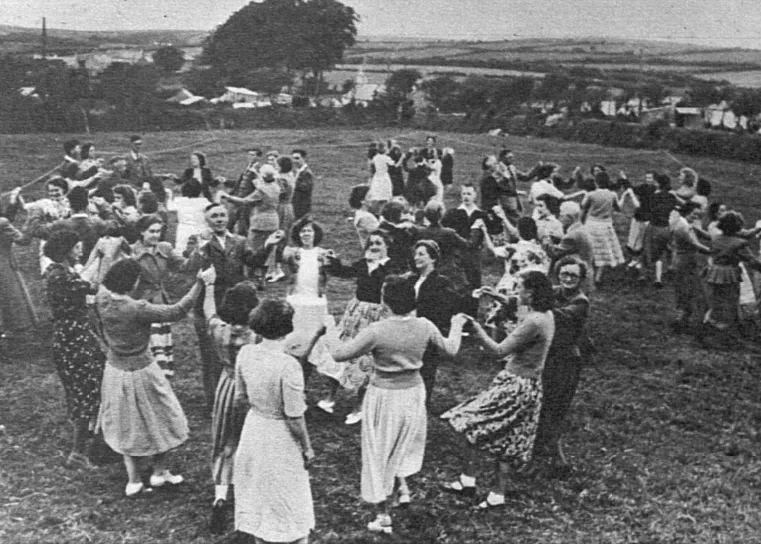
Such curious customs and festivals could be found, according to Academy, in Cornwall, where ‘promenaders used to carry lighted torches from village to village, perhaps a reminiscence of Druidical rites,’ and also in Ireland, ‘where as late as 1782 fires were lit ‘in honour of the sun,’ with accompaniments of solemn dances.’
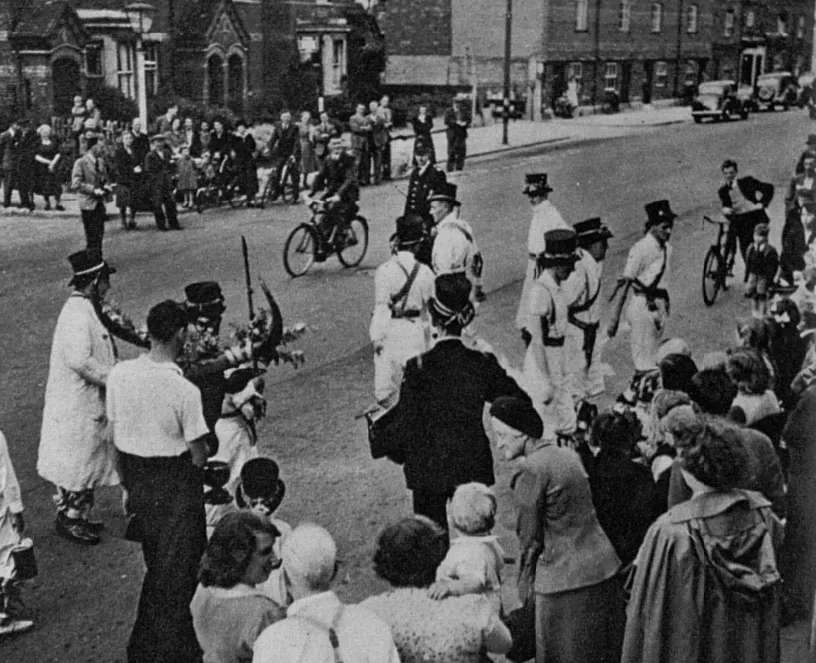
Elsewhere, in the likes of Chester and Nottingham, Academy speaks of masques and Morris dancing being used to ‘keep up this festival’ of Midsummer Eve. Meanwhile, in Somerset, ‘on the Saturday before Old Midsummer Day, allotments were chosen by means of apples marked with the number of corresponding pieces of land.’
But how was Midsummer Eve celebrated in the capital? Academy tells of how:
Midsummer Eve used to be celebrated in London by the lighting of bonfires, and in olden times a procession of the ‘watch’ passed through the principle streets, ‘To wit,’ says Stow, ‘from the little conduit by Paul’s gate, through West Cheape, and by the Stocks, through Cornehill, by Leadenhall to Aldgate, then backe down Fen-church Street, by Grasse-church, about Grasse-church conduit, and up Grasse-church Street into Cornhill, and through to West Cheape again.‘
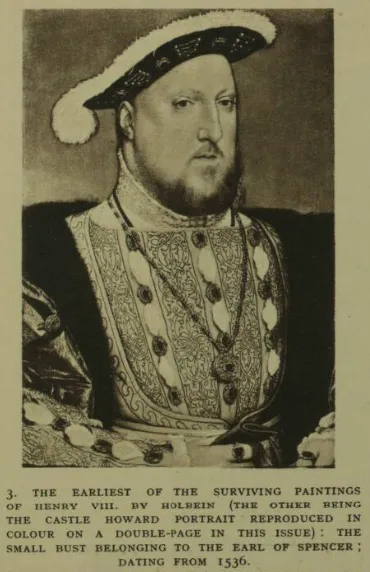
Indeed, Academy relates how this Midsummer Eve celebration was an ‘extensive – and expensive – affair,’ with ‘some thousands’ of people taking part in the procession. The paper also claims how a young King Henry VIII came, incognito, to watch the parade:
…in 1510, King Henry VIII came ‘to the King’s-head, in Cheap, in the livery of a yeoman of the guard, with a halbert on his shoulder, and there, in disguise, beheld the watch till it had passed, and was so gratified with the show that on St. Peter’s night next following he and the Queen came royally riding to the sayd place, and there, with the nobles, beheld the watch of the city, and returned in the morning.’
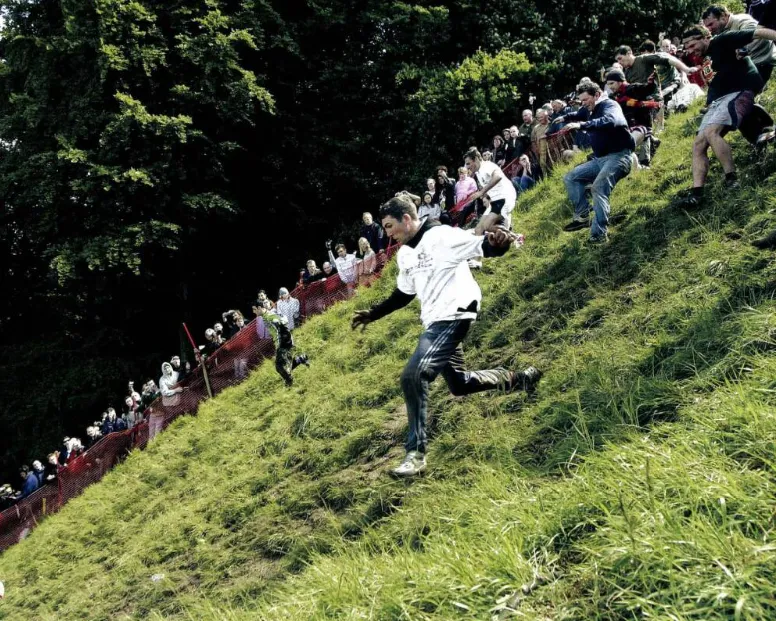
Academy furthermore ties the ‘delightful old ceremony of ‘cheese-rolling’’ to Midsummer Eve celebrations. Held at Cooper’s Hill, Gloucestershire, on Whit Monday, which generally falls in June, Academy describes how:
On the summit of the hill, a steep spur of the Cotswolds, covered with turf and surrounded by lovely woods, are booths and shows and all the paraphernalia of a country fair – albeit quite orderly. At a certain hour of the afternoon the younger folk line up on each side, from the bottom of the hill to half-way up, and small round cheeses are rolled from the top. They fly down at tremendous speed, glancing from inequalities in the ground, often bursting in many fragments over the roofs of two or three little cottages which are clustered below. The boy who captures one is entitled, we believe, to a small reward.
Academy labels this event as ‘one of the quaintest sights imaginable,’ and it still delights worldwide audiences to this day.
To discover more about Midsummer Eve traditions, head to our special blog, or delve into the pages of our newspapers today.
New Titles
Title | Years Added |
1869-1915 | |
1893-1894, 1898-1902, 1905-1908, 1910, 1912-1914, 1920-1923 | |
1883-1884 |
Updated Titles
This week we have updated fourteen of our existing titles.
You can learn more about each of the titles we add to every week by clicking on their names. On each paper’s title page, you can read a free sample issue, learn more about our current holdings, and our plans for digitisation.
Title | Years Added |
1891-1917, 1919 | |
1876 | |
1912, 1951 | |
1910, 1950 | |
1872, 1874, 1889 | |
1898, 1912 | |
1931-1933, 1940-1945 | |
1873 | |
1952 | |
1904-1907, 1909, 1911-1914, 1939, 1950 | |
1900, 1916-1927, 1947-1948 | |
1914, 1921 | |
1872-1896 | |
1980-1985 |
You can keep up to date with all the latest additions by visiting the recently added page. You can even look ahead to see what we’re going to add tomorrow.
More on this topic:
Share this article
About the author

Rose Staveley-Wadham
Newspaper Licensing Manager
Published on Mon, 16 June 2025.