
Hot Off The Press – New Titles This Week
Published on 28 April 2026 by Molly Pearce
This week at The Archive, we’re rewinding the clocks and stepping into the heart of the Industrial Revolution with our five brand new titles. From the rise and fall of Chartism, to the inception of the modern Co-operative Movement, this week’s pages present a tale told primarily from the worker’s perspective.
We’ve added 340,466 brand new pages in total this week, and with updates to a noble twenty-one of our pre-existing titles, there’s plenty to explore. One of these updates pertains to the esteemed Bookseller, as we edge ever closer to completing coverage of the years 1858-2008, with almost 440,000 pages in total for this cherished title.
Register now and explore The Archive
English Chartist Circular
First on our list of new titles this week is the gripping English Chartist Circular. Founded as a political organ, this title reflected the ideology of the rising Chartism movement, which proliferated across the United Kingdom from 1838 to 1857. This title cost one penny per issue, and was published to fellow Chartists every Saturday.
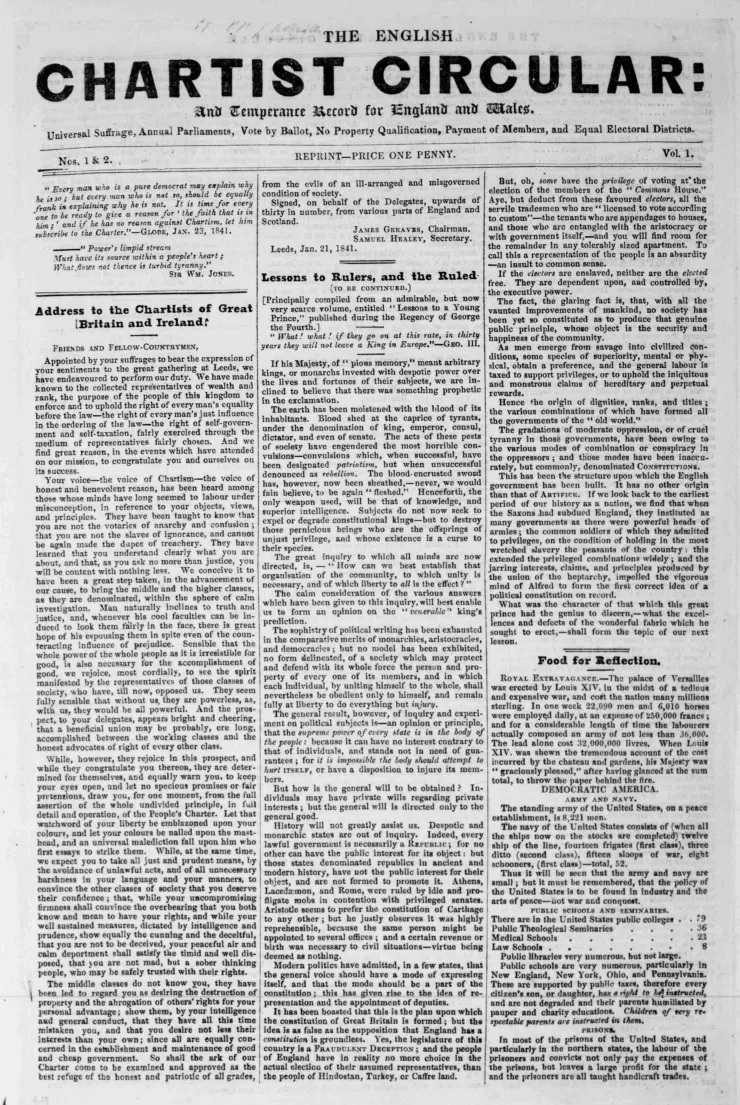
English Chartist Circular | 09 January 1841
The Chartist movement partially arose from the limited 1832 Reform Act, which, among many other restructuring measures, standardised property qualifications and allowed men who possessed property the right to vote. Its supposed aim was to democratise and modernise, but it left a significant proportion of those below the middle class feeling marginalised and without sufficient political representation.
Tensions increased among industry workers, and Chartism formed as a working-class, political reform movement that advocated for greater democracy in an industry-oriented society. The movement also attracted those who opposed wage cuts and unemployment.
In 1838, a People’s Charter was drawn up by radicals William Lovett and Francis Place, representing the London Working Men’s Association (LWMA). In June 1839, they presented the petition to the House of Commons, and despite having over 1.25 million signatures, it was swiftly rejected by Parliament.
A second petition was presented in 1842, signed by over 3 million people, but was also rejected. With increased frustration, the third and final petition was drawn up, and a meeting was held in South London among the Chartists. An influential figure present at this meeting was Feargus O’Connor, editor of Chartist paper, The Northern Star and Leeds General Advertiser.
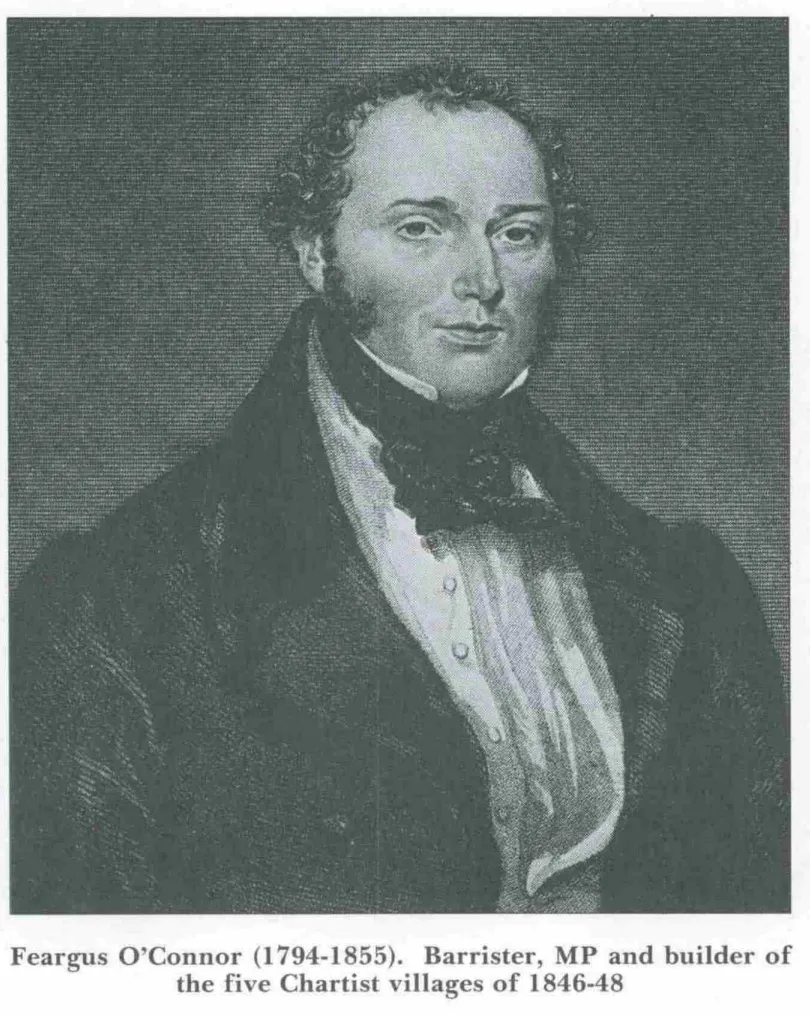
Country Life | 22 September 1988
Throughout this prolonged period of political unrest among the Chartist’s, several newspapers were established as a universal, written voice for the labouring-classes. Among these include the Chartist Circular, founded in Glasgow, the Poor Man’s Guardian, and our new title. the English Chartist Circular. These titles were all connected, insofar as they advocated for the six points covered in the People’s Charter; however, the demands themselves can be traced back to the eighteenth century.
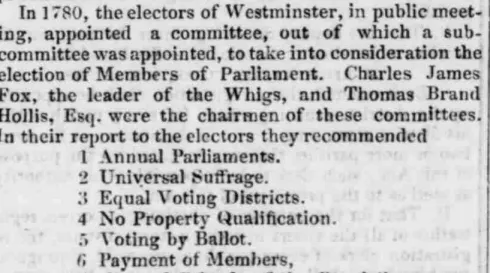
English Chartist Circular | 19 June 1841
Chartist’s called for six reforms to the political system, with the intention of placing the valued worker at the centre:
1. For every man over the age of 21 to have the vote.
2. The secret ballot put in place, to protect the voter.
3. No property qualification for MPs, allowing constituencies to return the person they choose.
4. Payment of Members, enabling tradesmen, working men, or those of modest means to leave or interrupt their livelihood to attend to the interests of the nation.
5. Equal constituencies, securing the same amount of representation for the same number of electors, instead of allowing less populous constituencies to have more weight than larger ones.
6. Annual parliamentary elections, which would make sure that bribery was not a long-term consideration in political situations.
The Chartists utilised newspapers, attempting to appeal to the middle-classes, asserting that their Parliamentary representatives did not have their best interests at heart. In an issue from 23 January 1841, an article addressed the middle-class directly;
How little real power does the present franchise confer upon you, witness the reception of your anti-corn law bill by your nominated representatives; in truth, there is no representation, your power only enables you to nominate once in seven years an individual, who then becomes independent of your opinions, and too often carless of your interests.
If there is a feeling of contempt in our mind for any man, it is for him, who, possessing the franchise, looks down with supercilious pride upon those who have it not; his power is but a name, his pride is that of as menial who points to his straw coronet and wooden sceptre and thinks himself a king, though chained and miserable.
Chartism would decline in popularity after the third petition was rejected by Parliament, but the shadow of their influence would elicit future Parliamentary actions throughout the later 1800s.
English Leader
We remain amidst the political and economic unrest brought about by the ongoing Industrial Revolution with the second title on our list; the English Leader. Published every Saturday and costing two pence per issue, this paper vowed to be a ‘Journal for the Discussion of Stationary Questions’,
The story of this title is mirrored in the political engagements of its editor, the renowned George Jacob Holyoake. Often thought of as the father of Secularism, inventing the word itself, although its roots can be traced back centuries. Alongside Secularism, which advocates for a distinct divide between religious and state institutions, Holyoake was a pioneer in the British Co-operative Movement.
Modern co-operatives formed during the intense period of poverty during the nineteenth century. As food prices were amplified due to marketisation, and a with pressing lack of working-class representation, co-operatives sought to provide food and other resources to members who did not have sufficient access to them.
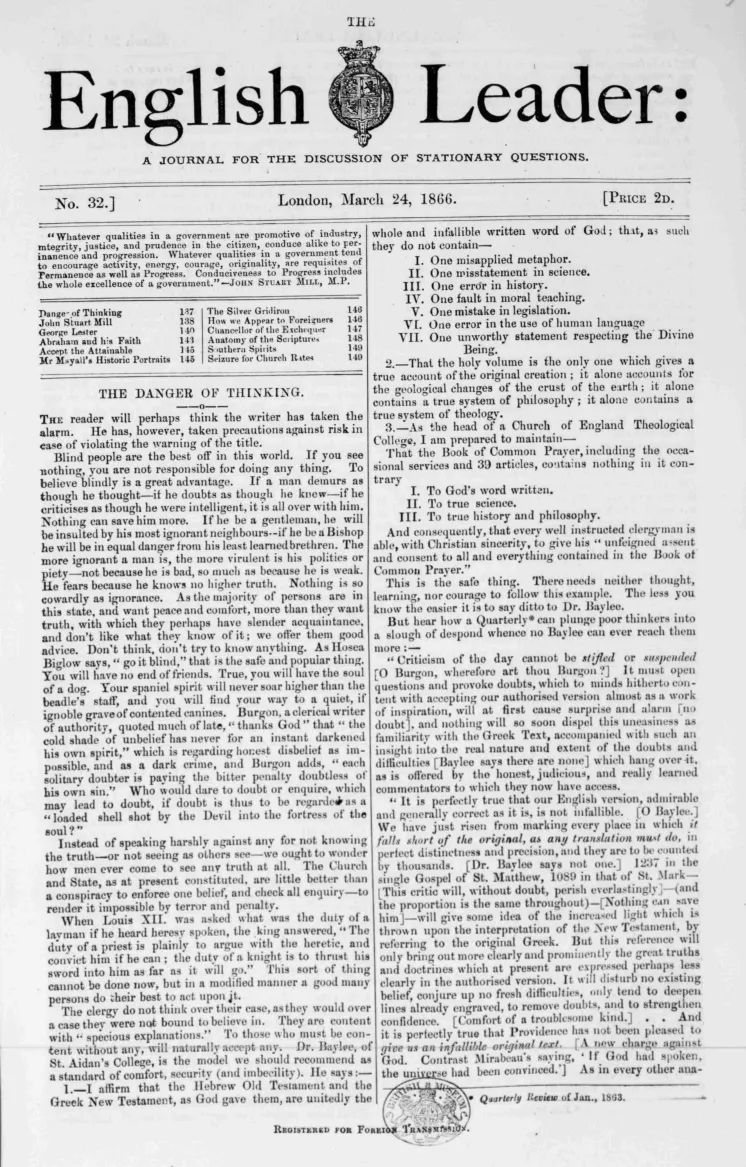
English Leader | 24 March 1866
This paper upholds strong liberal inclinations, with a focus on trades that experienced the most significant impact from rapid industrialisation, such as mining and weaving. It frequently questioned the intentions of government, and how its role fitted into the betterment of its people. On the front cover of an issue from 24 March 1866, it featured a quote from liberalist and political economist, John Stuart Mill.
Whatever qualities in a government are promotive of industry, integrity, justice, and prudence in the citizen, conduce alike to pertinanence and progression. Whatever qualities in a government tend
to encourage activity, energy, courage, originality, are requisites of Permanence as well as Progress. Conduciveness to Progress includes the whole excellence of a government.
The English Leader sustained Co-operative values, prioritising self-help, democracy, and sustainability among others, and prioritised the creation of a ‘co-operative commonwealth’ in the wake of economic upheaval.
Grimsby Advertiser
Third on our list of brand new titles is the Grimsby Advertiser, which focused on circulating ‘exclusively in all the Towns of North and East Lincolnshire, Hull, and other Seaports in Yorkshire’. It covered general news, including local business activities, trade and crime reports.
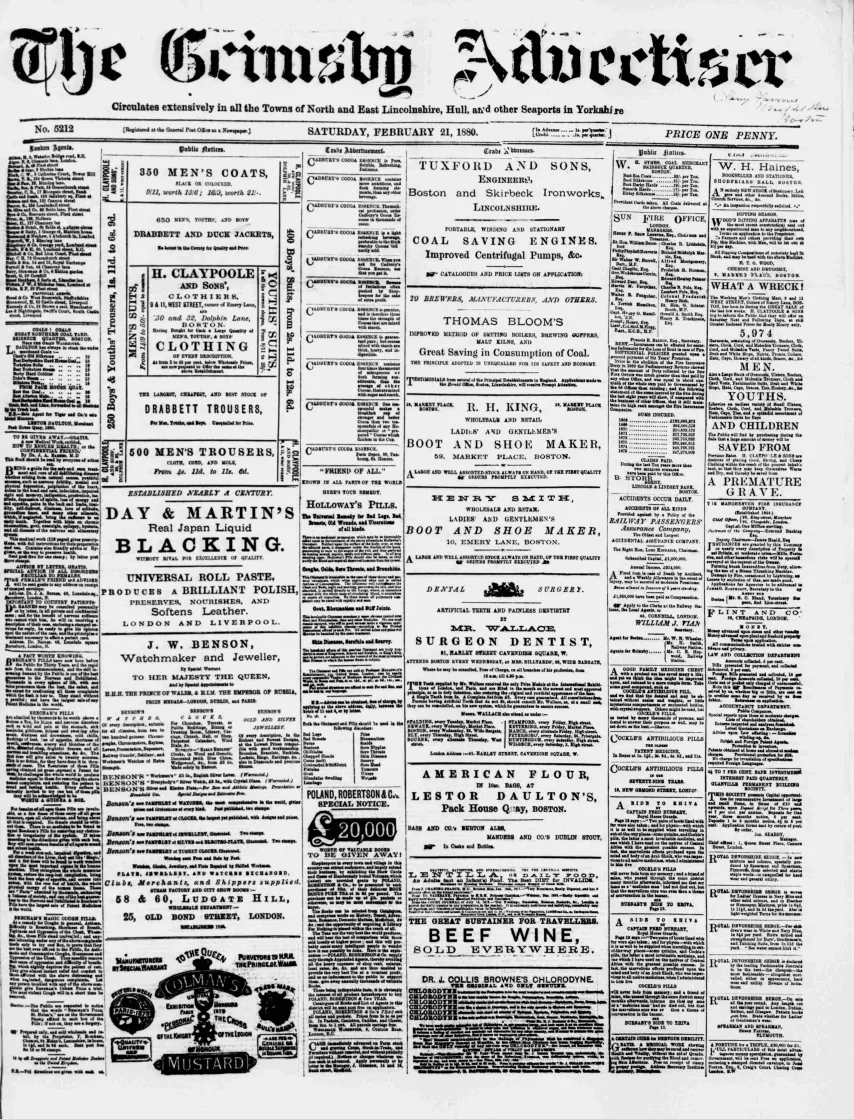
Grimsby Advertiser | 21 February 1880
Each issue was a concise four pages, and cost one penny. It was a valuable resource for local news, with its roots in the port town in Lincolnshire.
Putney & Wandsworth Borough News
Next up is the Putney & Wandsworth Borough News, which was incorporated with the Putney and South-Western Chronicle. Published every Saturday, this London-based title was circulated around Wandsworth, Wimbledon, Roehampton, Mortlake, Barnes, Tooting, Balham, and Fulham. This title advertised local businesses, and shared general news with its devoted community.
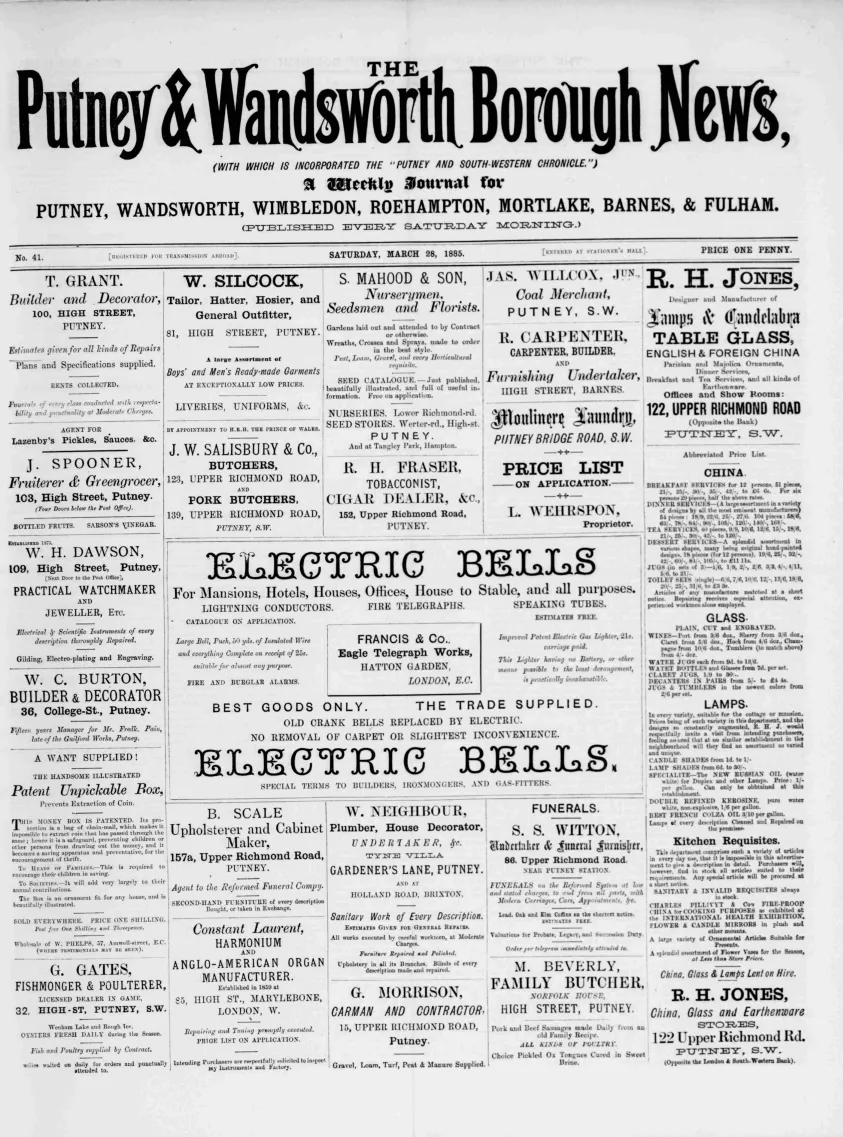
Putney & Wandsworth Borough News | 28 March 1885
Each issue features eight tightly-packed pages and cost one penny. It allowed its readers to stay up to date with the happenings in South-West London in the late 1800s.
Wearside Catholic News
The final new title added to The Archive this week is the Wearside Catholic News, which operated in conjunction with its sister titles, the Leicester Catholic News and Blackburn Catholic News. It’s intention was to humanise and collectivise ongoing Catholic discourse across the United Kingdom, balancing the delivery of clear and concise information on Catholic activity with general local news reports. As such, the title page contained several local business advertisements, while on page three of every issue, one could stay current on ‘Catholic News of the World’.
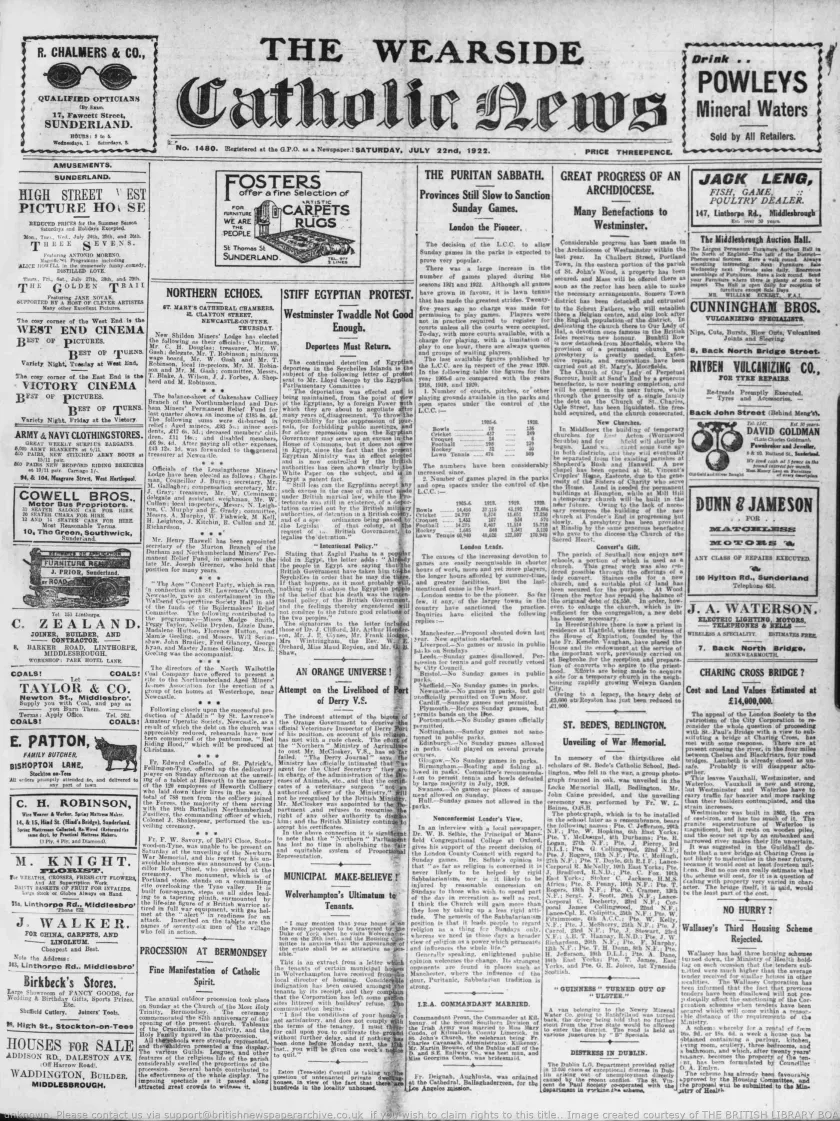
Wearside Catholic News | 22 July 1922
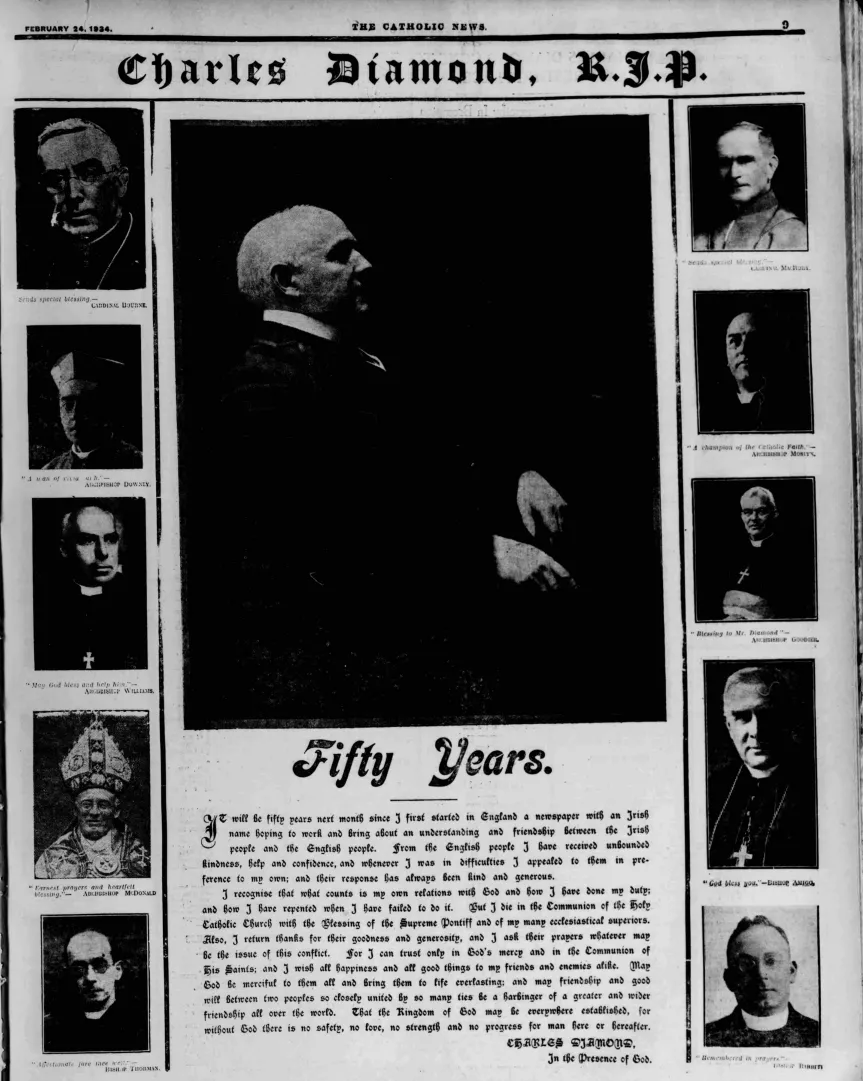
Its aforementioned sister titles all belonged to The Scottish Catholic Printing and Publishing Co., Ltd, with its Chairman, Irish Labour Party Politician and newspaper founder, Charles Diamond, delivering annual reports on the company’s progress. Diamond is perhaps more famed for the Catholic Herald, which is still in operation to this day. The Catholic Herald grew from an amalgamation of the Irish Tribune, Glasgow Observer, and Catholic News.
Although certainly well-known, Diamond was highly controversial and made a great deal of enemies throughout his career. In January 1920, he was arrested and sentenced to six months in prison for an article written in the Catholic Herald, titled “Killing No Murder”, which many saw as encouraging assassination in Ireland.
In its effort to balance religious thought and scholarship with general news, the Wearside Catholic News contained a page entitled, ‘For the Home Circle – Topical Historical Literary’. This page featured song lyrics, chapters from stories, and historical reflections.
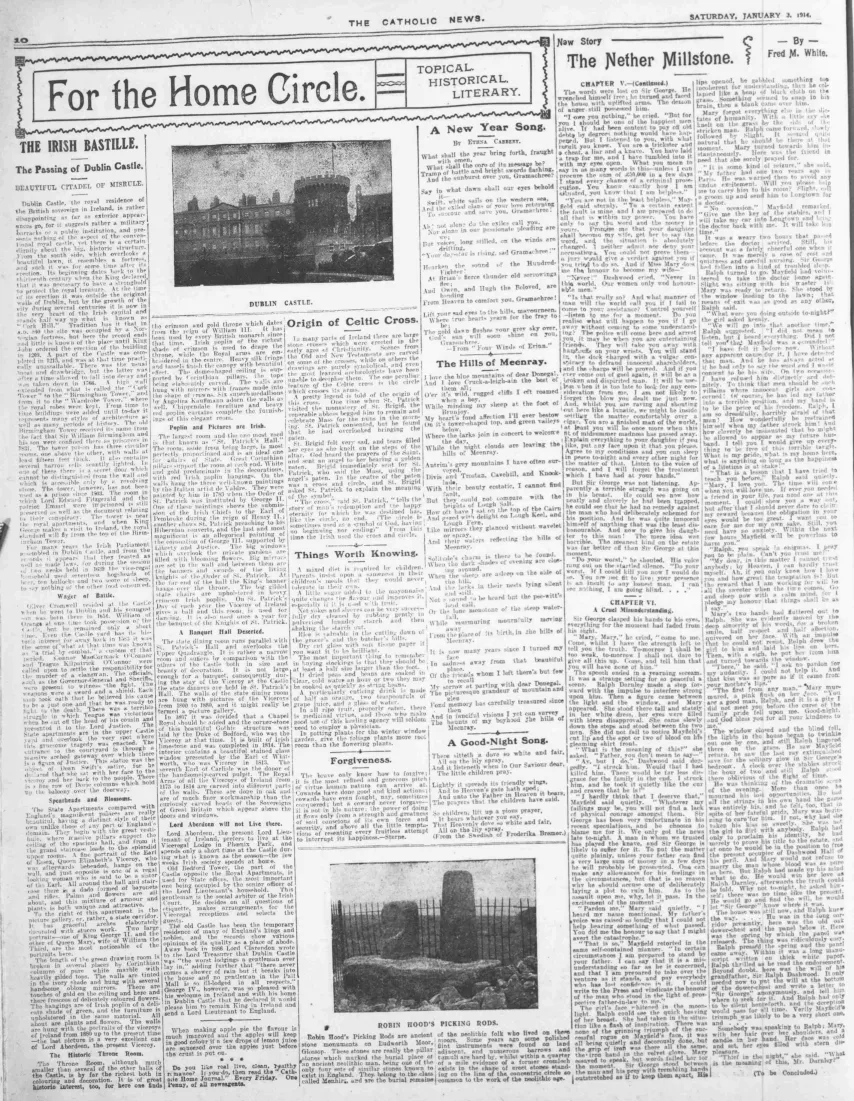
Wearside Catholic News | 03 January 1914
Each issue was sixteen pages long and cost one penny.
Our Updated Titles
This week we have updated twenty-one of our pre-existing titles from across the United Kingdom. Our largest contribution is to the Coventry Evening Telegraph, with 54,318 new pages now available. A close second is none other than the Dundee Weekly News, with 52,352 brand new pages. In addition to this, we’ve added to the Mining Journal, the Sporting Post, and filled in some previously missing issues in our beloved Bookseller.
You can learn more about each of the titles we add to every week by clicking on their names. On each paper’s title page, you can read a free sample issue, learn more about our current holdings, and our plans for digitisation.
John Le Carré in the Bookseller
11,152 pages have been added this week to our landmark title, the Bookseller. Coined the ‘Organ of the Book Trade’, Bookseller offers unparalleled access to literary history, encompassing publishing processes, library industries and bookselling standards. This title is one of the United Kingdom’s longest running titles, and allows its readers to stay current on all book-related happenings.
Its first issue was published 1 January 1858, and reported on new literary publications both across Britain and abroad, the continually-fluctuating climate of British bookshops, and other industry activities. It has survived both World Wars, and is still in print to this day.
While perusing our added pages for this week, we came across the a front cover from October 1990, showcasing the release of John Le Carré’s new episodic novel, The Secret Pilgrim.
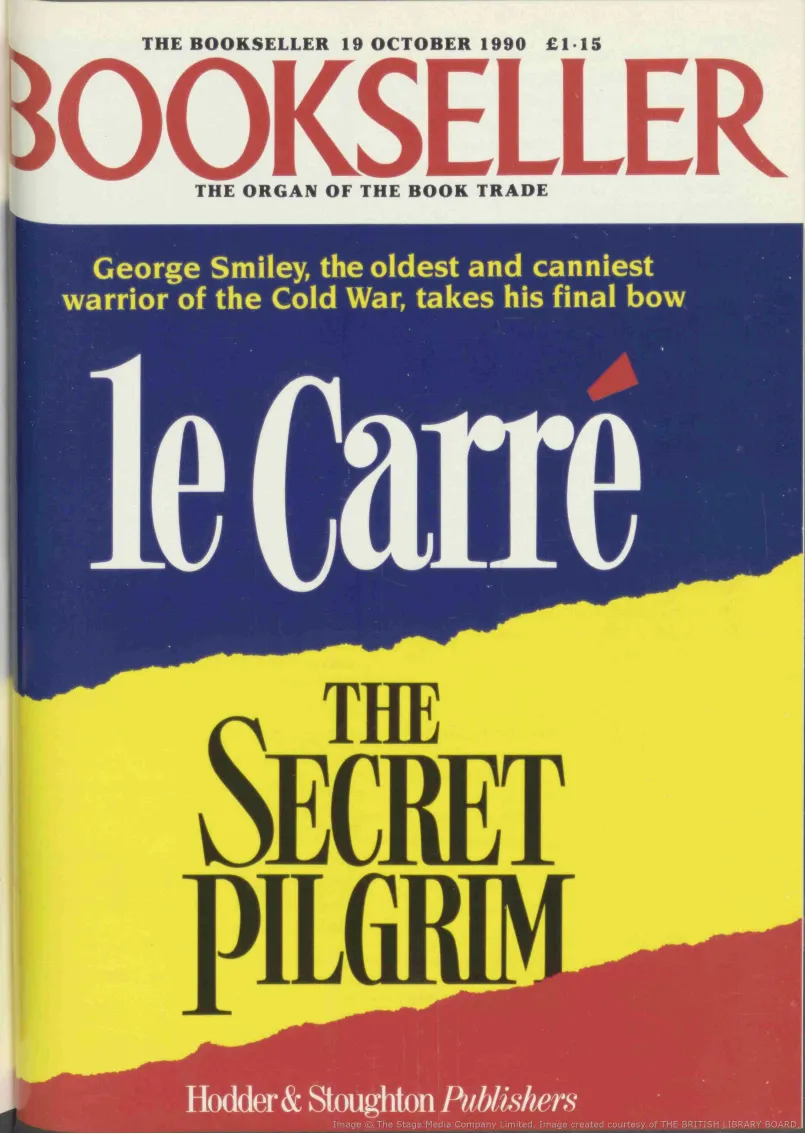
The novel was released at a time of political and economic disruption, wherein Britain was facing the end of the Cold War, and political discourse within Britain was in a period of transition. The Bookseller sets the scene for Le Carre’s story, stating;
The Berlin Wall is toppled, the Iron Curtain swept aside, the dark corners where espionage so lately flourished are bathed in light, the rules rewritten, the stakes changed…John le Carré has seized this extraordinary turning point in our history to give us The Secret Pilgrim.
The Secret Pilgrim frames the Cold War through the recollections of Ned, a British solider of the Cold War. As he nears the end of his career, he addresses the new recruits, narrating episodes from his secret past. Each episode involves tales of espionage, failed operations, moral compromise, and loyalty to flawed institutions. The novel speaks to themes of memory and introspection, and many consider this work ‘John Le Carré’s most magnificent novel.’
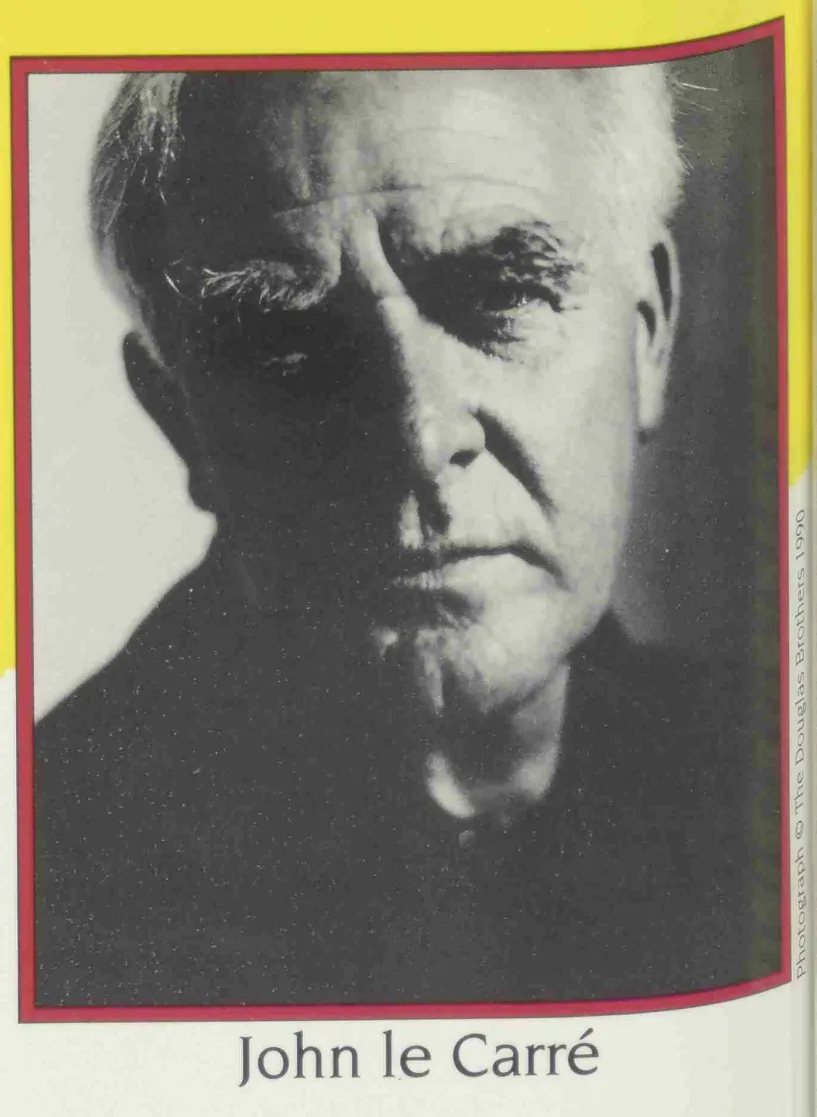
Le Carré’s novel was published by London-based company Hodder & Stoughton, founded in 1868 by Matthew Henry Hodder and Thomas Wilberforce Stoughton. The company continues to publish to this day, and is now a part of Hachette UK. Hodder & Stoughton also published several more of Le Carré’s novels, including one of his most recognisable works, Tinker, Tailor, Solider, Spy, in 1974.
David John Moore Cornwell, or otherwise known as his pen name, John Le Carré, maintained a career that was both temporally lengthy and geographically widespread. During the almost sixty-year span of his journey as a writer, he published twenty-six novels and one memoir, as well as several short stories, articles, and screenplays. The trajectory of his career as an author can be traced throughout the 150 years of the Bookseller available on The Archive
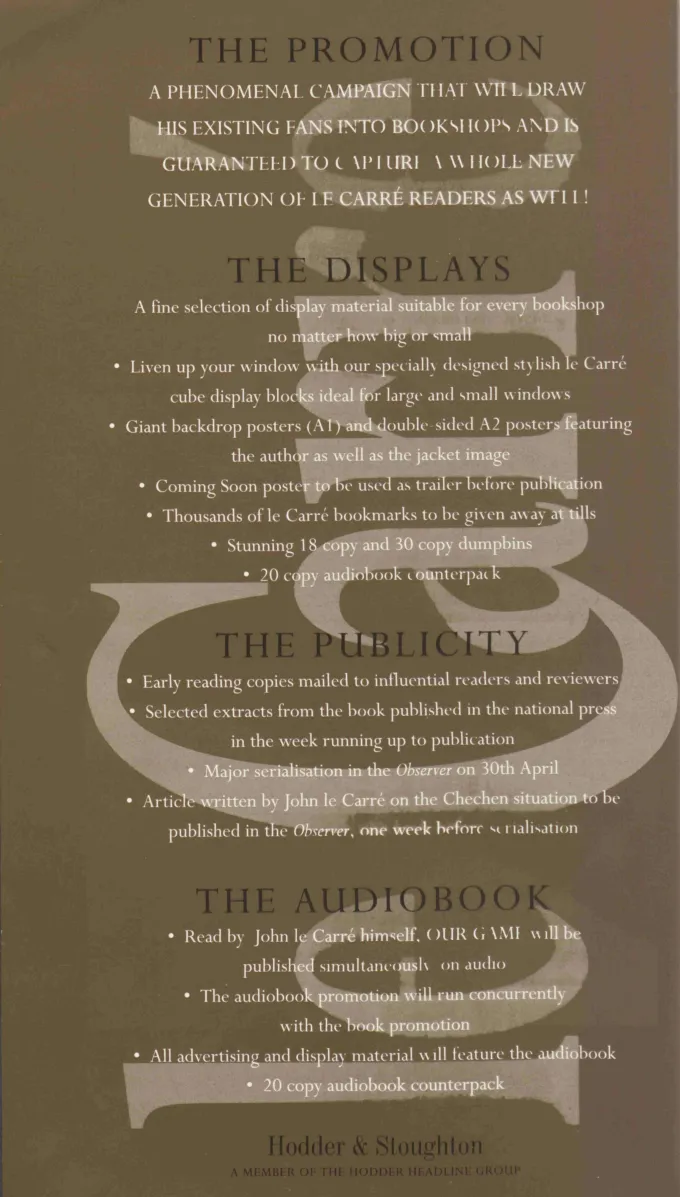
In 1995, Hodder & Stoughton introduced a campaign aimed at reinvigorating the love for Le Carré’s work, enticing both his loyal existing readers, and new, curious ones. This campaign emerged at the same time as his novel Our Game, set in the post-Cold War era.
The uniqueness of the Bookseller stems from its ability to let us trace the literary career of various British authors across genres and publications. Throughout the 150 years available to explore, we can uncover the history of both the bookselling trade, and the infinite works that are housed within them. This title demonstrates the amalgamation of moving parts that constitute the publishing process, and is quite something to behold.
New Titles
Title | Years Added |
1841-1843 | |
1866-1867 | |
1861-1887 | |
1885-1895 | |
1907-1908, 1914-1934 |
Updated Titles
Title | Years Added |
1979, 1989-1990, 1992, 1995 | |
2003-2004 | |
1882 | |
2002-2005 | |
1995-2004 | |
1885, 1893-1950 | |
2001-2005 | |
1889-1894, 1896-1902 | |
1884-1888, 1890 | |
1845-1856 | |
1898, 1900-1910, 1912-1913, 1921-1928 | |
1950-1962 | |
1871-1886, 1888-1903 | |
1919 | |
1934, 1939-1940, 1951-1962 | |
2001-2002 | |
1930-1938 | |
2002 | |
1924-1928, 1930-1946, 1948-1950 | |
1908-1928 | |
1867-1874, 1880-1895, 1897-1908 |
You can keep up to date with all the latest additions by visiting the recently added page. You can even look ahead to see what we’re going to add tomorrow.
More on this topic:
Share this article
About the author

Molly Pearce
Data Operations Executive
Published on Tue, 28 April 2026.