
Freshly styling our new titles on The Archive
Published on 17 June 2026 by Molly Pearce
This week at the The Archive, we take you on a journey from the poultry industry to the world of women’s hairdressing with two of our seven fantastic new titles. Step into a world of scientific discovery, wherein the shape of your head may just determine your criminal potential, and the concoction of dry shampoo will save you from greasy hairstyles.
With a grand total of 338,158 new pages added, and nineteen updates to our pre-existing titles, you’re guaranteed to find something of interest this week.
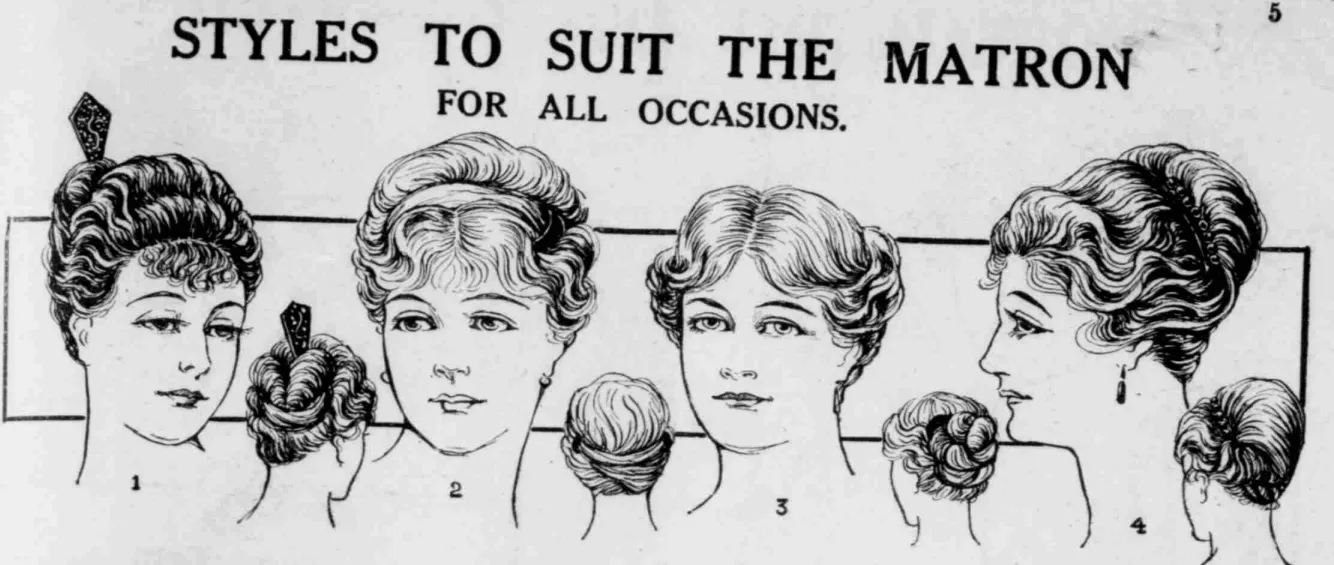
Weldon’s Practical Hairdressing | 01 January 1918
Register now and explore The Archive
Cinderford Journal
We begin our list of new titles for this week in the historic market town of Cinderford, Gloucester. The Cinderford Journal provided a tasteful mixture of advertisements and local, general, and foreign news. Its production aligned with a rise in coal mining in the town, and at one stage, Cinderford was the epicentre of the Forest of Dean coal mining industry. The Cinderford Journal provided frequent coal mining updates, as well as other British intelligence news and local business information.
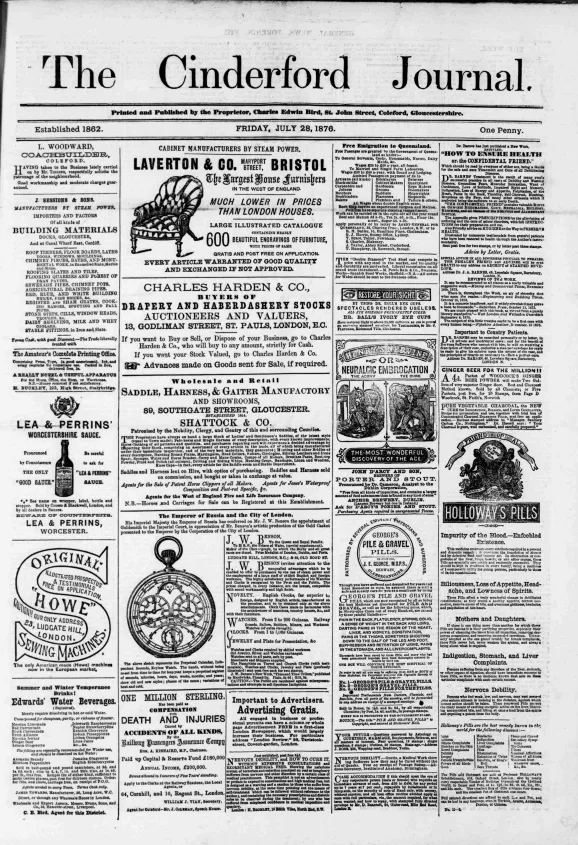
Cinderford Journal | 28 July 1876
In addition, Cinderford was known for its iron-smelting. In 1795, the first furnace to use coke for smelting iron-ore was built just half a mile from the town. The furnace continued to operate with varying success until it was officially demolished in 1901. The town’s name originates from this practice, as ‘cinder’ refers to the waste product created as a result of ironmaking, an industry that dates back to 1228. The Cinderford Journal cost one penny and was published every Friday.
Guardian and Constitutional Advocate
Next up this week is the well-established Belfast-based regional title, the Guardian and Constitutional Advocate. This paper ran from 1827-1836 and advocated for constitutional Whig politics, defending the interests of the Protestant middle-classes. It championed ‘the Restoration of the Constitution to its Purity, as Established in the Year 1688.’ acting as a political organ for conservative values within Belfast.
This title was established by former editor of the Belfast Newsletter, James Stuart, and prominent businessman, Fortescue Gregg. Each issue was four pages long and generally featured reports on foreign intelligence, job advertisements, and short literary works.
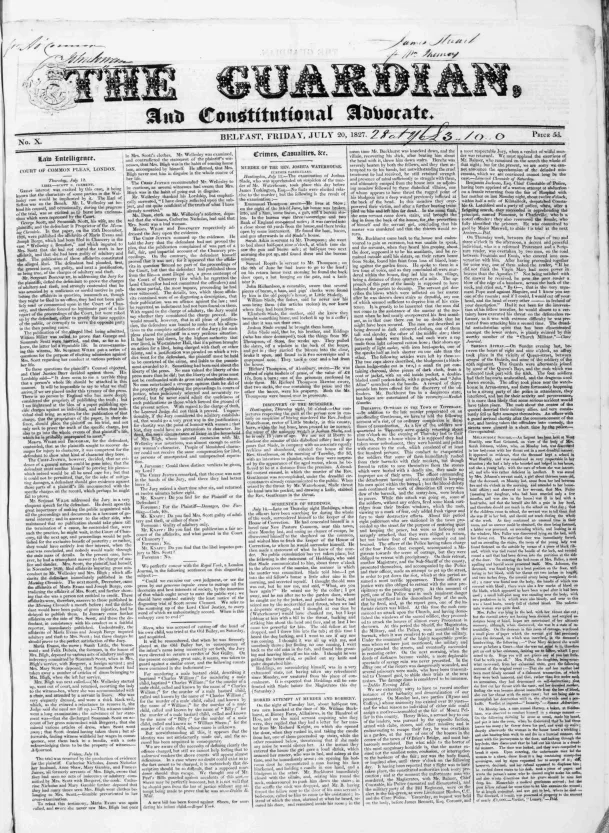
Guardian and Constitutional Advocate | 20 July 1827
Occasionally, the Guardian and Constitutional Advocate would generate controversy by involving itself in cultural debates. Examples of this arose in 1830 with the emergence of revolutionary scientific practices, such as Phrenology and Geology.
Phrenology began as an ‘analytical science’, studying the external dimensions and specific shapes of the skull with the intention of discovering certain aspects of an individual’s characteristics and personality. It was thought that by examining a person’s ‘affective and intellectual faculties’ present on the skull, one could tell whether the person would eventually end up committing a crime.
As this new science gained interest, multiple debates were sparked in relation to its fundamental principles. Phrenology understood the brain as an organ of the mind, which upset those who believed in the religious and spiritual freedom of human nature. It was also ridiculed for being biologically determinist, neglecting the notion that human beings have free will, or that this will is ordained by God.
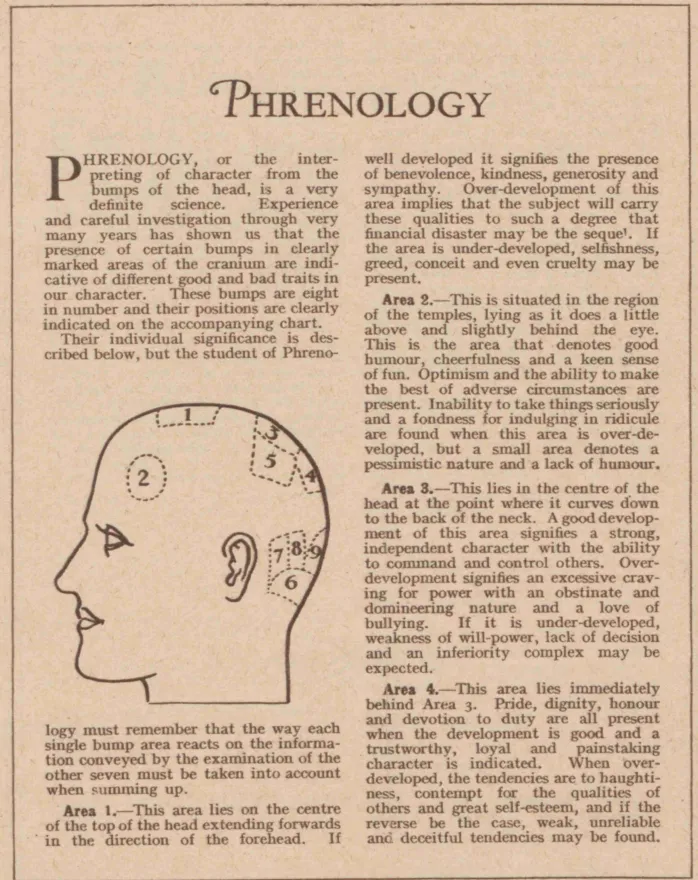
The Guardian and Constitutional Advocate would object to the science of Phrenology multiple times throughout the 1830s, their reasons were laid out plainly for readers to understand. In an issue from 25 June 1830, the paper reports its opinion on the topic:
If the soul be essentially free, its mere possession of material organs or instruments, adapted to particular objects, cannot render it a creature of necessity, nor their use prove that it is so. Man is furnished with hands, which he may apply to purposes of theft or of murder; and with a tongue, by which he may vilify and molest his neighbour, but he is not thereby necessitated to slander, to rob, or to slay any human being.
Debates around the free will of human action, development, or reform underpinned the controversial exposition of Phrenology. The Belfast paper contributed to ongoing public discourse on the matter, and was not afraid to highlight their stance. The Guardian and Constitutional Advocate thus provided its readers with a variety of thought-provoking topics every Tuesday and Friday.
Illustrated Poultry Record
We’re diving into something rather different for our next title this week. The Illustrated Poultry Record, produced and published at Tudor House, London, was ‘A Journal for the Farmer, Gardener, and Poultry Keeper.’ This fascinating title was founded in 1908, with the ‘desire to help those who are in difficulty regarding the management of their poultry.’ It actively encouraged readers to send in queries, assuring them that these would be answered efficiently and with professionalism.
The London Standard, 3 October 1908, published a notice explaining the need for a poultry magazine
Of late years poultry farming has received a considerable share of public notice as one of the most remunerative of farming industries. In this connection it is interesting to note that a new monthly illustrated magazine dealing with the poultry industry has just been published. The “Illustrated Poultry Record” as it is called, should certainly appeal to a large section of the public, containing as it does matters interesting to the professional and amateur alike. The quality of the production is especially good, the first number containing no fewer than 22 admirable illustrations of social and technical interest.
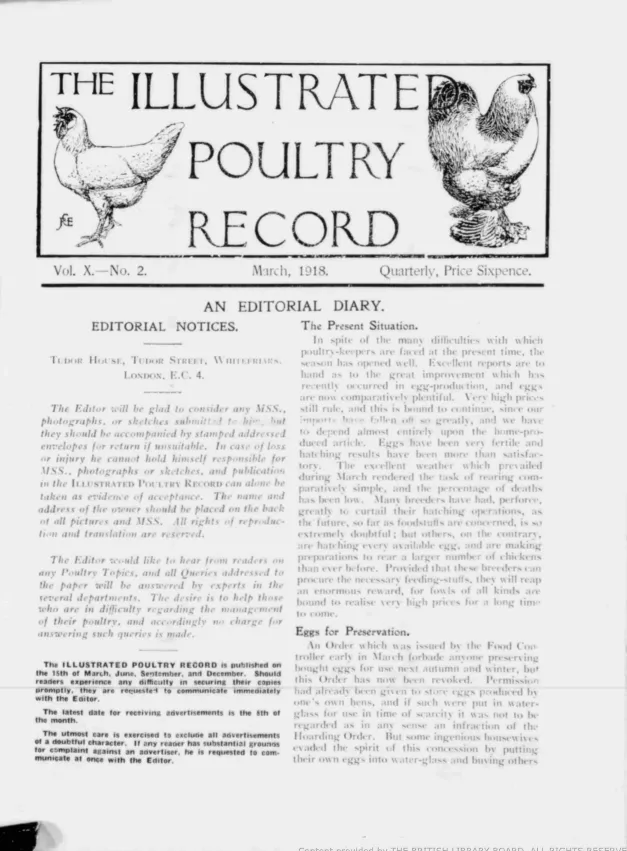
Illustrated Poultry Record | 01 March 1918
It covered a wide variety of poultry-related topics, such as ‘Effect of Light Upon Egg Production’, ‘Current Poultry Literature’, and ‘Rations for Chickens. One ounce per hen per day.’ Alongside this, it kept faithful readers up to date with the global industry market, and advocated for a central poultry union.
It was both informative and accessible, catering for varied levels of knowledge.
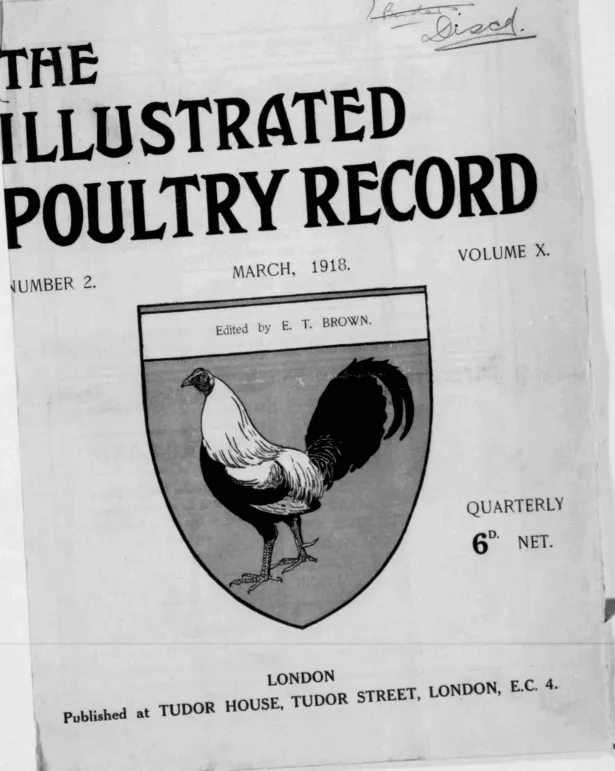
Illustrated Poultry Record | 01 March 1918
Its influence was far-reaching, and although the magazine was London-based, the Cork Examiner promoted its valuable content across countries, thanks to its article, ‘”What the Poultry Industry is doing for Ireland.”‘ It was published each month and cost a total of sixpence per issue.
Southport Critic
Moving on to our next brand new title is nineteenth-century local paper, the Southport Critic. During its run, it was printed and published by the Southport Critic Printing and Publishing Company. This title called itself a ‘Literary, Satirical, and Social Review’, blending local news with light-hearted literary and cultural commentary.
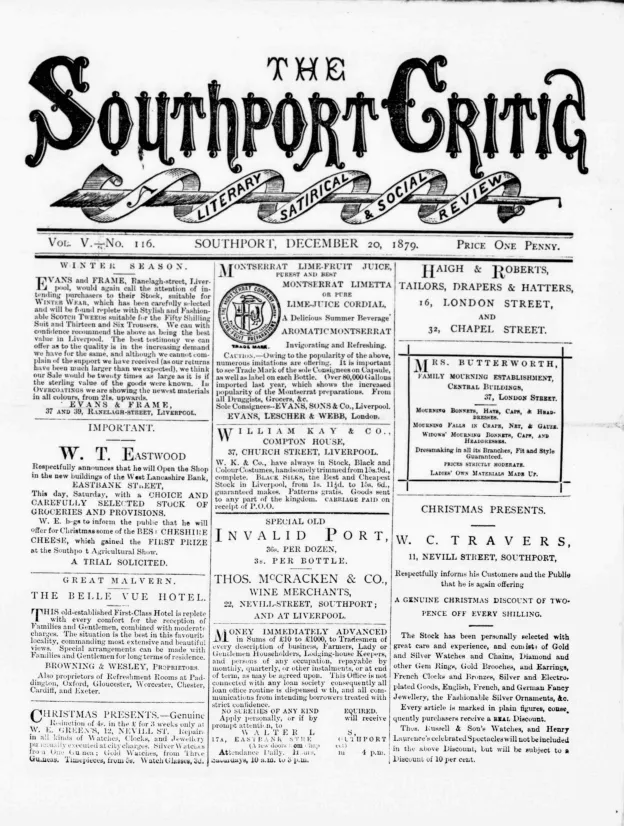
Southport Critic | 20 December 1879
The Southport Critic contained several short stories and poems, all with humorous undertones. An edition from 23 February 1878 featured an article titled, ‘On The Line. (By the Critic Himself)’ It becomes obvious from this piece that the ‘Critic’ from the title’s name refers to the editor, and in its humorous nature, refers to his family as ‘Mr. Critic, and Mrs. Critic and Baby Critic’. The words of Mr. Critic feature in multiple editions, his input guiding the political direction of the paper.
While the paper primarily featured satirical articles, it also contained several local business advertisements.
St. Mary Cray, Orpington & District Times
We travel back down to London for our next title, the St Mary Cray, Orpington & District Times. A local paper reporting on the ongoing events at St. Mary Cray, readers were kept informed on every parish meeting, cricket club meeting, and photographic competition. For the price of one penny, one gained another eight packed pages of local news every single Friday.
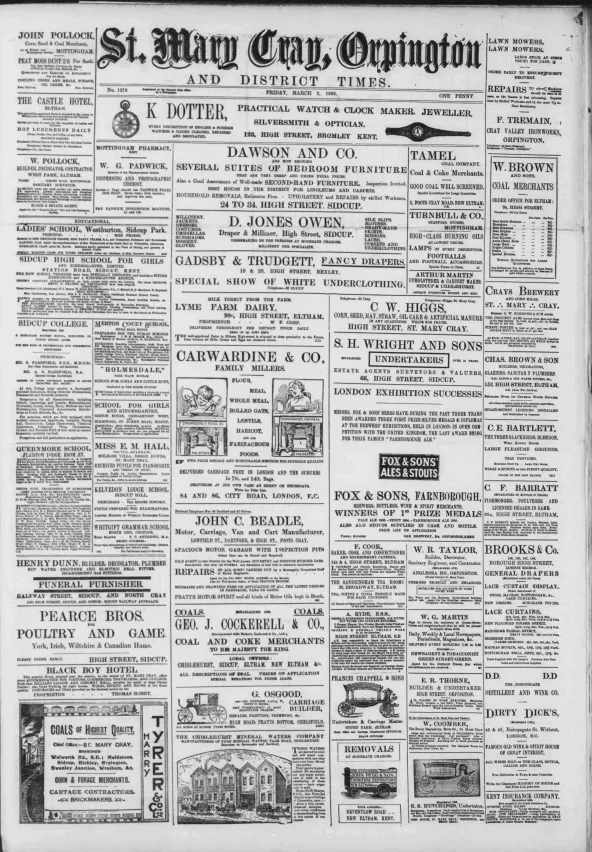
St. Mary Cray, Orpington & District Times | 02 March 1906
Sunderland Daily Shipping News
We’re almost at the end of our list, but we aren’t finished yet. Next up is The Sunderland Daily Shipping News, which, usurpingly, provided daily reports on shipping updates for the low price of one penny. Its title page featured ‘The Furness Line’; a list of the passenger liners, cargo ships, and mail carriers that operated between Newcastle and New York during the late nineteenth and early twentieth centuries.
In its first issue, its editor would publish a statement in the newspaper, establishing its intention:
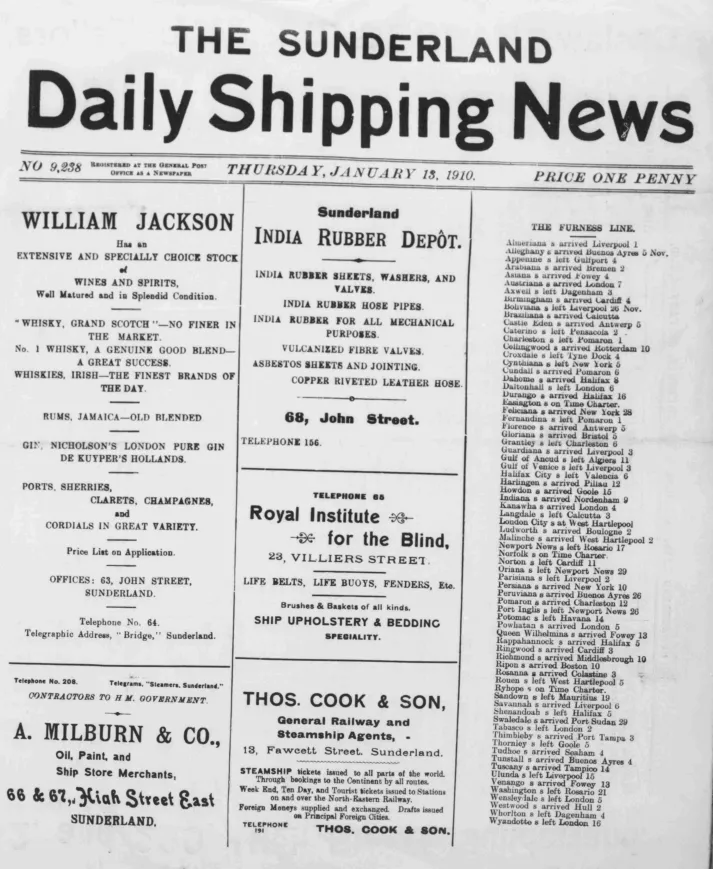
Sunderland Daily Shipping News | 13 January 1910
This title featured several Newcastle-based business advertisements and job openings, as well as wind reports and a daily tide table. It was short, sometimes only one or two pages long, but contained highly worthwhile information related to shipping operations out of Sunderland.
Weldon’s Practical Hairdressing
Last on our list for this week is another unusual one. Weldon’s Practical Hairdressing was a monthly publication featuring ‘The Latest Styles of Hairdressing Enabling Every Woman to Dress Her Hair Becomingly.’ This title contained multiple hair treatment tips and step-by-step hair tutorials, and formed part of a wider series, which also included Weldon’s Practical Crochet and Weldon’s Practical Needlework. In the twentieth century, Weldon’s (a renowned British publishing company), also published books and pattern leaflets relating to lifestyle and culture.
These ‘practical guides’ were very well received, with the Airdrie & Coatbridge Advertiser called them ‘delightful’, and ‘simply marvellous value for the money’, in an article from 31 March 1900.
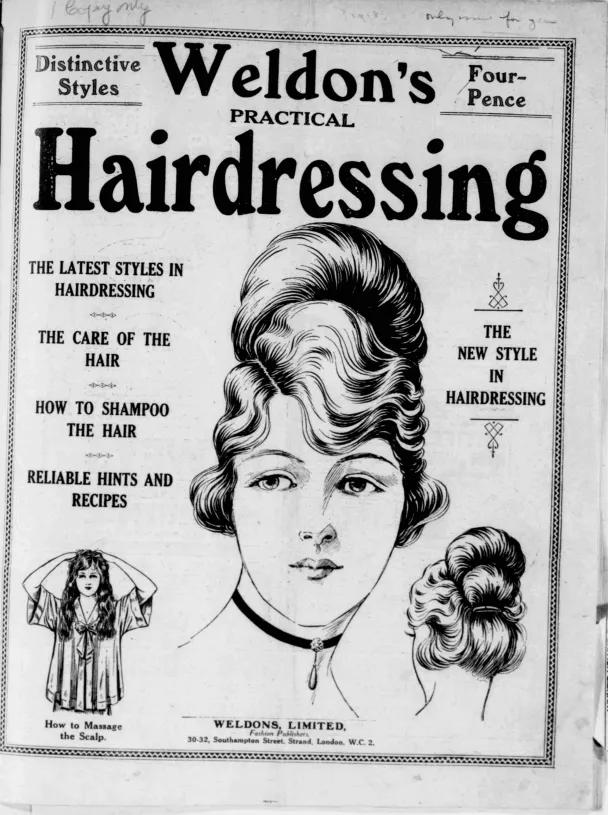
Weldon’s Practical Hairdressing | 01 January 1918
The magazine was full of detailed illustrations and specific styling tips dedicated to different occasions and necessities. One page features ‘Pretty Styles for Theatre and Indoor Wear’, while another offers ‘Styles to Suit the Matron’.
This title is a true time capsule of favoured hairstyles in the early twentieth century, allowing us to explore how women obtained fashion and style advice over one hundred years ago.
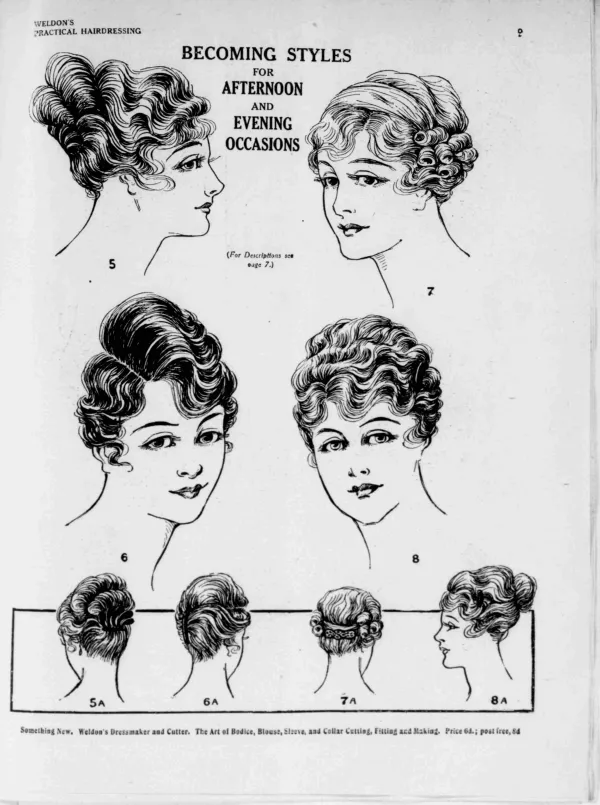
This magazine cost a reasonable fourpence and featured sixteen pages of meticulous styling pointers.
Our Updated Titles
While we’ve covered our seven new titles for this week, we are not short of pre-existing titles to update you on. Out of our nineteen updates, six are from Scotland, and make up the vast majority of our new pages. The biggest update was made to the Perthshire Advertiser, where we added 54,196 pages. Following this, we have also added 36,394 pages to the Stirling Observer, 36,142 pages to the Blairgowrie Advertiser, and 35,908 to the Lennox Herald.
If Scottish titles don’t tickle your fancy, we’ve also updated some of our English, Irish, and Welsh titles, as well as to Isle of Man-based paper, Mona’s Herald.
Dry Shampoo in the early 1900s
While looking through one of our new special interest titles, Weldon’s Practical Hairdressing, we came across a hair-cleaning technique that remains, to this day, a large part of many people’s daily hair routines – dry shampoo. We had understood dry shampoo as a commercial product that emerged in the 1940s, but evidence from our newspapers suggests that it had been around in varying forms throughout history for significantly longer.
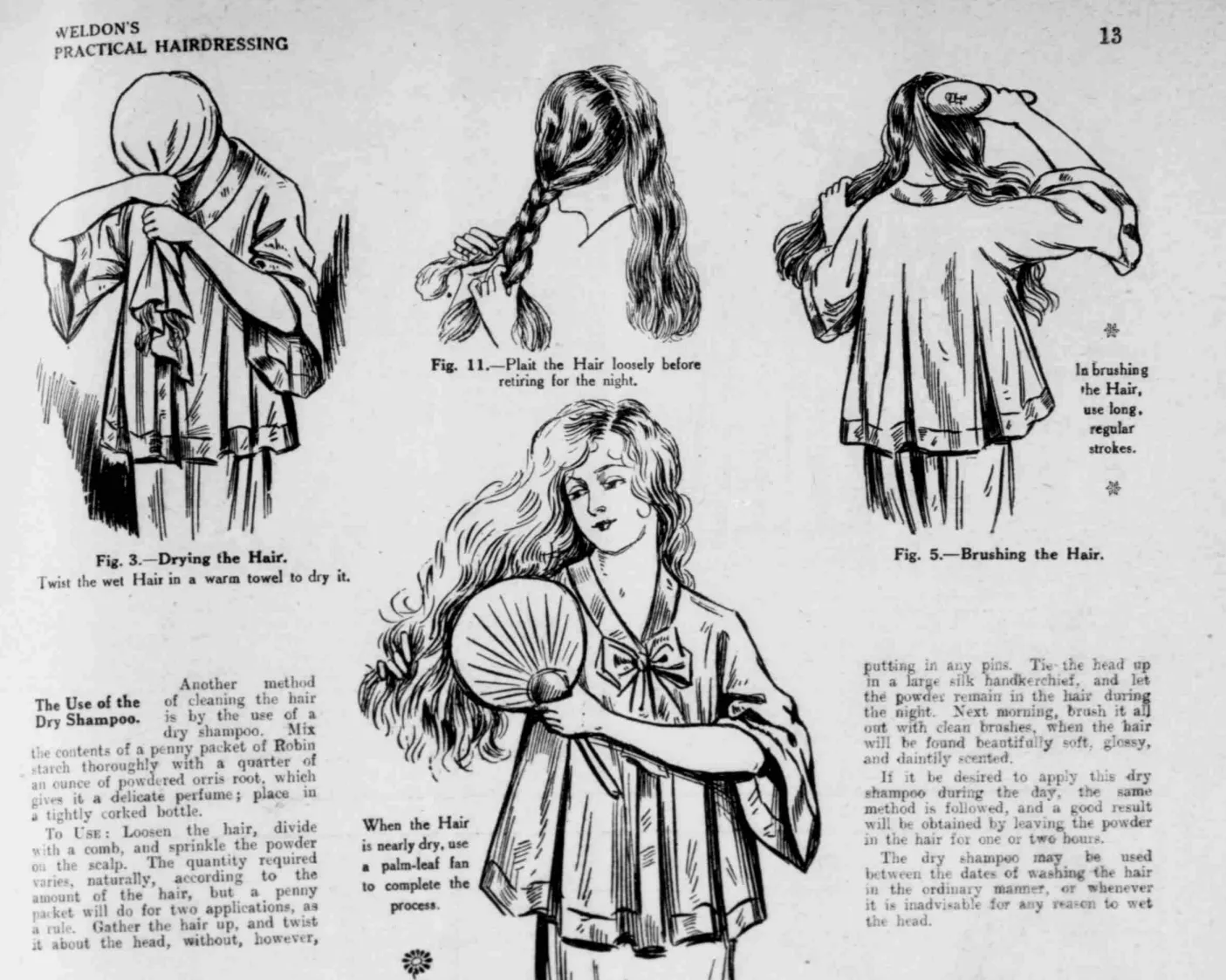
Weldon’s Practical Hairdressing | 01 January 1918
The practice of using dry shampoo to cleanse the hair in instances when washing with water was not an accessible option has dated back to the fifteenth century, wherein it is thought that Asian women used dry clay powder to clean the hair of excess oil and dirt.
Into the eighteenth century, written references to dry shampoo emerged among the British and American elites, who used dry shampoo to soak up, deodorize , or even change the colour of long-haired wigs. Wigs of a longer length were seen at the time as a symbol of masculine entitlement and authority, which thus meant they were worn significantly more often and needed to be cleaned. With regular bathing less possible or socially normative, dry shampoo continued to exist over the next centuries as a stopgap for ‘in between the dates of washing the hair in the ordinary manner, or whenever it is inadvisable for any person to wet the head.’
Instances of dry shampoo being used in regular haircare routines can be seen in our newspapers much more frequently at the turn of the twentieth century. Instructions provided are not dissimilar from those we would use today.
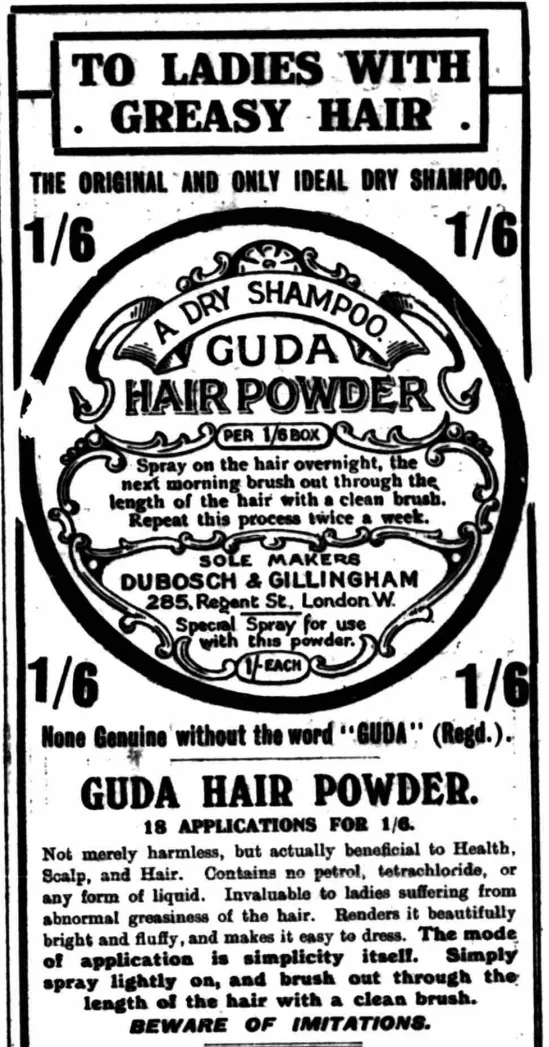
Votes for Women | 24 December 1909
This advertisement from 1909 advises women with greasy hair to be using dry shampoo twice per week; typically more frequently than we see it used on average today. This routine was incredibly normal at the time, however, as women often went anywhere from one week, up to one month, without washing their hair with water.
Indeed, newspapers were quick to dispel rumours of dry shampoo being bad for the head, and frequently answered questions related to its use. In an issue of The Queen from 12 July 1933, a formula was recommended that strays rather far from the chemicals used in modern-day dry shampoo:
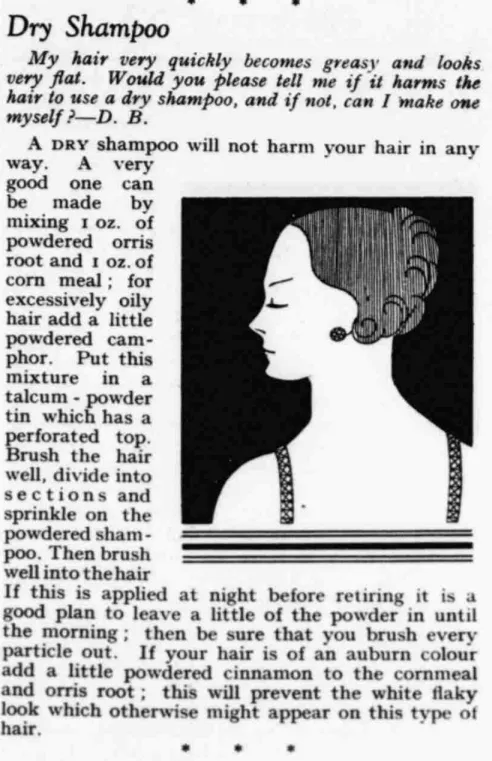
This particular concoction suggests mixing ‘1 oz of powered orris root and 1 oz of corn meal; for excessively oily hair add a little powdered camphor.’ Interestingly, this paper states that those with auburn hair should ‘add a little powered cinnamon’, illustrating how adaptable and organic previous versions of dry shampoo appeared to be.
By the 1940s, the first commercially-produced dry shampoo began to hit the American haircare market. Minipoo, developed in New Jersey, did not achieved worldwide success. Nonetheless, it inspired several other dry shampoo brands to emerge globally, and slowly but surely, the dry shampoo we know today was born.
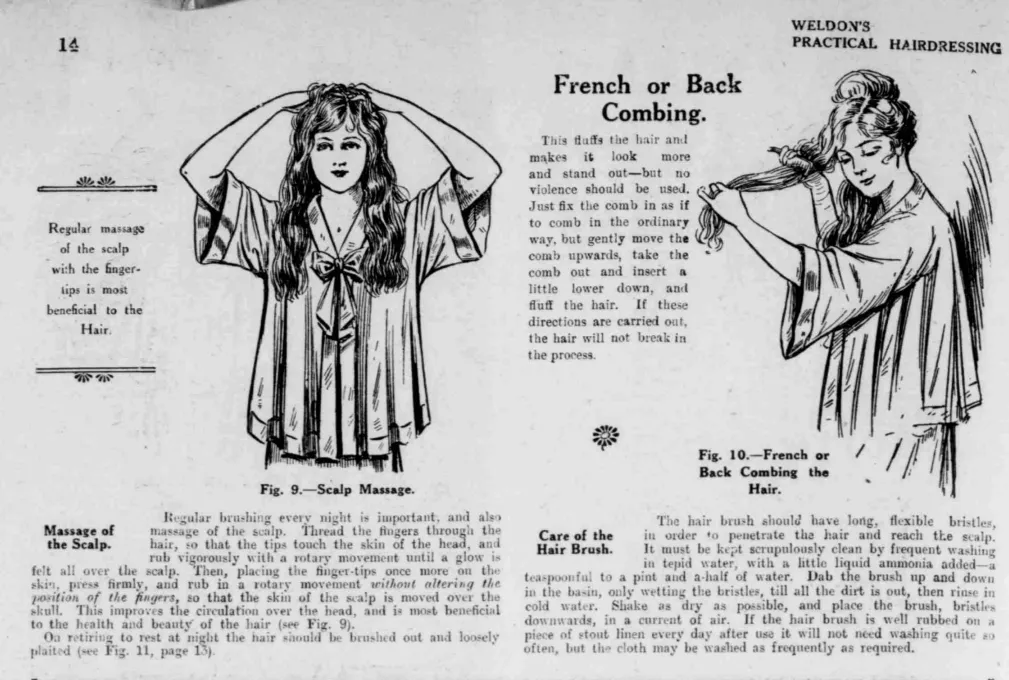
Weldon’s Practical Hairdressing | 01 January 1918
Our newspapers allow us to trace the history of women’s haircare, at a time when cleansing standards and favoured ingredients reflected an entirely different societal expectation. We can see how natural and unprocessed concoctions were the norm, with their properties thought to provide lasting positive benefits for both the scalp and hair. Continue to trace the history of dry shampoo, discover more fashionable women’s hairstyles, and much more besides, in the pages of The Archive today.
New Titles
Title | Years Added |
1875-1877, 1879, 1889, 1891 | |
1827-1836 | |
1918 | |
1878-1879 | |
1905-1919 | |
1865, 1872, 1888, 1897, 1910 | |
1918 |
Updated Titles
Title | Years Added |
1997-2005 | |
1984-1985 | |
1861-1878, 1881-1884, 1887-1935, 1953-1969, 1996-1999 | |
1874-1875, 1877 | |
1986-1991, 1995-1996, 1998, 2000 | |
1871-1884, 1897-1913 | |
1995-1999 | |
1946-1962, 1966-1984, 1999-2002 | |
1919 | |
1871, 1874, 1877, 1889, 1912 | |
1889, 1893, 1919 | |
2000-2003 | |
1877-1892 | |
1953-1970, 1997-1999 | |
1873-1877 | |
1836-1843, 1868-1874, 1878-1880, 1893-1901, 1903-1913, 1919-1938, 1946-1960, 1969-1970, 1975-1976 | |
1919 | |
1869, 1873-1874, 1878, 1884 | |
1918-1919 |
You can keep up to date with all the latest additions by visiting the recently added page. You can even look ahead to see what we’re going to add tomorrow.
More on this topic:
Share this article
About the author

Molly Pearce
Data Operations Executive
Published on Wed, 17 June 2026.