1992-2012: Celebrating Pride in the United Kingdom
Published on 5 June 2026 by Molly Pearce
Back in June 2022, we wrote a blog covering the formative, contentious years of the Pride movement in the United Kingdom. Looking through our newspapers on The Archive, we were able to piece together a historical trajectory from 1972-1992, demonstrating how Gay Pride rallies and marches drove both cultural and political expansion in the fight for LGBTQ+ rights. Tracing the narrative of Pride’s inception, we saw how members of Gay Pride protests, marches, and riots were met with widespread hostility and intolerance. Despite this, Pride – and all that it represents – would not only endure but proliferate, maturing into a vibrant, intersectional sanctum for marginalised voices.
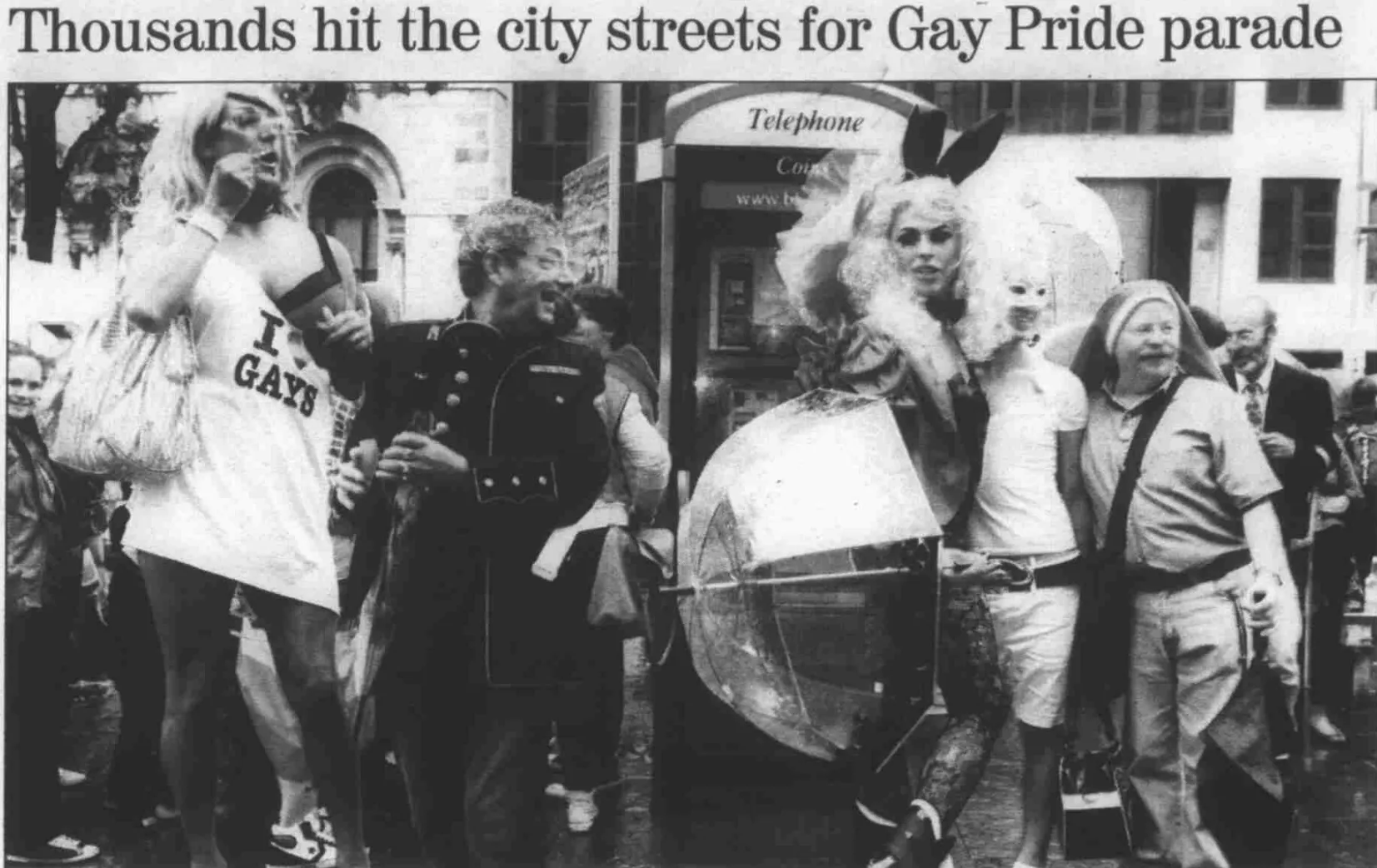
Belfast Telegraph | 02 August 2010
Since the 1990s, the Pride movement has continued to develop and spread into the furthest corners of the United Kingdom. We will pick up where our previous blog left off, at a time where attitudes towards openly gay individuals were beginning to transition alongside increasing cultural awareness. Prejudice lingered, and negative misconceptions surrounding same-sex relationships were rife, yet members of the Pride movement were deeply committed to rewriting the narrative.
Register now and explore The Archive
Reinvigorated Political Activism
While Gay Pride was growing as a powerful and influential symbol into the 1990s, so were harmful actions taken to quell progressive discourse on homosexuality. The introduction of Section 28 of the Local Government Act in 1988, the first anti-gay law to be passed since 1885, played a large role in reinforcing a culture of fear in members of the public. The clause forbade homosexuality from being ‘promoted’ by ‘teaching or publishing material’. On the day it was introduced, over 20,000 people joined together in Manchester to protest.
This led to a series of intense debates between members of gay and lesbian groups and local councils, over the political and societal consequences of implementing Section 28. While gay groups were finally being allowed to become involved in local council meetings under the Labour Party, members of the Conversative Party were endorsing Section 28 in an effort to quash rising voices.
One such debate occurred in Wolverhampton and was reported in the Wolverhampton Express and Star.
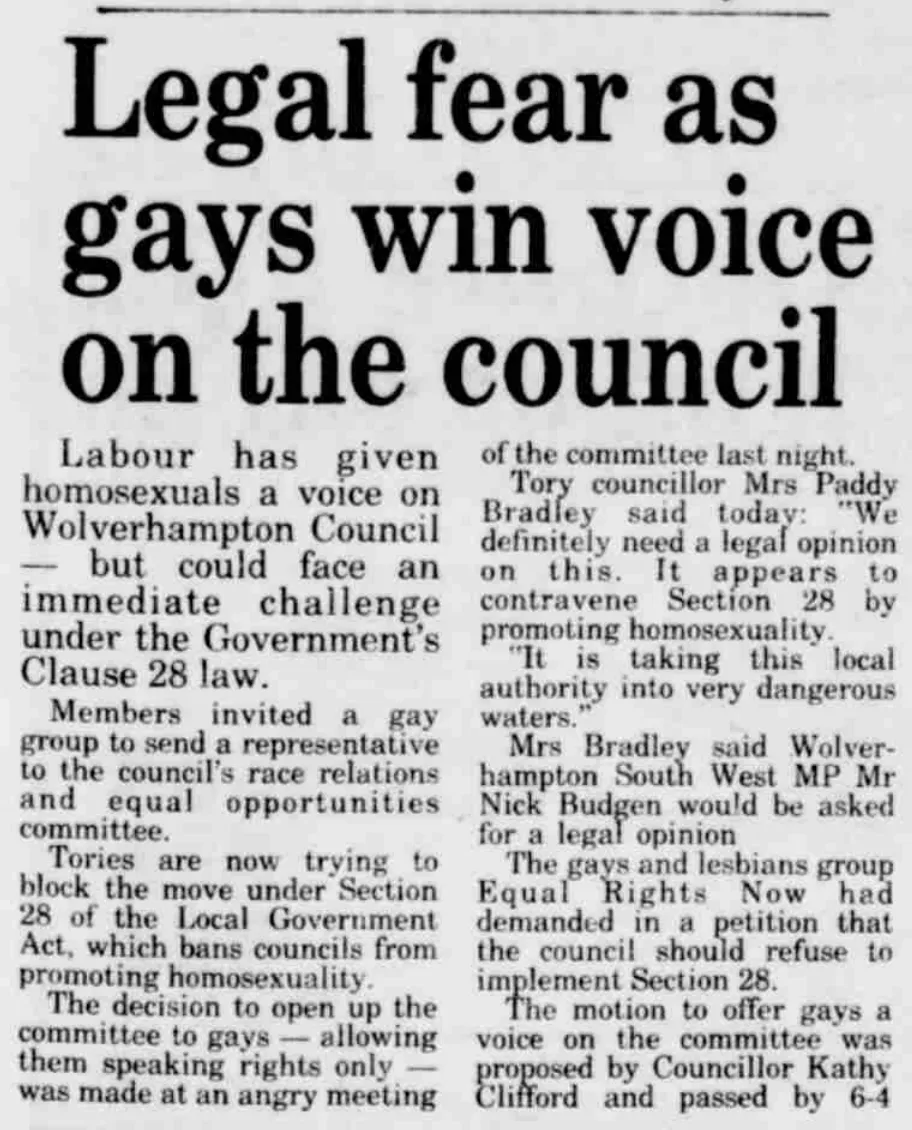
Wolverhampton Express and Star | 11 October 1988
This marks a striking dichotomy among political representatives, exposing how resentment and fear of change sat deeply entrenched within established government systems. While some local authorities across the United Kingdom utilised Section 28 as a tool of oppression, others would take action to stand against it. Four London borough councils – Camden, Hackney, Haringey, and Islington – challenged Section 28 through ‘openly pledging support for the Lesbian Strength and Gay Pride Festival’, just days before it would begin.
These boroughs released a joint statement on the matter, which read as follows:
‘”We believe that at the present time, with growing intolerance and prejudice, we should restate our commitment to our policies and reaffirm our determination to work with lesbians and gays to bring an end to the discrimination they face every day,”‘
These four London boroughs were not alone, for additional councils would emerge in support of the gay and lesbian community. Although Section 28 was certainly utilised by several authority figures as a weapon against progress, it continued to face sustained opposition from the second it was introduced, supplying hope where it was needed in the fight for LGBTQ+ rights. While discrimination had not gone anywhere, gay and lesbian groups felt encouraged in the knowledge that their extensive work was paying off, and they were not alone in the fight for equal rights.
As Pride transitioned into the 90s, it truly became a force to be reckoned with. The movement remained inherently political, with action taken on both a moderate and radical level, owing to the founding of several activist groups such as Stonewall in 1989 and OutRage! (formed in 1990 after the murder of gay actor Michael Boothe). Members of activist groups challenged oppressors of homosexuality from inside the protection of their institutions and faced large amounts of backlash in response. Particular focus was placed on the Church of England. In March 1992, a group of campaigners stood outside Milby Church, ‘heckling’ leaders as they ‘arrived to hear a talk given by Jeremy Marks, of the national organisation Courage, for gays who have converted to heterosexuality.’ The Church Minister would insist that the OutRage! group misunderstood their intentions; ‘”The protesters thought we were trying to encourage people to go straight but what we are trying to do is give encouragement to people who want to go straight.”‘
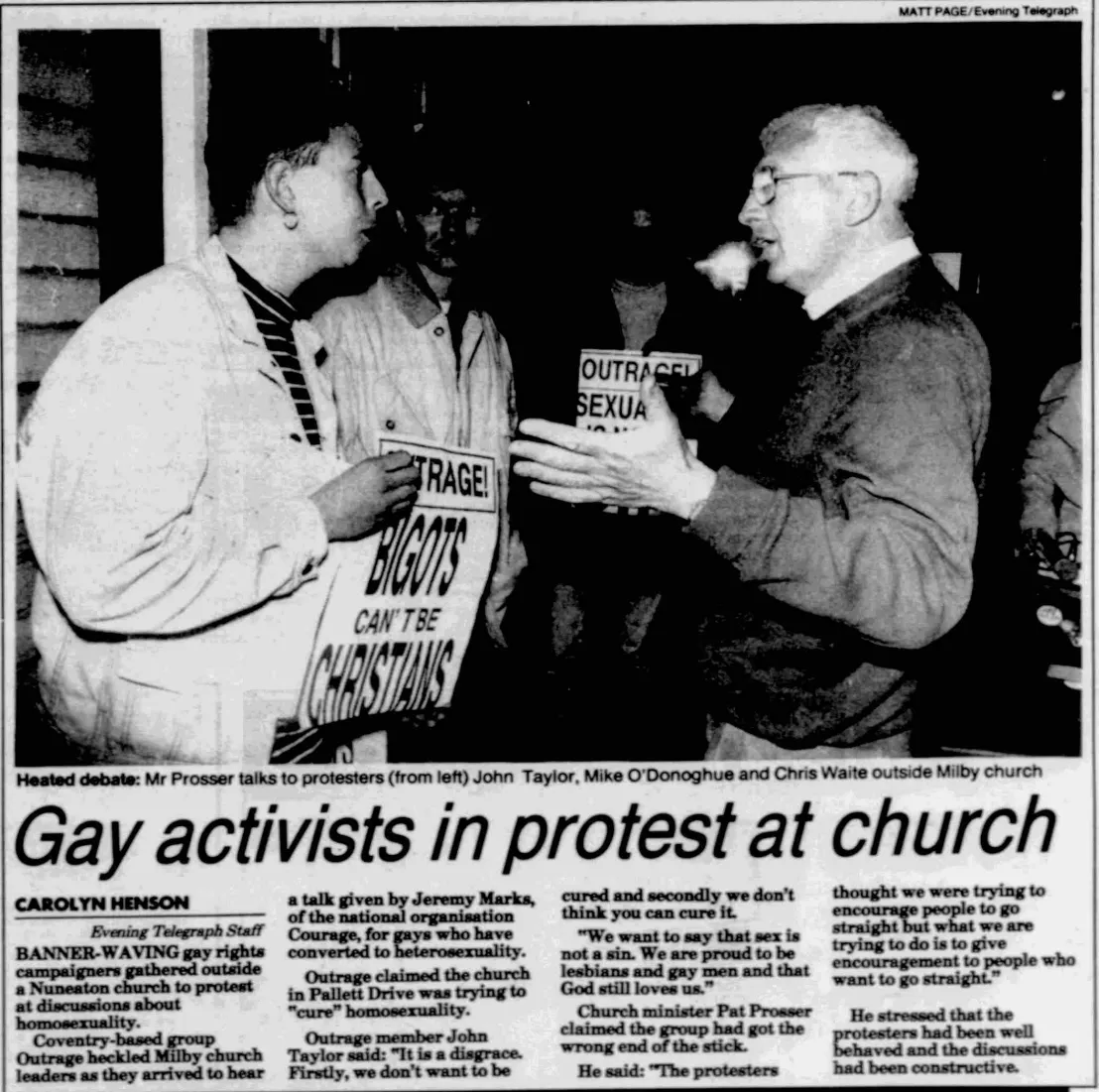
Coventry Evening Telegraph | 05 March 1992
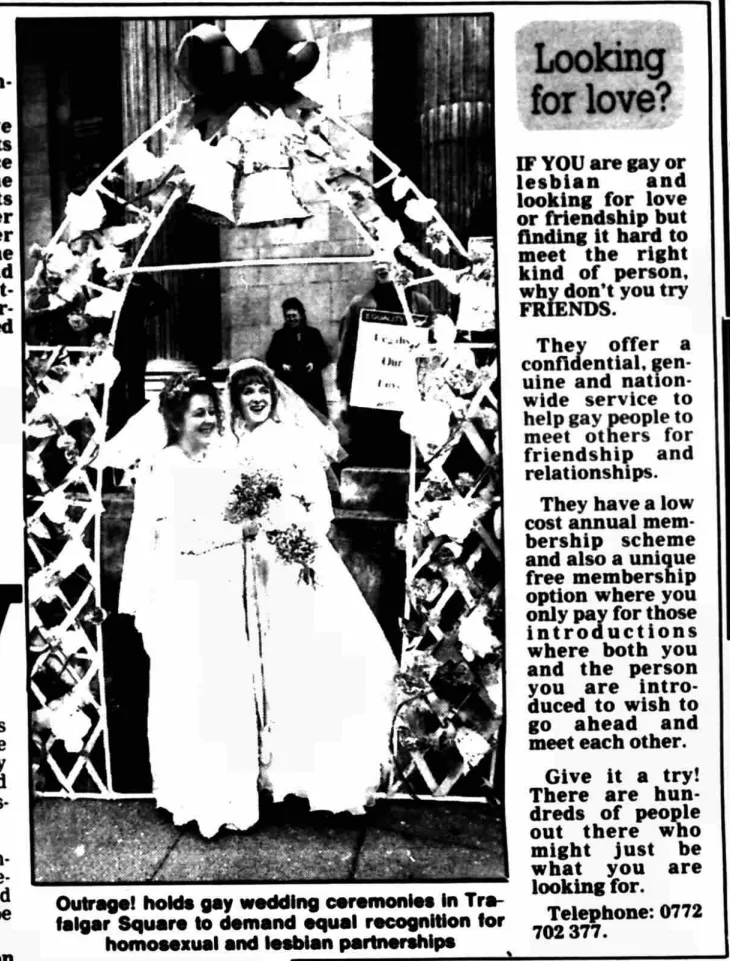
Activist groups such as OutRage! openly criticised measures used to suppress homosexuality. As part of their mission, they sent letters to Members of Parliament compelling them to come out, held gay wedding ceremonies in Trafalgar Square, and caused a widespread debate on the legality of ‘outing’ after the Bishop of London openly condemned the group for attempting to ‘expose him as a homosexual’.
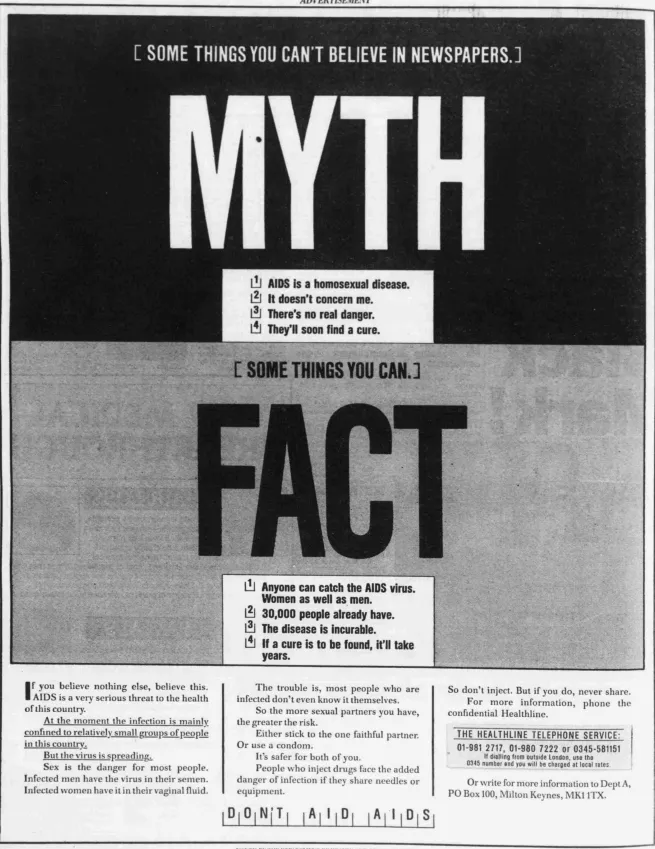
The Pride movement responded passionately to regressive legislation and negative stereotypes introduced in the 80s, fighting against a widespread culture of fear and misinformation that represented epidemics such as AIDS as a purely ‘gay disease’. Efforts were taken in various newspapers throughout the United Kingdom to destigmatise the virus, with a November 1986 edition of the Daily Star publishing a visually striking page, clearly stating fact from fiction. It openly acknowledged that newspapers often act as incubators for misconceptions, but in the worldwide battle against AIDS, the Daily Star aimed to spread the truth. Nonetheless, a destructively large number of individuals would continue to see AIDS as a disease caught only by homosexual men, with newspapers continuing to educate readers on the virus well into the 1990s and beyond.
Pride members continued to involve themselves in widespread political debates across Britain, for although public visibility of gay and lesbian individuals was rapidly increasing, seamless enmeshment and peaceful coexistence were still far in the future. At its roots, Pride remained a political battle, and activism was more important than ever. Alongside the political urgency, however, another current was flowing through the heart of the Pride movement: cultural celebration. As awareness grew, increasing numbers of events began to occur across the UK. People were beginning to realise the true potential of the movement, recognising its ability to foster hope through vivacity and self-expression.
“Out of the Closets and Into the Streets”
The power of the movement grew exponentially into the 90s. In 1991, Belfast experienced its first Pride event, with roughly 50 men and 25 women marching ‘from the Art College to Botanic Gardens under the banner “Gay Pride Belfast 1991”‘. The event was met with large opposition, as disruptors sought to prevent growing interest in a more permanent Northern Irish Pride.
Despite these attempts, Gay Pride Belfast would return in 1992, with Sunday Life reporting ‘more than 100 people’ present. Organisers were passionate about bringing the event to the city each year, although vicious harassment and violent assaults would persist.
Also in 1992, London held its first EuroPride, which the Westminster & Pimlico News ‘heralded as the lesbian and gay event of the decade’. This momentous march was attended by more than 100,000 people and was broadcast across thousands of televisions. EuroPride not only cemented the importance of community and collective action in raising awareness, but also emphasised the role played by television representation.
The Sunday Tribune would report on the London-based event on the 5th July 1992, affirming;
I watched 60,000 gay people march through London last Saturday on their way to a Europride Festival where they joined another 40,000 gay revellers…Had it not been for the Out programme, I would have no idea that such a huge demonstration had taken place. It was very moving. I kept thinking of gay people in Ireland, living at home, dying to switch on to Channel Four for their very own weekly news slot, but how do you do that with parents present? One hundred thousand people, all of them gay, dancing and singing and chattering away on British television and I only found it by accident…
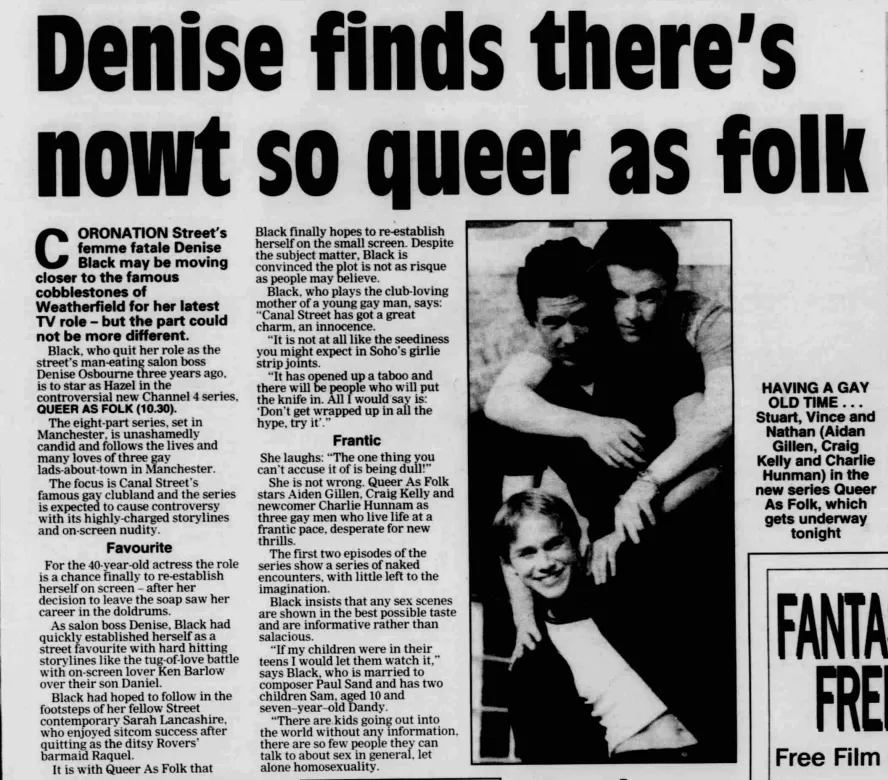
The significance of Channel Four’s, Out, alongside late-90s shows such as Queer as Folk and Will & Grace, would help propel gay people onto the screens of everyday television audiences. Media representation allowed gay people to exist both in real-world Pride events and in the homes of those who tuned in to watch the shows.
Hartlepool Northern Daily Mail | 23 February 1999
While television increased on-screen representation, Pride continued to evolve, expanding its inclusion and diversity within the community. On 17th July 1995, Scotland would hold its first large scale Pride event. Attendees marched through central Edinburgh and finished in the Meadows with a festival. In an edition of The Scotsman, Christopher Brown would report, ‘First it was New York and Sydney, Now its Edinburgh’s turn to look pretty in pink as Scotland’s own Gay Pride march takes place today’
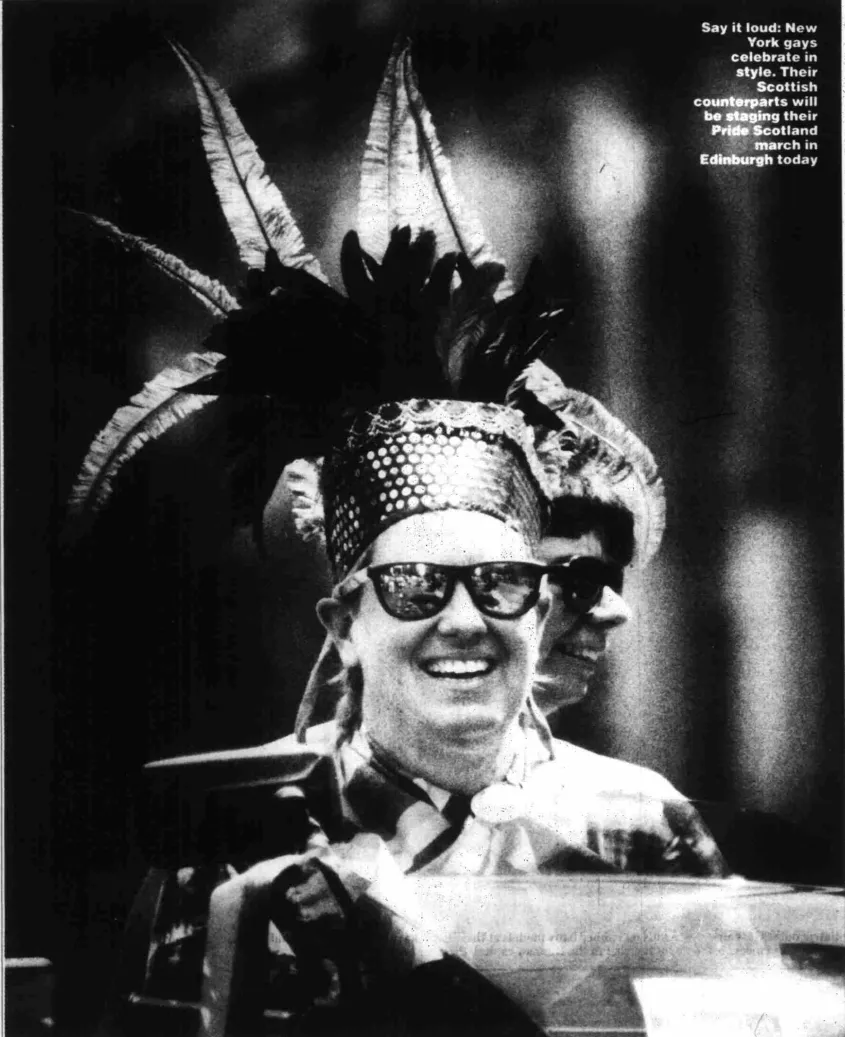
Scenes from New York Pride | The Scotsman | 17 June 1995
The Scotsman asked the question, ‘But why has it taken over a quarter of a century for Pride to take root in Scotland?’ to which Duncan Hothersall, chair of Pride Scotland, would respond ‘”I think there has just been a groundswell of interest…there was a distinct feeling among a group of us that it was time we had an event here, instead of always having to go to London, or the regional English Prides in places like Manchester, Brighton or Bristol”‘
“The important thing is to make our presence felt.”
Regardless of how long it had taken Pride to seep out of London and into further cities across the United Kingdom, the important thing was that the process had begun. Hothersall would go on to say,
“These days Pride is as much a celebration as it is a protest. It continues to fight for equality and it reclaims the space that is denied to us all other days of the year; that is an immensely powerful and political part of it. The other side is a celebration; of who we are and the people who came together to make it happen and, of course, all those who have helped us get this far.”
Indeed, the celebratory aspect of the Pride movement was its most captivating. People revelled in the possibility that self-expression and liberation could come in the form of joyous, colourful carnivals and fun days out with friends. Once this prospect was unlocked, Pride was unstoppable.
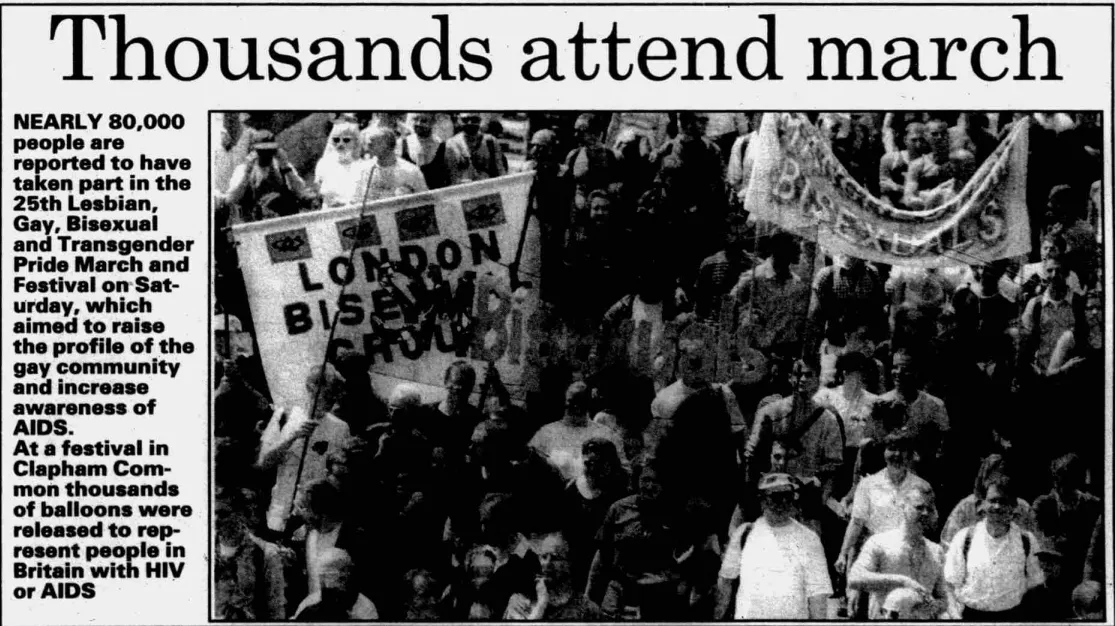
In 1996, the movement was renamed Lesbian, Gay, Bisexual, and Transgender Pride, and in the same year, became the biggest music festival in Europe. The London Gay Pride event of 1996 saw Boy George, ABBA tribute band Björn Again, Kylie Minogue, and several other performers take proudly to the stage. The event was so widely publicised that Sunday Life called it ‘one of the largest ever gay rights demonstrations in Britain.’
Leicester Daily Mercury | 08 July 1996
Pride would only continue to progress across the United Kingdom. In 1999, Cardiff held its first Mardi Gras festival, which was both a celebration of the gay rights movement, and a demonstration against police brutality and gay hate crime in Wales. Over 2,000 attended the festival, which has been known as Pride Cymru since 2014. Participation would climb as the years went on, and it remains Wales’s largest LGBTQ+ celebration to this day.
2000s: Repealing and Reclaiming the Narrative.
Another success for the Pride movement would occur in June 2000, when Scotland voted to repeal Section 28. This decision, however, was far from universally supported. Many considered the repeal of Section 28 as a danger to children, with the tenacious Keep The Clause campaign publishing in several regional and local newspapers across Scotland. A private referendum was held in order to combat political talks of repeal, and was funded and sustained by Brian Souter, the founder of Stagecoach. The referendum amassed over one million votes in favour of Section 28, although with almost four million ballots sent out, it was clear that an overwhelming majority did not care for it. The results were subsequently ignored by politicians, and talks of repeal would continue relatively unperturbed.
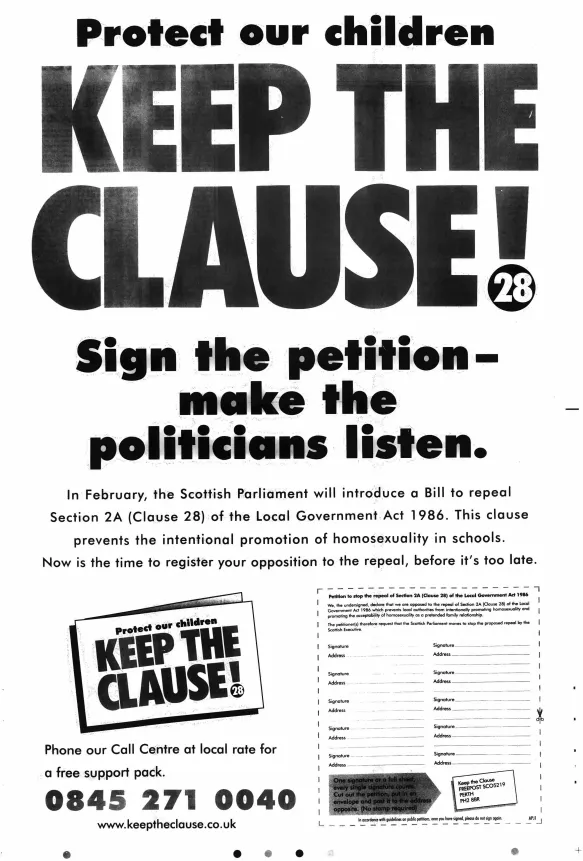
Aberdeen Press and Journal | 04 February 2000
Campaigns such as these serve to demonstrate the continued stigmatisation of homosexuality as hazardous rather than as a natural aspect of human identity. Documentation of the Keep The Clause movement in our newspapers illustrates that while LGBTQ+ rights were evolving, a defiant, bitter taste in the air would persist among select groups.
Once Section 28 was revoked, society began to gradually accept that public recognition or endorsement of homosexuality was not wrong, reframing the narrative instead as educational and liberating. In the same year, the legal age of consent was finally lowered from 18 to 16, and in November 2003, England and Wales would eventually follow Scotland’s lead with the repeal of the backwards clause.
In 2004, the Labour Government would introduce the Civil Partnership Act, which granted gay and lesbian couples similar legal rights to marriage, and was thus another step forward for LGBTQ+ rights. Kay Harrison, writing in the Hastings and St. Leonards Observer in April 2004, stated, ‘”It is true gays and lesbians are making massive strides forward with the repeal of Section 28 and the unveiling of new civil partnership laws. It is a very inspirational time, with such colourful changes.”‘
Things would continue to develop within the Pride community, as participation numbers would increase year on year, and the movement would open itself up for intersectional celebration. The United Kingdom’s first Black Pride occurred in August 2005, although it is important to recognise resistance from white peers in the planning of the event. The movement was not perfect; at times it was restrictive, angry, and unorganised, but it developed and improved as a result of its blunders.
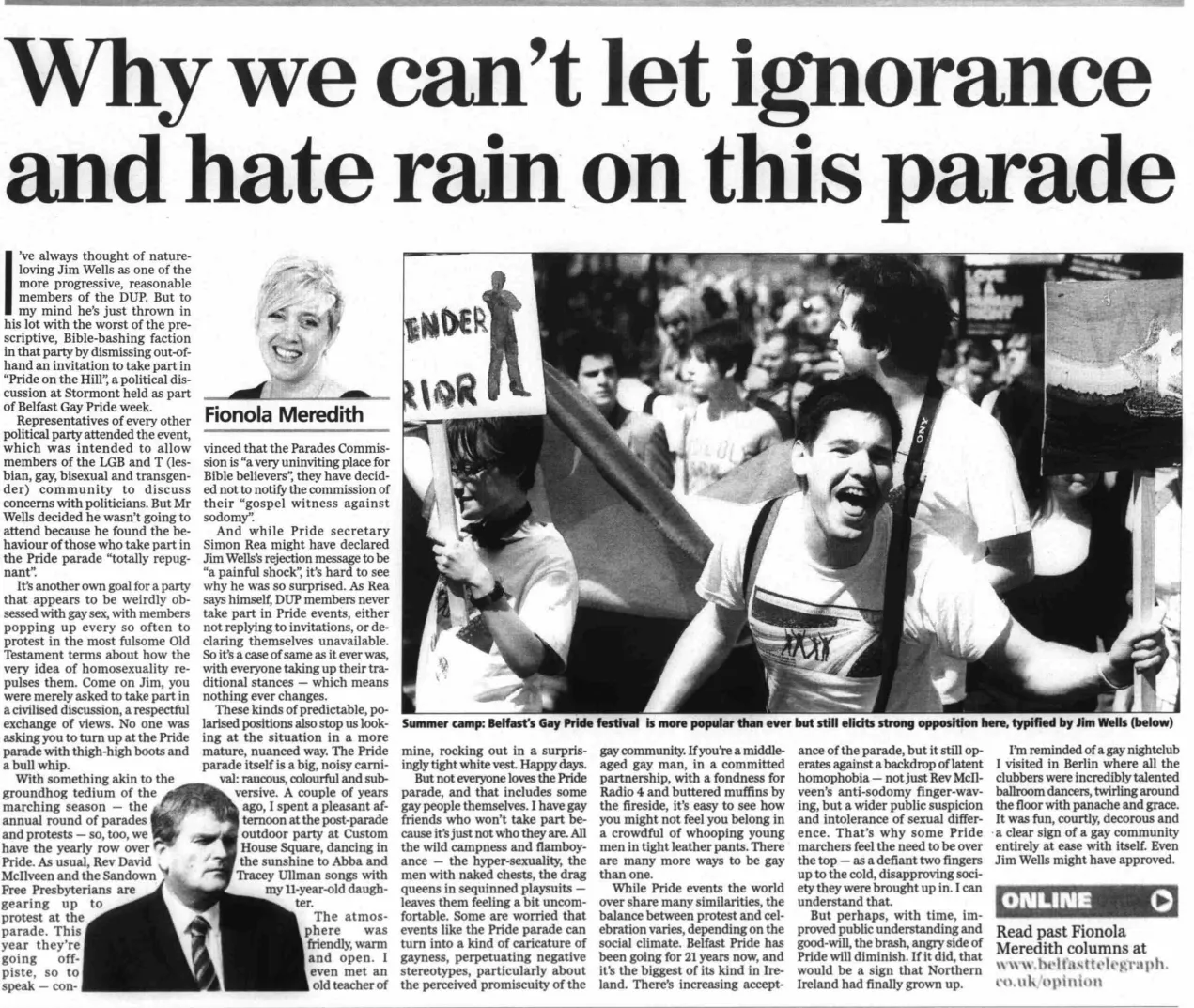
Belfast Telegraph | 27 July 2011
This is what makes Pride so attractive to participants. Since its inception, it has been spearheaded by humans, and only humans can be held accountable for its errors and successes. Pride has become synonymous with tangible connection, historical and cultural celebration, and wholehearted acceptance. Its intersectional development has only evolved, and in 2013, the United Kingdom held its first Trans Pride in Brighton.
In a July 2011 edition of the Belfast Telegraph, Kerry McKittrick and Laura McGarrity uncovered what it was like to be gay in Northern Ireland. They spoke to several gay individuals and asked them about their experiences. One interviewee, Thomas Parry, validated the importance of Pride for young gay people as they navigate their identity:
“Growing up I got bullied because of my sexuality and I never had much support from school….I only found out about Pride when I was around 18, but I wish I had known about it before because I could have really used the support and the community aspect of it. Belfast Pride is a great way to show a brighter side of the city and to highlight its culture, especially after the troubles we have all been through lately.”
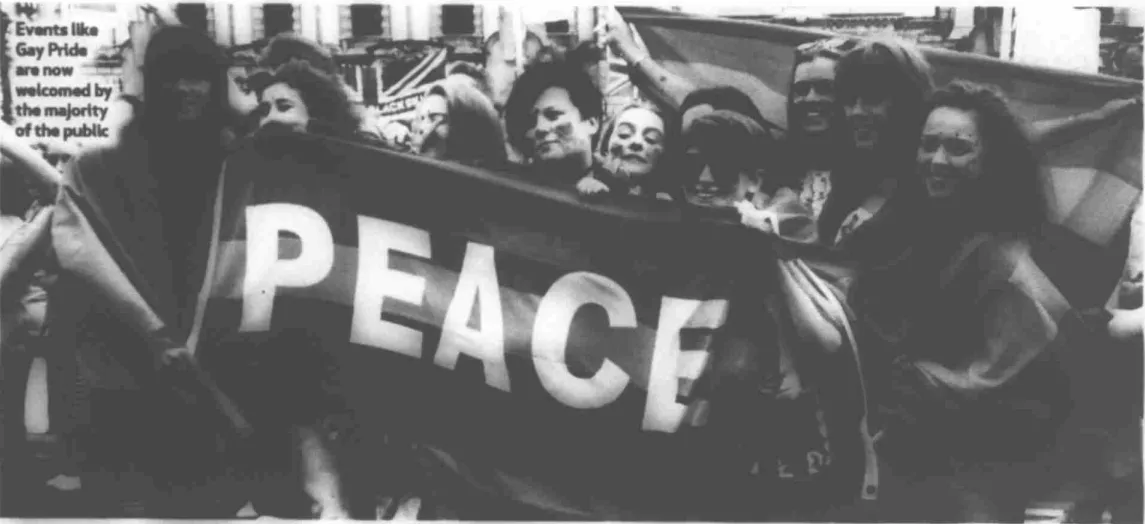
Belfast Telegraph | 31 January 2018
Pride is no longer a fixed, recorded series of events. It is a thriving, vivacious energy that exists in the air across the United Kingdom. The joy and celebration brought about by the Pride movement can be felt as a lingering presence throughout the year, but, when given the space, it truly comes to life each June.
Looking at Pride today, we still recognise the struggle for basic LGBTQ+ rights that has underpinned the movement since the 1969 Stonewall Riots. Our newspapers allow us to explore the shifting history of Pride as it has transitioned from a political protest to widespread cultural collaboration and exuberant self-expression. Nowadays, young people do not feel the sharp sting of Section 28, and are increasingly free to discover themselves in a world of acceptance and community.
Find out more about the history of the Pride movement, or search for a specific event in the pages of The Archive today.
More on this topic:
Share this article
About the author

Molly Pearce
Data Operations Executive
Published on Fri, 5 June 2026.