Hot Off The Press – New Titles This Week
Published on 16 March 2026 by Rose Staveley-Wadham
This week at The Archive we are marking St Patrick’s Day with the addition of five brand new Irish titles, and updates to 29 of our existing Irish titles, as we delve into a potential Oscar Wilde work, where all is not as it seems. Furthermore, in all, we’ve added 215,303 brand new pages to our collection, as The Archive continues to grow.
So read on to discover more about our new and updated titles of the week, and also to read a poem entitled ‘A Romanesque Sestine,’ with possible ties to Oscar Wilde, as we discuss whether it is indeed the Irish author’s work, or a parody.
Register now and explore The Archive
Blarney
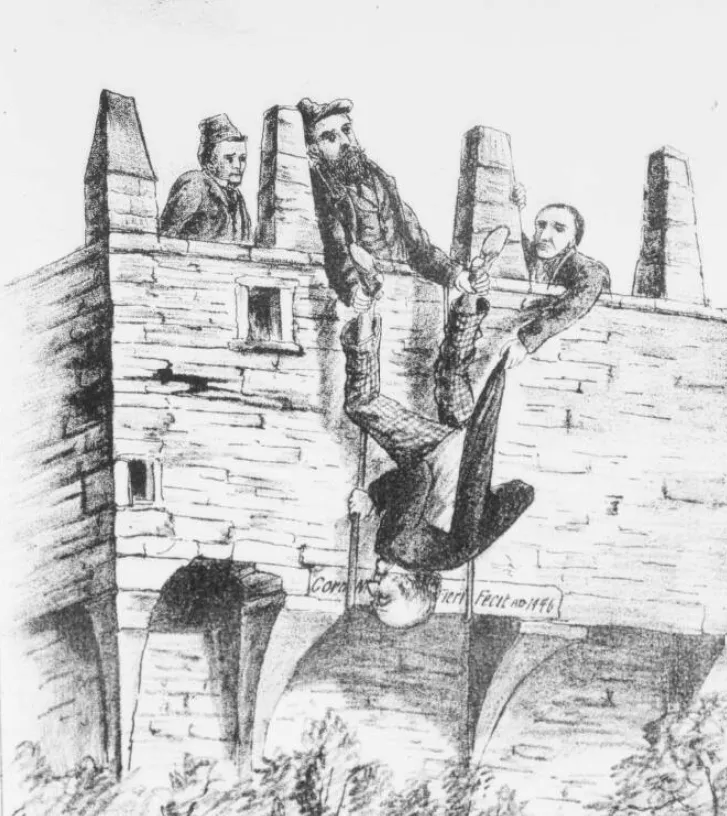
But before we delve into this potential Oscar Wilde work, we must first dive into our first new title of the week. Named Blarney, after the Irish slang term for smooth but also misleading talk, and from the Blarney Stone, famed for the legend that kissing it upside down grants one ‘the gift of the gab,’ the paper dubbed itself as ‘Ulster’s loyal comic journal.’
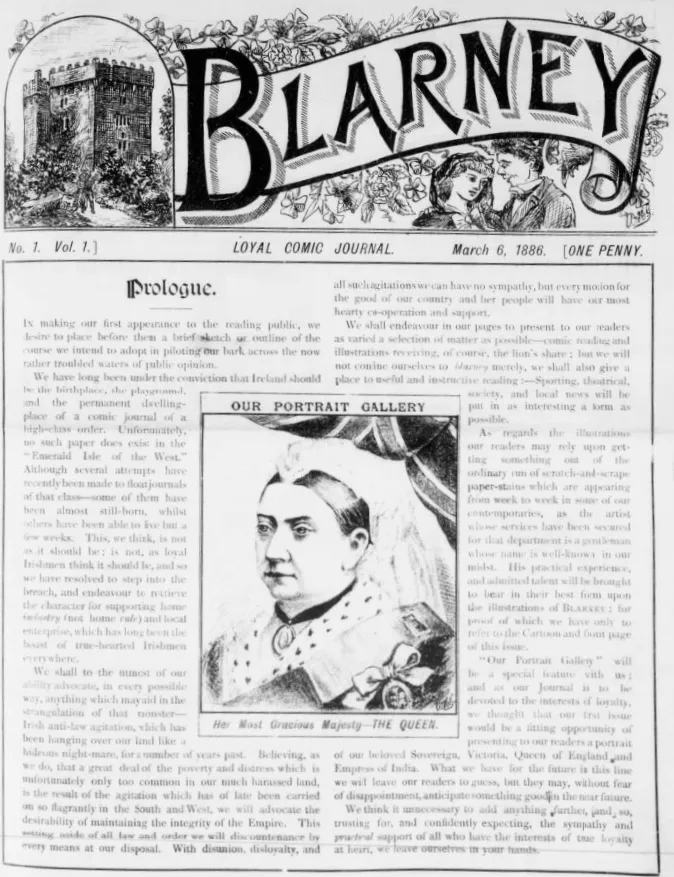
Blarney burst onto the publishing scene on 6 May 1886, regretting how no comic, high-class, journal existed in Ireland. It promised to be such a publication, whilst firmly tying its colours to the loyalist mast:
We shall to the utmost of our ability advocate, in every possible way, anything which may aid in the strangulation of that monster – Irish anti-law agitation, which has been hanging over our land like a hideous nightmare, for a number of years. Believing, as we do, that a great deal of poverty and distress which is unfortunately too common in our much harassed land, is the result of the agitation which has of late been carried on so flagrantly in the South West, we will advocate the desirability of maintaining the integrity of the Empire.
To hammer that point home, the first edition of Blarney featured a portrait of that indomitable symbol of empire, Queen Victoria, on its front page.
Published in Belfast every Saturday at the price of 1 d., Blarney filled sixteen pages with a variety of short comic paragraphs, accompanied by short stories, illustrations, poetry, and cartoons.
The Kilkenny People
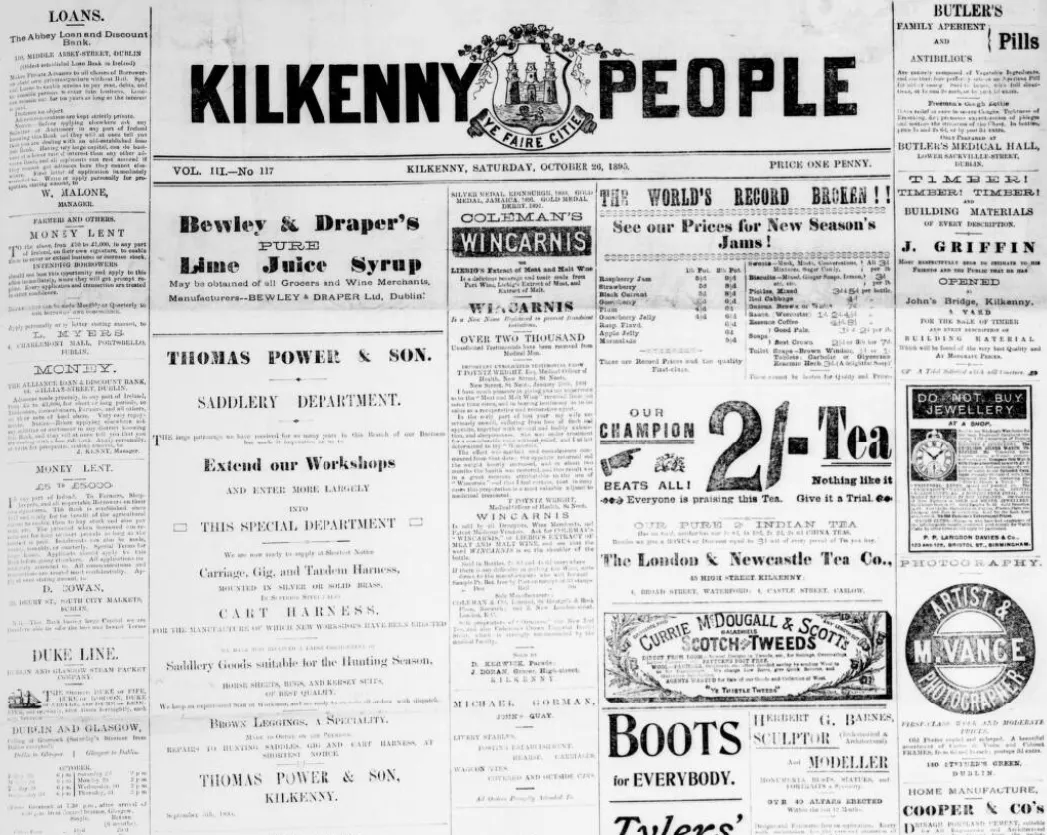
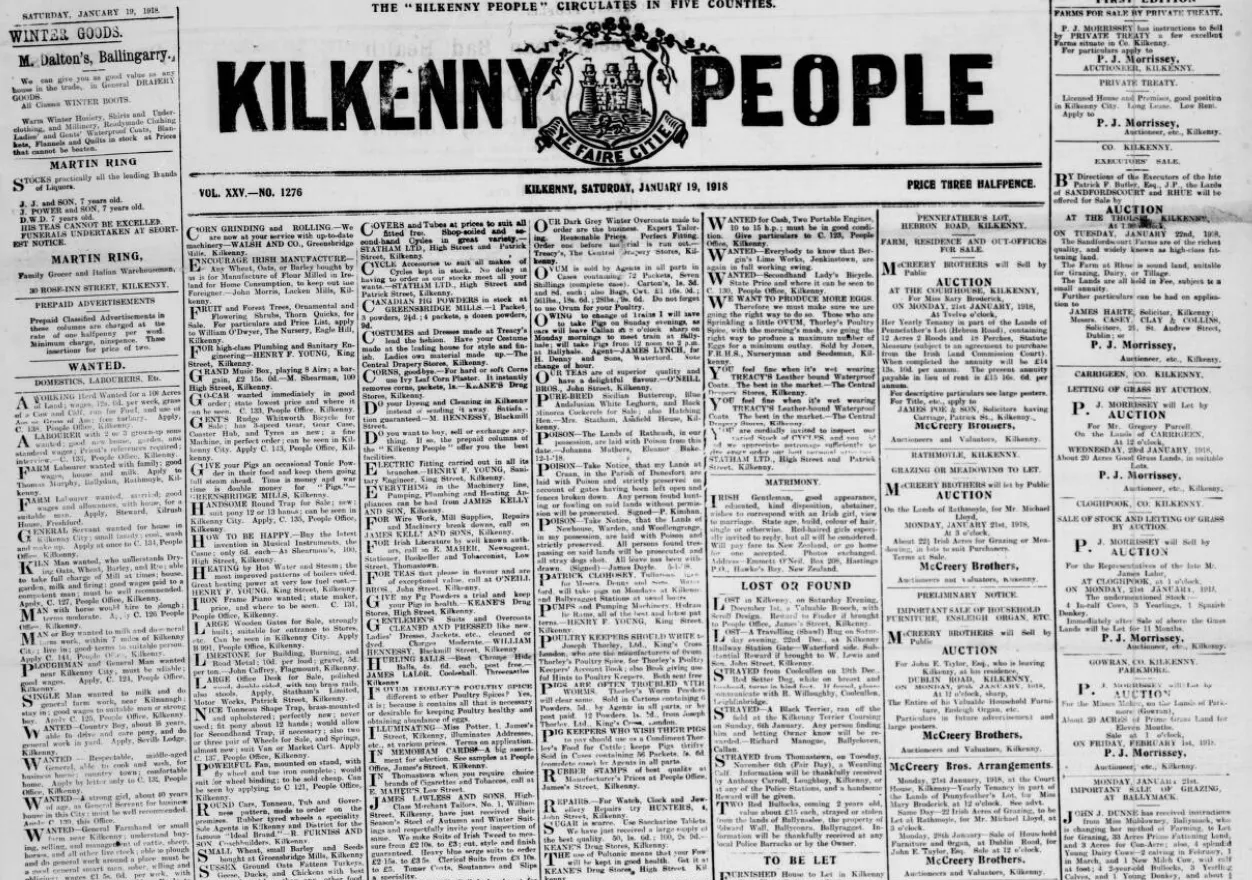
Taking quite a different political allegiance is the Kilkenny People, which was founded in 1893 by Edward Thomas Keane (1867-1945) and Patrick J. O’Keefe. From the outset, the Kilkenny People was a ‘Parnellite organ,’ supportive of the cause embodied by Charles Stewart Parnell (1846-1891), a key figure in the Irish Nationalist movement, and the leader of the Irish Parliamentary Party. This was in opposition to the Kilkenny Journal, which had become critical of Parnell.
For Keane and O’Keefe, the Kilkenny People represented a division of labours, with Keane taking on the editorial reins, and O’Keefe the commercial ones. As per Christopher Doughan’s work The Voice of the Provinces, Keane was known for being ‘forthright in his speech and writings.’ This reached a head after the Easter Rising in 1916, when Keane published an editorial piece in the Kilkenny Journal that criticised police action in the area:
Kilkenny appears to us to have been selected for an extra special dose of martial law. The ‘mailed fist’ and the cold steel seem to have been more strongly in evidence here than in any other part of Ireland outside the actual scenes of disturbance. What have we done to deserve all this? Is it that we have been too quiet? – shall we say too meek and subservient? Perhaps ‘the powers that be’ considered that ‘like a dog and a greenwood tree, the more they beat us the better we’ll be.’
Consequently, Keane was urged by the Press Censor Lord Decis to ‘moderate the tone of your paper,’ with Decis in July 1917 condemning the editor as ‘a decidedly dangerous class of man.’ Keane was not to be cowed in his cause of supporting Irish independence, going on to help elect W.T. Cosgrave (1880-1965) as the Sinn Féin M.P. for Kilkenny City in 1917. After this, the Kilkenny People was suppressed for fourteen weeks.
Still Keane persevered. In 1919 the newspaper was suppressed again after Keane was arrested and charged with the possession of two revolvers. In the same year the printing presses and equipment were removed from the Kilkenny People‘s offices. Keane’s resistance continued into the Second World War, when he was accused of undermining censorship laws. He edited the paper until his death in 1945.
So what did the pages of the Kilkenny People contain? Originally published every Saturday, and filling six to eight pages, the Kilkenny People printed the news from the Kilkenny area, featuring the latest from the Urban Sanitary Authority, the City Petty Sessions, the Town Court and the Kilkenny Union. Once published at the cost of one penny, Keane’s legacy continues to this day, as the Kilkenny People remains popular in the city and county of Kilkenny.
Magee’s Weekly Packet
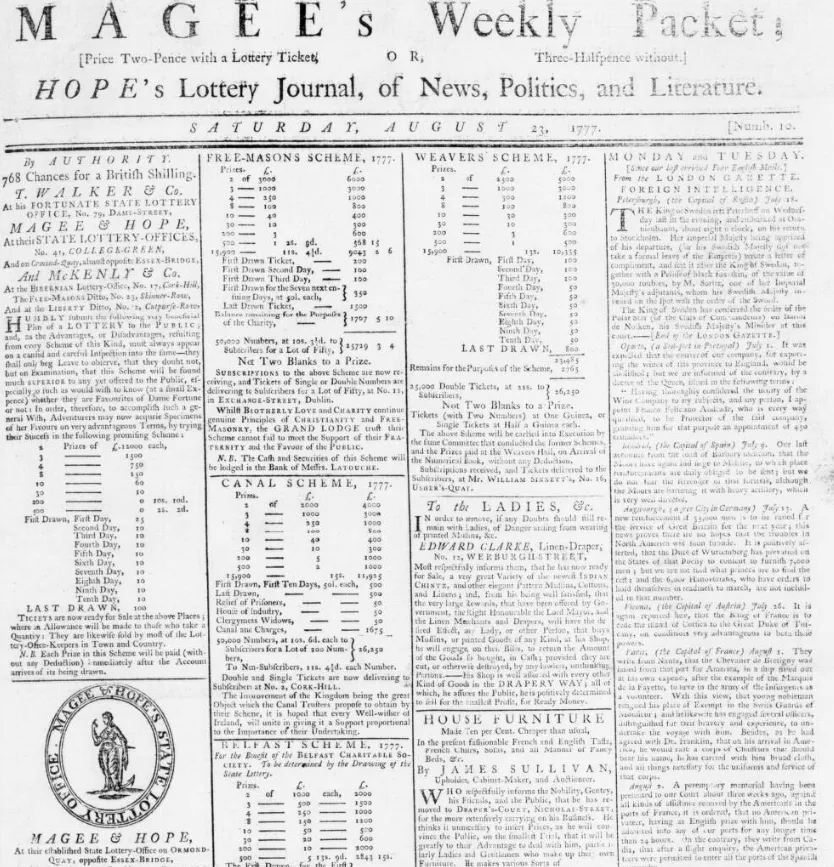
The editor of our next title also was arrested, the difference being that it was over one hundred years before E.T. Keane. Magee’s Weekly Packet was founded by John Magee (c.1750-1809) in Dublin, and was launched on 21 June 1777 as Magee’s Weekly Packet or Hope’s Lottery Journal, of News, Politics, and Literature.
Magee also owned and ran the Dublin Evening Post, but his eponymous publication appeared in Dublin every Saturday, filling four pages at the cost of two pence. Featuring foreign intelligence, with news from London and America, alongside domestic news, in 1789 the newspaper’s owner became famed for the attacks he made on the controversial figure, known as the ‘Sham Squire,’ Francis Higgins (1746-1802).
Higgins was a journalist in government pay and owner of the Freeman’s Journal, and for Magee’s remarks on his fellow journalist’s character, he was tried for libel. Chaos ensued. Thomas Brennan, also of the Freeman’s Journal and another of Magee’s targets, personally ransacked Magee’s home on 30 July 1789. Magee then arranged for a festival on 1 August 1789, Lammas day, beside the home of Viscount Clonmell, a further target. Providing free alcohol and putting on a ‘grand Olympic pig hunt,’ the event terrified Clonmell, who mistook the activities for a rebellion. This only spurred Magee on, and he advertised another gathering, before he was eventually imprisoned.
Supportive of the Patriot campaign for economic and political reform, and known for his lampooning of the Dublin Castle administration, John Magee was eventually imprisoned in Newgate in 1790. After his death in 1809, John Magee’s other publishing concern, the Dublin Evening Post, was carried on by his sons.
PAT (Dublin)
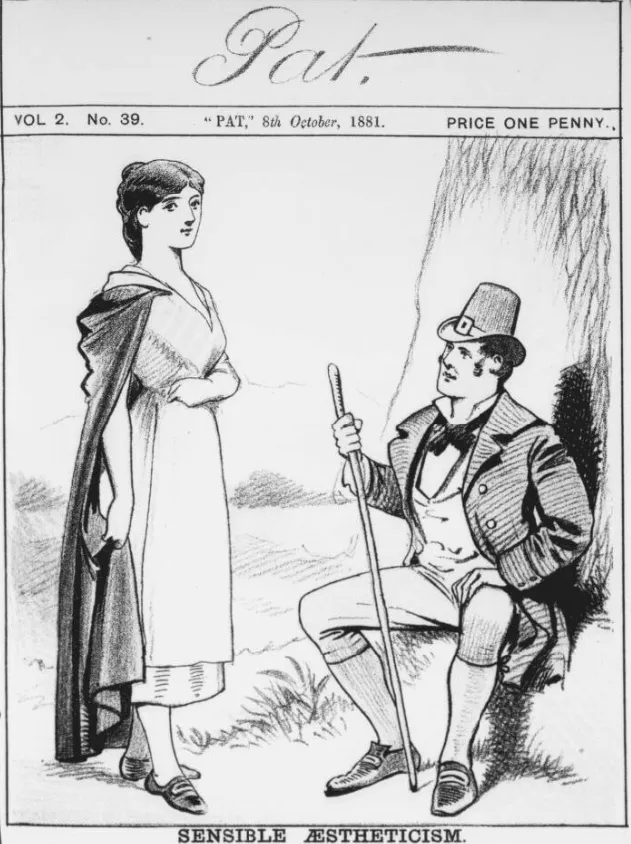
First published in late December 1879, PAT (Dublin) would go on to garner the reputation of being ‘the leading Dublin comic weekly.’ Originally costing 3 d., on 23 April 1881 the price of PAT was lowered to just 1 d.
Filled with jokes, puns and cartoons, spread out across short comic essays and paragraphs, PAT appeared every Saturday. Indeed, PAT was co-founded by cartoonist John Fergus O’Hea (c.1838-1922), who had also founded Zozimus in 1870, an Irish answer to Punch. Alongside Edwin Hamilton, O’Hea founded PAT, with his cartoons providing commentary on the political issues of the week.
With an illustrated front page, PAT also featured columns with a mix of comic and more serious commentary. In its ‘Pat in the Pit’ column it provided reviews of pantomimes and plays. PAT, which filled eight pages, ceased publication in 1883.
The World (Dublin)
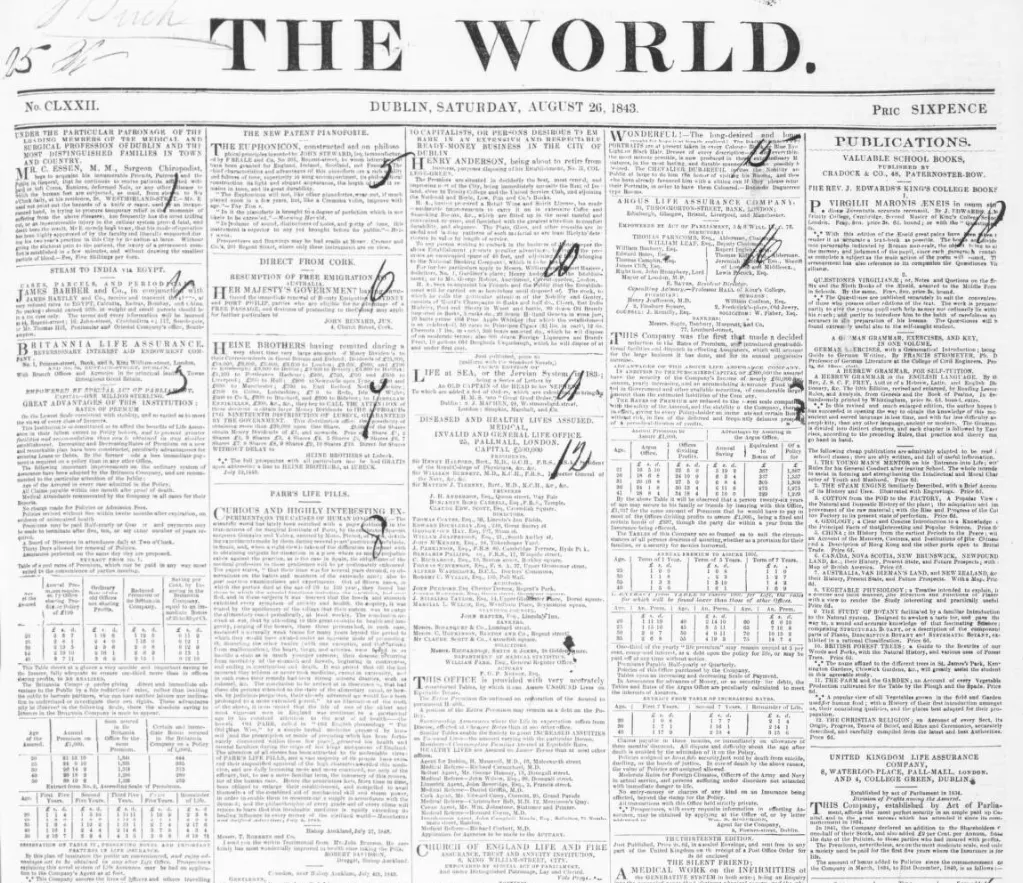
We end our trip around Ireland with the World (Dublin), which was described by the Blackburn Standard as a ‘very clever readable journal’ in October 1840. Established that same year, making its debut on 16 May 1840, the World was a Liberal Dublin paper that appeared every Saturday.
Indeed, the Newry Examiner and Louth Advertiser on 21 November 1840 described the World as ‘professing Radical principles.’
But what filled the eight pages of the World? The Dublin newspaper printed an array of international, domestic and parliamentary news, alongside special ‘world’ columns devoted to the sporting, literary and legal worlds. Meanwhile, the World also printed news from the navy and the church.
Our updated titles
This week have updated our existing titles from across Northern Ireland and the Republic of Ireland. Our largest update of the week is to the Waterford Mail, which sees over 28,000 brand new pages join its ranks, whilst the Irish Field and the Skibbereen & West Carbery Eagle both have over 18,000 brand new pages joining them. Meanwhile, you’ll also find exciting updates to some of our more specialist titles, with new pages being added to the Belfast Linen Trade Circular, the Dublin Hospital Gazette and the Irish Textile Journal.
‘A Romanesque Sestine’ – by Wilde O’Scar or Oscar Wilde?
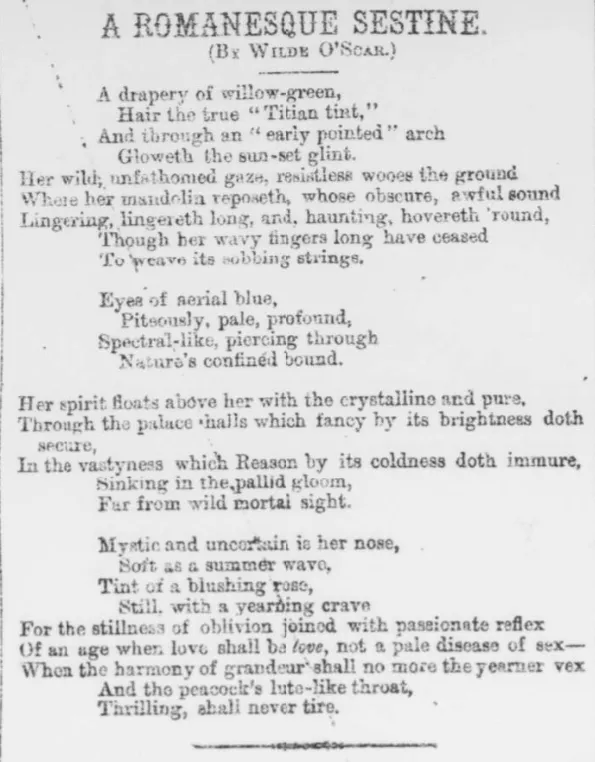
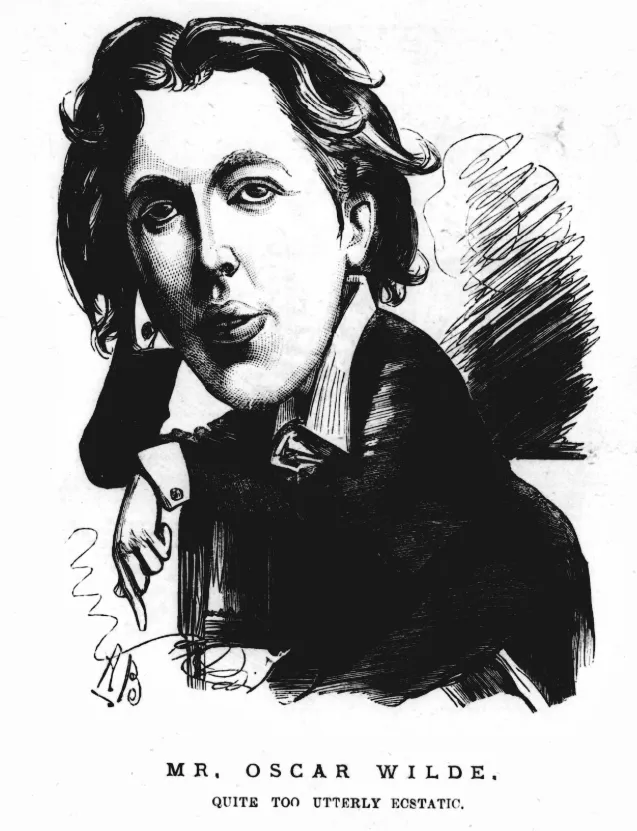
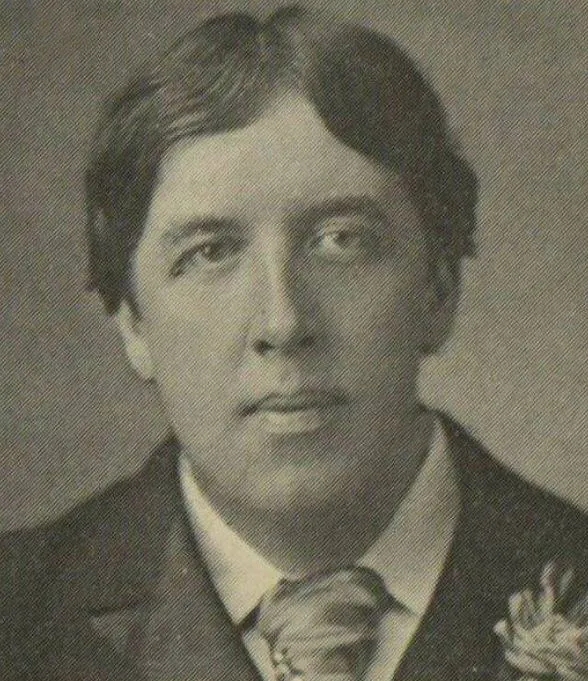
Whilst perusing the pages of our new title PAT, the Dublin comic paper, we came across a poem entitled ‘A Romanesque Sestine,’ with the author’s name given as Wilde O’Scar. Of course, this name immediately brought to mind the Irish author Oscar Wilde (1854-1900), whose ultimately tragic life dominated the headlines of the late Victorian period.
We wondered, given the poem and this attribution, could this be a work submitted by Oscar Wilde himself, under a pseudonym? Or, given the paper’s reputation as a comic publication, was it more likely to be a parody of the author?
The poem was published in PAT on Christmas Eve 1882. Although this was well before his success as a playwright, by 1882 Oscar Wilde was already well known in the press as a devotee of the Aesthetic Movement, which placed ‘art for art’s sake’ at the centre of its doctrine. Therefore, the investigation of the context of the poem becomes extremely important. Given Wilde’s growing notoriety, the fact that he had given a tour of the United States and that had been mocked within the press, it would appear that ‘A Romanesque Sestine’ may well be a parody, rather than a genuine Oscar Wilde work.
Let’s look at the poem itself. Its themes of languid women, musical instruments, and Renaissance imagery all tally with poetry of the Aesthetic Movement. However, given how densely layered these themes are, is there a touch of overkill, which would lean towards the poem being a parody?
Use of phrases such as ‘Titian tint’ and ‘early pointed arch’ within quote marks emphasise their Aesthetic ties, and indeed, ‘early pointed arch’ sounds like something out of a textbook on Gothic architecture. Furthermore, the repeated use of pseudo-medieval diction like ‘gloweth’ and ‘hovereth’ points to a parody, with the phrase ‘lingering, lingereth’ drumming that point home.
Indeed, the poem almost borders on the comic with the line ‘mystic and uncertain is her nose.’ And perhaps the clue as to the origins of the poem lies in the most obvious of places, the title. A sestine, or a sestina, is a tightly structured poem of Italian origins, with six repeating end words, known as being an extremely form. This poem does not fit the mould of a sestine.
Finally, we have that attribution, ‘Wilde O’Scar.’ A clever play on Oscar Wilde’s name, given Wilde’s fame by 1882, and the fact he had already published a volume of poetry a year before in 1881, why would he need to publish under a pseudonym? This would lead us to think that the poem was a parody, although, there is always a chance that the great author was having a joke at his own expense.
Discover more about Oscar Wilde, changing reactions to the author after his death, and much more besides, in the pages of our Archive today.
New Titles
Title | Years Added |
1886 | |
1895, 1898, 1905-1919 | |
1777-1785, 1787-1790, 1792-1793 | |
1881-1882 | |
1840-1851 |
Updated Titles
This week we have updated 29 of our existing titles.
You can learn more about each of the titles we add to every week by clicking on their names. On each paper’s title page, you can read a free sample issue, learn more about our current holdings, and our plans for digitisation.
Title | Years Added |
1850-1857, 1871-1873, 1890-1896 | |
1852-1856, 1858-1877, 1880-1884 | |
2015-2018 | |
1963 | |
1910-1915 | |
1874-1881, 1883-1884, 1887-1896 | |
1883-1885 | |
1845-1846, 1854 | |
1926 | |
1918 | |
1863-1864 | |
1830-1839 | |
1870-1880, 1888-1896, 1911 | |
1886-1892, 1895-1896 | |
1885 | |
1871-1879, 1896 | |
1878-1879, 1885-1899 | |
1890-1906, 1908-1920, 1922 | |
1872-1880, 1882-1884, 1887-1890, 1892-1896, 1914, 1916-1919 | |
1975 | |
1898-1929, 1931-1936 | |
1870, 1872-1874, 1876-1882, 1884-1885, 1887-1921 | |
1873-1878, 1883-1909, 1911 | |
1902-1909 | |
1870, 1872-1896 | |
1808-1809, 1813, 1827-1836, 1841-1843 | |
1872-1880, 1882, 1884, 1886-1896 | |
1913-1920 | |
1835-1840 |
You can keep up to date with all the latest additions by visiting the recently added page. You can even look ahead to see what we’re going to add tomorrow.
More on this topic:
Share this article
About the author

Rose Staveley-Wadham
Newspaper Licensing Manager
Published on Mon, 16 March 2026.