Hot Off The Press – New Titles This Week
Published on 10 March 2026 by Molly Pearce
With one week to go until St Patrick’s day, we at The Archive are turning our focus across the water to Ireland for this week’s titles. We will uncover how Cork Free Press was involved in a printing disgrace following an editorial disagreement, with the paper eventually being brought to an end following an act of suppression by the British authorities. Additionally, newly added pages from the Belfast Telegraph allow us to dive into the passage of the Thirty-fourth Amendment of the Constitution (Marriage Equality) Act 2015, which made Ireland the first country to approve same-sex marriage by popular vote. With four brand new titles and twenty one updated titles, we’re bringing you a grand total of 200,362 pages from all over Ireland and Northern Ireland.
Register now and explore The Archive
Cork Free Press
Our first new title for this week at The Archive is the fascinating Cork Free Press. It was published between June 1910 and December 1916 and was founded by William O’Brien, a nationalist MP who utilised the paper as a political mouthpiece.
O’Brien believed that the value of newspapers lied in their ability to become an extension of one’s political beliefs, acting as a sort of external organ for the advocacy of political change. Therefore, if you take a look at the Cork Free Press, you will see that many of its pages include reports on government affairs, death reports, and political protest meeting locations.
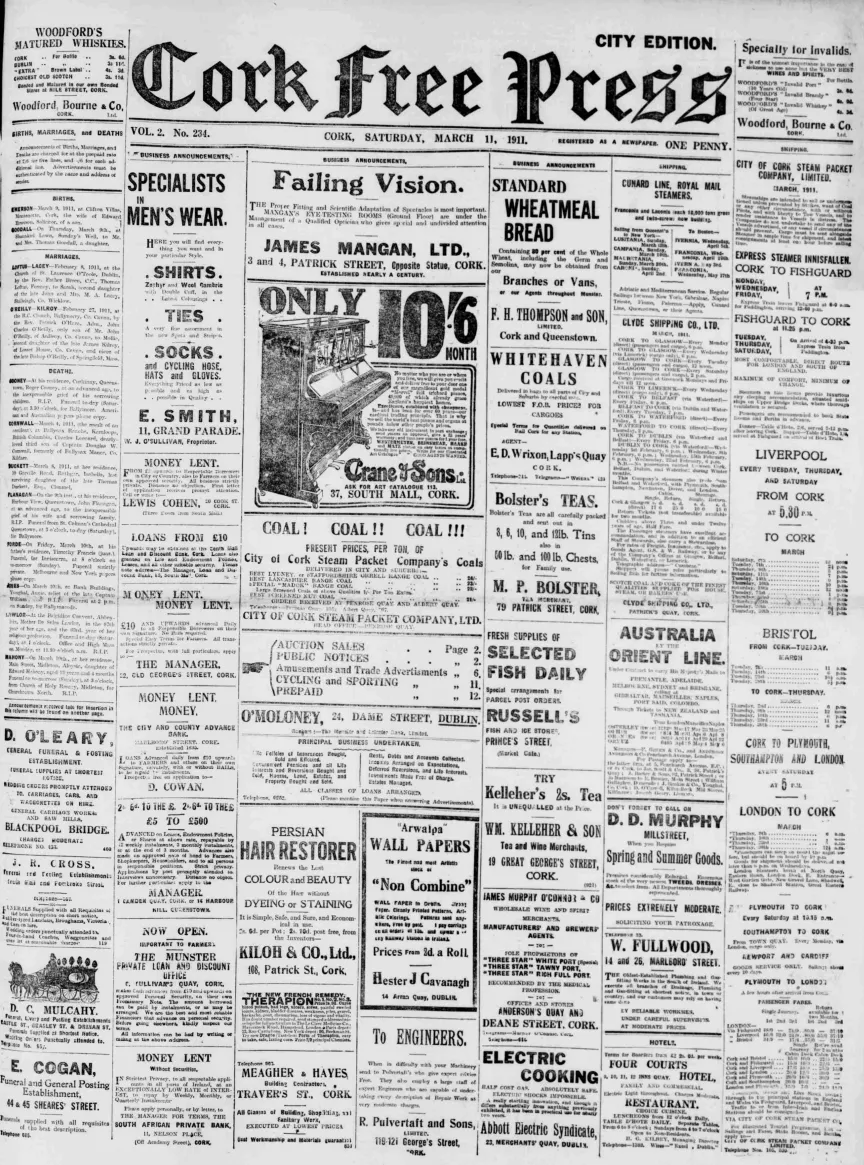
Cork Free Press | 11 March 1911
The title started off as a daily publication, but rising economic losses and shortages in paper forced it to change to a weekly publication mid-1915. Cork Free Press was edited by three men during its run: John Herlihy (1863-1941), Hugh O’Grady (1874-1932) and Frank Gallagher (1893-1962). It was eventually suppressed by the British authorities after Gallagher continued to publish articles about the condition of republican prisoners in the Welsh internment camp at Frongoch.
During the First World War and the 1916 Easter Rising in Ireland, Frongoch was utilised as a makeshift imprisonment camp, and it housed around 1,800 Irish Republicans at its peak. Many complaints were made about the treatment of the prisoners living in the camp, and an investigation was reported to have been carried out on its condition. In a report located within a December 1916 issue of one of this week’s updated titles, Northern Whig, Sir G. Cave was asked about the inquiry. He remarked that the senior medical offer at the camp, who ‘had carried out his duties very effectively and had shown much kindness to the prisoners, was found drowned near Bala’. Cave mentioned suspected suicide as the cause of his death, stating the man as ‘much worried by certain unfounded charges made against him and his staff’.
Each editor of the Cork Free Press has his own fascinating story, but today we will focus on the title’s first, John Herlihy. He had previously edited the post-1904 incarnation of O’Brien’s Dublin-based weekly paper, the Irish People. Soon after the Cork Free Press commenced its daily publication, Herlihy and O’Brien would have a falling out. Herlihy had thought that it would be a good idea to equip the paper with newly developed monotype technology, rather than linotype machines. The difference between the two is vast – linotype sets a whole line of metal type for printing; monotype sets it word by word. As such, monotype is better suited for the slower process of book production than for the high-volume and fast-paced nature of newspaper publishing, as it allows much greater scope for error. The Cork Free Press became notorious for misprints, subsequently leading to Herlihy being fired. In vain, he attempted to sue for unfair dismissal and soon went bankrupt. He remained active in London journalism, however, and in the mid-1930s edited the Irish Press for a year.
Saturday Record (Ennis)
The Saturday Record was published in Ennis, County Clare, and was founded in September 1885. The paper ran for half a century until its final publication in December 1936.
The only authorised agent in Dublin for the Saturday Record was tobacconist and radical political activist, Thomas Clarke. Clarke’s history is extensive, and it was believed that he was the person held most accountable for the infamous 1916 Easter Rising. He was a driving force in the formation of the rising, openly opposing a surrender, but was subsequently outvoted. He met his end at Kilmainham Gaol, where he was one of three rebels executed on May 3, 1916.
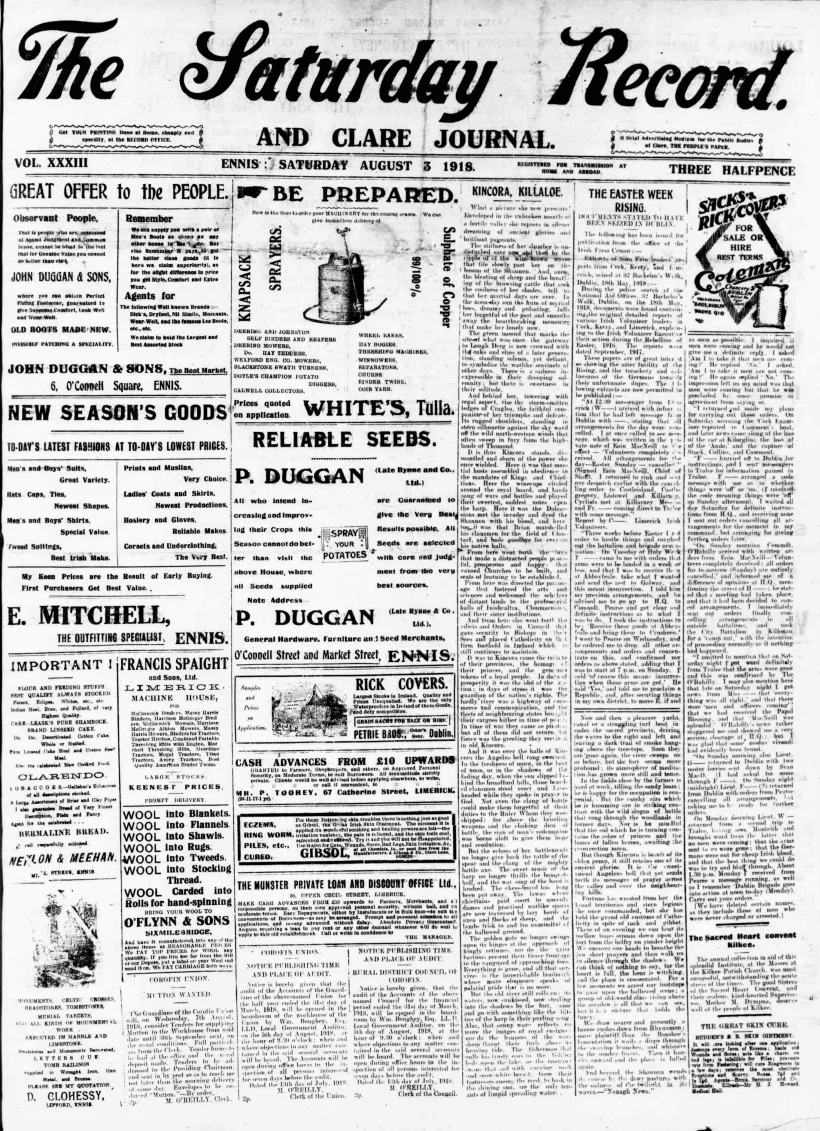
Saturday Record (Ennis) | 03 August 1918
Keeping its publications short, the Saturday Record delivered information to its readership on all matters relevant to County Clare. From advertisements to death and crime records, you can find the history of events in this area of Ireland within the pages of the Saturday Record. Additionally, the paper cost three halfpence, and (as its same suggests) was published every single Saturday.
Ulster Times
Next on our list of new titles is Ulster Times. You may have noticed our updated title, Ulster Weekly News, and other titles with similar names already on our site, Ulster Echo and Ulster Star, but our new title differs from all of these.
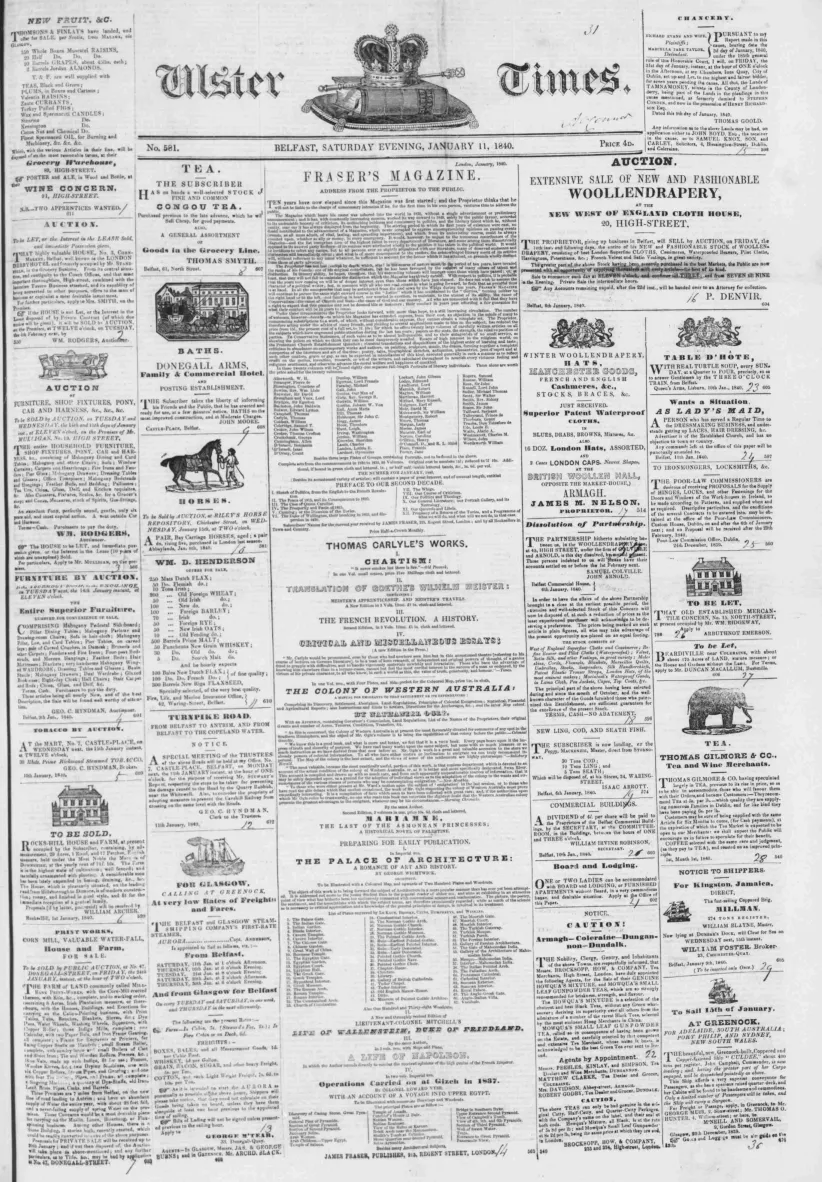
Published in Belfast every Tuesday, Thursday and Saturday morning, this paper provided information on stocks, business advertisements, international affairs, and even literature. On the fourth and final page of each issue, Ulster Times featured a piece of poetry.
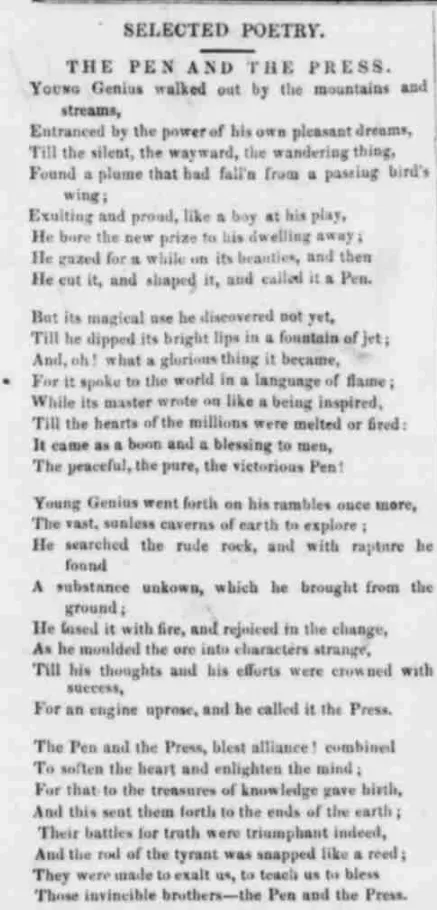
Ulster Times | 11 January 1842
On occasion, the final page of the title would also promote a new literary publication for the month. The promotion found in the above January 11, 1842 issue was University Magazine, Dublin, which;
opens with “chapters on Ghostcraft”, in which a number of German works on Ghost and Ghostseers are reviewed. The Germans are either too metaphysical for us, or else we are a too much matter of fact people for the Germans.
If you hadn’t guessed already, ‘Ghostcraft‘ refers to the knowledge or procedure of interacting with and understanding ghosts, often with the intention of proving their reality. The term is not used anywhere near as much in today’s language, as we opt instead for ‘ghost hunting’ or ‘paranormal investigator’. This a prime example of how the pages found within The Archive act as fascinating timestamps of discipline terminology throughout history.
Western News and Galway Leader
The final title to complete our set of new titles for the week is the Western News and Galway Leader. We have added over 10,000 new pages, with various years available between 1878-1926. Each issue of this title contained four packed pages, covering everything from advertisements, and agricultural news, to foreign affairs.
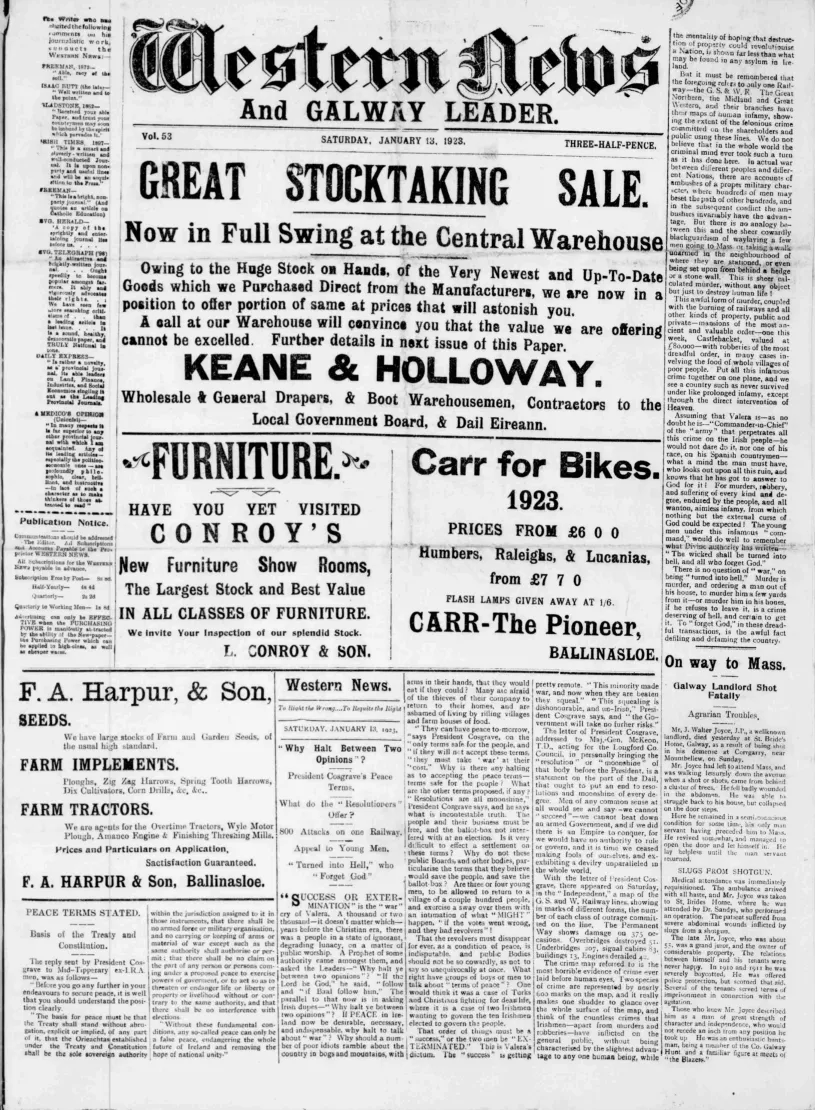
Western News and Galway Leader |13 January 1923
The Western News and Galway Leader was published every Saturday and throughout the years, its front page changed design multiple times. In the 1920s, it featured one large advertisement and many other smaller ones, which allowed businesses to utilise the space for their own promotion. If you search the many front covers in the collection, you will see several issues without an advert, the space instead left empty.
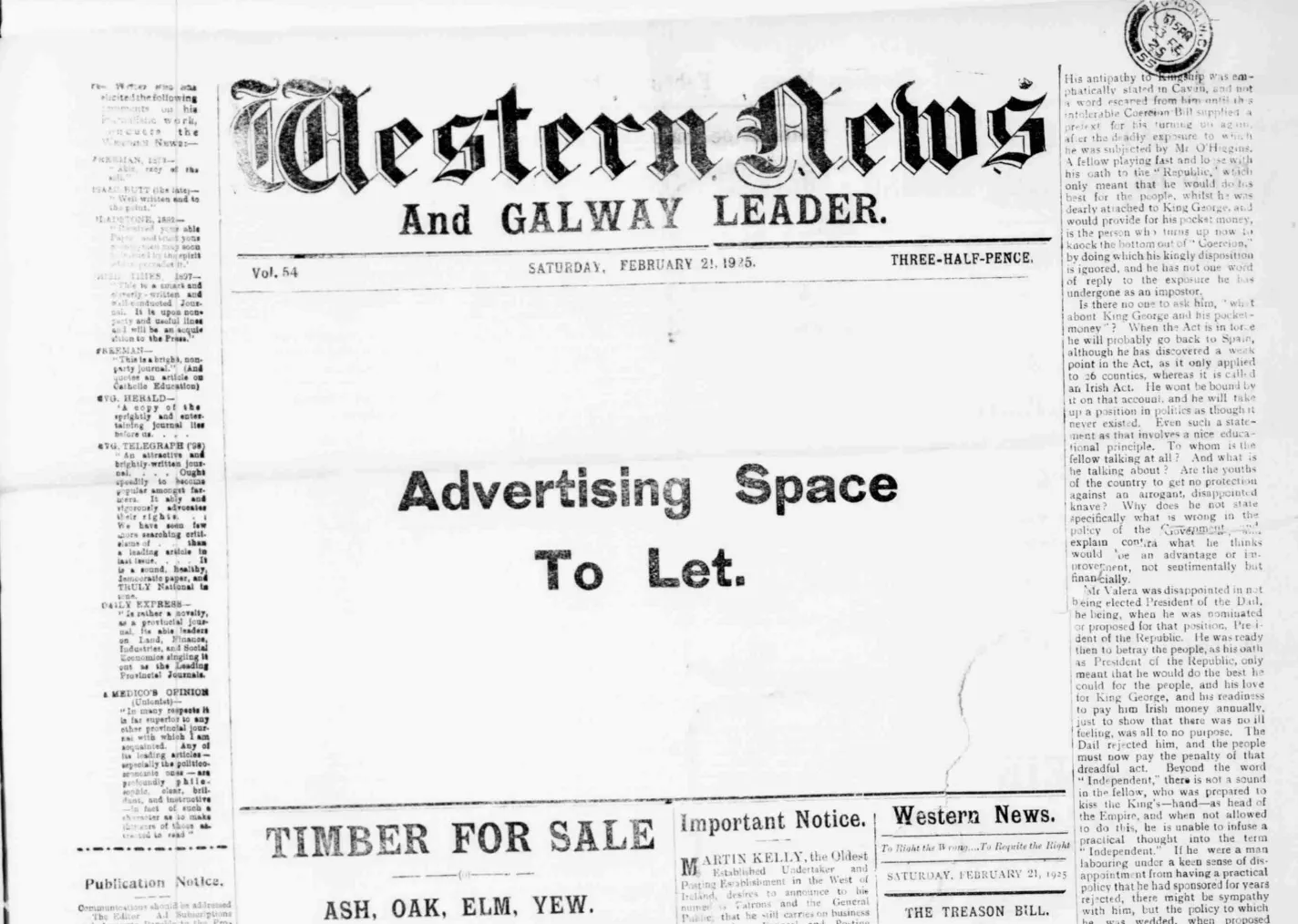
Western News and Galway Leader | 21 February 1925
Our Updated Titles
This week we have twenty one updated titles for you to get stuck into. With over 200,000 brand new pages to explore this week, you won’t be leaving without learning something new about Ireland or Northern Ireland . We’ve added 52,010 pages to the beloved Belfast Telegraph this week, alongside 20,868 brand new pages of the Waterford Mail spanning 1872-1894. As well as this, special interest title Whiskey Trade Review (Dublin) can now be viewed for the year 1896.
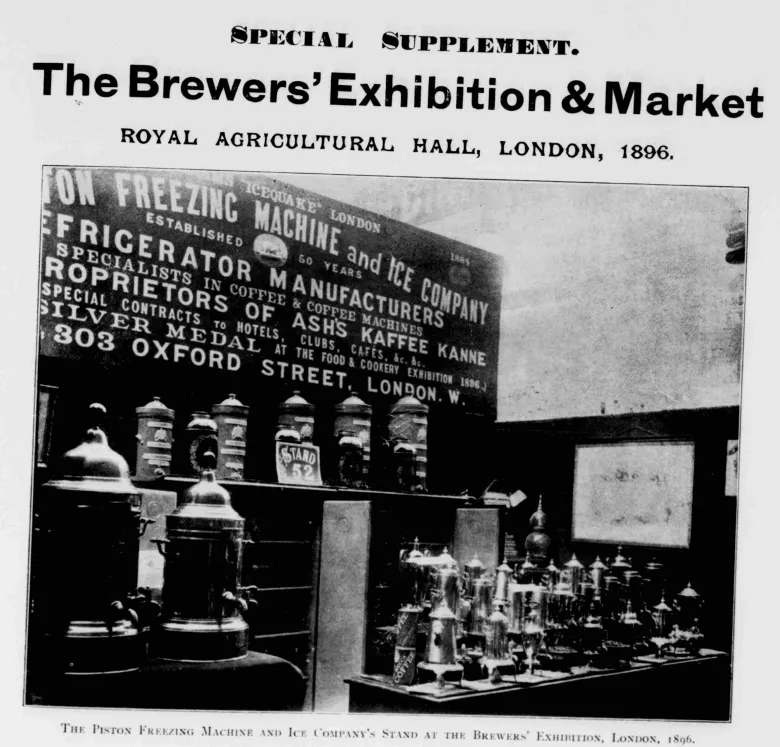
Whiskey Trade Review (Dublin) | 18 December 1896
Same-Sex Marriage Referendum
On Friday, 22 May 2015, Ireland officially approved the passage of The Thirty-fourth Amendment of the Constitution Act, with upwards of 1.2 million people voting in its favour. This made Ireland the first to permit same-sex marriage through a popular vote, letting its people use their voice to promote change. The Yes vote triumphed by 62% to 38%, with thousands taking to the street in celebration. The event marked a significant historical moment in Irish history, setting a precedent for other countries. The Thirty-fourth Amendment of the Constitution formally altered the Constitution of Ireland to permit marriage to be contracted by two persons without distinction as to their sex.
The Belfast Telegraph was one of many newspaper publications that reported on the momentous occasion. The overwhelming consensus was that now the Republic had passed such an Act, that Northern Ireland should soon follow.
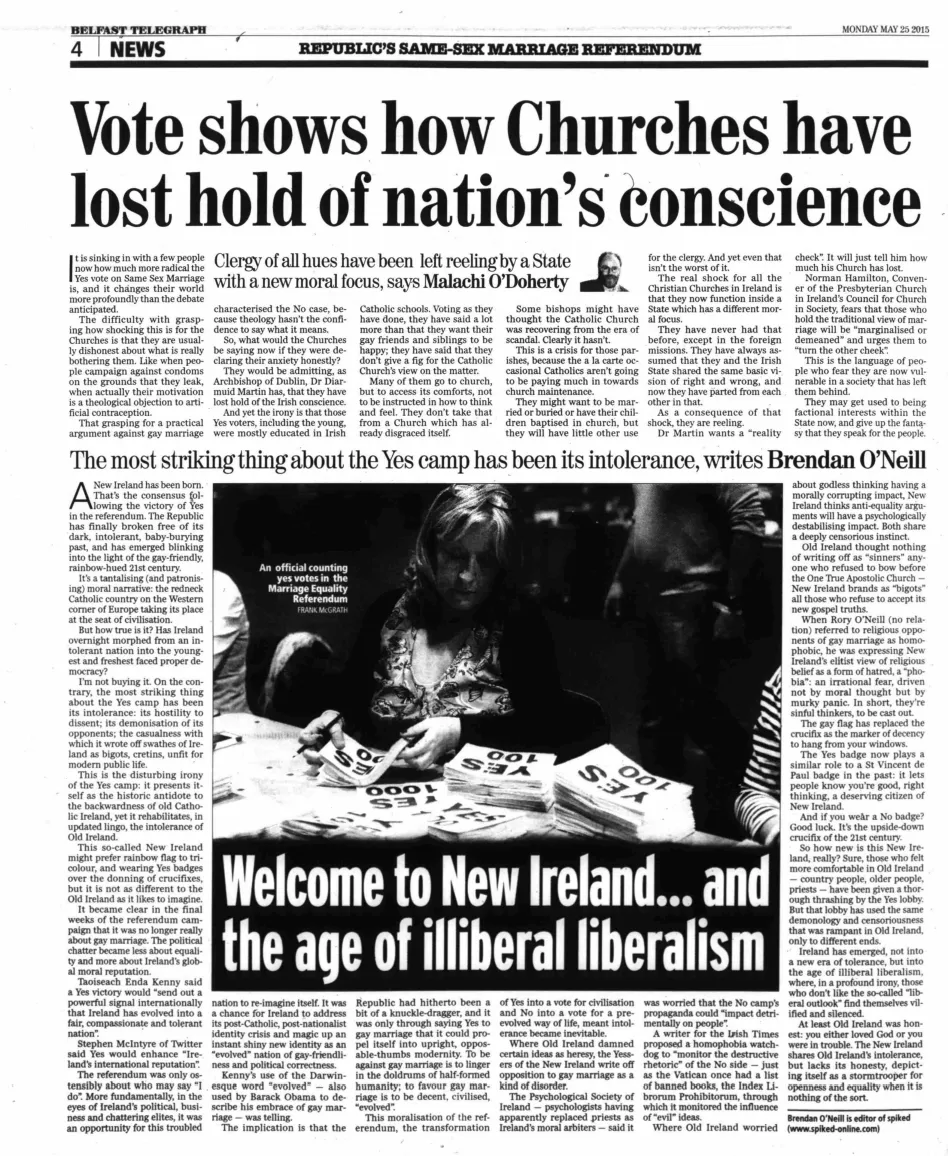
Belfast Telegraph | 25 May 2015
The legalisation of same-sex marriage came as a sigh of relief to some, and a breathe of fresh air to others. Ireland had let its people speak for what they believed in, and had transformed its history through the referendum. The power of positive change hung in the air, as supporters flooded the streets on the day of the amendment passage.
Nonetheless, the referendum was for some, just the beginning of a lengthy process. An article from 30 April 2015 of the Belfast Telegraph reported, ‘Northern Ireland’s largest gay and lesbian support organisation has said a referendum on marriage equality would not solve the issue.’
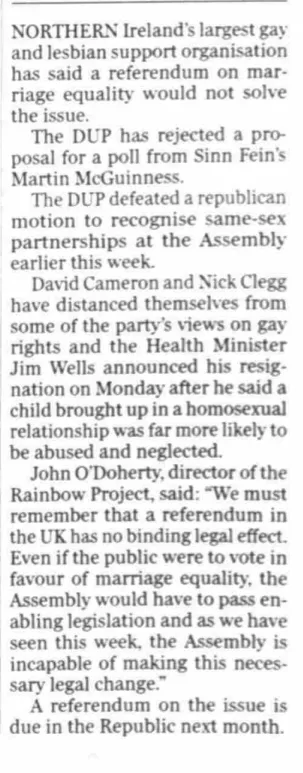
Article written by Michael McHugh | Belfast Telegraph | 30 April 2015
While some from within the community were commenting on the referendum as only one piece of a very large puzzle, others were outright advocating against it. Dana, winner of the 1970 Eurovision Song Contest, pleaded for those considering voting Yes to change their minds.
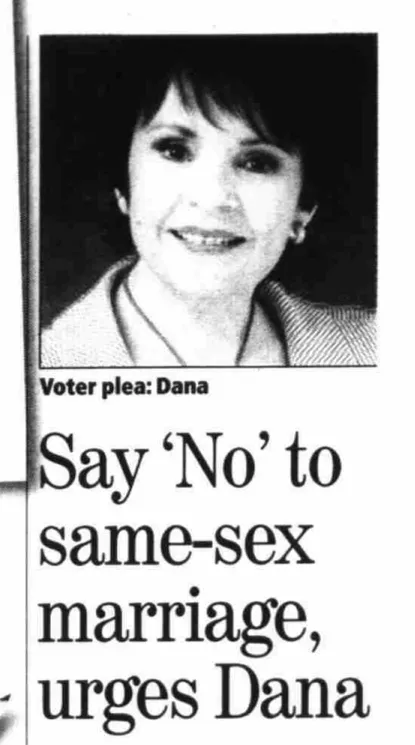
Belfast Telegraph | 21 May 2015
She wrote a letter to the Belfast Telegraph as a last-minute plea against the referendum. She wrote that traditional marriage ‘”deserves to be protected and maintained”‘, continuing on to state that ‘”the gift of a mother and a father to a child is something that should never be undermined.”‘ The Belfast Telegraph continued to report on Dana’s letter,
Dana argued that the British Constitution is duty bound to protect the institution of marriage from attack, as the traditional family is the “natural, primary and fundamental unit group of society.” “Marriage between a man and a woman deserves to be protected”, she said.
The conversation on same-sex marriage and the complex consequences of the referendum on different groups within society run deep, and reflect the variety in public attitude. Although the amendment of the act was passed due to popular opinion, this was not everyone’s opinion, and discriminatory behaviour remained rife.
There was an expectation that Northern Ireland would shortly respond, and in November 2015, the Belfast Telegraph reported on the ‘opening salvo in what could be a lengthy legal battle for same-sex couples to marry in Northern Ireland’
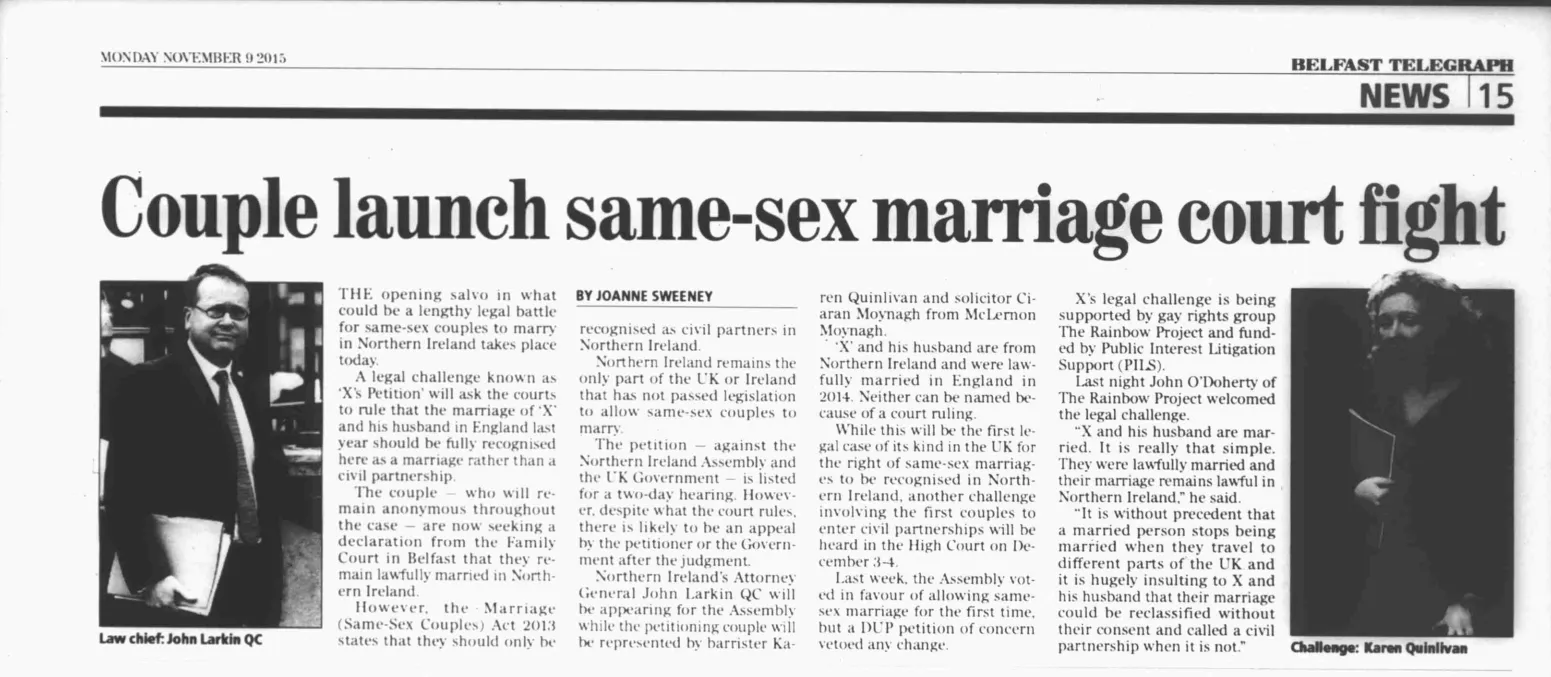
Belfast Telegraph | 09 November 2015
Same-sex marriage would eventually be legalised on 13 January 2020, with the first marriage ceremony taking place in February 2020.
Discover more about the Thirty-fourth Amendment of the Constitution (Marriage Equality) Act 2015, the 1916 Easter Rising, and much more, in the pages of our Archive today.
New Titles
Title | Years Added |
1910-1913, 1915 | |
1898, 1900, 1902, 1905-1906, 1909-1910, 1912-1929, 1931-1936 | |
1836-1843 | |
1878-1892, 1899-1903, 1905-1926 |
Updated Titles
Title | Years Added |
1852-1854, 1859-1877, 1880-1884 | |
2015-2016 | |
1950 | |
1860 | |
1950 | |
1873, 1877-1880 | |
1950 | |
1930 | |
1768-1770, 1776-1778, 1780, 1790 | |
1860 | |
1871-1880, 1882-1885, 1887-1896, 1899-1910, 1912, 1914-1915, 1917-1919 | |
1890-1905, 1907-1909 | |
1858-1928 | |
1868-1875 | |
1871-1881 | |
1873-1881 | |
1872-1887, 1894 | |
1889 | |
1860-1879, 1881-1896 | |
1901 | |
1896 |
You can keep up to date with all the latest additions by visiting the recently added page. You can even look ahead to see what we’re going to add tomorrow.
More on this topic:
Share this article
About the author

Molly Pearce
Data Operations Executive
Published on Tue, 10 March 2026.