
The power of search on the new British Newspaper Archive
Published on 29 June 2026 by The BNA
An exciting feature of the new British Newspaper Archive will be the advanced search capabilities that are coming to the site.
Searching historic newspapers has always been a balancing act
Searching historic newspapers has always been a bit of a tightrope walk. Search too narrowly and you miss the articles you need. Cast the net too wide and you’re wading through pages of irrelevant results. Throw in inconsistent spelling, occasionally damaged print, and the inevitable quirks of Optical Character Recognition (OCR) text and even seasoned researchers can find themselves going in circles.
The NEW British Newspaper Archive has been built to change that.
At the heart of the new site is a significantly more powerful and more intelligent search experience, designed to help you surface relevant articles more reliably, even when the newspaper wording isn’t exact.
This is about helping you find more of what matters.
One clear search, designed for how newspapers actually work
The new BNA search experience is built around a simple idea: not everything you search for behaves the same way.
That’s why search is now split clearly into two complementary tools:
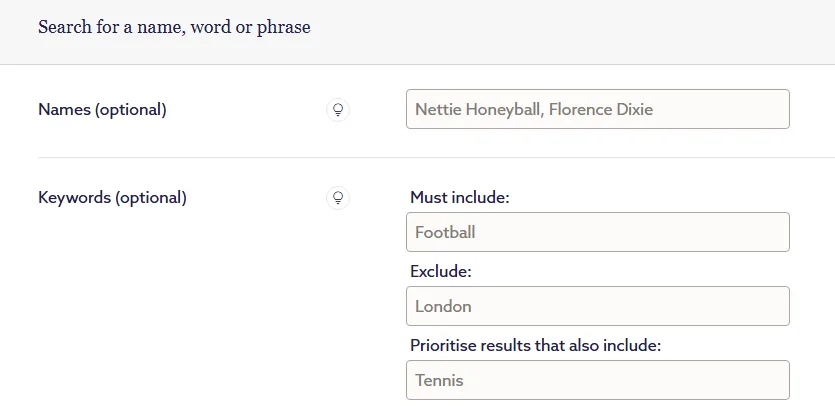
- Searching for People: The Names Box
Newspapers mention people constantly in reports, court notices, advertisements, and local announcements. Searching for names effectively requires different handling than searching for topics.
The Names box is purpose‑built for this job.
It is optimised specifically to:
- Recognise first names, surnames, middle names, and titles
- Understand name structure rather than treating names as ordinary words
- Reduce irrelevant matches, such as classified ads or unrelated phrases
This means you can enter names naturally e.g. Robert Smith, Major Henry Hunt and let the search logic do the heavy lifting.
Just as importantly, it avoids common pitfalls by clearly signalling what not to include i.e. places, events, symbols, or long chunks of text don’t belong here.
Always remember if you’re not searching for a name simply leave the name box empty.

- Searching for Everything Else: The Keywords Box
The Keywords box handles the rest of the historical world that newspapers describe.
This is where you search for:
- Events and incidents
- Places and streets
- Occupations and industries
- Organisations and institutions
- Themes, objects, and social issues
Together, the two search boxes give you clarity and control, while still keeping the search experience approachable.
Advanced search that works with you, not against you
You can also use Advanced Search to shape results by:
- Requiring certain terms
- Excluding unwanted results
- Prioritising multiple words or phrases
Historic newspapers rarely use consistent language. Reporting styles vary by title and decade, and OCR can introduce small errors that break exact word matching.
That’s why the new British Newspaper Archive introduces a major improvement: phrase flexibility.
Phrase flexibility: finding articles that mean the same thing
Traditionally, searching for a phrase like “Battle of Mons” would only return articles where the exact words Battle and Mons appear together.
But newspapers rarely cooperate so neatly.
Phrase flexibility allows the archive to recognise when articles are:
- Describing the same event using different wording
- Separating key words across a sentence
- Reordering words while keeping the same meaning
In practice, this means an article doesn’t have to say “Battle of Mons” exactly to be found, it just needs to clearly be about the Battle of Mons.
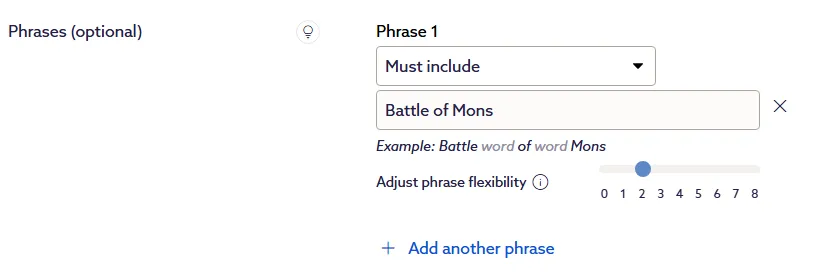
You can control how flexible the search should be:
- Lower phrase flexibility for near‑exact matches
- Higher flexibility when exploring broader coverage
The result is fewer missed articles and far less guesswork.
Why phrase flexibility matters
This new approach to search supports how people actually use the archive:
- Genealogists tracing individuals across decades
- Historians following events as they unfold over time
- Local researchers navigating variant place names
- Students exploring themes without knowing exact terminology
Instead of compensating for the limitations of search, you can focus on interpretation, comparison, and insight.
Search that connects directly to your research
Finding the right article is only part of the journey.
From search results, you can:
- Clip articles directly as you find them
- Group them into curated Collections
- Save them into Workspaces for ongoing research
Search is no longer a standalone action it’s the entry point into building structured, meaningful research over time.
Search at scale, built for the future
With millions of pages spanning centuries, the British Newspaper Archive needs search that is both powerful and forgiving. The new experience reflects years of learning about how people search, where traditional approaches fall short, and how historical language actually behaves in practice.
The goal is simple: help you find more, miss less, and trust what you find. Whether you’re tracking down a single individual or exploring an entire chapter of history, the new British Newspaper Archive search is built to support discovery at scale.
More on this topic:
Share this article
About the author

The BNA
News from the British Newspaper Archive
Published on Mon, 29 June 2026.