
Hot Off The Press – New Titles This Week
Published on 11 November 2025 by Mary McKee
This week, we have added another 203,028 pages of historical newspapers from 1884 to 2004. We have introduced two new titles, including the literary Shamrock from Ireland and the Rushcliffe Advertiser from the East Midlands.
We’ve also added 185,884 pages to two of our existing titles. Dive into stories of revolt and German royalty, then journey back 145 years to witness the hanging of Ned Kelly, the notorious outlaw celebrated by some as Australia’s Robin Hood.
Register now and explore The Archive
Shamrock
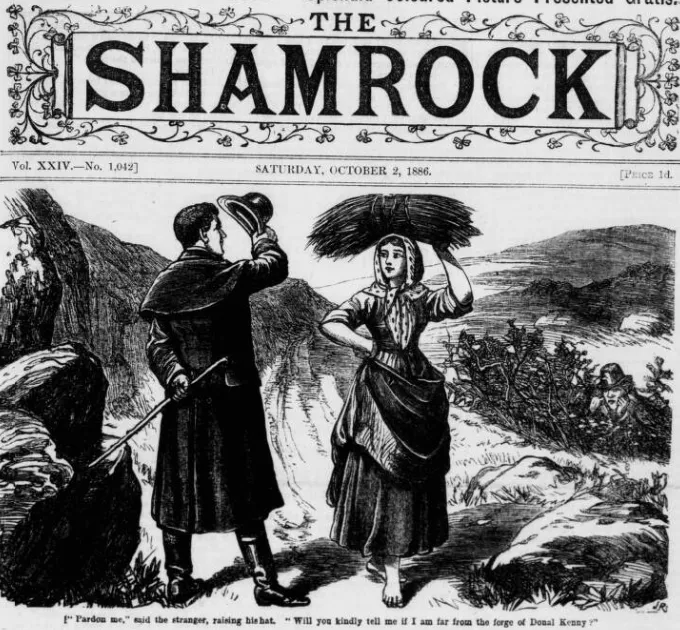
The Shamrock was a notable Dublin-based weekly literary newspaper, first published on 6 October 1866. It cost only a penny, making it accessible during a period of expanding readership. The Shamrock was published from 1866 to 1912 (when it merged with the Irish Emerald). This week’s release includes 12 years of the newspapers’ run from 1884 to 1896 with 11,374 pages.
The Shamrock served as a mirror and a vehicle for the cultural nationalism embodied by the Gaelic Revival, an era in Irish history where sport, language, music and literary expression all contributed to the reawakening of Irish national identity. In this context, the paper offered more than just reportage: it combined illustrated pages, serial fiction (such as romance, rebellion and adventure tales), poetry, and historical reminiscences (for example, stories of the Irish Brigade or of Robert Emmet and the 1798 Rebellion).
Among its many serials was The Green Cockade: A Tale of the Rebellion in Ulster, written by Mrs M. T. Pender and published on 2 October 1886. Combining elements of romance and uprising, it transports readers to the era of the 1798 Rebellion. Through its rich, evocative descriptions of the Irish landscape, the story captures both a sense of nostalgia and a deep undercurrent of nationalist pride.
‘Below laughed the mountain streams, rustled the purple heather, the tall ferns and dwarf wild roses and myriad sweet, delicate blooms that clothed the Squire’s Hill from head to foot like a royal robe, through which the grey rocks and boulders showed like silver studs, and the clumps of blossomed furze like clasps of gold. The Squire’s Hill is one of that group of wild mountains lying northward of Belfast, and having the back of the Cave Hill on one side, the brow of Divis on the other, and the long, cairn-crowned head of Glen Mountain. Away down in the sea-washed mouth of the valley nestles the good town of Belfast.’
This blend of literary content and nationalist sentiment placed the paper firmly within the social and political transformation of late nineteenth-century Ireland. As a nationalist weekly title published every Saturday, The Shamrock featured contributions from prominent figures such as William O’Brien (Ireland’s first investigative journalist).
Rushcliffe Advertiser
The Rushcliffe Advertiser was a Saturday newspaper representing South Nottinghamshire that combined coverage of world events with the rhythms of local life. Our latest addition to The Archive has added 5,770pages from the years 1888-1889, 1896, 1899-1909.
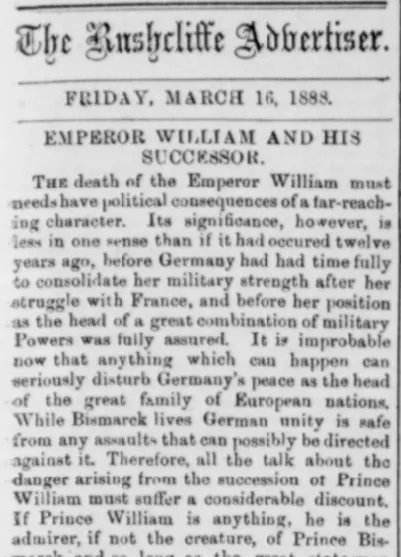
The paper’s inaugural issue, dated 16 March 1888, opened with news of the death of Emperor William of Germany, marking the passing of the first emperor after German unification. The paper praised William and his chancellor, Otto von Bismarck, for their role in establishing the new nation, noting that while William’s death could have political consequences, German unity remained secure under Bismarck’s leadership. From these international headlines, the Advertiser turned to the local community, reporting on the vestry meeting and even sharing the latest cricket club averages, reflecting its mix of global and local interests.
Updated Titles
This week we have updated two of our titles with 185,884 new pages. Page through Peterborough’s past with an exciting addition of 179,276 pages for The Peterborough Evening Telegraph. We also added 6,608 pages of the West Yorkshire title Heckmondwike Herald.
Capture of Ned Kelly
One hundred forty-five years ago, Ned Kelly was hanged in Melbourne, Australia. He remains one of the most iconic and controversial figures in Australian history. Born in 1854 to Irish immigrant parents, he grew up amid poverty, discrimination, and tension between settlers and colonial authorities. Kelly’s life of hardship and rebellion culminated in his transformation from bushranger to folk hero, symbolising resistance against an unjust system. His story, ending in capture and execution in 1880, continues to provoke debate about crime, justice, and national identity. To some, he was a ruthless outlaw; to others, a courageous symbol of defiance against colonial oppression.
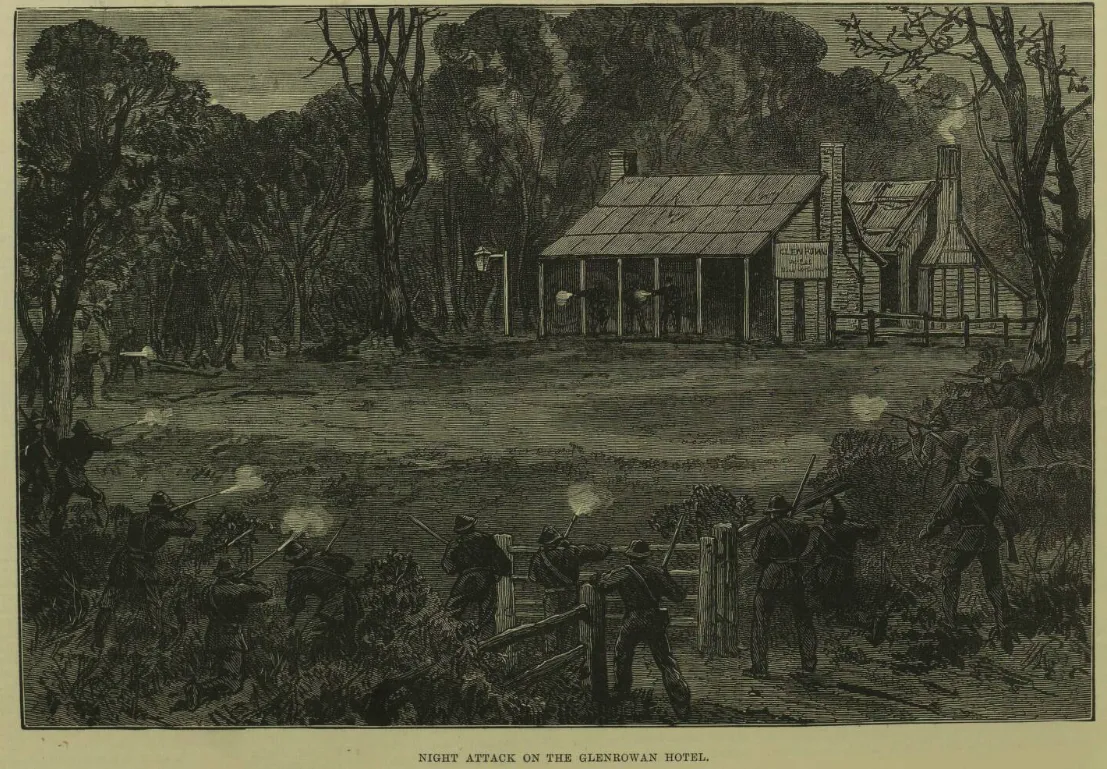
Illustrated London News | 11 September 1880
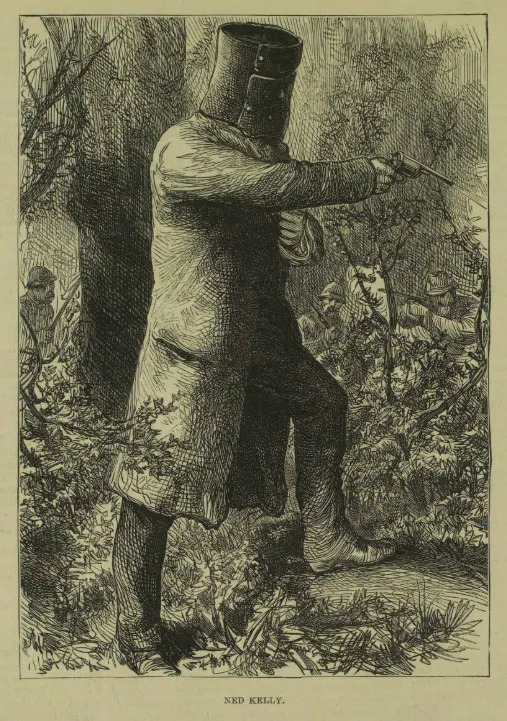
The Illustrated London News reported on the Kelly Gang and the events that led to the capture and ultimately the execution of Ned Kelly. It described that the ‘colonists of Victoria and New South Wales, on both sides of the River Murray, have repeatedly, in the past two years, been thrown into excitement by the unpublished outrages of a large party of robbers and murderers, headed by Edward and Daniel Kelly.’ The article details their outrageous bank robberies, conflicts with the police and murders. Their final offence came in 1880 at Glenrowan, where the gang planned to derail a police train and ambush its passengers. Dressed in their now-famous homemade metal armour, they engaged in a dramatic shootout with police. The plan failed, resulting in the deaths of Kelly’s companions, Joe Byrne, Dan Kelly, and Steve Hart, and Ned Kelly’s capture.
The Glasgow Evening Post published the story within one day of the execution. It published the Reuters Telegram: ‘Melbourne, Tuesday. The bushranger Kelly, who, together with his gang, was captured a few months ago, was hanged today.’ A short telegraph and announcement for a larger-than-life character.
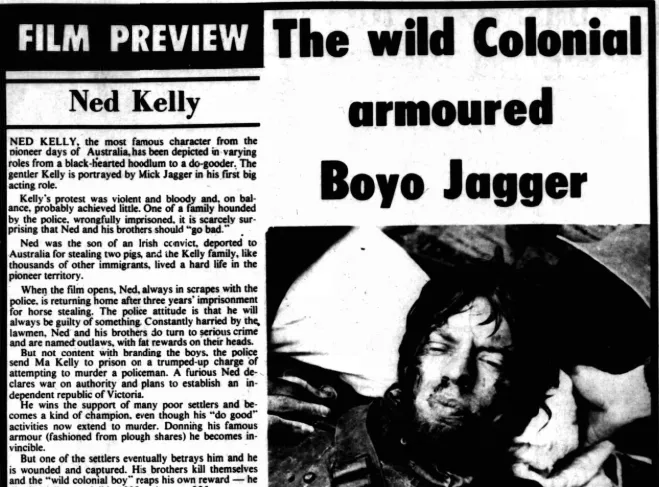
The story of Ned Kelly has lived far beyond his lifetime, retold through plays, serials, and other popular forms of entertainment. The Archive preserves numerous reports of stage productions and serialised stories inspired by his life and legend, such as the 1969 production of ‘The Legend of Ned Kelly’ at Worthing Connaught Theatre which called Kelly ‘the Robin Hood of Australia.’ The famous bushranger was even portrayed by the infamous rock star Mick Jagger in his first big acting role in 1970.
Harrow Observer | 17 July 1970
Explore the Archive and discover more about the life and legacy of Ned Kelly.
New Titles
Title | Years Added |
1994-1997, 1999-2004 | |
1990-1993 |
Updated Titles
Title | Years Added |
1884-1896 | |
1888-1889, 1896, 1898-1909 |
You can learn more about each of the titles we add to every week by clicking on their names. On each paper’s title page, you can read a free sample issue, learn more about our current holdings, and our plans for digitisation.
You can keep up to date with all the latest additions by visiting the recently added page. You can even look ahead to see what we’re going to add tomorrow.
More on this topic:
Share this article
About the author

Mary McKee
UK Archives Manager
Published on Tue, 11 November 2025.