
Hot Off The Press – New Titles This Week
Published on 14 April 2025 by Rose Staveley-Wadham
This week at The Archive we are excited to bring you eight brand new titles, with a trio of new specialist titles, namely the Anti-Corn Law Circular, the National Reformer and the Police Chronicle joining us this week. Our other new titles, meanwhile, span Lancashire, Durham, Kent and Birmingham, as we’ve added a whopping 268,627 brand new pages to our collection in all over the past seven days.
That’s not it either, as we’ve updated 20 of our existing titles from across the United Kingdom and the Republic of Ireland. So what are you waiting for? Delve into our blog to discover more about our new and updated titles of the week, and also to learn about a ‘sagacious’ wild rabbit named Moses, who lived at a pub in Kent during the early 20th century.
Register now and explore the Archive
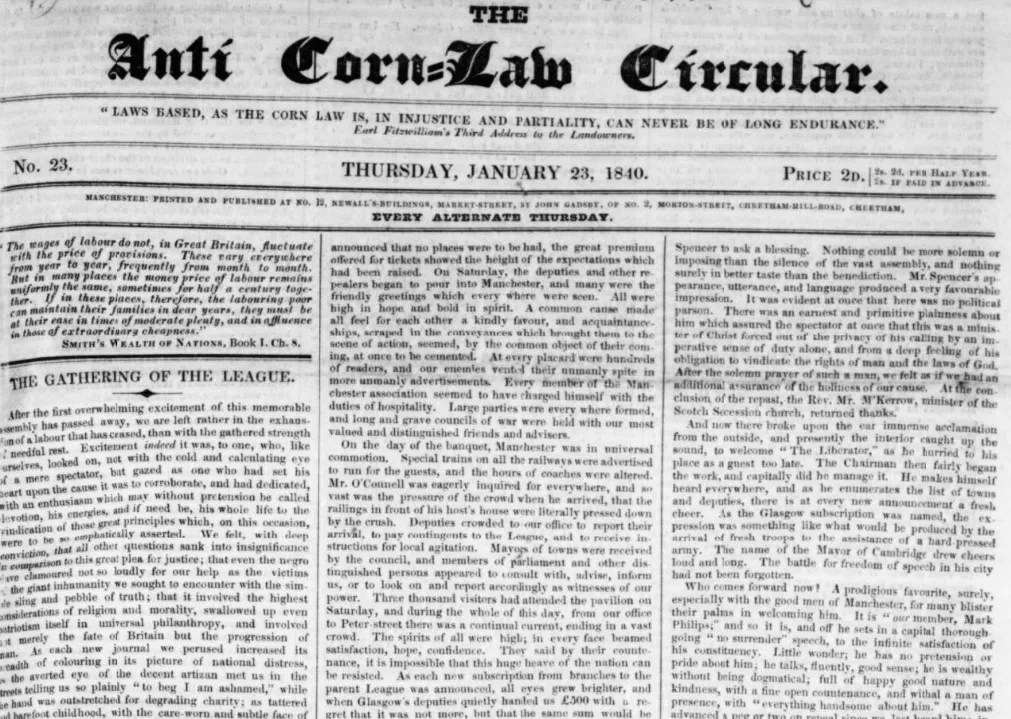
Let’s get cracking then, and we begin with the Anti-Corn Law Circular. Published every fortnight in Manchester, the Anti-Corn Law Circular was the journal of the Anti-Corn Law League, which itself had grown from the National Corn Law Association, founded in London in 1836, and the Manchester Anti-Corn Law Association in 1838.
But what were the corn laws to which the league were so opposed? The corn laws were a series of trade restrictions and tariffs placed on imported foodstuffs, like wheat, oats, barley and corn, imposed from 1818 onwards. They were intended to protect domestic farmers, as the importation of cheap wheat was blocked, but this drove up prices, especially following bad harvests.
Manchester, meanwhile, became an important centre of the anti-corn law movement, as the city was key importer of raw materials. It was only fitting that it became the home of the Anti-Corn Law Circular, which first appeared on 16 April 1839, 186 years ago this week. With a quote from Earl Fitzwilliam adorning the masthead – ‘Laws based, as the corn law is, in injustice and partiality, can never be of long endurance. They are only fit for fair weather – they cannot resist the storm’ – the new publication’s first editorial explained how:
In laying before the public the first number of the Anti-Corn Law Circular, we are relieved from the necessity of explaining, in a lengthened preface, the objects we have in view. They are sufficiently expressed by the title itself.
The Anti-Corn Law Circular, therefore, featured news from the Anti-Corn Law League, descriptions of lectures given across the country about the impact of the corn laws, and different politicians’ takes on the tariffs. Indeed, the first edition featured an article entitled ‘Sir Robert Peel a Free-Trader,’ which turned out to be most apt. Faced with the famine in Ireland, and with the opposition of his own party, Sir Robert Peel repealed the unpopular laws in 1846.
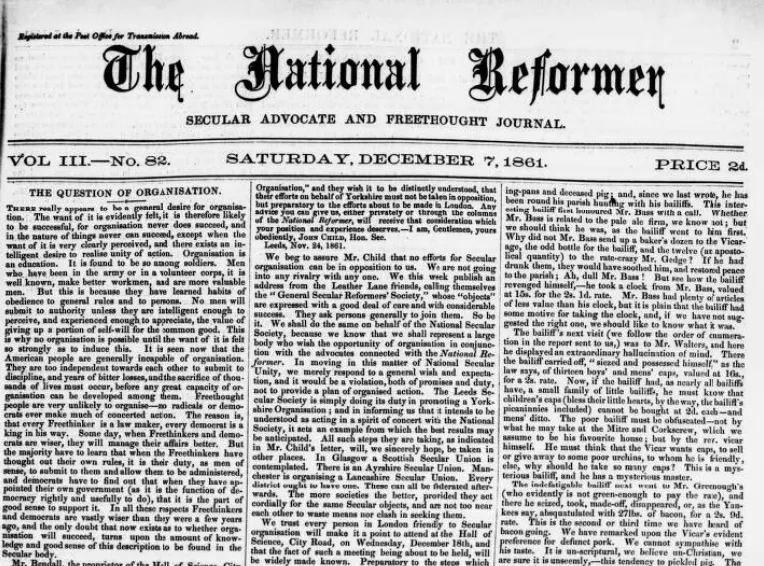
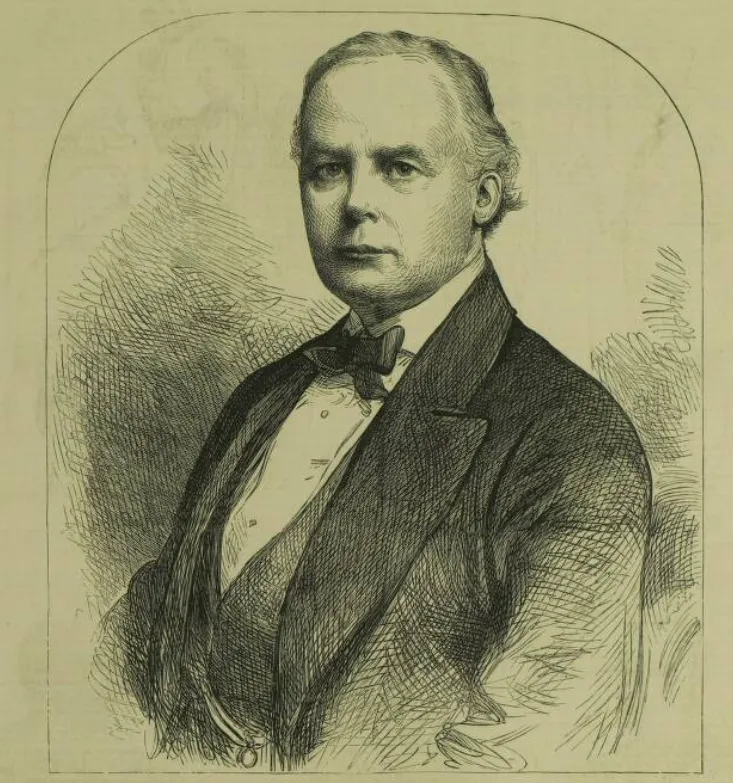
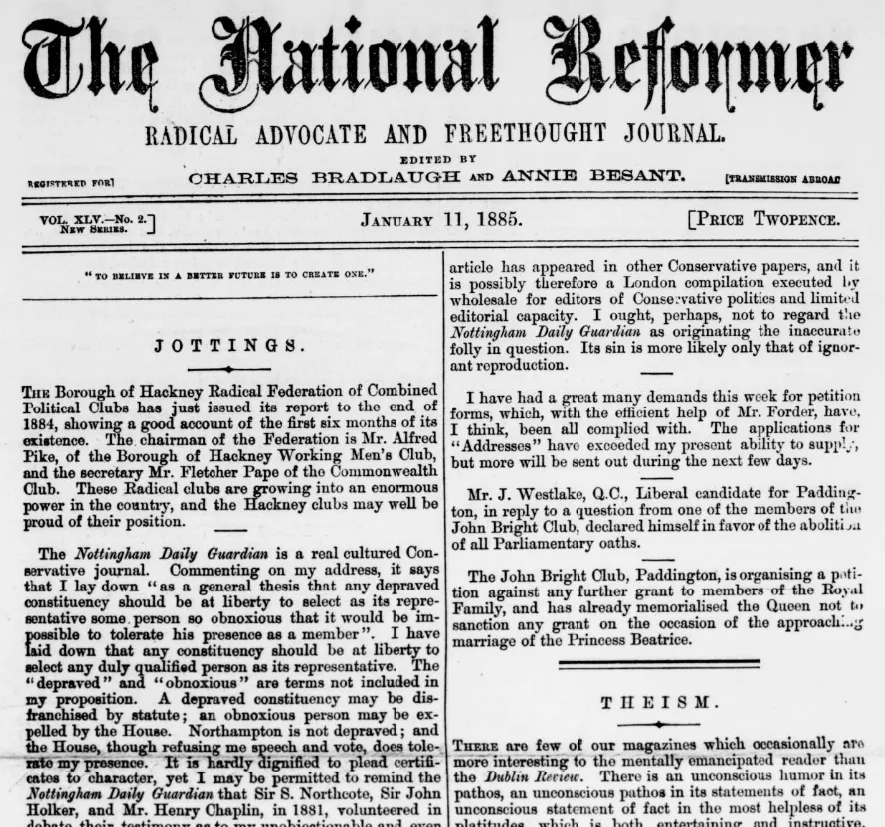
From the anti-corn laws movement now to the secularist movement, and its own title, the National Reformer. The National Reformer was founded in 1860 to promote secularism, and was edited by pioneering atheist and political reformer Charles Bradlaugh (1833-1891). Bradlaugh would go on to form the National Secular Society in 1866, and the National Reformer would become its organ.
The National Reformer, then, ran with both secularist and republican principles, advocating ‘the views of the Secularists and Republicans.’ According to adverts at the time, the National Reformer’s articles were ‘written with great spirit.’ Indeed, the paper featured a range of thought pieces, alongside reports on secular organisations and cases featuring secularists from across the country. The National Reformer also featured general news, as well as reviews and poetry.
Unsurprisingly, Bradlaugh’s radical views on religion would land him in hot water, with consequences for the National Reformer. In 1868 the Commissioners of the Inland Revenue acted against the paper under the 1819 Blasphemous and Seditious Libels Act. Bradlaugh and philosopher John Stuart Mill fought back, with success. In 1869 the Act was repealed and publication of the National Reformer continued.
A weekly newspaper, appearing every Saturday, the title became associated with the socialist and educationalist Annie Besant (1847-1933). Besant, who was notable for her support of both Irish and Indian home role, as well as for women’s rights, co-edited the National Reformer with Bradlaugh until 1887. Indeed, her name appeared on its masthead from 1881 onwards. Besant and Bradlaugh were both prosecuted in 1877 for publishing material advocating birth control.
After Charles Bradlaugh passed away in 1891, the National Reformer was edited by Scottish journalist and politician J.M. Robertson (1856-1933), with assistance from Bradlaugh’s daughter, Hypatia Bradlaugh Bonner (1858-1935). However, the paper was very much Bradlaugh’s baby, as it ceased publication a few years after his death in 1893.
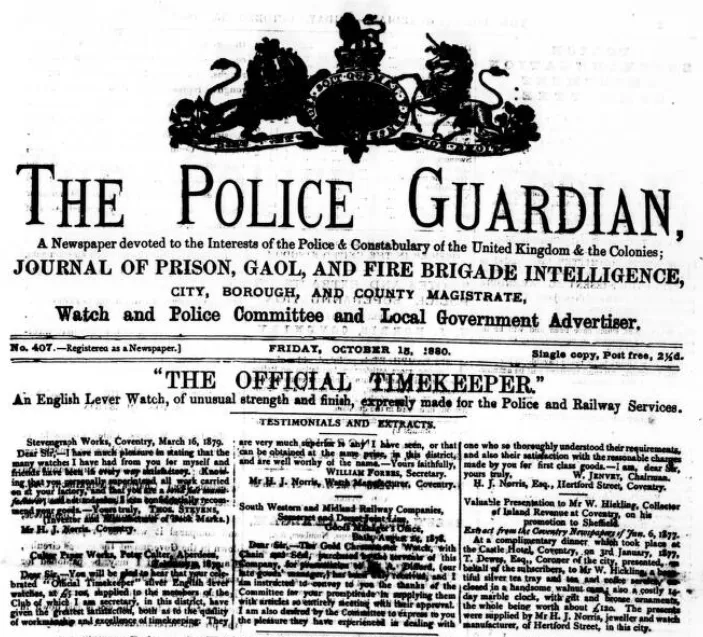
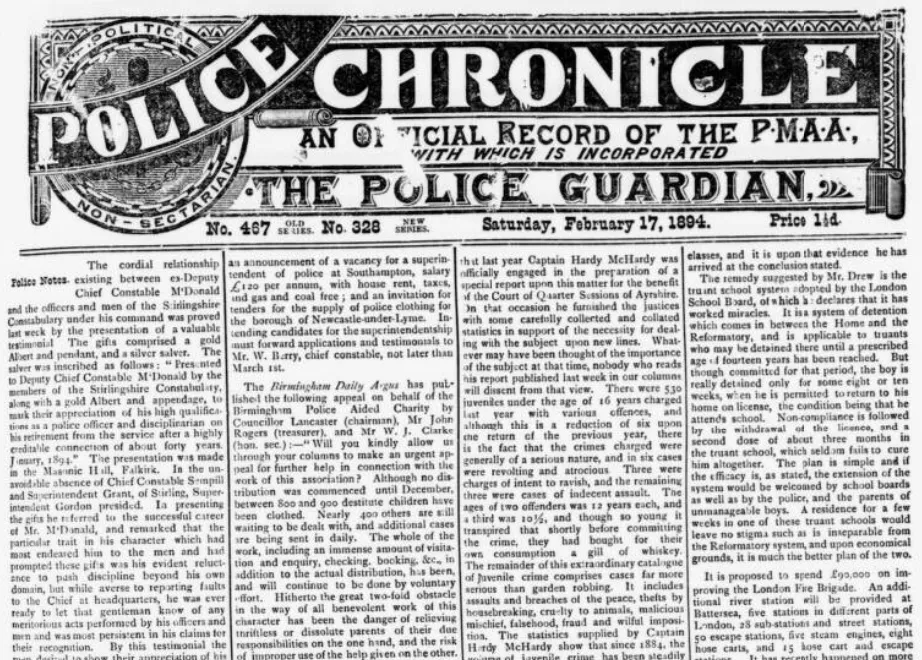
The final of our trio of new specialist titles is the Police Chronicle, which was established in 1866. ‘A Newspaper devoted to the Interests of the Police & Constabulary of the United Kingdom & the Colonies,’ it also labelled itself as a ‘Journal of Prison, Gaol, and Fire Brigade Intelligence, City, Borough and County Magistrate, Watch and Police Committee and Local Government Advertiser.’
Initially known as the Police Guardian, the Police Chronicle was essentially a paper for members of the police force. Appearing every Friday at the cost of two and a half pence, the paper featured adverts targeted at police officers, such as adverts for uniforms, news on appointments within the police force, as well as news from police forces across the world, from the likes of the Cape Police, the Worcester City Police, and the Huddersfield Borough Police.
A thorough guide to Victorian policing, the Police Chronicle investigated new acts of parliament pertinent to policing, and featured letters to the editor on a range of policing matters.
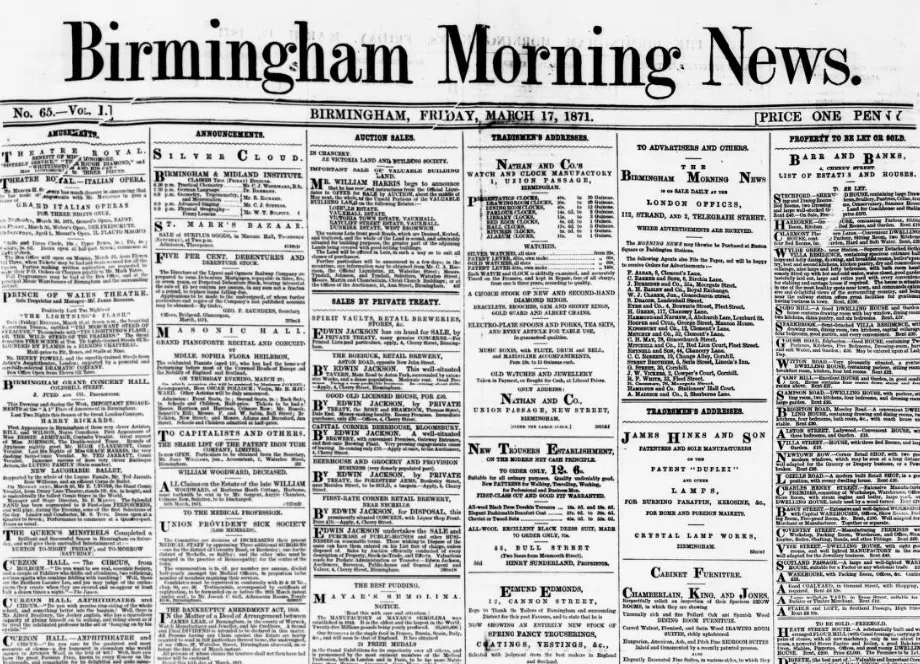
We travel now to Birmingham for our next new title of the week, which is the Birmingham Morning News. A sister paper of the Birmingham Evening News and the Birmingham Weekly News, the Birmingham Morning News was first published on 2 January 1871 at the cost of just one halfpenny.
Promising that its politics would be ‘thoroughly Liberal,’ and pledging its ‘hearty support to the Liberal party whenever that can be done without sacrifice of principles or descent to the dirty work too common at elections,’ the Birmingham Morning News also promised to champion ‘religious liberty and equality in the broadest sense.’ As for its content, the new publishing venture aimed ‘to give a lively narrative of all that is going on the world, especially in our special world, this great town and its neighbourhood.’
To that end, the eight pages of the Birmingham Morning News were filled with a mix of local, national and international news. For example, the paper took in the latest from the likes of the Sutton Coldfield Corporation and the Birmingham Police Court, as well as publishing thought-pieces on issues like ‘Working Men’s Questions.’ Meanwhile, the title printed pieces on literature, art, sport and trade.
By 1876 the Birmingham Morning News had ‘a large and increasing circulation among the Manufacturing, Trading and Mining Interests’ in Birmingham and beyond.
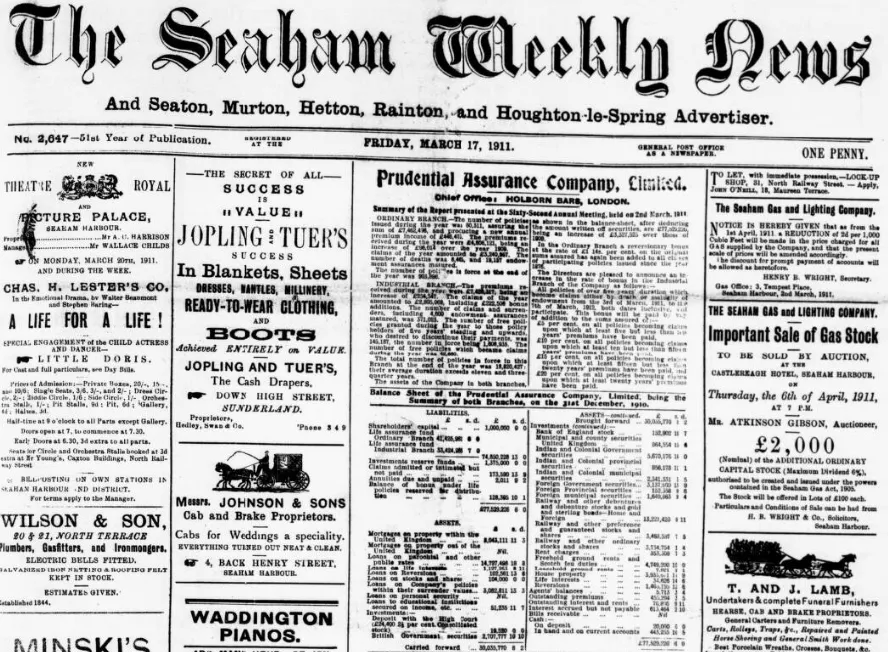
We travel up to Country Durham now for our next new title of the week, which is the Seaham Weekly News. With the full name of the Seaham Weekly News and Seaton, Murton, Hetton, Rainton, and Houghton-le-Spring Advertiser, this penny paper was established in the seaside town of Seaham in 1860.
Conservative in its politics, and appearing every Saturday, the Seaham Weekly News circulated in ‘Seaham Harbour and North Durham.’ Filling four pages, the title sold approximately 1,400 copies per week, and contained a mix of local and national news. For example, the Seaham Weekly News featured the latest from the seaside town, as well as from the Seaham Harbour Police Court, alongside more general news contained in columns like ‘Epitome of News’ and ‘Telegrams of the Week.’
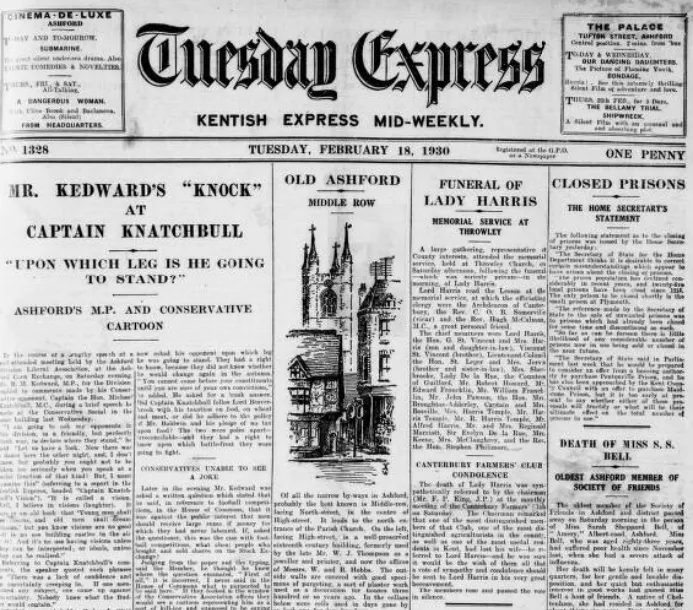
From north to south now, and we’re delighted to welcome to The Archive Ashford’s Tuesday Express. Known as ‘the Kent mid-weekly,’ the Tuesday Express was first published in the Kent town of Ashford on 22 September 1903 at the cost of one halfpenny. Unsurprisingly appearing every Tuesday, the new title proclaimed:
We present to our readers this week a new Kent paper – a halfpenny mid-weekly. The development of education in recent years has given a zest to newspaper reading, for, whereas only a comparatively small percentage of the population could read some fifty years ago, the present day finds everybody capable of enjoying the recreation of reading. This fact, alone, we think, justifies the introduction of a new paper in our midst – a paper that will give up-to-date news, as well as special articles of interest.
Independent in its politics, the lively four page newspaper focussed mainly on local issues. For example, it reported on the latest from the Maidstone Police Court, the Ashford Police Court, the Canterbury Farmers’ Club, the Romney Marsh Board of Guardians, and the Bearsted Petty Sessions, alongside news of accidents and deaths in the local area.
Circulating in Kent and East Sussex, the Tuesday Express presented its readers with entertaining drawings and cartoons, alongside sporting news and household hints.
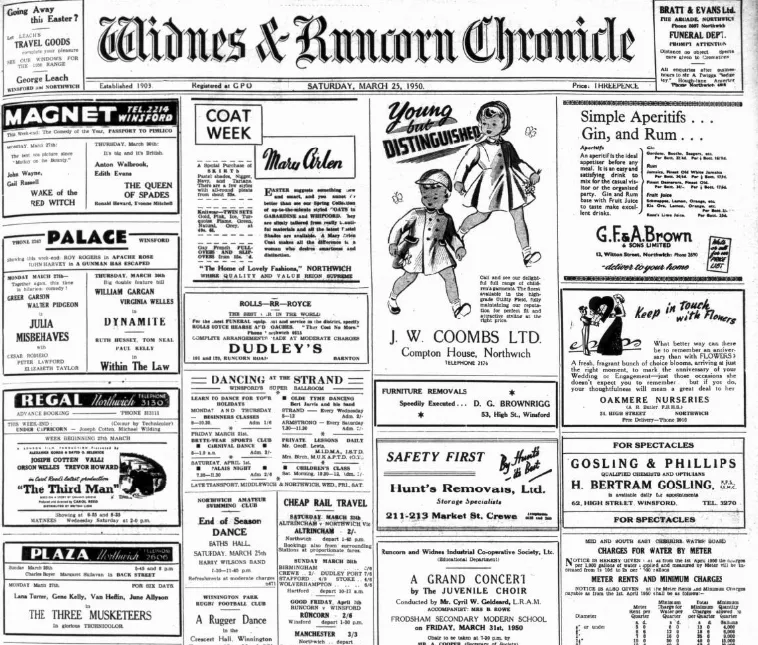
Our two final new newspapers of the week both hail from Lancashire. First up is the Widnes & Runcorn Chronicle, which was established in 1902 as part of the Chester Chronicle series of newspapers. Liberal in its politics, this paper began life as the Runcorn Chronicle and Mid Cheshire Advertiser before settling on the title of the Widnes & Runcorn Chronicle.
Appearing every Saturday at the cost of one pence, the Widnes & Runcorn Chronicle was largely focussed on local topics, reporting on the latest from the industrial towns of Widnes, historically a part of Lancashire, and Runcorn, which lies on the opposite bank of the Mersey. It featured the latest from the likes of the Hawarden Rural District Council, the Runcorn Board of Guardians, the Winsford Urban Council and the Nantwich Police Court, as well as covering news of accidents and deaths across the local area.
An entertaining read, the eight pages of the Widnes & Runcorn Chronicle covered a range of sports, as well as reporting on chess matters, and featuring a ‘Ladies’ Corner,’ ‘Natural History Notes,’ and ‘Farm Notes.’
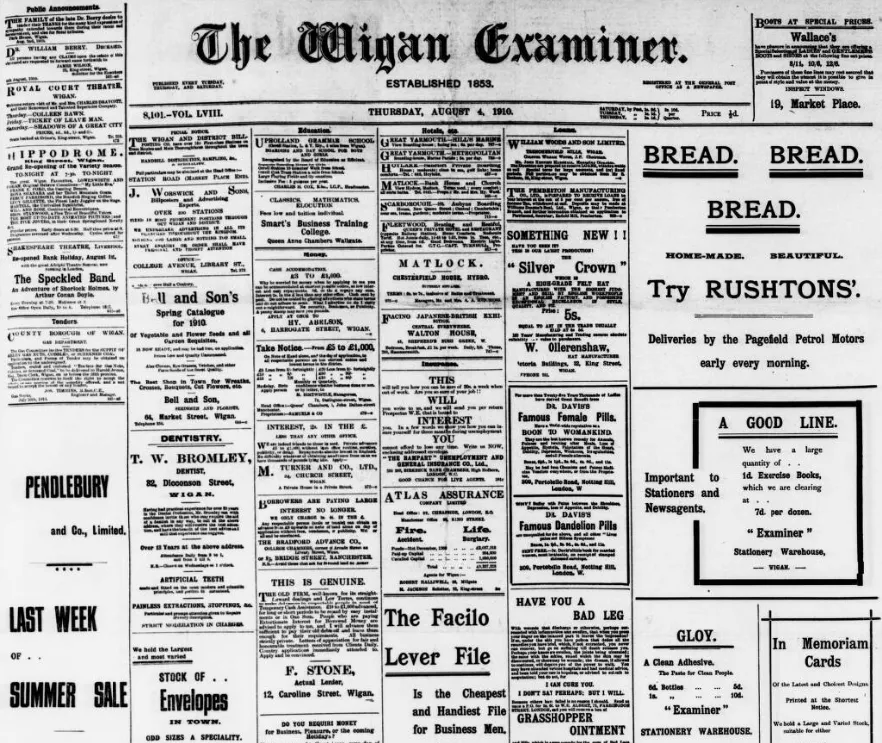
Our final new title of the week is the Wigan Examiner, which was first published in Wigan, historically a part of Lancashire, in 1858. Conservative in its politics, the Wigan Examiner initially appeared weekly every Friday, before moving to a tri-weekly publication schedule, appearing every Wednesday, Friday and Saturday. Finally, the paper shifted to a bi-weekly publication plan, appearing every Tuesday and Saturday.
Conservative in its politics, the Wigan Examiner circulated ‘in Wigan and the colliery districts of South-west Lancashire.’ A mix of local, national and international news, the Wigan Examiner also printed poetry, literary extracts, sporting intelligence, news of bankrupts, and notices of births, marriages and deaths.
After one hundred years in print, the Wigan Examiner closed in 1961.
That’s it from our new titles of the week, but we still have 20 of our updated existing titles for you to explore. Highlights include the pages we have added to some of other our specialist titles, with the likes of feminist political review Time & Tide and illustrated weekly King and his Navy and Army being updated, as well as the Saturday Review of Politics, Literature, Science and Art seeing over 20,000 brand new pages join its ranks.
Meanwhile, covering Wales, we’ve updated the Prestatyn Weekly, for Scotland, we’ve added new pages to the Banffshire Journal and the Inverness Courier, and for the Republic of Ireland, new pages have joined the Roscommon Herald, the Waterford News and the Westmeath Guardian and Longford-News Letter.
Moses The ‘Sagacious’ Wild Rabbit
Sometimes when researching our new titles we come across stories that capture our attention, and transport us down an unexpected rabbit hole. This story, of Moses the ‘sagacious’ wild rabbit, took us down a very literal rabbit hole as we were exploring the pages of one of our new titles this week, the Tuesday Express.
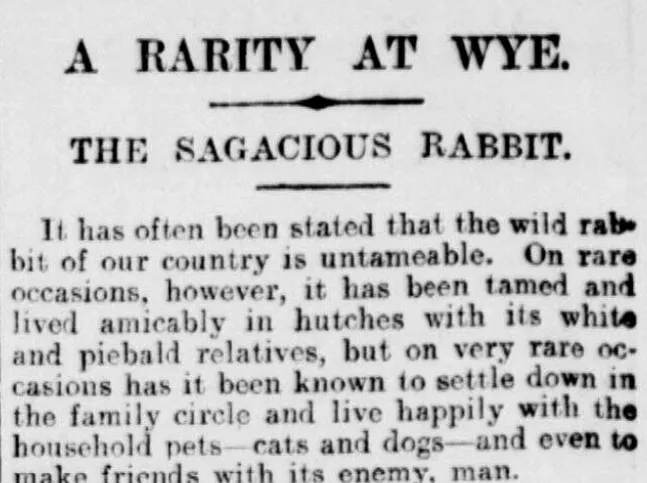
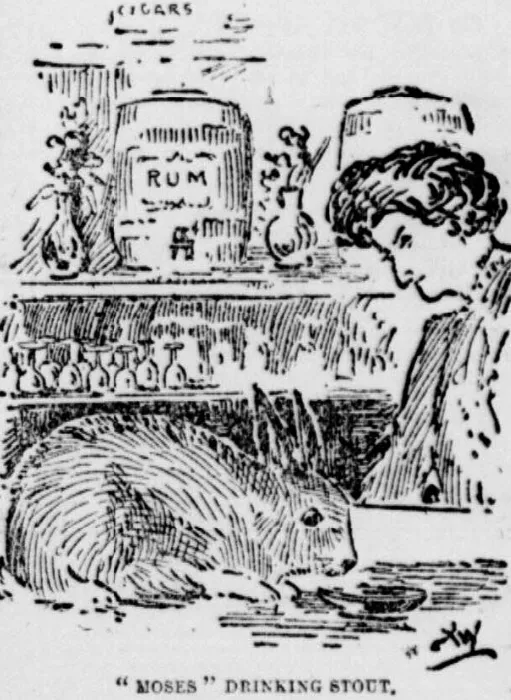
Under the heading ‘A Rarity at Wye – The Sagacious Rabbit,’ with a drawing of a rabbit sat on a table apparently drinking stout, we were drawn in, and compelled to read the story that was published on 22 September 1903.
In the wonderfully written piece, which begins by observing how ‘it has often been stated that the wild rabbit of our country is untameable,’ the writer takes us to the Victoria Inn at Wye, about five miles away from Ashford:
If anyone has a few minutes to spare when in the old-fashioned town of Wye, it would amply repay them for their time and trouble if they would just drop in at the hostelry known as the Victoria Inn, close to the South Eastern station, and see for themselves the sagacious little wild rabbit known as ‘Moses.’
Moses was a wild rabbit, who had been rescued some six years before by the ‘late Mr. Howland.’ Mr. Howland, who had ironically been out ‘ferreting for rabbits at Bramble Farm, Wye,’ had discovered Moses, ‘a tiny rabbit who had barely got his eyes open.’
Thus Moses was transported from the fields to the Victoria Inn, where he was ‘at once pounced upon as a pet in his new quarters, and being fed on bread and milk, soon settled down in his new surroundings.’ The Tuesday Express article goes onto tell us how during those cold January and February days, the ‘wild little animal learnt to nestle up affectionately to the dog and cat, and by the kitchen fire would pass many an enjoyable hour.’
Over the next six years, Moses became quite a fixture at the Wye institution. ‘Strongly’ objecting to being ‘teased by strangers,’ Moses was not opposed to biting those who teased him a little too much. However, he appears to have been very food motivated, jumping up and begging ‘like a dog for any little dainty morsel he may fancy, being especially fond of cake.’
Cake was not the only thing Moses enjoyed, as the Tuesday Express explained:
‘Moses’ is by no means a teetotaller, being particularly fond of stout. Whether this has stunted his growth one cannot say. In our sketch he is depicted as having a drop of stout at the private bar of the Victoria.
Aside from imbibing at the bar, Moses also spent time in the pub’s garden, where he could be ‘seen having a scamper on the lawn.’ However, if disturbed by a unknown dog or cat, he would ‘immediately take refuge in the kitchen, near his old chum, a terrier named ‘Tip,’ who has taken a lifelong interest in the confiding little rabbit.’
Unsurprisingly, Moses had caused quite a stir, with his owner, Mrs. Back, receiving ‘several tempting offers to sell him.’ She refused, meaning that Moses continued to enjoy ‘his life at the Victoria, safe from the gun, the dog and – rabbit pie.’
Find more wonderful stories like that of Moses the ‘sagacious’ wild rabbit in the pages of our Archive today.
New Titles
Title | Years Added |
1839-1843 | |
1871-1875 | |
1861-1891 | |
1880, 1886, 1892, 1894-1899 | |
1861-1863, 1865-1868, 1873-1880, 1889, 1911-1938 | |
1903-1910, 1912-1916, 1918-1973 | |
1903, 1911, 1921-1929, 1931-1954 | |
1854-1858, 1875, 1890-1896, 1898-1899, 1910 |
Updated Titles
This week we have updated 20 of our existing titles.
You can learn more about each of the titles we add to every week by clicking on their names. On each paper’s title page, you can read a free sample issue, learn more about our current holdings, and our plans for digitisation.
Title | Years Added |
1960-1969 | |
1892, 1896-1898, 1910 | |
1986 | |
2004 | |
1983 | |
1910-1927, 1931 | |
1900-1902 | |
2004 | |
1913-1918 | |
2004 | |
1911-1918 | |
1934-1937, 1953-1958 | |
1897-1899, 1910-1913 | |
1860-1869 | |
1779-1780, 1787, 1790-1799, 1801, 1803, 1809-1822, 1827, 1830, 1873-1877, 1911, 1913, 2003 | |
1920-1929, 1940-1942 | |
2004 | |
1901-1902, 1905-1907, 1909 | |
1922-1924, 1926-1928 | |
1889-1899, 1911, 1913-1914 |
You can keep up to date with all the latest additions by visiting the recently added page. You can even look ahead to see what we’re going to add tomorrow.
More on this topic:
Share this article
About the author

Rose Staveley-Wadham
Newspaper Licensing Manager
Published on Mon, 14 April 2025.