Hot Off The Press – New Titles This Week
Published on 9 June 2025 by Rose Staveley-Wadham
This week at The Archive we are delighted to welcome 148,935 brand new pages to our collection, as we explore superstitions around Friday the thirteenth, and the death of a French aviator some 115 years ago. Meanwhile, we’ve welcomed four brand new titles to The Archive, with updates to 20 of our existing titles, with over half of our updated titles this week hailing from Scotland.
So read on to discover more about our new and updated titles of the week, and also to learn more about Friday the thirteenth, and the death of Gabriel Hauvette-Michelin on 13 May 1910.
Register now and explore the Archive
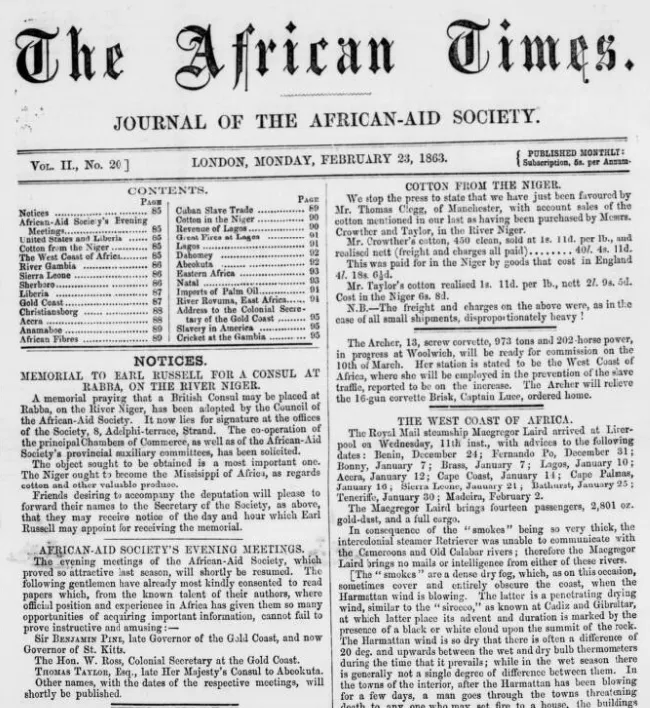
The African Times
The first of our new titles this week is the African Times, which was established in 1860. This monthly publication was the ‘Journal of the African Aid Society,’ a Liverpool-based organisation which counted Lord Alfred Churchill (1824-1893), younger son of the Duke of Marlborough, as its chairman.
According to Edward Beasley in his book Empire as the Triumph of Theory, the African Aid Society ‘pushed for the expansion of British control and trade in West Africa.’ Its chairman, Lord Alfred Churchill, unsuccessfully advocated for the British government to relocate its West African stores and ships to the Cameroon Mountains, and ‘to found a sanatorium there to save the lives of European soldiers and traders who were too weak to reach a place of rest in Europe.’
As Beasley puts it, ‘Churchill was indeed a humanitarian by intention, but he had convinced himself that European presence [in Africa] was really the best for everyone.’
The African Times, therefore, was largely focussed on commercial matters in West Africa. It printed the latest news from West Africa, from the likes of Sierra Leone, Sherboro (an area of Sierra Leone), Liberia, Accra, Dahomey (Benin) and Lagos, and then down to the Cape of Good Hope and Natal. The newspaper, for example, reported on ventures to plant cotton in West Africa.
Meanwhile, the African Times supported the abolition of slavery in both Africa and North America, closely following African American issues.
By 1880 the African Times was subtitled the Gold Coast Mining and Railway Chronicle, with the motto of ‘for God, and Good to Africa, and her People.’ The paper also included a quote from the Earl of Carnarvon (1831-1890), who served as Secretary of State for the Colonies from 1866 to 1867, and again from 1874 to 1878:
If any Colonist suffers from injustice, whatever may be his class, his condition, or his colour, he has a right to redress at the hands of the Colonial Minister in this country.
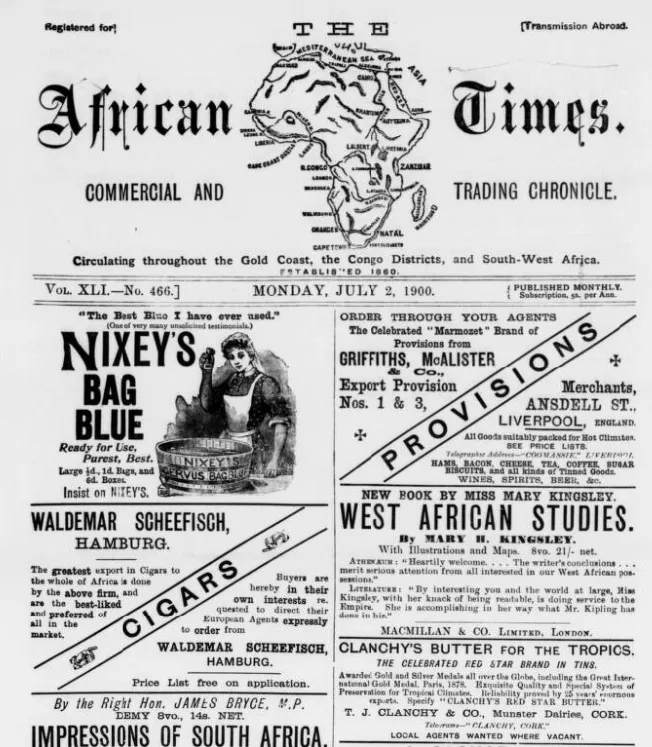
Fast forward to 1900, and the African Times was now subtitled as the Commercial and Trading Chronicle. By this time, it was said to be ‘circulating through the Gold Coast, the Congo Districts, and South-West Africa.’
The North Derbyshire & North Cheshire Advertiser
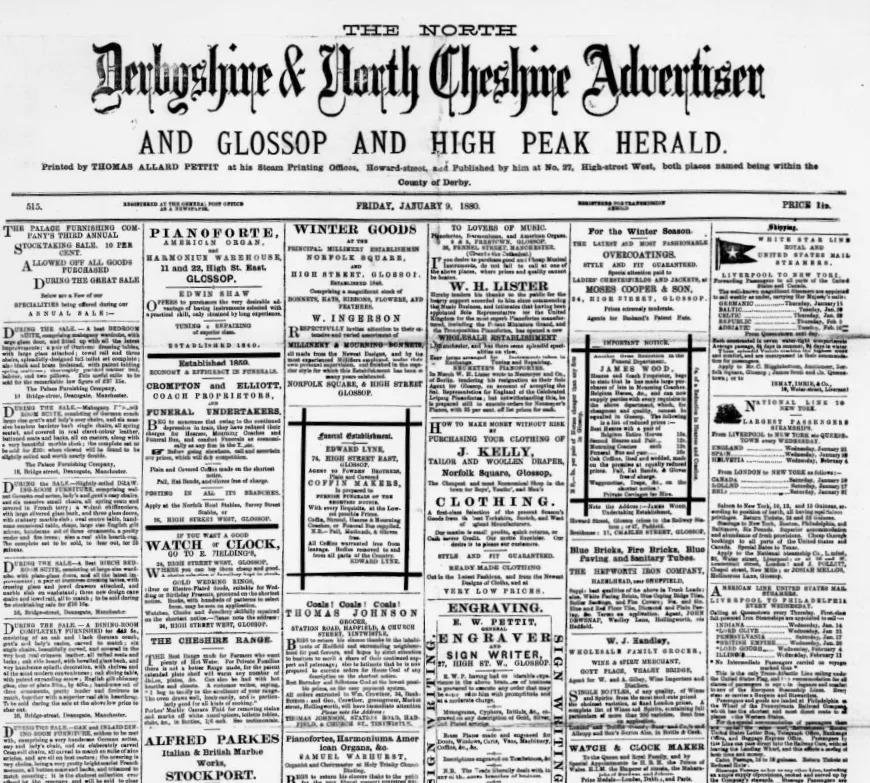
Our next new title of the week is the North Derbyshire & North Cheshire Advertiser, which was first published in the North Derbyshire market town of Glossop on 7 January 1871 as the Glossop Advertiser and High Peak Herald. Appearing every Saturday, this title was established to advance the Liberal cause in North Derbyshire, the debut editorial stating how:
The Advertiser will take its place in the category of Liberal papers. Our politics are of the advanced school: we are in favour of progress. Though civil and religious liberty have made rapid strides of late years, we do not think they have attained to the acme of perfection. Much has been done, but much yet remains to be done. Religious equality has yet to become an established fact.
Circulating through Buxton, Bakewell, Bradwell, Baslow, Chapel-en-le-Frith, Charlesworth, Compstall, Castleton, Disley, Eyam, Great Huckely, Hyde, Hadfield, Hayfield, Hollingworth, Hope, Hathersage, Marple, Mottram, Mellor, New Mills, Peak Forest, Romley, Stalybridge, Stockport, Tideswell, Tintwistle, Whaley Bridge and Woodhead, the North Derbyshire & North Cheshire Advertiser contained all the ‘local and district news’ from these towns and villages.
Filling eight pages, the newspaper also printed serialised fiction, railway timetables, miscellaneous news items, features on agriculture, and notices of births, marriages and deaths. In 1923 the title again became known as the Glossop Advertiser.
The Norwood Review and Crystal Palace Reporter
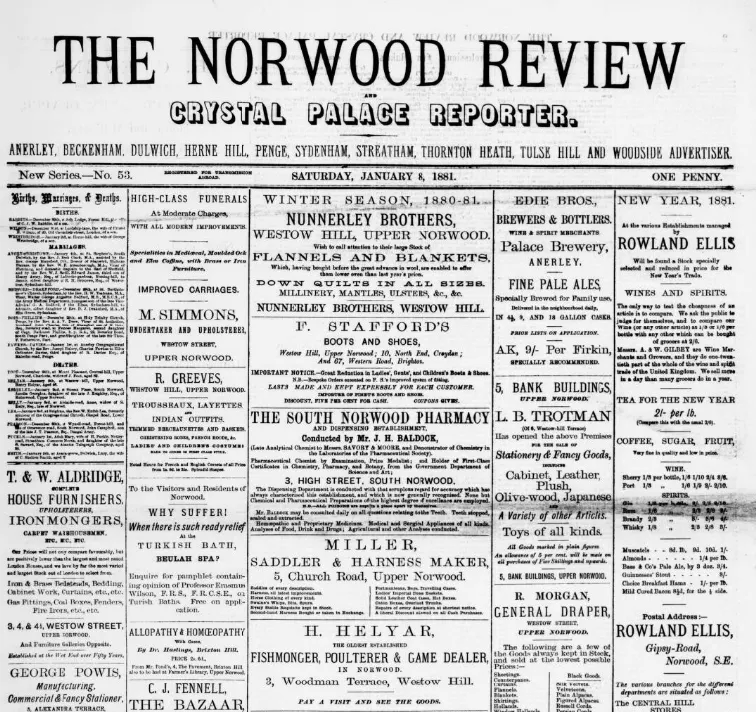
We travel to London for our final pair of new titles this week, beginning with the Norwood Review and Crystal Palace Reporter. This eight-page newspaper was first published in the Norwood area of South East London on 17 January 1880, and like the North Derbyshire & North Cheshire Advertiser, its politics were also Liberal. To this end, the debut editorial of the Norwood Review and Crystal Palace Reporter stated how:
We shall therefore rejoice to the see the Liberal party of the district, organised and consolidated, successfully return their candidates at the next election…We plead for education, the most efficient that can be got, to raise our masses from the shiftless poverty and ignorant stupidity into which so many are sunk…
Costing just one penny, the Norwood Review and Crystal Palace Reporter circulated ‘largely in Norwood and the Crystal Palace district, also in Anerley, Dulwich, Forest Hill, Penge, Selhurst, Streatham, Sydenham, and Tulse Hill.’ Its pages covered the local news from the area, with a feature entitled ‘Our Local Watch Tower,’ with news from the likes of the Lambeth Vestry, the Lambeth Guardians, the local police and the local volunteers. The paper also featured a children’s column, which was called ‘For The Young.’
The Weekly Times & Echo (London)
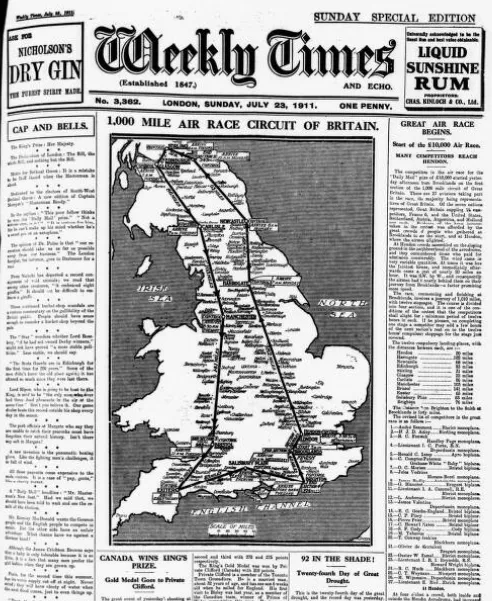
Our final new title of the week is the Weekly Times & Echo (London), which made its first appearance on the publishing scene on 24 January 1847, priced at three pence. A ‘London Newspaper of History, Politics, Literature, Science, and Art,’ the Weekly Times & Echo (London) was a Sunday paper, which was again Liberal in its politics, and filled some twelve pages.
Indeed, the Weekly Times & Echo (London) was known for advocating ‘all measure of political and social progress,’ as well as for supporting ‘the abolition of all distinctive privileges in the Universities, Church, &.’
And so, filling the pages of the Weekly Times & Echo were looks at political news, ‘General Domestic Intelligence,’ which covered the ‘metropolis and the provinces,’ as well as Scotland and Ireland, trade and commerce features, law and police items, religious news, the latest from the worlds of literature and the arts, and also from fine arts. The paper, meanwhile, also had a ‘Weekly Gossip’ column, alongside news from the navy and the military.
Our Updated Titles
This week we have updated twenty of our existing titles in all, with updates to eleven of our Scottish titles. Particular highlights from our cohort of new Scottish titles include the over 21,000 brand new pages we’ve added to the Highland News, which cover the years 1916 to 1963, the over 12,000 brand new pages we’ve added to the Fifeshire Advertiser, and the over 11,000 brand new pages we’ve added to the Northern Times and Weekly Journal for Sutherland and the North.
Elsewhere, we’ve added new pages to one of our titles from the Republic of Ireland, namely to the Roscommon Herald, whilst back across the Irish Sea, we’ve added over 11,000 brand new pages to the Illustrated Berwick Herald.
Friday the Thirteenth and the Death of Gabriel Hauvette-Michelin
With this coming Friday being Friday the thirteenth, we thought we’d delve into our new pages of the week to discover anything about the superstition of that particular date being unlucky. In the pages of the Weekly Times & Echo (London), we discovered an article that highlighted the superstitions held around Friday the thirteenth bringing with it ill luck, and even worse, a fatality.
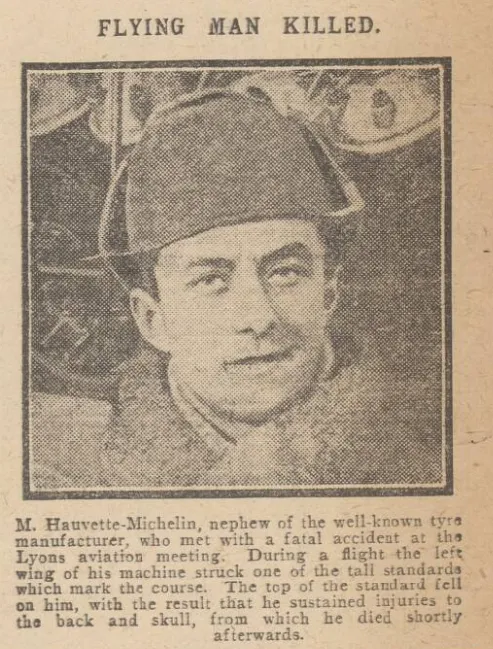
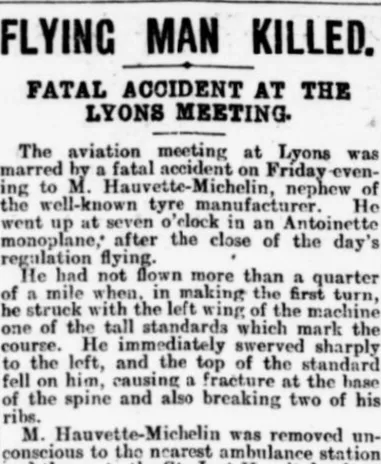
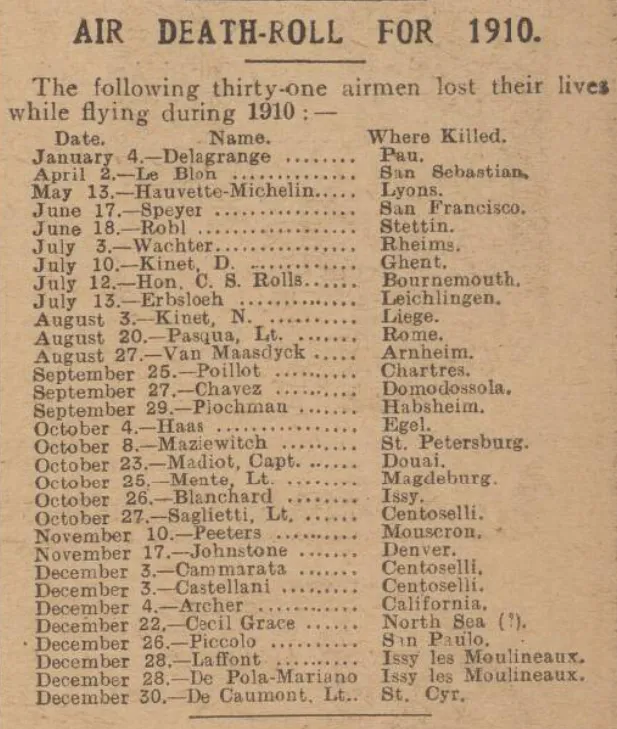
On 15 May 1910 the Weekly Times & Echo (London) published an article under the headline ‘Flying Man Killed – Fatal Accident at the Lyons Meeting.’ The piece reported on the death of M. Hauvette-Michelin, ‘nephew of the well-known tyre manufacturer,’ at an aviation meeting in Lyons.
But what had the sad death of Gabriel Hauvette-Michelin to do with Friday the thirteenth?
First of all, let’s look at what happened to Hauvette-Michelin. The Weekly Times & Echo (London) tells us he had made a flight at seven o’clock, ‘after the close of the day’s regulation flying,’ in his Antionette monoplane, when disaster struck. The article explains how:
He had not flown more than a quarter of a mile when, in making the first turn, he struck with the left wing of the machine one of the tall standards which mark the course. He immediately swerved sharply to the left, and the top of the standard fell on him, causing a fracture at the base on the spine and also breaking two of his ribs.
Tragically, Hauvette-Michelin was ‘removed unconscious to the nearest ambulance station and thence to the St. Just Hospital, where he died at a quarter past ten without regaining consciousness.’
Thus far, there is no mention of the dreaded date, Friday the thirteenth. However, the piece goes on to say how the ‘accident had caused general depression at Lyons, and the superstitious aviators remark that the day was Friday and the thirteenth of the month.’
But could Hauvette-Michelin’s accident be really pinned on the date, Friday the thirteenth?
The writer of the piece for the Weekly Times & Echo (London) was not so sure. It was reported how Hauvette-Michelin had only ‘made two or three flights at Châlons Camp,’ where the accident occurred. Indeed, prominent French aviator Georges Legagneux was quoted as saying that his fellow aviator’s death was ‘the result of sheer inexperience.’
Whether linked to the ill fated date of Friday the thirteenth, there was something still a little eerie surrounding Hauvette-Michelin’s death. The Weekly Times & Echo (London) reported how, ‘before the making the ascent he had remarked to one of the stewards, ‘I shall not make any attempt to fly after to-day. I consider it a very dangerous game.’’
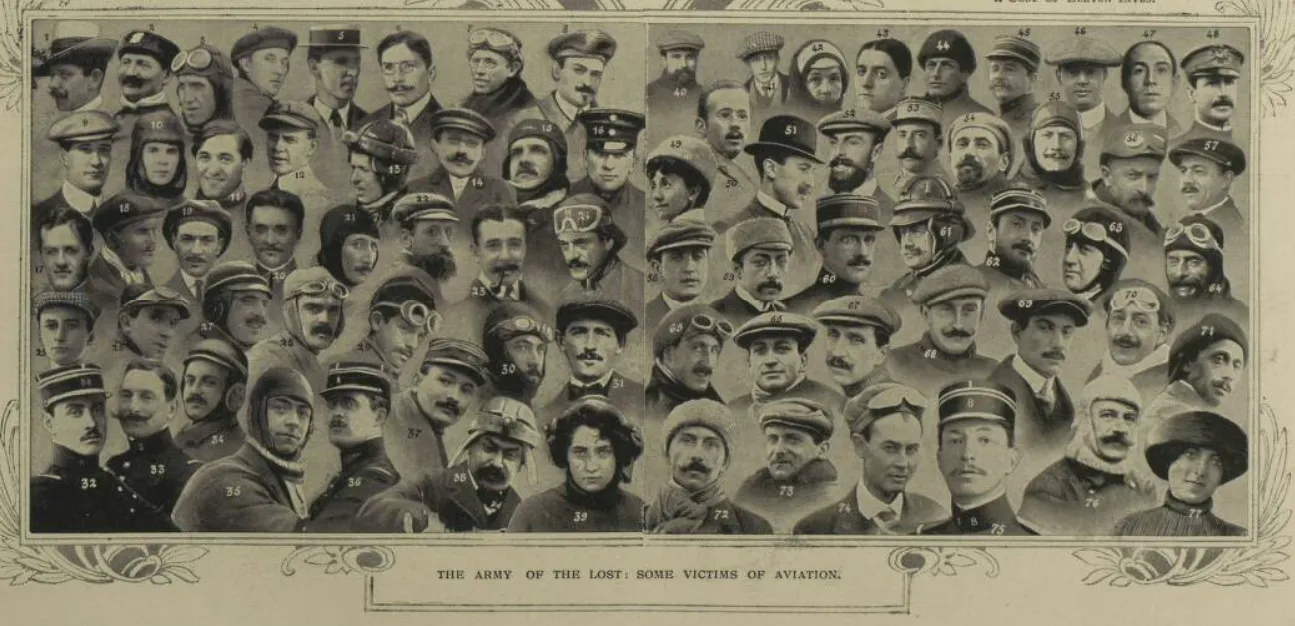
Flying at this time was indeed a very dangerous game, as the lists of fatalities contained in the contemporary press show. It seems unlikely that the date of Friday the thirteenth had anything to do with Hauvette-Michelin’s sad death, but the timing perhaps would have given some comfort to his fellow aviators, who regarded him as ‘a great favourite,’ and to blame the timing rather than the intrinsically dangerous nature of their hobby may have been easier for them.
Discover more about the early days of aviation, superstitions around Friday the thirteenth, and much more besides, in the pages of our newspaper Archive today.
New Titles
Title | Years Added |
1863-1869, 1880-1889, 1900-1902 | |
1871-1872, 1874-1880, 1882-1887, 1890-1893 | |
1880-1888, 1890-1900 | |
1847-1867, 1885-1892, 1894, 1896-1901, 1908-1912 |
Updated Titles
This week we have updated twenty of our existing titles.
You can learn more about each of the titles we add to every week by clicking on their names. On each paper’s title page, you can read a free sample issue, learn more about our current holdings, and our plans for digitisation.
Title | Years Added |
1872-1875, 1980-1989 | |
1950 | |
1930-1933 | |
1951-1953, 1955-1959 | |
2003 | |
1920-1930, 1937-1939, 1957-1965 | |
Forres Elgin and Nairn Gazette, Northern Review and Advertiser | 1917-1933, 1991-1992 |
1877 | |
1916-1963 | |
1889 | |
1880-1889, 1900-1909, 1920-1927 | |
1928-1930 | |
1955 | |
1952 | |
Northern Chronicle and General Advertiser for the North of Scotland | 1930-1939, 1950-1952 |
Northern Times and Weekly Journal for Sutherland and the North | 1905-1906, 1913-1917, 1919-1921, 1930-1939, 1950-1952, 1986-1989 |
1879, 1887 | |
1863, 1872-1878, 1881, 1883, 1900-1906, 1908-1909, 1920 | |
1859-1860, 1866, 1876, 1879, 1889 | |
1890-1895, 1897-1898 |
You can keep up to date with all the latest additions by visiting the recently added page. You can even look ahead to see what we’re going to add tomorrow.
More on this topic:
Share this article
About the author

Rose Staveley-Wadham
Newspaper Licensing Manager
Published on Mon, 9 June 2025.