
Hot Off The Press – New Titles This Week
Published on 11 August 2025 by Rose Staveley-Wadham
A week on from our record-breaking smorgasbord of 80 brand new titles, we are continuing to spoil you with exciting brand new newspapers, such as the politically charged Bradford Socialist Vanguard, the story rich Fireside Companion, and fan favourite the Walsall Football News. With five brand new titles, updates to 21 of our existing titles from all around the world, and 204,610 brand new pages in all, it’s another great week here at The Archive.
So read on to discover more about our new and updated titles, and also to learn more about the Bradford Socialist Vanguard’s heavy criticism of the First World War, which led to the prosecution of its editor under the Defence of the Realm Act.
Register now and explore The Archive
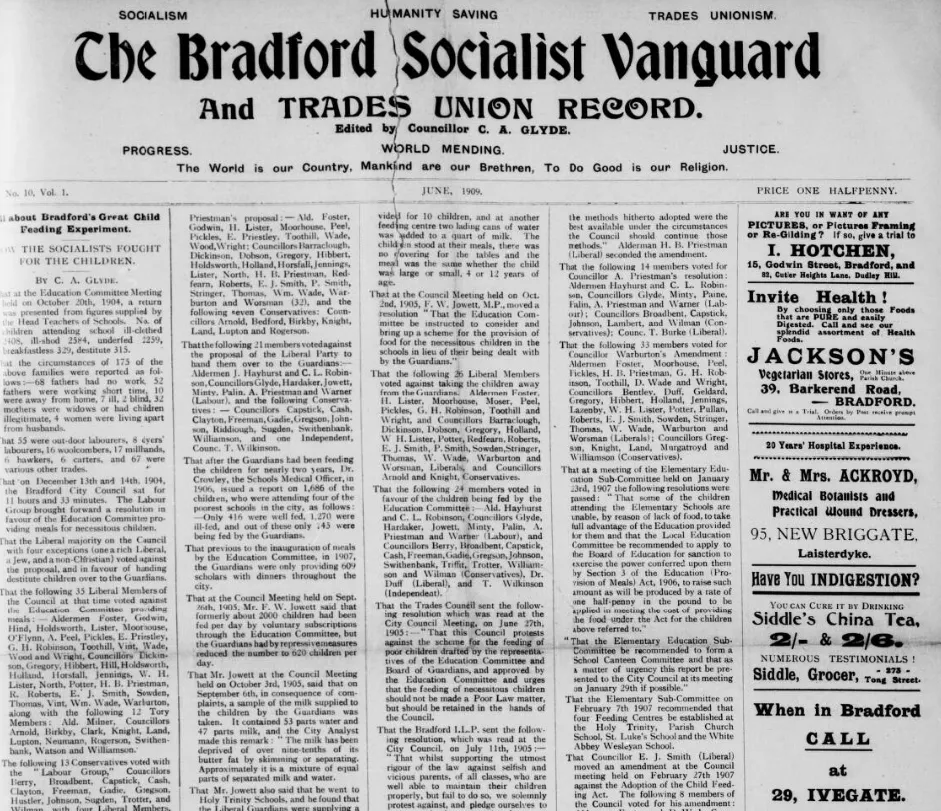
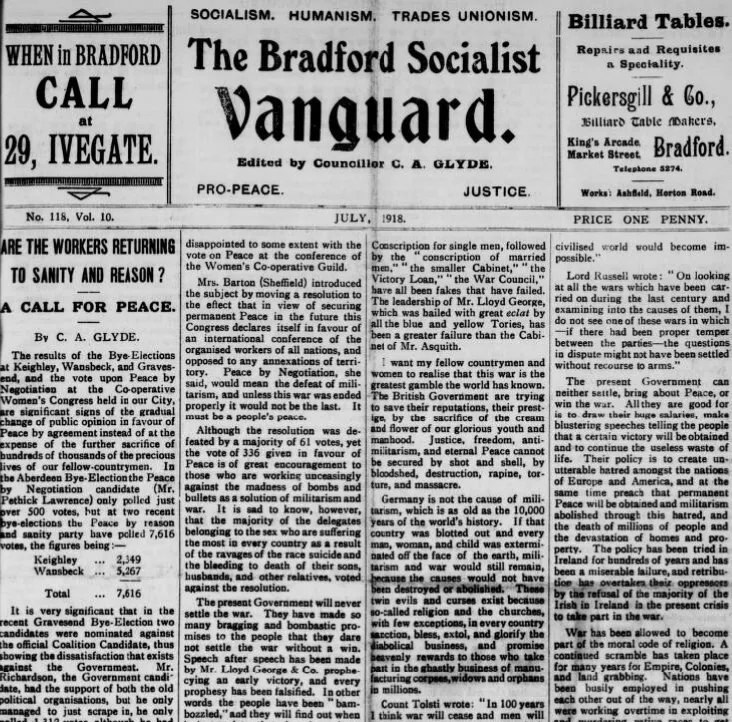
The Bradford Socialist Vanguard
It’s only fitting then that we kick off our look at this week’s new titles with the Bradford Socialist Vanguard, which was launched in 1908 by Charles Glyde. Indeed, from the paper’s very first editorial, it is clear that the publication was set to be the very particular mouthpiece of its founder and editor:
For some time I have desired a medium for which I could fearlessly place before my fellow citizens my views with regard to Socialism, municipal affairs, reform, and the humanisation of our present chaotic system of capitalism. This paper will be run in the interests of the wage-earners only. It will attack without fear or favour every evil which is cursing the people.
So who exactly was Charles Glyde? Born in 1869 in Leeds, Charles Glyde moved to Bradford in 1890. Soon after this he witnessed the Manningham Mills strike, which highlighted the failure of the Liberal Party in championing working class causes. Glyde soon joined the Bradford Labour Union and the Fabian Society, as well as becoming a member of the Bradford branch of the Socialist Democratic Federation.
In 1904 Charles, or Charlie as he was known, was elected as a councillor for the Tong Ward in Bradford. According to Martin Crick in his article The Bradford Branch of the Social-Democratic Federation, Glyde ‘became one of the leaders of Bradford’s unemployed,’ whilst also championing free school meals.
The Bradford Socialist Vanguard then became another of Glyde’s efforts in the name of socialism. Costing just one halfpenny and appearing every month with the words ‘Socialism, Humanity Saving, Trades Unions, Progress, World Mending, and Justice’ emblazoned on its masthead, it aimed to ‘fight the hypocrisy of Liberalism, the ignorance and selfishness of Toryism, and milk-and-water Labourism.’
Within the pages of the Bradford Socialist Vanguard you could find news on the ‘Latest Socialist Movements’ in the likes of North Bierley, Allerton, and Eccleshill, news from the Bradford City Council, and socialist themed ‘Stories for the People.’ The Bradford Socialist Vanguard also printed notes from the Clarion Club, the cycling club tied to the Labour movement, and named after the Clarion newspaper.
Being very much tied to its founder, Charles Glyde, the Bradford Socialist Vanguard came to an end in 1920 when Glyde retired due to ill health. The pioneering councillor passed away three years later in 1923.
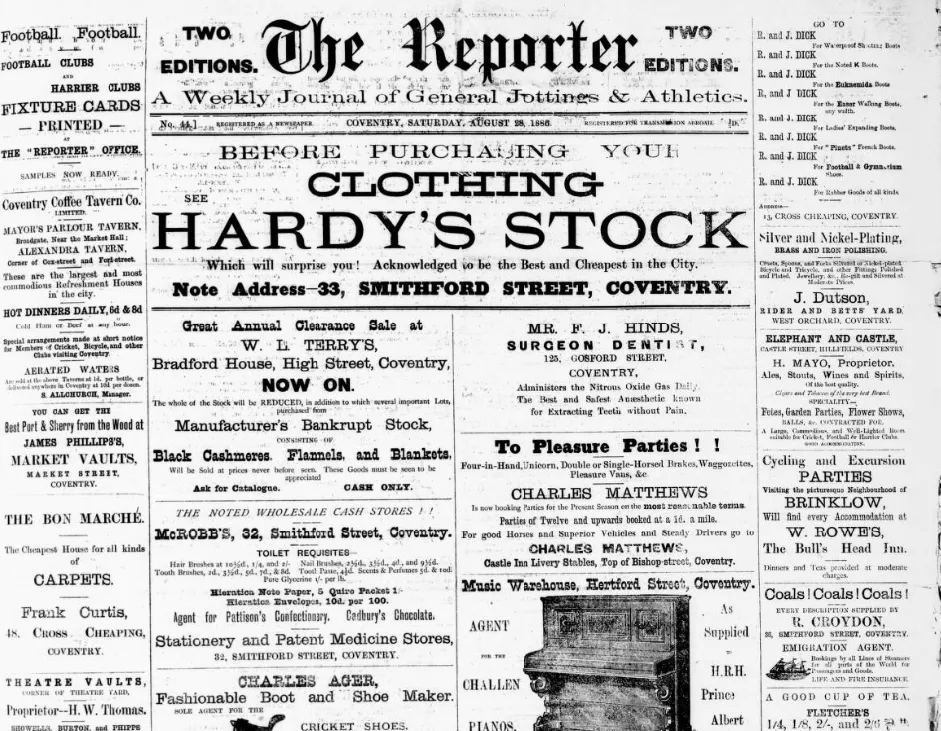
The Coventry Reporter and General Advertiser
Our next new title of the week is the Coventry Reporter and General Advertiser, which began life as the Athletic Reporter. ‘A Weekly Journal devoted to Football, Cricket, Cycling, Pedestrianism, and Athletic Sports in general,’ this title appeared every Saturday priced at one halfpenny, and covered that day’s football fixtures. Furthermore, the publication printed news from the athletics, rugby, cross-country, and billiards worlds, alongside its heavy coverage of football matters.
Change was in the air in 1886 when the title became known as the Reporter, becoming in 1888 the Midland Counties Reporter and General Advertiser, before the publishers finally settled on the Coventry Reporter and General Advertiser in 1889. During these changes the newspaper shifted away from simply being a sporting journal, dubbing itself as ‘An Advertising Medium for the Midland & Adjoining Counties.’ Alongside more general reporting, the Coventry Reporter and General Advertiser retained its ‘To-day’s Football’ column.
By 1898 the Coventry Reporter and General Advertiser was calling itself ‘The People’s Weekly.’ Now filling eight pages instead of four, it printed serialised fiction, a trade directory, poetry, and news from the Coventry School Board. Sport was not forgotten, however, as it printed a ‘Football Notes’ section.
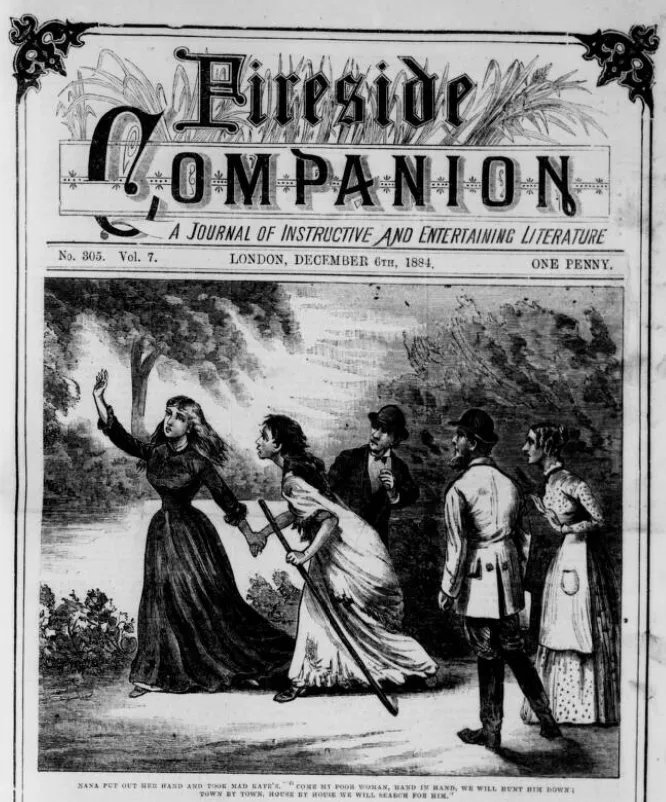
The Fireside Companion
From football to the fireside now, with the Fireside Companion. ‘A Journal of Instructive and Entertaining Literature,’ the Fireside Companion was founded in London in 1850. Its formula of short stories, serialised fiction and poetry proved to be a winning one, as it gained by the 1880s a circulation of some 200,000 copies.
Appearing every Saturday and costing one penny, the Fireside Companion was an affordable source of entertainment. Calling itself a ‘literary, biographical and anecdotical book for all seasons; being a series of tales, sketches, poems,’ the Fireside Companion featured illustrations on its front page, which were sure to draw the eye.
Inside, the title featured stories that often contained warnings about heading down the wrong path. For example, you can find within its pages tales like Lucille Edgerton; or, From Affluence to Poverty, written by a ‘temperance advocate,’ Eileen’s Temptation by Emma M. Bartlett, and Louise Forrest; or, the Shadow of a Girlish Folly by Geraldine Fleming. What is striking about the stories contained in the Fireside Companion is that many of them are penned by women, and are aimed at younger, female, audience.
The Walsall Football News
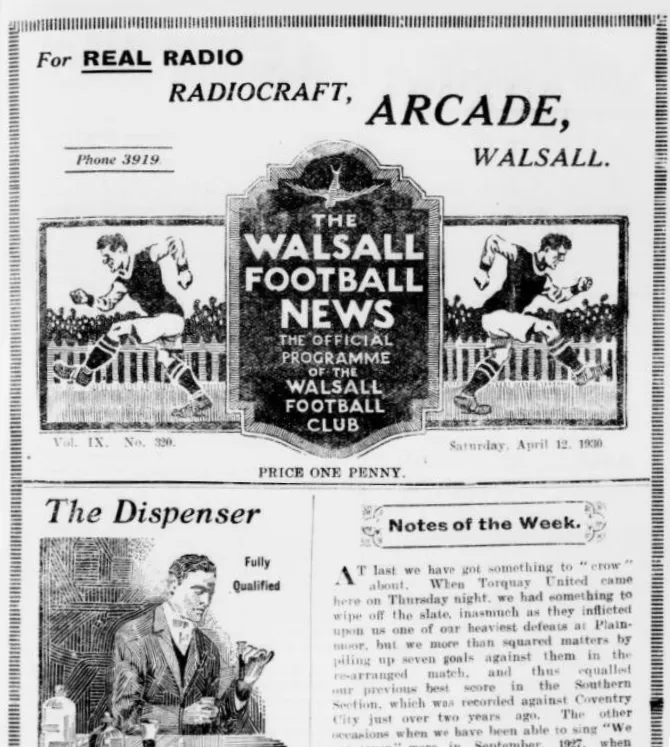
We’re not straying away from football for long, however, having taken a brief rest at the fireside. It’s appropriate, really, as another football season begins, and we welcome the Walsall Football News to our collection. ‘The Official Programme of the Walsall Football Club,’ the Walsall Football News first appeared on 4 September 1920, and was set to ‘be published for every match at Hillary-street this season.’
Indeed, the Walsall Football News appeared every Saturday throughout the football season, from August through to April, costing just one penny. It featured ‘Notes on Games and Players,’ as well as lists of Walsall F.C.’s fixtures, and details of other fixtures throughout the country. A wonderful record of all things Walsall F.C., the title had a column devoted to the Walsall Football Supporter’s Club, and even printed photographs of members of the team.
Having been founded in 1888, Walsall F.C. are currently placed in League Two.
The Wiltshire News
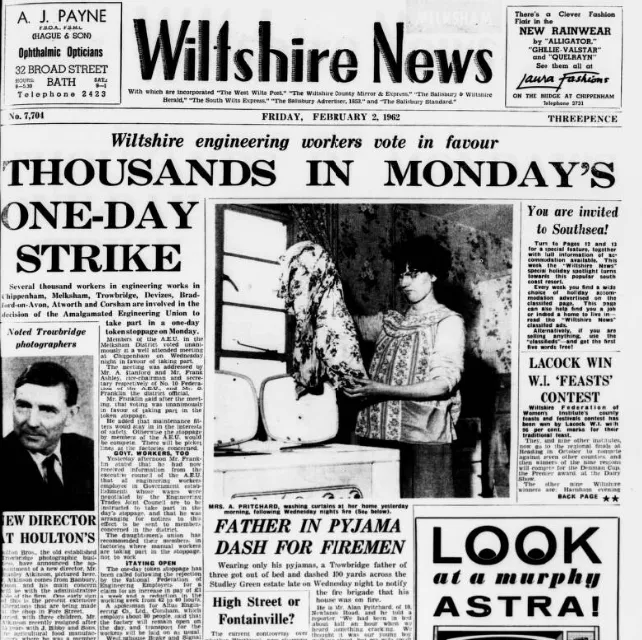
All that is left now to do is to introduce our final new title of the week, which is the Wiltshire News. With roots all the way back to 1833, the Wiltshire News was published in Wiltshire’s county town of Trowbridge. Appearing every Friday, it was fittingly dubbed ‘The County Paper,’ as it incorporated the other titles of the West Wilts Post, the Wiltshire County Mirror & Express, the Salisbury and Wiltshire Herald, the South Wilts Express, the Salisbury Advertiser, 1853, and the Salisbury Standard, 1869.
A lively local paper, the Wiltshire News filled some twelve pages and covered a range of topics such as agriculture, farming notes, gardening, hunting, and football. Meanwhile, it printed the news from the likes of Trowbridge, North Bradley, Wingfield, Bradford, Westbury, Melksham, Chippenham, Corsham, Devizes, Warminster, and Frome, alongside ‘news from all parts.’ The paper, furthermore, printed photographs of local events and personalities, cartoons, correspondence, and notices of births, marriages and deaths.
Our updated titles
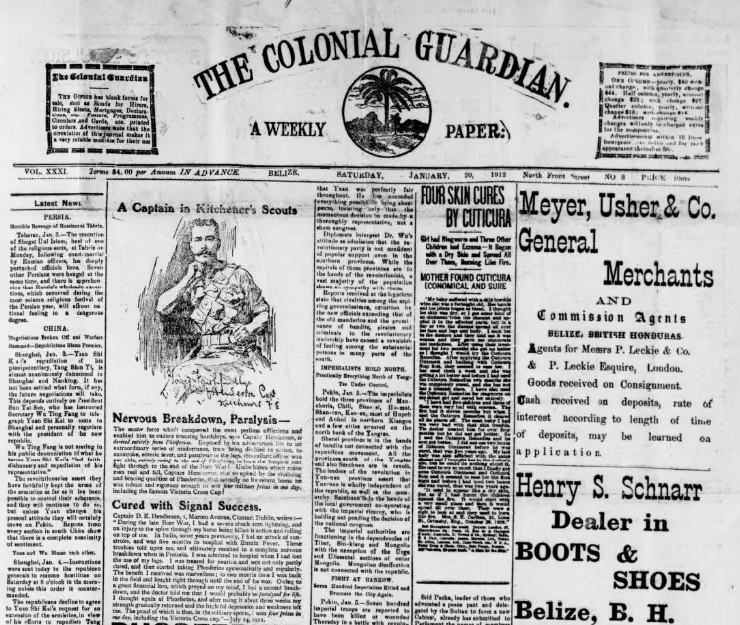
Meanwhile, we have been busy updating our existing titles from near and far. Our largest update of the week is to the Bedford Record, to which we have added over 33,000 brand new pages. From further afield, we have added new pages to the Colonial Guardian (Belize), whilst international matters are also dealt with in updates to the Home News for India, China, and the Colonies.
Elsewhere, we have updated one of our Welsh titles, the Caernarvon & Denbigh Herald, and one of our titles from Northern Ireland, the Irish News and Belfast Morning News. For the Republic of Ireland, we have updated four titles, including special sporting title the Irish Field. Finally, we have updated a duo of our Scottish titles, Inverness’s Northern Chronicle and General Advertiser for the North of Scotland, and Golspie’s Northern Times and Weekly Journal for Sutherland and the North.
Voices of Dissent – the Bradford Socialist Vanguard
Whilst restrictions were imposed on the press during the First World War through the Defence of the Realm Act (DORA), it is possible to find voices of dissent through our Archive. One such voice was that of Charles Glyde, and his newspaper, the Bradford Socialist Vanguard, which was known for its strong criticism of the First World War.
A flavour of the criticism to be found within these newspapers pages can be seen in this advert for the Socialist Review, which appeared in the December 1914 edition of the Bradford Socialist Vanguard:
The Liberal and Tory Press, the politicians, priests, and parsons have bluffed, deceived, deluded, and chloroformed the people as to the causes and the progress of one of the most calamitous and disastrous wars that has ever cursed humanity. All those who want the truth, and who refuse to be bamboozled by the capitalist piffle and fiction that is being retailed ad lib in the Press, will send for a copy of the ‘Socialist Review’ for the present quarter.
Nowhere are Charles Glyde’s dissenting views better represented than in his own words. A year later, in the December 1915 edition of the Bradford Socialist Vanguard, he penned a dramatic dialogue entitled ‘The War Mongers Catechism.’ The fact that Glyde chose to attach his name to his writings was indeed a brave one, knowing he could face prosecution, which he eventually did, for airing his criticism of the war.
‘The War Mongers Catechism‘ is enacted between a chorus of ‘Royalties, Rulers, Priests and Parsons,’ and the ‘Working class soldiers.’ For example, the group of royals, rulers and religious leaders tell the soldiers how ‘to kill, maim, wound, and mutilate your fellow creatures when we tell you to do so is the noblest, highest, grandest, and most glorious form of human service.’ Meanwhile, the soldiers contrast their current situation with ongoing industrial disputes, all the while showcasing Glyde’s pertinent post-colonial point of view:
If we fight for Freedom and Justice, how is that in the past we have been called out to shoot down our fellow workers when they are out on strike for better wages, also to throw out onto the streets in pouring rain, storm, and wind, the rack-rented tenants of grasping landlords, also to act as blacklegs in strikes, and finally, to slaughter and exterminate heathen and native races all over the world, and assist to filch their lands in the interests of the extension of Empires.
Most of Glyde’s criticism of the First World War is framed through the lens of workers’ issues. For example, in July 1916 he penned a piece in the Bradford Socialist Vanguard entitled ‘The Abolition of the Rights and Freedom of the Workers.’ In this article, Glyde is fiercely critical of recruitment methods like the pals battalions, writing how:
Voluntary army service has been abolished and one of the worst forms of conscription has been adopted and for the first time for over a hundred years, a system of Press gang methods were adopted, prior to the passing of conscription, to coerce, intimidate, and force many of the workers, married and single, to fight against their moral principles, their wills, and inclination. Many were threatened with the sack by their masters if they did not don military uniform.
A year later, in October 1917, as the war continued, a piece appeared in the Bradford Socialist Vanguard under the heading ‘Why the War Goes On.’ Here, Glyde offers some stinging reasons as to why the war carried on:
Because the rank and file are suffering from delusions.
To save the reputations of the politicians.
To create swag for the profiteers and bleeders.
To make interest for the gambles in munition shares. The profiteers, politicians, and interest mongers are gambling, throwing the dice with the lives of the workers.
Amongst the jingoism and the propaganda, Glyde’s voice of dissent emerges powerfully through the Bradford Socialist Vanguard, revealing the frustration, the absolute sense of rage and disbelief that was felt as the First World War raged on. Read his words here, and discover more about the First World War and other dissenting voices through our Archive today.
New Titles
Title | Years Added |
1908-1910, 1912-1920 | |
1886, 1888-1893, 1895, 1898-1911 | |
1879-1888 | |
1920-1939 | |
1913, 1916, 1918-1929, 1938-1945, 1949, 1960, 1962 |
Updated Titles
This week we have updated 21 of our existing titles.
You can learn more about each of the titles we add to every week by clicking on their names. On each paper’s title page, you can read a free sample issue, learn more about our current holdings, and our plans for digitisation.
Title | Years Added |
1924-1965 | |
1836 | |
1898-1913 | |
1855 | |
1855-1856 | |
1871-1878 | |
1928-1957 | |
1881-1887 | |
1896, 1912-1916, 1918 | |
1865, 1873 | |
1882-1883, 1888, 1890, 1990, 2002 | |
1900-1914 | |
1820-1821, 1889, 1910 | |
Northern Chronicle and General Advertiser for the North of Scotland | 1920-1929, 1940-1949, 1953-1969 |
Northern Times and Weekly Journal for Sutherland and the North | 1918, 1922-1929, 1940-1949 |
1844-1846, 1862-1865 | |
1889, 1894, 1897 | |
1822-1831 | |
1876-1884, 1886-1888, 1890-1896 | |
1868-1885, 1902-1907 | |
1911 |
You can keep up to date with all the latest additions by visiting the recently added page. You can even look ahead to see what we’re going to add tomorrow.
More on this topic:
Share this article
About the author

Rose Staveley-Wadham
Newspaper Licensing Manager
Published on Mon, 11 August 2025.