
Hot Off The Press – New Titles This Week
Published on 20 May 2025 by Rose Staveley-Wadham
This week at The Archive we celebrating reaching over 92 million pages now available to search, as we also look back at a largely forgotten part of industrial history, the Blackburn Corporation Strike. There’s a lot to celebrate this week, as we’ve added nine brand new titles to our collection, alongside 125,764 brand new pages in all.
So be sure to read on to discover more about all of our nine new titles of the week, and to learn which of our 29 titles we have updated. Also, stay tuned to explore more about the Blackburn Corporation Strike of 1914.
Register now and explore the Archive
Achill Missionary Herald and Western Witness
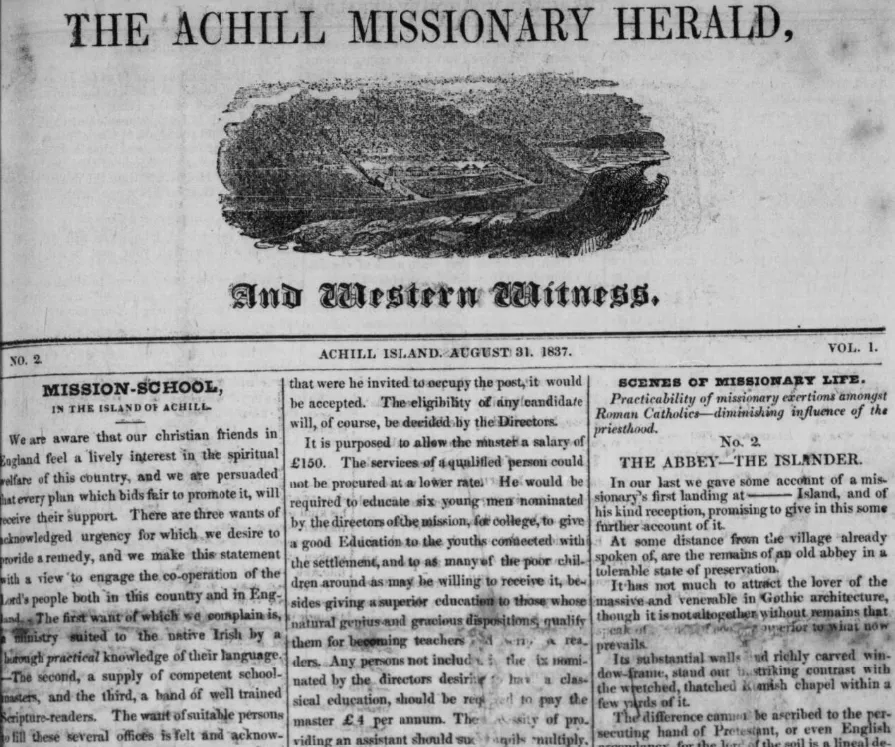
We begin this week’s tour of our nine brand new titles with a look at our most controversial, the Achill Missionary Herald and Western Witness. This title was published on Achill Island, off the coast of County Mayo in the Republic of Ireland, and it was the mouthpiece of the Achill Mission Colony, which was founded by the Reverend Edward Nangle (1799-1884) of the Church of Ireland in 1834.
Edward Nangle’s controversial ‘Colony’ was intended to convert the local Roman Catholic inhabitants of Achill Island, of which many were traditional Irish speakers. It saw the building of schools, cottages, an orphanage, an infirmary, a guesthouse, and on 31 July 1837 the founding of a newspaper, the Achill Missionary Herald and Western Witness.
Of course, Edward Nangle was at the editorial helm of the Achill Missionary Herald and Western Witness. Its first edition laid out what the publication would be:
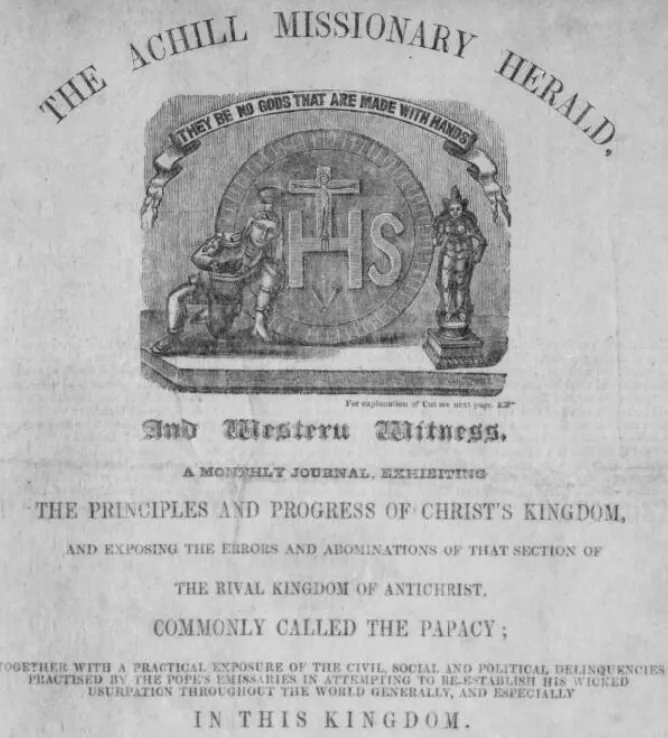
A Monthly Journal, exhibiting the Principles and Progress of Christ’s Kingdom, and exposing the errors and abominations of that section of the rival Kingdom of Antichrist, commonly called the Papacy, together with a practical exposure of the civil, social and political delinquencies practised by the Pope’s emissaries in attempting to re-establish his wicked usurpation throughout the world generally, and especially in this Kingdom.
Virulently anti-Catholic, the first edition also took a shot at Hinduism, denouncing the ‘idolatry’ of both faiths. It did so by depicting ‘idols’ of Hinduism and Catholicism in an illustration, the Roman Catholic idol in question being a communion wafer made in Tuam, ‘taken from the same heap as those which receive divine worship in the Romish Cathedral.’
The first edition of the Achill Missionary Herald and Western Witness also featured a drawing on its masthead of ‘the Missionary Settlement in the Island of Achill from which this paper issues.’ Indeed, the inaugural edition of this publication also described how the Achill Mission Colony was ‘the first Missionary settlement which had ever been established among the Native Irish, using the Irish language.’
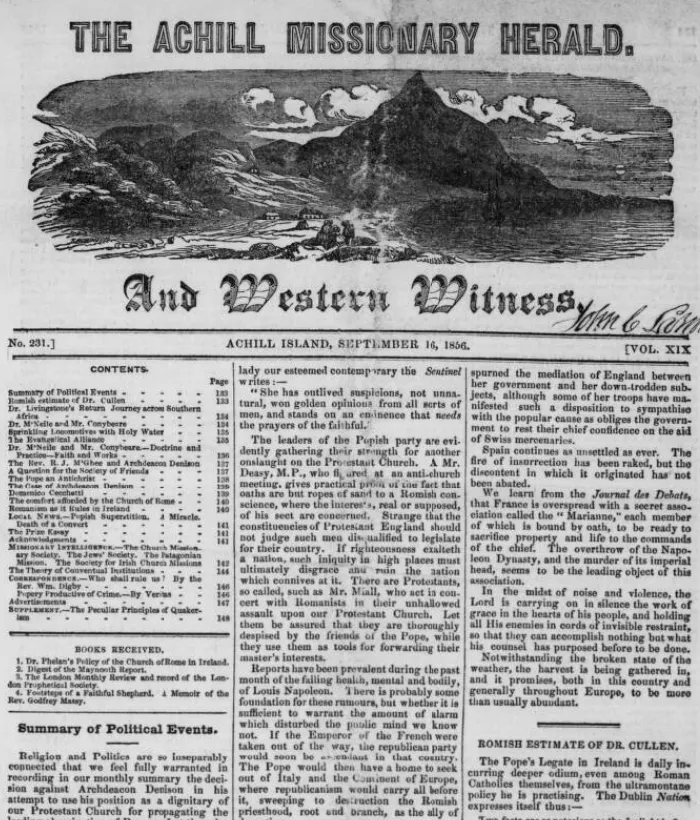
So what did the pages of the Achill Missionary Herald and Western Witness contain? Well, it printed ‘scenes’ of missionary life on Achill Island, alongside more general ‘Missionary Intelligence.’ The title also printed many articles condemning Roman Catholicism, with more practical articles addressing the weather.
Meanwhile, Edward Nangle and the Achill Mission Colony would go on to face accusations of ‘souperism’ during the Great Famine. This was the idea that Protestant societies would set up schools in which starving children were fed, only on the condition of receiving Protestant instruction.
Nangle’s mission would not last without him. After he left Achill, the Achill Mission Colony closed down in the 1880s.
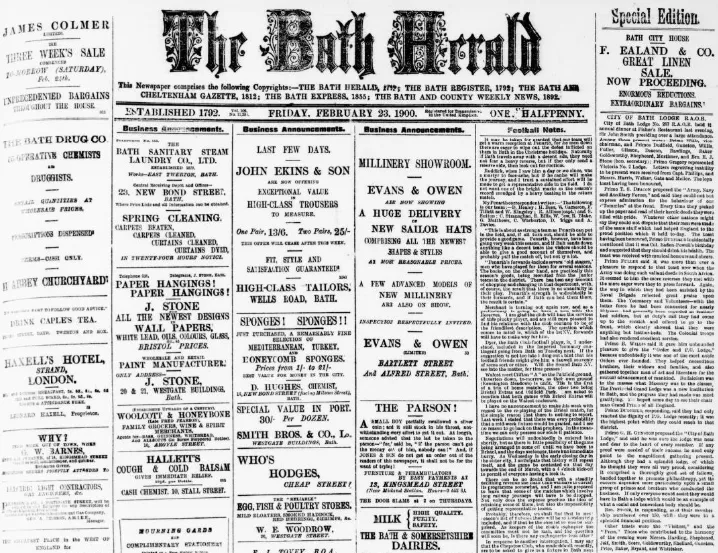
Bath Herald
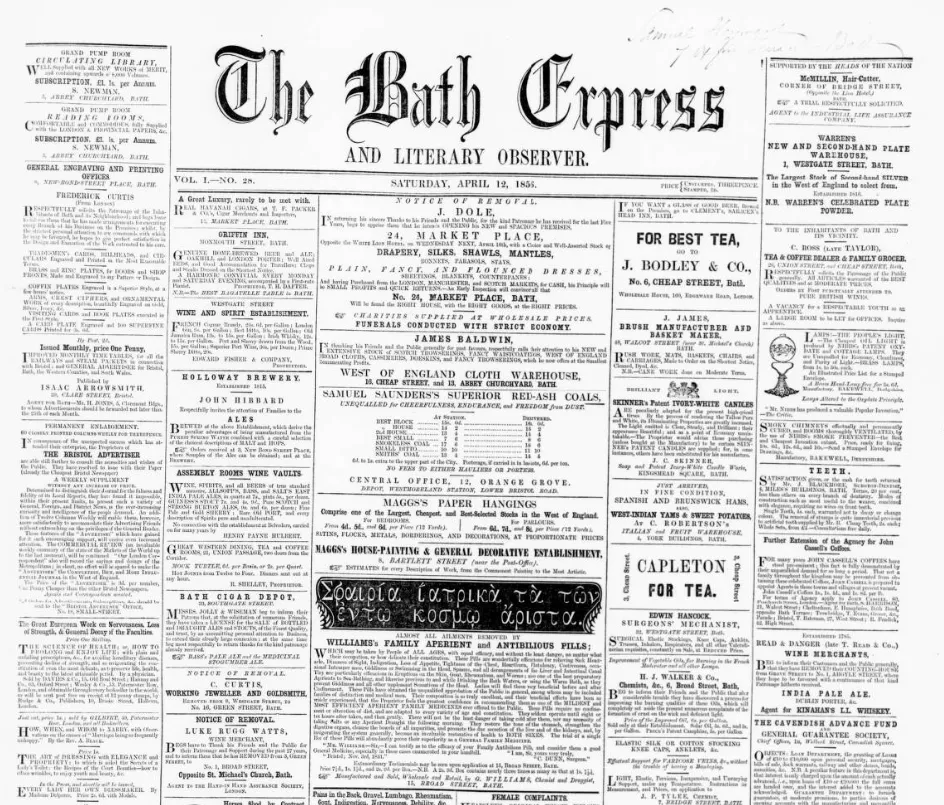
Across the Irish Sea now to historic Somerset city of Bath and to the Bath Herald, which first made its appearance as the Bath Express and Literary Observer on 6 October 1855. Priced at three pence, the title marked the beginning of its publishing tenure by boldly introducing itself and its aims:
Good morning, public! We this day commence an existence which shall be entirely devoted to your service. We think we understand your wants and feelings, and we will endeavour to satisfy them. We commence our task untrammelled by the fetters of party, while we avow a heart-felt and devoted loyalty to our unrivalled institutions.
The Bath Herald was set to awaken a ‘sleeping Bath’ with its new weekly title, which appeared every Saturday and filled eight pages.
Fast forward to 1876, and the Bath Express and Literary Observer assumed its new title of the Bath Herald, a title which was established all the way back in 1792 by William Myler. The newly minted Bath Herald was described as being a ‘high-class family newspaper,’ with ‘an unrivalled circulation in the City of Bath and the three counties of Somerset, Wilts, and Gloucester.’
‘Generally read by all classes,’ the paper featured ‘the best written original articles, original high-class fiction, literary and dramatic criticisms, occasional illustrations, the latest telegrams home and foreign, midday forecasts of the weather, the result of every race and amplest reports of local news.’
In 1925 the Bath Herald merged with the Bath Chronicle to become the Bath Chronicle and Herald.
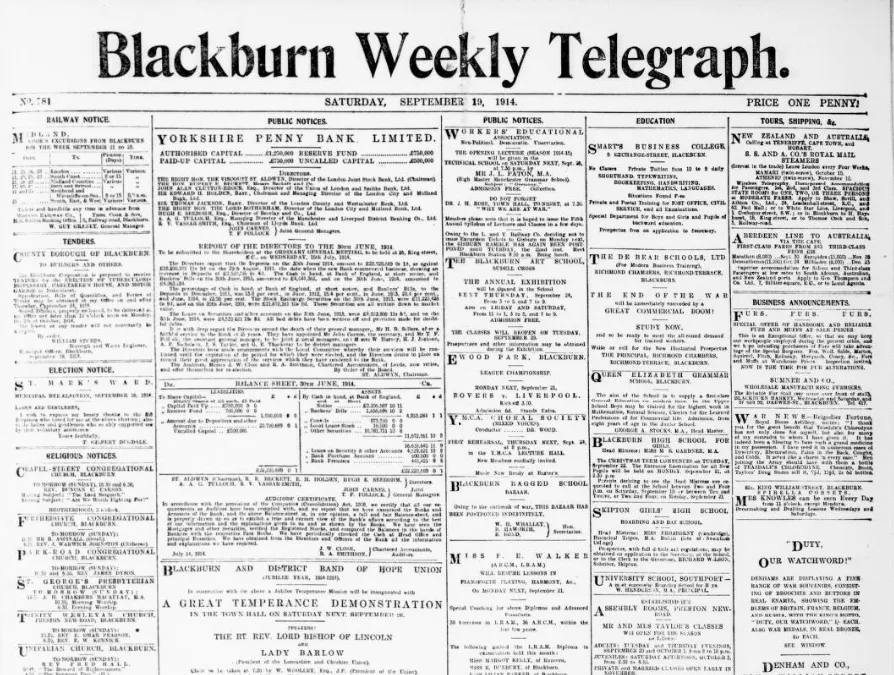
Blackburn Weekly Telegraph and East Somerset Telegraph and General Advertiser
We’re heading north now to Blackburn for our next title of the week, the Blackburn Weekly Telegraph, which first appeared on 7 October 1899. Published by the North-Western Newspaper Company, its debut was made in a ‘very presentable fashion.’
Appearing every Saturday at the cost of the one penny, the Blackburn Weekly Telegraph filled its sixteen pages with news from the industrial Lancashire town of Blackburn. The title often featured photographs of local groups and personalities, as well as illustrations of the latest fashions. As well as reporting on local issues, including the latest from the police courts, the publication featured columns dedicated to gardening, the raising of poultry, and religion.
We really are criss-crossing England now as we return to the south-west to welcome our next new title of the week, the East Somerset Telegraph and General Advertiser. Published in the Somerset town of Frome, the politically independent East Somerset Telegraph and General Advertiser made its debut on 25 June 1859.
Serving Frome, Shepton Mallet, Midsomer Norton, Paulton, Radstock and the neighbouring towns and villages, the East Somerset Telegraph and General Advertiser was published by J.C. Tucker of Frome. Featuring a mix of local and more general news, with reports on the latest from parliament sitting alongside international news and details of accidents and offences in the area, the paper appeared every Saturday at the cost of just one penny.
Greenock Elector
Our next new title of the week is a Scottish one, and it is the Greenock Elector. First published on 5 November 1885 to further the electoral cause of the Conservative candidate for Greenock, a town in Inverclyde, this title appeared on a tri-weekly basis in the lead up to the 1885 General Election.
Fittingly for the organ of Conservative candidate John Scott, who had unsuccessfully contested the Greenock by-election in 1884 and the Greenock seat in the 1880 General Election, the Greenock Elector contained a letter penned by the man himself, alongside printing speeches he had made. The paper also put about supportive statements for the Conservative candidate, to the detriment of his Liberal rival Thomas Sutherland, via its ‘What Folks Are Saying’ column:
That Mr John Scott is again in the field. That the General Elector will see that he gets fair play. That Mr Scott’s indomitable pluck has given him good heart to, and increased the number of, his supporters. That Mr Sutherland was considered a very heavy card to play at the last election. That on his return as member for Greenock there came a smile upon the wan faces of the unemployed. That time has shown there was not the slightest reason for that smile.
Also filling the four pages of the Greenock Elector were some local news, letters to the editor, and a section entitled ‘Notes From the Electoral Battlefield.’ John Scott, however, would not prove successful on this particular electoral battlefield, polling 2,954 votes as opposed to Thomas Sutherland’s 3,057, although he managed to cut Sutherland’s majority by some 10%. This trend was reflected in the General Election as a whole, as Liberal Prime Minister William Gladstone lost his majority.
Macclesfield, Stockport, & Congleton Chronicle and Salford Weekly News
Our next new title of the week is the Macclesfield, Stockport, & Congleton Chronicle, which was established in the Cheshire market town of Macclesfield in approximately 1842. Filling four pages, this weekly title featured a mix of international, national and local news, covering the latest from the Chester Sessions and the Altrincham Union. The Macclesfield, Stockport, & Congleton Chronicle also printed news of local bankruptcies, poetry, and notices of births, marriages and deaths.
We don’t have to travel too far to welcome our next new title of the week, which is the Salford Weekly News. This succinct local paper was established in Salford, Greater Manchester, in 1859. Costing just one penny, the Salford Weekly News was Liberal in its politics. Its four pages were filled with ‘Local Intelligence’ from the likes of the Salford Borough Council and the Salford Borough Police Court, alongside news of accidents and offences, the latest from local churches and chapels, and what was showing at local theatres.
Scarborough Express and General Advertiser and St. Helens Reporter
From the north west now to the north east, and our penultimate new title of the week, which is the Scarborough Express and General Advertiser. Founded in the North Yorkshire seaside town of Scarborough in 1864, the Scarborough Express and General Advertiser was ‘the largest penny paper published in Scarborough.’
Circulating ‘in the towns and villages on the east coast of Yorkshire,’ the title was ‘spiritedly conducted… on independent principles.’ Indeed such independence made the Scarborough Express and General Advertiser ‘the most popular organ issued in the borough.’ Sold at the cost of just one penny, and filling four pages, the paper printed local and district intelligence, notices of births, marriages and deaths, and a railway timetable.
That brings us now to our final new title of the week, which hails from the Merseyside town of St Helens. This publication is the St. Helens Reporter, which was established as the St. Helens Standard in 1860. After incorporating the Prescot Reporter in 1880, the title became known as the St. Helens Reporter in 1888.
Costing one penny, the St. Helens Reporter filled eight pages with mainly local news. It covered the latest from the community in minute detail, reporting on accidents, robberies, deaths and minor misdemeanours in the local area. Meanwhile, the paper reported from the St Helens Town Council, the local Board of Guardians and the council, as well as from the Prescot Highway Board and the St Helens Burial Board. Within the pages of the St. Helens Reporter you can also find football news, and a look at ‘Current Agricultural Topics.’
Looking at our updated titles now, and we’ve added new pages to our holdings from across the United Kingdom and beyond. Particular highlights are the four titles from the Republic of Ireland to which we have added new pages (the Cork Weekly Herald, the Drogheda Advertiser, the Drogheda Argus and Leinster Journal, and the Wicklow Press), and the duo of Welsh titles we have also updated (the Prestatyn Weekly and Wrexham Guardian and Denbighshire and Flintshire Advertiser). Meanwhile, we’ve also added new pages to the Dundee Evening Telegraph and the Jersey Express and Channel Islands Advertiser, as well as to two of our specialist titles, the Aldershot Military Gazette and Cotton Factory Times.
‘In The Throes of the Strike’ – The Blackburn Corporation Strike of 1914
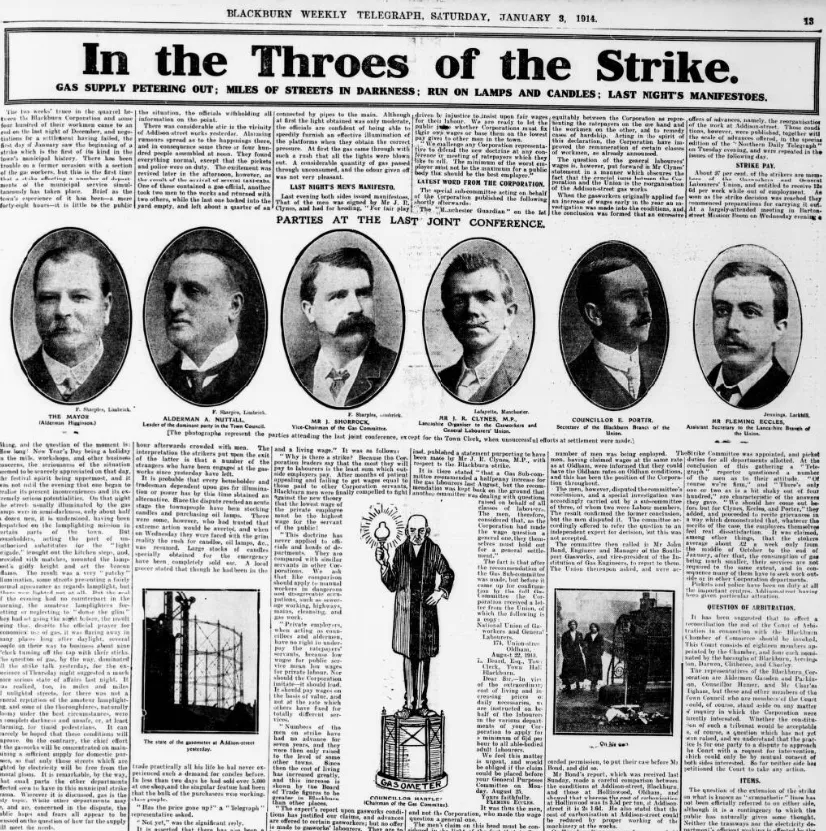
On 3 January 1914 one of our new titles this week, the Blackburn Weekly Telegraph, printed a spread with the dramatic heading ‘In the Throes of the Strike – Gas Supply Petering Out; Miles of Streets in Darkness: Run on Lamps and Candles: Last Night’s Manifestoes.’
We immediately wondered what this strike was about, and with no ready results elsewhere, we were intrigued to discover this important part of Blackburn’s industrial history, as the Blackburn Corporation and over four hundred of its workers clashed over pay.
Indeed, the Blackburn Weekly Telegraph tells us that the Blackburn Corporation and ‘some four hundred of their workmen’ had been quarrelling over pay, which had resulted in an uneasy ‘truce’ for the last two weeks of November. However, ‘negotiations for a settlement having failed, the first day of January saw the beginning of a strike which is the first of its kind in the town’s municipal history.’
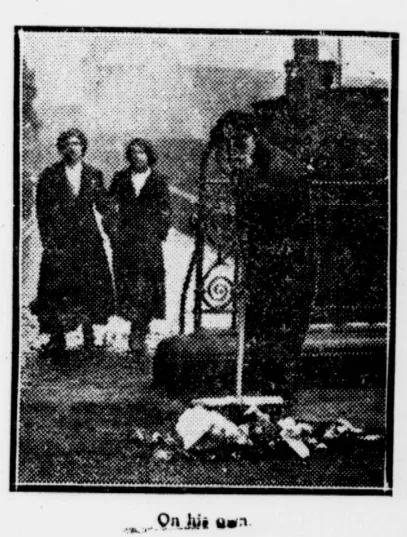
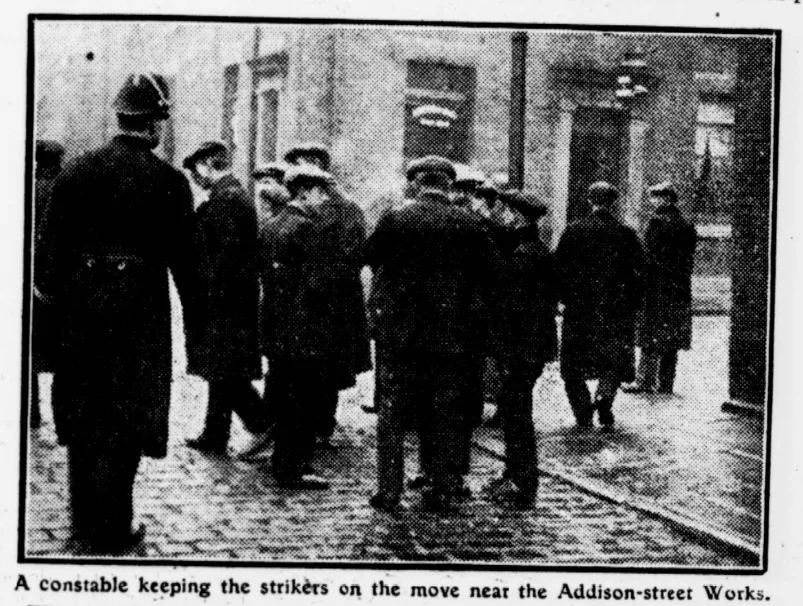
The Blackburn Weekly Telegraph went on to describe the uneasiness in the town as the strike took effect, with a ‘considerable stir’ being reported near the Addison Street works, and ‘alarming rumours’ spreading about the activities there. The spread featured an early example of prompt photojournalism, with a photograph show a ‘constable keeping the strikers on the mover near the Addison-street works.’
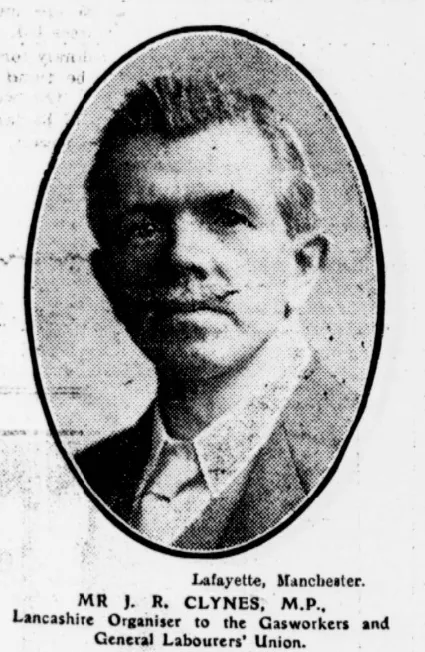
Meanwhile, the Blackburn Weekly Telegraph reported on the publication of manifesto on behalf of the Blackburn Corporation employees. Signed by trade unionist and M.P. J.R. Clynes, the manifesto demanded ‘fair wages’ for the work of the Blackburn Corporation labourers.
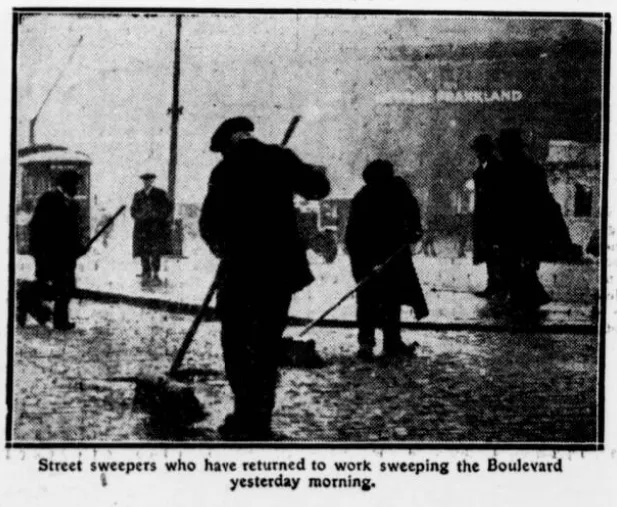
As the strike wore on, the streets of Blackburn were plunged into darkness, as many Blackburn Corporation employees did not arrive to turn the gas lamps on. This resulted in ‘a very ‘patchy’ illumination,’ with ‘amateur lamplighters’ being relied upon for the town’s only light.
At the time of the report, on 3 January 1914, it was suggested that reconciliation might be achieved via the ‘aid of the Court of Arbitration in connection with the Blackburn Chamber of Commerce.’ But no such reconciliation had been achieved, with the Blackburn Corporation relying on a ‘policy of silence.’
Read more about the Blackburn Corporation strike here.
New Titles
Title | Years Added |
1837-1849, 1856, 1867-1868 | |
1855-1869, 1871-1876, 1878, 1880-1882, 1884-1885, 1887-1897, 1899-1900 | |
1914-1918 | |
1859-1860, 1862-1873, 1875, 1878, 1880-1885 | |
1885 | |
1843-1848 | |
1875 | |
1873-1880 | |
1889, 1911-1912, 1918 |
Updated Titles
This week we have updated 29 of our existing titles.
You can learn more about each of the titles we add to every week by clicking on their names. On each paper’s title page, you can read a free sample issue, learn more about our current holdings, and our plans for digitisation.
Title | Years Added |
1874, 1888 | |
1893, 1899, 1902-1903 | |
1883, 1899-1901, 1903, 1946-1947, 1962, 1964-1965 | |
1922 | |
1986 | |
1872, 1876 | |
1991, 1996 | |
1878, 1889 | |
1900-1901 | |
1921-1937 | |
1775, 1882, 1884 | |
1878, 1880-1883, 1885-1888, 1891, 1914-1918 | |
1908 | |
1851-1859, 1861-1863 | |
1991 | |
1992 | |
1866-1869, 1880-1883, 1885-1888, 1893, 1900 | |
1876, 1881 | |
1912 | |
1848, 1855 | |
1897, 1913, 1916, 1918-1919 | |
1940-1941, 1943, 1945-1946, 1949, 1960-1965 | |
1913-1918 | |
1888, 1890 | |
1882-1884, 1920 | |
1893, 1905 | |
Whitehaven Advertiser and Cleator Moor and Egremont Observer | 1892-1893, 1905-1906, 1909, 1912, 1920 |
1905-1906, 1909 | |
1900 |
You can keep up to date with all the latest additions by visiting the recently added page. You can even look ahead to see what we’re going to add tomorrow.
More on this topic:
Share this article
About the author

Rose Staveley-Wadham
Newspaper Licensing Manager
Published on Tue, 20 May 2025.