Hot Off The Press – New Titles This Week
Published on 3 May 2022 by Rose Staveley-Wadham
This week has been another mammoth week here at The Archive, as we have added 1,861,031 brand new pages, with 20 brand new titles joining us over the past seven days alone, from Ashby all the way to Wallasey. Meanwhile, we have updated 148 of our existing titles from across the United Kingdom, meaning that you have a feast of new pages to enjoy this week.
So read on to find out more about all of our new titles of the week, which include a duo of Nottingham titles, and one that hails from the north of Wales. We also travel back 182 years ago to May 1840, when the world’s first ever postage stamp, the Penny Black, was issued.
Register now and explore the Archive
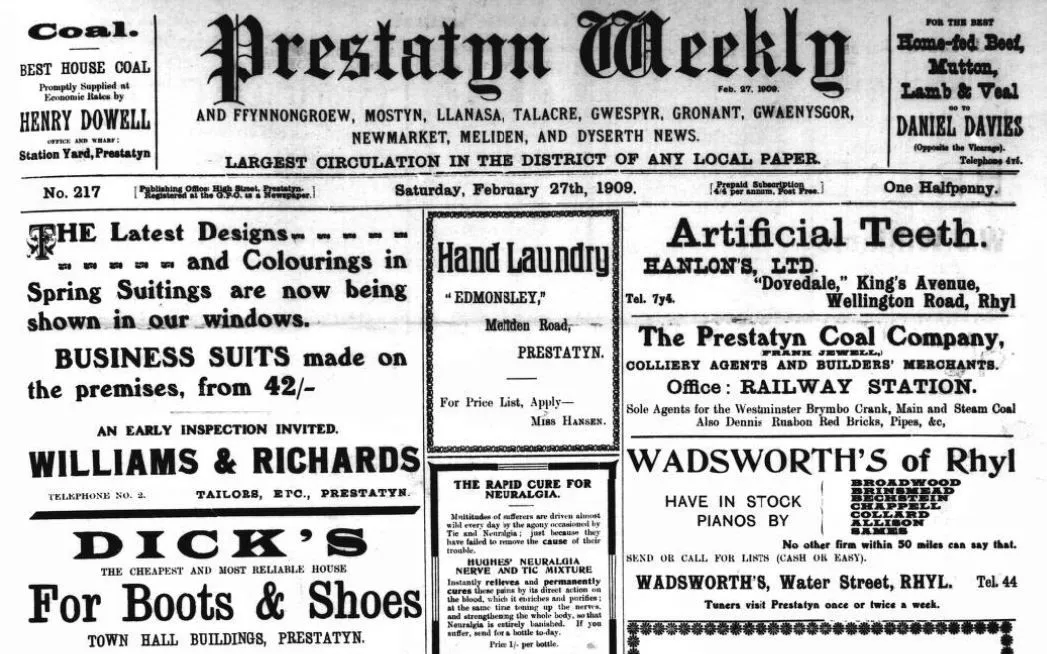
Let’s begin our journey into this week’s new titles then in Wales, with the Prestatyn Weekly, which was first published in 1905. With the ‘largest Circulation in the district of any local paper,’ this newspaper’s full name ran to the Prestatyn Weekly and Ffynnongroew, Mostyn, Talacre, Gwespyr, Gronant, Gwaenysgoar, Newmarket, Meliden, and Dyserth News, and it cost just one halfpenny. Appearing every Saturday, the Prestatyn Weekly filled four pages, its main content being local news.
Indeed, the Prestatyn Weekly is a wonderful record of all the happenings in the seaside town of Prestatyn, which became a popular resort in the nineteenth century thanks to the advent of the railways. For example, it included a ‘Record of Coming Events,’ a list of church services in the area, as well as news from the nearby Wesleyan Chapels. Furthermore, the Prestatyn Weekly contained notices of marriages and deaths, a look at the region’s weather and news from the nearby towns and villages of Gronant, Briwsion, Dyserth, Gwepsyr, Llanasa, Mostyn and Newmarket. The newspaper ceased publication in 1969, over sixty years after it was first launched.
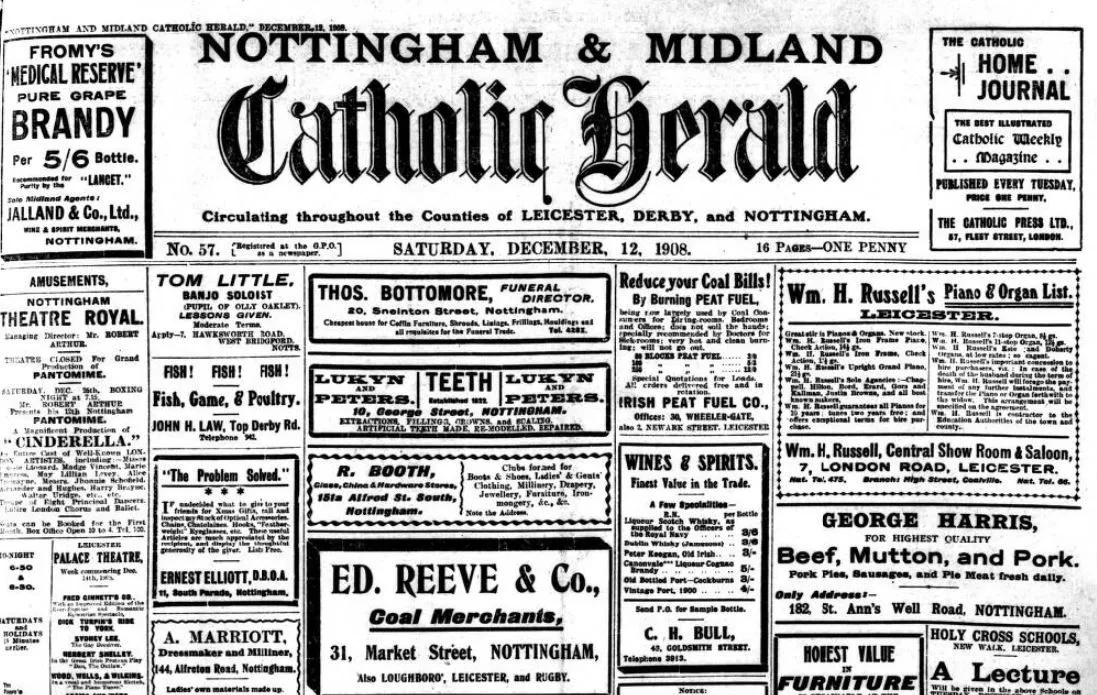
We move now across the Welsh border to welcome our duo of Nottingham-based titles to The Archive, with includes a special religious one, the Nottingham and Midland Catholic News. Founded in 1907 as the Nottinghamshire Herald, this Saturday newspaper rebranded on 3 October 1908 to become the Nottingham and Midland Catholic News, offering a ‘comprehensive record of Catholic news and opinion from across the Midlands and beyond.’ Costing one penny, this newspaper circulated ‘throughout the Counties of Leicester, Derby and Nottingham,’ and contained news from the Roman Catholic dioceses across the country, from Westminster, Newcastle, Portsmouth and of course Nottingham.
Meanwhile, the Nottingham and Midland Catholic News featured news from further afield, incorporating an ‘Irish’ and a ‘Scotch Letter,’ with Catholic related news from both countries, as well as looking at the Catholic clergy in farther flung places like Colombo, Sri Lanka. Furthermore, the newspaper looked at Catholicism in Russia, Germany, America and China, and in particular, missionary work in the latter country. In addition to this, the newspaper contained an illustrated section, which included portraits of deans and reverends from across the country, as well as of Catholic personalities, and drawings of Catholic churches.
At the heart of the Nottingham and Midland Catholic News were various thought pieces written by academics and members of the clergy, with articles such as ‘Can Catholics Be Socialists?’ and ‘Catholicity and Science.’ It also included a ‘Rome Letter,’ and a profile of the Pope. Finally, the Nottingham and Midland Catholic News included something ‘for the ladies,’ as well as serialised fiction with a Catholic theme, and ‘Parochial News.’
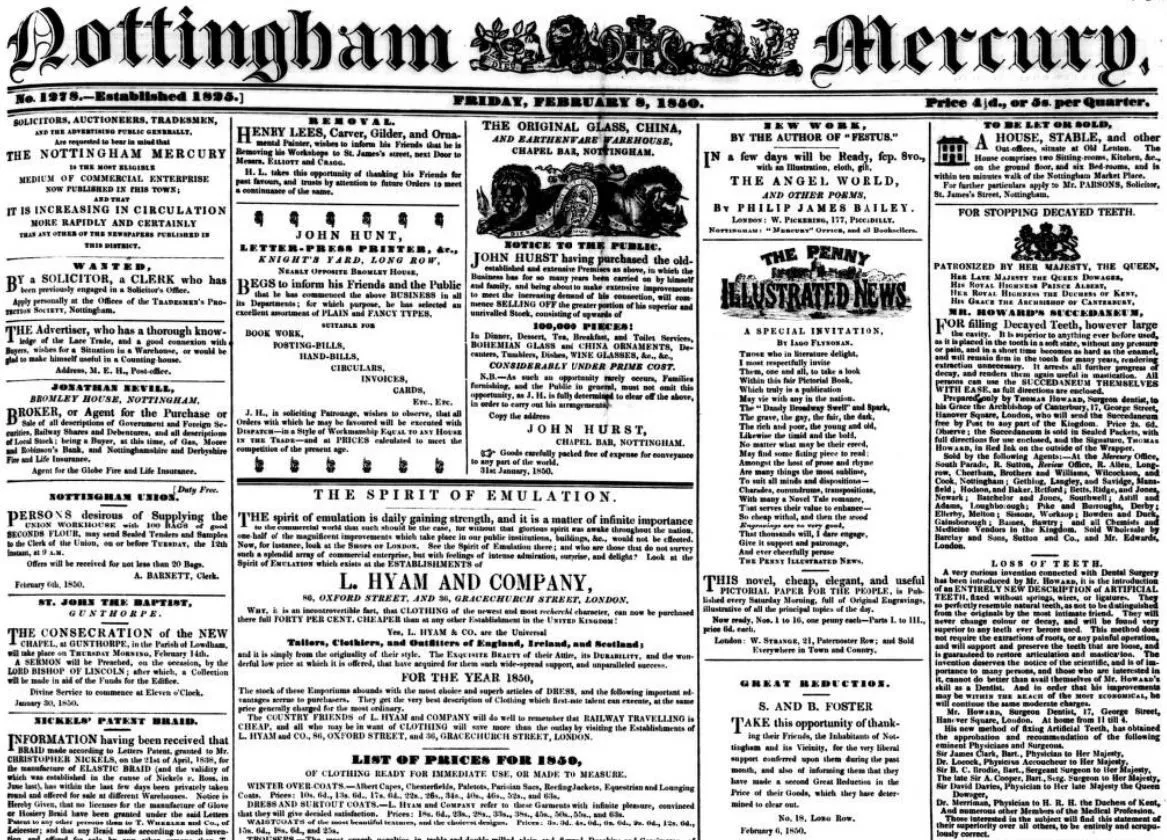
Our second new Nottingham title of the week is the historic Nottingham and Newark Mercury, which was established in the 1820s at the cost of 7 pence with the by-line ‘The Good of the People Is The Supreme Law.’ Appearing every Friday, by 1839 the newspaper had a yearly circulation of 68,500, with an average weekly distribution of 1,317 copies. In 1840 it reinstated its purpose as a Liberal newspaper, declaring how:
The Politics of this Paper advocates liberality without licentiousness – Reform in the Institutions of the Country wherever they be required – Truth, Law, and Justice, as the foundation of every Englishman’s political right.
The newspaper affirmed that its information was ‘collected from the best and most authentic sources,’ and that such news, from the locality and from the country as a whole, would be ‘imparted honestly, fairly, without fear or favour.’ But what sort of the information did the Nottingham and Newark Mercury contain? The newspaper went on to state how:
As one chief origin of England’s greatness, the details of COMMERCE find ample scope in the columns of the MERCURY; whilst TRADE and MANUFACTURES, the grand stimulus to Commerce, meet with every attention that anxious watchfulness can afford them. Looking at the true interest of the AGRICULTURIST, as bound up with the well being of the Community, no pains are spared to promote his advantage in connection with his fellow subjects. The SPORTSMEN will enjoy the History of the Chase, the Turf, and those athletic exercises which are peculiar to the land of their nativity.
Nothing if not thorough, the Nottingham and Newark Mercury filled 14 pages and was ‘extensively circulated…through all the Midland Counties,’ featuring news from the court, as well as notices of births, marriages and deaths.
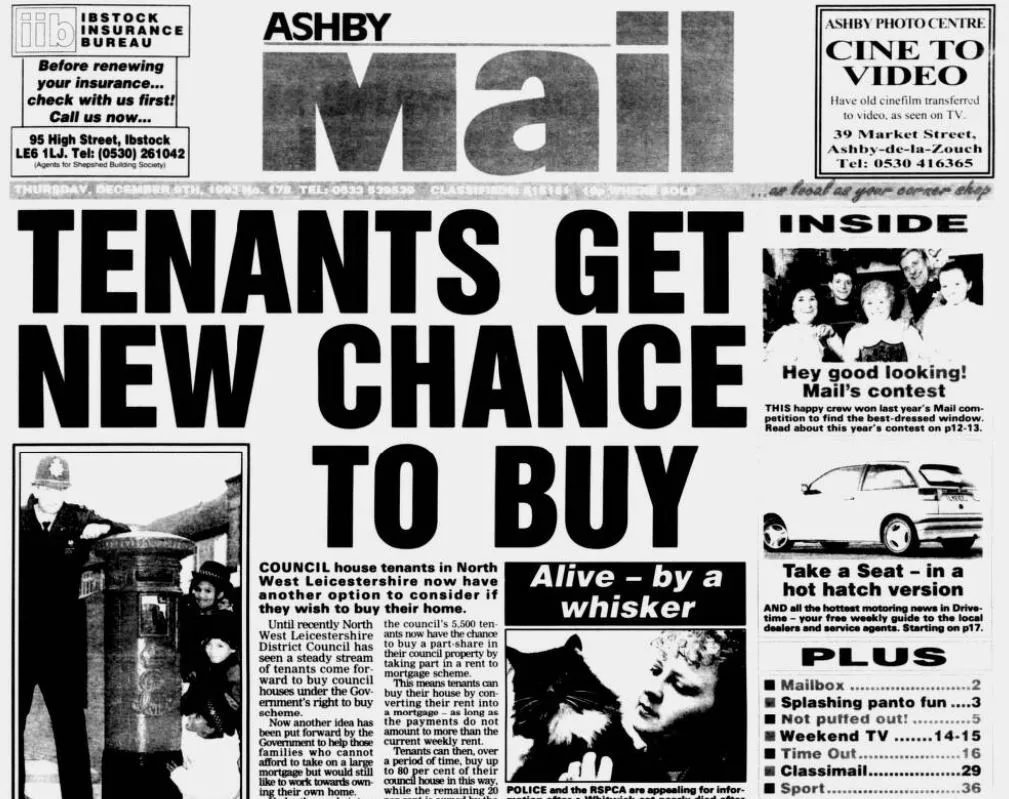
Our next new title of the week also hails from the Midlands and is the Ashby Mail, which is a weekly freesheet that served Ashby-de-la-Zouche and the community of north west Leicestershire. A companion to the paid for daily Leicester Mercury, this newspaper was originally known as the Mail for Communities of Ashby and District.
Another free companion to the Leicester Mercury was the Oadby & Wigston Mail, which was founded in 1978. This weekly freesheet circulated in the Borough of Oadby in south east Leicestershire, and in 2010 it became the Oadby, Wigston & Blaby Mail. Publication of this title, which appeared every Thursday, came to an end in February 2013 with the launch of My Extra.
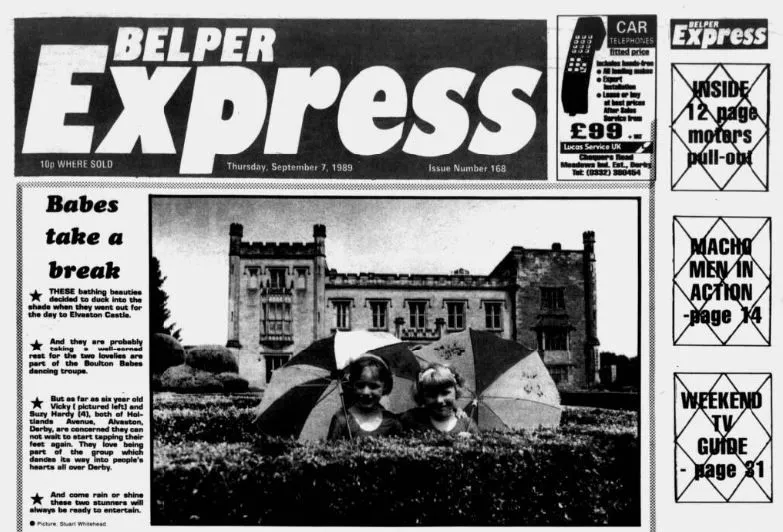
Remaining in the Midlands, we are delighted to welcome the Belper Express to The Archive. Another weekly freesheet, the Belper Express was launched in 1986, as part of the Derby Express series of freesheets, with its editorial offices in Derby. Appearing every Thursday, the Belper Express circulated in and around the market town of Belper and in the Amber Valley district of central Derbyshire, which incorporates Kilburn and other smaller villages. The Belper Express ceased publication in 2012.
Forming a trio of new Derbyshire papers this week are the Belper Express’s two sister papers, the Ilkeston Express and the Ripley Express. The Ilkeston Express was another weekly freesheet which appeared in the town of Ilkeston, in the Borough of Erewash, and its surrounding villages. Appearing every Thursday, it ceased publication in 2011 when it merged with the Ripley & Heanor Express to form the Ilkeston, Ripley & Heanor Express, the former title stemming from fellow Amber Valley publication the Ripley Express.
We move into Staffordshire for our next two new titles of the week, which are the Burntwood Post and the Burntwood Mercury. Covering the former mining town of Burntwood, Staffordshire, the Burntwood Post was a weekly freesheet tabloid newspaper, which was delivered to homes across southern Staffordshire, in Burntwood, Hammerwich and Chasetown. Appearing every Thursday, the Burntwood Post was established in 1989, with its editorial offices being located in Cannock. The final edition of the Burntwood Post appeared in 2011.
The Burntwood Mercury, meanwhile, was a free sub-edition of the historic Lichfield Mercury, which was founded in 1815. It remerged with its parent newspaper in 2013.
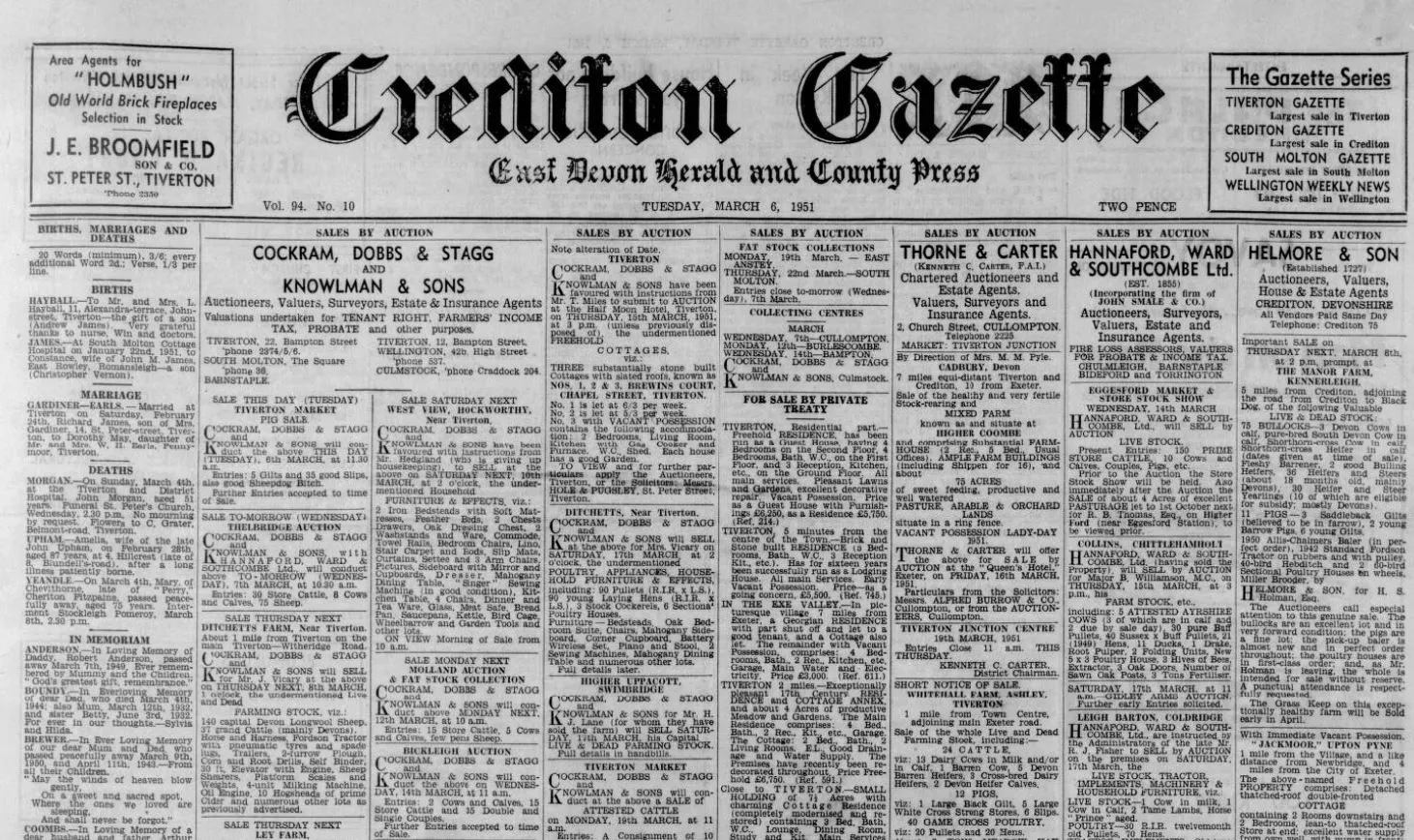
We travel to the south west of England for our next new title of the week, which is the Crediton Gazette. Established in the 1881 as a politically independent newspaper titled the Crediton & North Devon Chronicle and West of England Advertiser, ten years later it became the Crediton Chronicle & North Devon Gazette. This publication again changed its name in 1931 to become the Crediton Chronicle & Taw Vale Gazette, and once more in 1944 it altered its title to become the Crediton Gazette, East Devon Herald & County Press. It finally assumed the title of the Crediton Gazette in 1966.
A weekly tabloid newspaper, the Crediton Gazette is sold in and around the market town of Crediton in mid Devon, and appears every Tuesday.
Our next new title of the week hails from west London, and is the Ealing & Southall Informer. Part of the Informer series, which covers West London and Surrey, this weekly freesheet covered the west London district of Ealing, alongside Southall, through which the Grand Union Canal passes.
From London now to England’s second largest city of Birmingham, and the Great Barr Observer. Published in Tamworth, this newspaper covers the large area of north west Birmingham known as Great Barr, which also incorporates the Boroughs of Walsall and Sandwell, and was formerly a part of Staffordshire.
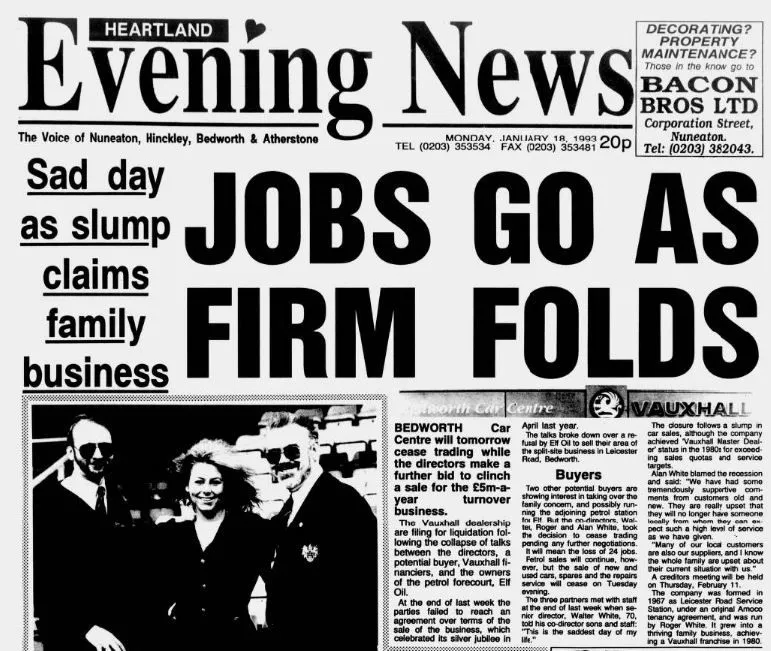
To England’s heartlands now and staying near Birmingham, we are delighted to welcome the Heartland Evening News to our collection. Founded in 1991 by former printer Peter Young and his business partner Tony Parratt, the first edition of the Heartland Evening News appeared on 16 March 1992. Published in the north Warwickshire market town of Nuneaton, this newspaper was founded after the Nuneaton Evening Tribune switched to a weekly publication schedule.
Serving Nuneaton and other towns and villages of north Warwickshire, by 2007 the newspaper had nightly sales of 10,000 copies. Meanwhile, in 2009 the publication was renamed to the Nuneaton News, and in 2016 it became a weekly freesheet.
Moving to the north of England for our next new title, and we are delighted to welcome the Midweek Visiter (Southport) to our collection. A free sub-edition of the much beloved Southport Visiter, which was founded in 1844 as a single sheet that listed visitors to the Merseyside seaside town of Southport, the Midweek Visiter was launched in 1981 and appeared every Tuesday, before ceasing publication in 2017.
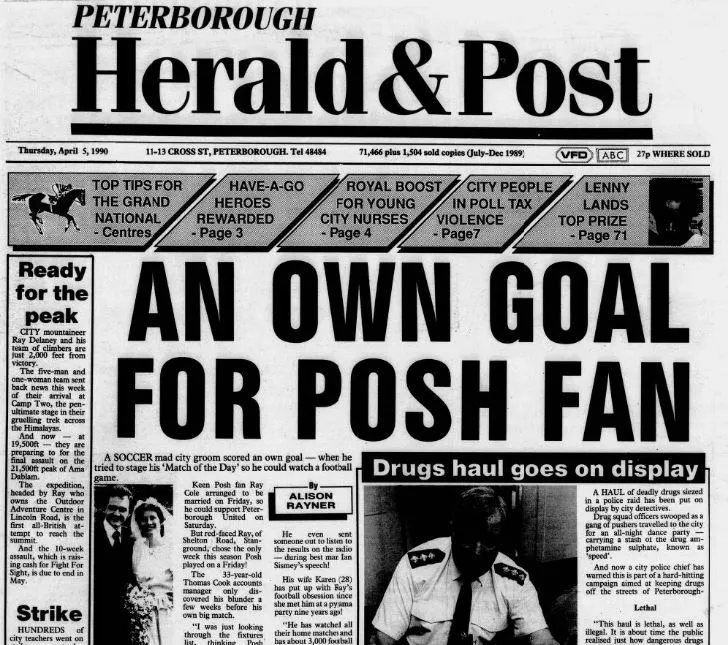
We travel to Cambridgeshire now to welcome our next new title of the week, which is the Peterborough Herald & Post, which was launched in 1989 as a replacement for the Peterborough Standard. The Peterborough Herald & Post was a weekly freesheet that was delivered to households across the cathedral city of Peterborough, which formerly was a part of Northamptonshire. It ceased publication in 2008.
Moving to Hertfordshire now, and we are excited to welcome the Royston and Buntingford Mercury to The Archive. A weekly tabloid newspaper that was launched in 1990 as a sub-edition of the Hertfordshire Mercury, the Royston and Buntingford Mercury is sold in and around the towns of Royston and Buntingford in north Hertfordshire. It appears every Thursday, and its title was reversed in 2006 to become the Buntingford and Royston Mercury.
We’re back up to Birmingham now to introduce our next new title of the week, which is the Solihull News. Founded in 1930 as the Warwickshire News, this newspaper served the large market town of Solihull. Delivering local news and sport to the Borough of Solihull and south Birmingham, this newspaper eventually became free, and ceased publication on 21 December 2018.
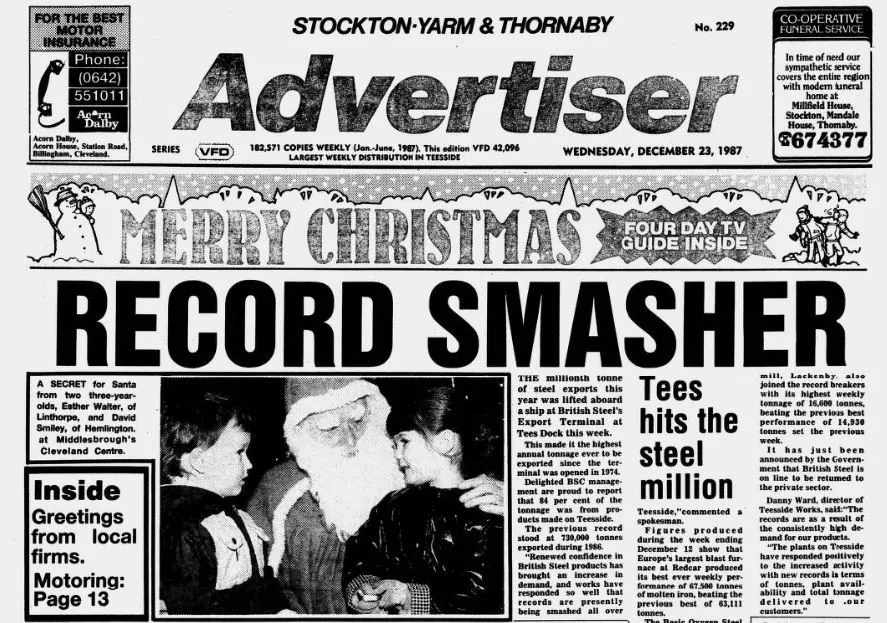
Our penultimate new title of the week is the Stockton & Billingham Herald & Post, a free newspaper that forms one of the six different editions of the Teesside-based Herald & Post series. Containing a mix of general, local and sporting news, as well as details of local events, this newspaper serves Stockton, a market town in County Durham, as well as the civil parish of Billingham, which lies within Stockton.
Our final new title of the week hails from Cheshire, and is the Wallasey News and Wirral General Advertiser. Appearing every Wednesday and Saturday, this newspaper served the town of Wallasey, which lies on the mouth of the River Mersey, and was historically a part of Cheshire.
That’s it from our 20 brand new titles of the week, but what about our updated ones? Well, with 148 newspaper titles all getting updates this week, it’s a struggle to pick some highlights, but picked we have! We’ve added over 11,000 pages to the Coventry Evening Telegraph, whilst over 10,000 new pages have joined the Pontypridd Observer. Meanwhile, we’ve augmented the Herts and Essex Observer by 9,000 pages, whilst over 8,000 pages have joined the Salford Advertiser and the Southport Visiter respectively.
The Penny Black – The World’s First Postage Stamp
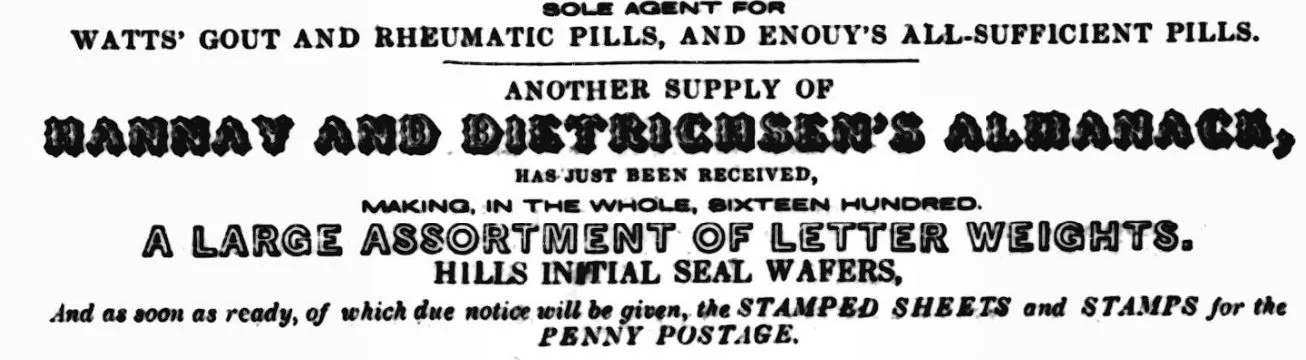
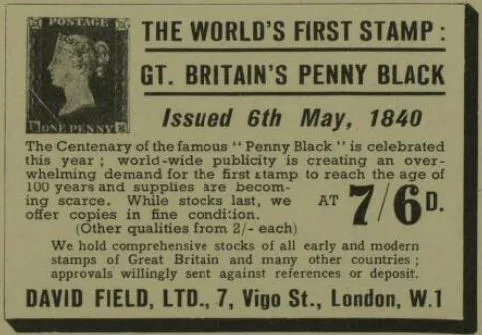
On 10 January 1840 our new newspaper the Nottingham and Newark Mercury contained an advertisement for ‘STAMPS for the PENNY POSTAGE…as soon as ready, of which due notice would be given.’ The existing postal service in Britain, prior to 1840, was ambiguous, and one often had to pay for a letter upon its arrival, the cost calculated by the distance the letter had travelled. But the postage stamp would erase this, meaning that for the first time a flat rate for postage was introduced, irrespective of how far a letter had travelled.
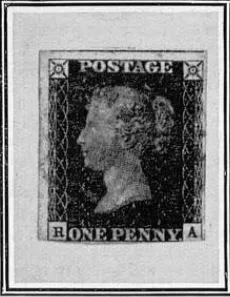
And notice was given several months later, when the world’s first adhesive postage stamp, the Penny Black, went on sale on 1 May 1840. On that historic day, the Nottingham and Newark Mercury contained a copy of the minutes from the Treasury, which were dated 22 April 1840, and ran as follows:
That the issue of Postage stamps for sale to the public be commenced as early as practicable; that such issue be, in the first instance, confined to London; and that it be extended first to Dublin and Edinburgh, and afterwards to other parts of the kingdom, in such order as the Commissioners of Stamps and Taxes may determine, and as rapidly as the necessary supply be obtained.
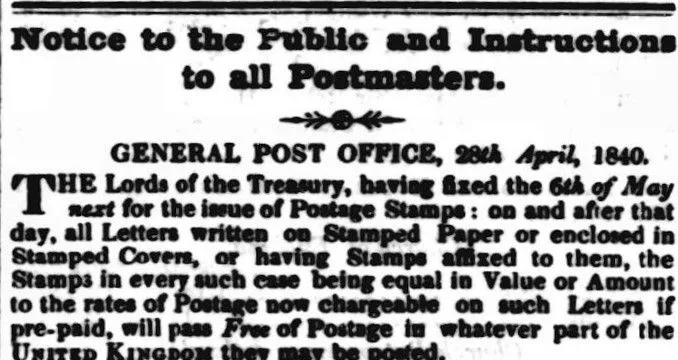
But even though the new stamps were to be issued on 1 May, they would not valid for postage until several days later, 6 May 1840. The minutes further explained how:
That on and after the 6th of May next, letters written on stamped paper, or enclosed in stamped covers, or having a stamp or stamps affixed thereto (the stamp or stamps in every such case being of the same value or amount as the rates of postage now charged on such letters if pre-paid), shall pass by the post free of postage in whatever part of the kingdom they may be posted.
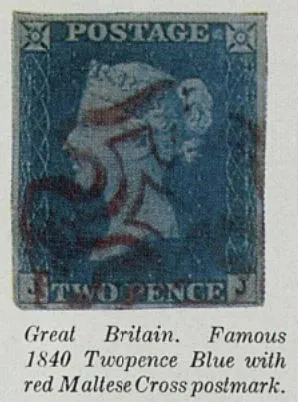
The Nottingham and Newark Mercury went on to explain how ‘Black will be the colour of the penny [stamp]; blue, of the two penny stamps,’ both stamps featuring a portrait of the young Queen Victoria.
Further clarification on the new postage system was also given by the newspaper on 1 May 1840, as it enclosed a command by W.L. Maberly, from the General Post Office, who explained how:
Stamps may also be used on Foreign, Colonial, and Ship Letters, &c., outwards. If any Letter, however, addressed to Places beyond Sea, shall bear an insufficient number of Stamps, it will be sent to the Dead Letter Office, to be returned in all practicable cases, to the writer. Stamps are not permitted to be used on Letters arriving in the United Kingdom from the Colonies or Foreign Countries.
A further ‘Notice to the Public’ from W.L. Maberly appeared in the Nottingham and Newark Mercury on 15 May 1840. One can imagine how revolutionary the system was, and how it would have taken some time to get used to. And one such teething problem was where to actually place the stamp, which Maberly addressed as below:
In those cases where Adhesive Stamps are used, it is requested that they may be placed on the Front of the Letter, and upon the right-hand corner on the upper side. Should this direction not be attended to, from the rapidity of which the duty must be performed, Letters which bear Stamps will frequently be taxed, while the Parties receiving them will be put to much trouble in obtaining a return of the Postage improperly charged.
It is amazing to see the genesis of something we take for granted so much today in the pages of our newspapers – what stories can you uncover?
New Titles
Title | Years Added |
1993 | |
1989-1990 | |
1991-1992 | |
1991 | |
1951 | |
1992 | |
1991 | |
1993 | |
1990 | |
1988, 1991 | |
1908-1911, 1913-1934 | |
1827-1852 | |
1990-1991 | |
1990 | |
1908-1933 | |
1989-1991 | |
1991-1992 | |
Solihull News | 1990-1992 |
1988, 1990-1991 | |
1910 |
Updated Titles
This week we have updated 148 of our existing titles.
You can learn more about each of the titles we add to every week by clicking on their names. On each paper’s title page, you can read a FREE sample issue, learn more about our current holdings, and our plans for digitisation.
Title | Years Added |
1950 | |
1876 | |
1869, 1950, 1991 | |
1987 | |
1951, 1981 | |
1993 | |
1912 | |
1950-1951, 1976 | |
1950, 1993-1994, 1996 | |
1984-1985 | |
1876 | |
1980-1982 | |
1991, 1994, 1996 | |
1894 | |
1990, 1992 | |
1951 | |
1950-1951, 1989-1990 | |
1874 | |
1950, 1952, 1993-1995 | |
1872, 1874, 1880, 1951, 1995 | |
1897, 1950, 1988 | |
1950 | |
1950 | |
1994 | |
1910, 1912 | |
1991-1992 | |
1951 | |
1911 | |
1979 | |
1898, 1976, 1993-1995 | |
1992 | |
1972-1973 | |
1990, 1992 | |
1912, 1993 | |
1991-1992 | |
1989-1991 | |
1950-1951, 1995-1996 | |
1950-1951 | |
1991 | |
1950-1951, 1990-1991 | |
1950, 1989, 1992 | |
1991 | |
1989-1990, 1992 | |
1992 | |
1950-1951, 1994, 1996 | |
1876-1877, 1951, 1990-1992 | |
1945, 1950 | |
1986 | |
1978, 1987 | |
1950-1951, 1991 | |
1919 | |
1993 | |
1989 | |
1990-1992 | |
1950, 1981, 1992 | |
1991 | |
1950 | |
1912 | |
1872, 1879 | |
1988-1990 | |
Folkestone Express, Sandgate, Shorncliffe & Hythe Advertiser | 1895-1896, 1899, 1902, 1914 |
1992 | |
1990 | |
1996 | |
1951-1953 | |
1990 | |
1876, 1879, 1882, 1885-1888, 1910-1913, 1919-1920 | |
1991 | |
1876 | |
1990-1991 | |
1935 | |
1872, 1950, 1980 | |
1994-1995 | |
1990, 1992 | |
1989, 1992 | |
1950, 1952 | |
1877, 1898, 1950, 1952 | |
1992, 1994 | |
1949, 1963 | |
1980-1981 | |
Leek Post & Times and Cheadle News & Times and Moorland Advertiser | 1990-1992 |
1880, 1898, 1950 | |
1991, 1996 | |
1950, 1988 | |
1993-1994 | |
1877, 1908-1909, 1938, 1945-1946, 1948, 1951, 1981 | |
1981 | |
1872, 1897 | |
1862 | |
1897 | |
1898-1899, 1911 | |
1990 | |
1912 | |
1821, 1823, 1871 | |
1984-1985, 1988 | |
1987-1989, 1991 | |
1951 | |
1861 | |
1990-1991 | |
1951-1958, 1963, 1991 | |
1861 | |
1908, 1979, 1994, 1996 | |
1993-1995 | |
1990-1992 | |
1991-1992 | |
1989, 1991, 1993 | |
1855, 1863 | |
1952 | |
1952 | |
1896 | |
1873, 1912 | |
1889 | |
1914 | |
1996 | |
1990, 1992 | |
1989-1990, 1992, 1996 | |
1992 | |
1988, 1992, 1995-1996 | |
1873, 1911 | |
1925 | |
1989 | |
1991 | |
1989-1990 | |
1950 | |
1877 | |
1991 | |
1991 | |
1901, 1903, 1912, 1950, 1991 | |
1879, 1987, 1990-1991, 1993-1994 | |
1992-1995 | |
1893 | |
1952-1953 | |
1876 | |
1990-1991 | |
1989-1991 | |
1949 | |
1991 | |
1989, 1991 | |
1873, 1879, 1882, 1885, 1888, 1891, 1986, 1990, 1992 | |
1879, 1888, 1911 | |
1987 | |
1993, 1996 | |
1991 | |
1875 | |
1987, 1992, 1994-1995 | |
1991-1992 | |
1871, 1893 | |
1910 |
You can keep up to date with all the latest additions by visiting the recently added page. You can even look ahead to see what we’re going to add tomorrow.
More on this topic:
Share this article
About the author

Rose Staveley-Wadham
Newspaper Licensing Manager
Published on Tue, 3 May 2022.