Hot Off The Press – New Titles This Week
Published on 9 February 2026 by Rose Staveley-Wadham
This week at The Archive we’re celebrating Valentine’s Day with the ringing of some very special Wedding Bells, whilst we also explore a Blackpool bathing scandal which erupted in the summer of 1879. Furthermore, you may have noticed that our front page is ticking ever closer to our 100 million newspaper pages milestone. Contributing to this are the 286,735 brand new pages we have added this week alone, whilst we’ve added a total of seven brand new titles, and updated six of our newspapers from across the United Kingdom.
So read on to discover more about our new titles of the week – there’s treats for those interested in railway history and labour history – as well as to discover which of our newspaper titles we’ve updated over the last seven days. You’ll not want to miss our exploration of the Blackpool bathing scandal from July 1879.
Register now and explore The Archive
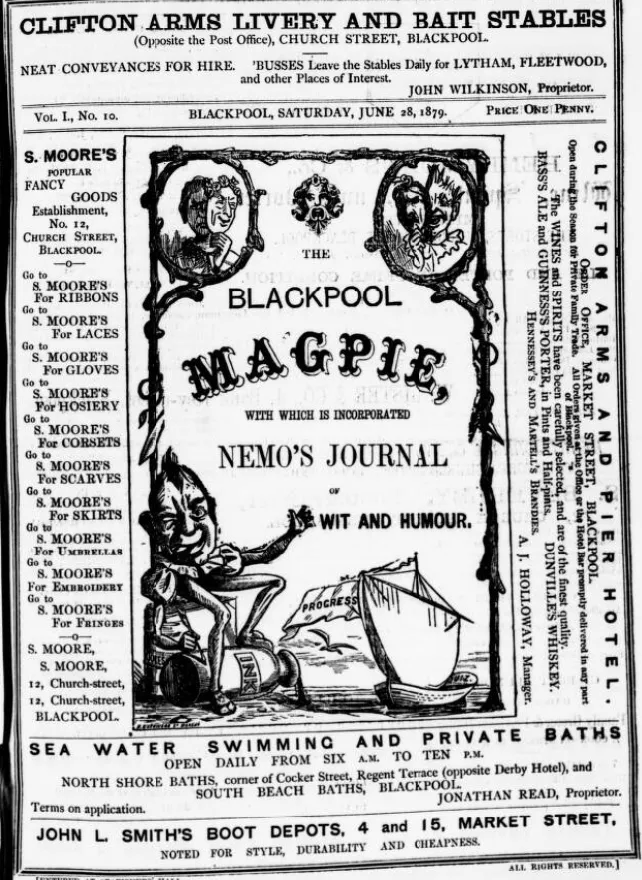
The Blackpool Magpie
We were led to the Blackpool bathing scandal through the pages of the Blackpool Magpie, which was first published on 26 April 1879 as Nemo’s Journal. ‘Essentially a humorous and satirical review of the week’s local events, and not a stereotyped hash-up of antique newspaper clippings referring to anywhere under the sun but Blackpool,’ the Blackpool Magpie appeared every Saturday priced at one penny.
Paying particular attention to Blackpool’s famous ‘places of amusement,’ such as the Blackpool Winter Gardens, the Blackpool Magpie featured the poetical ‘rav(ing)en’ of Nemo’s jackdaw, alongside cartoons, illustrations, and humorous pieces, with one such comical fare being entitled ‘People We Should Like to Meet.’ These imagined characters included ‘an undertaker who is not in a hurry,’ and ‘a cab driver who does not charge extra on wet nights.’
Changing its name during its short publication run from the Blackpool Magpie and thence to the Magpie and Fylde Chatterer, this publication also printed ‘Gossip of the Clubs.’ In July 1879, the newspaper picked up on an alleged Blackpool bathing scandal, as reported on by other newspapers, which we shall explore later in this blog.
The Democrat
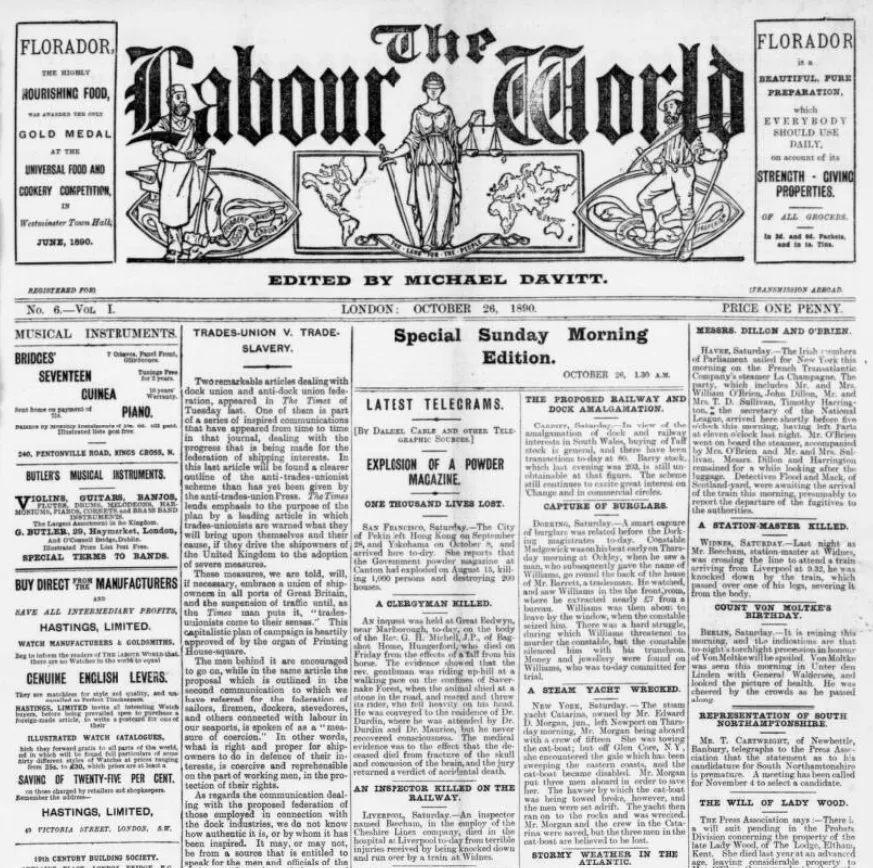
Like many of our new titles this week, the Democrat went through several name changes during its publishing lifetime. Aimed at ‘English Radicals at Home and Abroad,’ the Democrat was first published in London in the 1880s by John Charles Durant (1846-1929).
An English printer and briefly the M.P. for Stepney, Durant was a Christian socialist who founded the Land Nationalisation Society, the Land Restoration Scheme, and the People’s League. His monthly title, the Democrat, therefore advocated ‘democratic principles.’ Costing 2 d., the Democrat covered such subjects as distress in East London, and ‘robbery’ by the Charity Commissioners.
By 1890 it was all change at the publication. Now entitled Labour World and appearing every Saturday priced at 1 d., the title was edited by Irish republican and fellow land reform advocate Michael Davitt (1846-1906). Naturally, the paper adopted more of an Irish focus, with articles on the Irish Democratic Labour Federation and Land Labours in the South of Ireland.
However, the publication covered labour matters across Britain and beyond, whilst also printing more general news and poetry. In 1891 the title became known as the Sunday World.
The Hour Glass
We take a shift in tone now as we welcome the Hour Glass to The Archive. First published in December 1886 by A.G. Dawson, this title labelled itself as an ‘illustrated family magazine.’ Featuring pieces by the likes of famed suffragist Millicent Fawcett (1847-1929), journalist and young adult fiction writer G. Manville Fenn, German revolutionary and writer Karl Blind (1826-1907), cleric and writer the Reverend H.R. Haweis (1838-1901), Liberal politician and author Arthur Arnold (1833-1902) and children’s book creator and illustrator Walter Crane (1845-1915), the Hour Glass offered a rich fair of stories and illustrations with a wide family appeal.
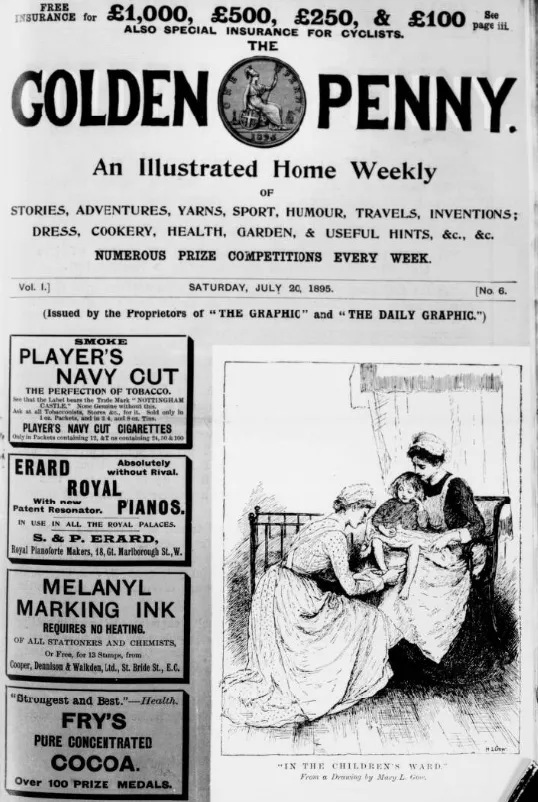
Name changes in our titles, as already mentioned, is something of a theme for us this week. On 15 June 1895 the Hour Glass was relaunched as the Golden Penny. Filling 24 pages and appearing every Saturday, the re-branded magazine promised to be an ‘Illustrated Home Weekly of Stories, Adventures, Yarns, Sport, Humour, Travels, Inventions; Dress, Cookery, Health, Garden & Useful Hints.’
To that end, the Golden Penny featured such sections as ‘Fashion Fancies’ and ‘Gardening Notes,’ alongside its more traditional fare of illustrated short stories. Meanwhile, the publication also featured a prize competition, a column entitled ‘Gossip About Authors,’ and intriguing pieces imagining the ‘warfare of the future.’
The Irish Railway Gazette
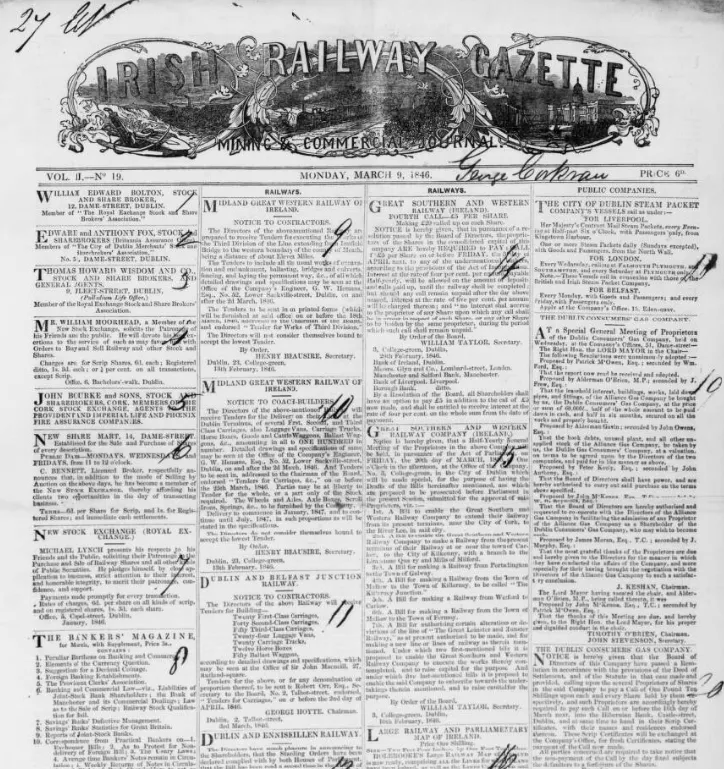
We hop across the Irish Sea now to welcome the Irish Railway Gazette to our collection. First published on 4 November 1844 with the full title of the Irish Railway Gazette, Mining and Commercial Journal, this title was published during the railway boom, which saw railways being developed across the world.
The situation in Ireland was no different. As the Cork Constitution noted on 19 November 1844 about the establishment of the Irish Railway Gazette:
The Progress which Ireland is now making in the internal improvements demands the establishment of a Journal exclusively devoted to the sustainment of her Industrial Interests… A year ago we had not 30 miles of Railway open in Ireland – now we have four important lines in full operation… Yet there is no publication in Ireland to which reference can be made for a full and accurate account of Railway proceedings.
The Irish Railway Gazette aimed to fill that gap. A few months before the title launched, fellow specialist title the Scottish Railway Gazette reported how the new publication would be a ‘non-political Journal… exclusively devoted to the sustainment of the Railway, Mining, Commercial, and General Industrial Interests of Ireland.’ Moreover, the Irish Railway Gazette would be ‘entirely independent’ of outside influences, such as engineering or railway companies, providing ‘an honest and impartial opinion on every subject on which it treats.’
Filling eight pages and appearing every Monday morning at the cost of 6 d., the Irish Railway Gazette provided a glimpse of the expansion of the railway in Ireland, with articles covering rail extensions to Limerick and Cork, and the Belfast Junction Railway. Moreover, the title printed lists of shares of mining, banking, canals and other such companies, alongside of course railway shares, both in Ireland and Great Britain.
The Mansfield & North Nottinghamshire Chronicle-Advertiser
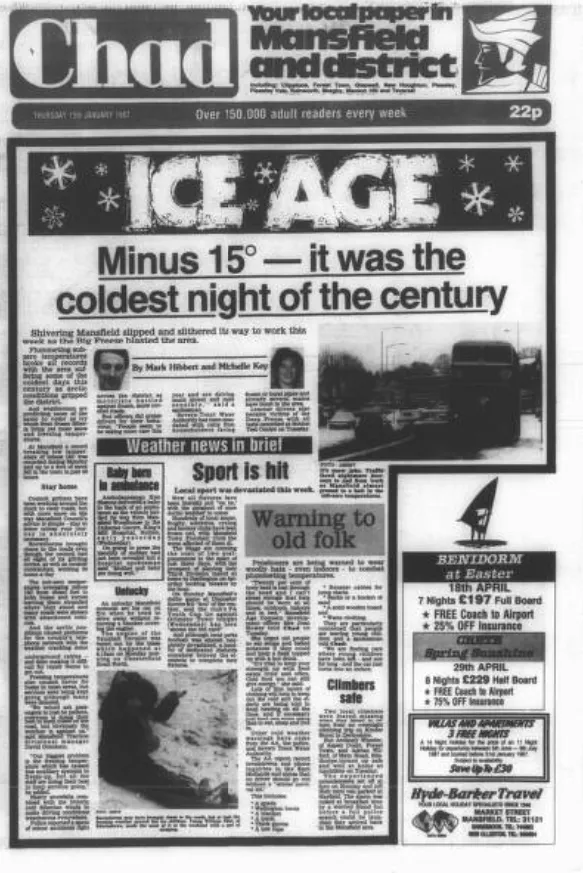
First published on 3 April 1952, the Mansfield & North Nottinghamshire Chronicle-Advertiser soon became known as the Mansfield Chad, ‘Chad’ being a portmanteau of ‘Chronicle-Advertiser.’ A beloved weekly regional newspaper covering the Nottinghamshire market town of Mansfield and the Ashfield district, which consists of the towns of Kirkby-in-Ashfield, Sutton-in-Ashfield and Hucknall, in the 1980s this newspaper had a circulation of some 60,000 copies.
Appearing every Thursday at the cost of 20 p., the Mansfield & North Nottinghamshire Chronicle-Advertiser incorporated the news from the likes of Clipstone, Forest Town, Glapwell, New Houghton, Pleasley, Pleasley Vale, Rainworth, Skegby, Stanton Hill, and Teversal. The paper is still in print to this day.
Pullen’s Kent Argus
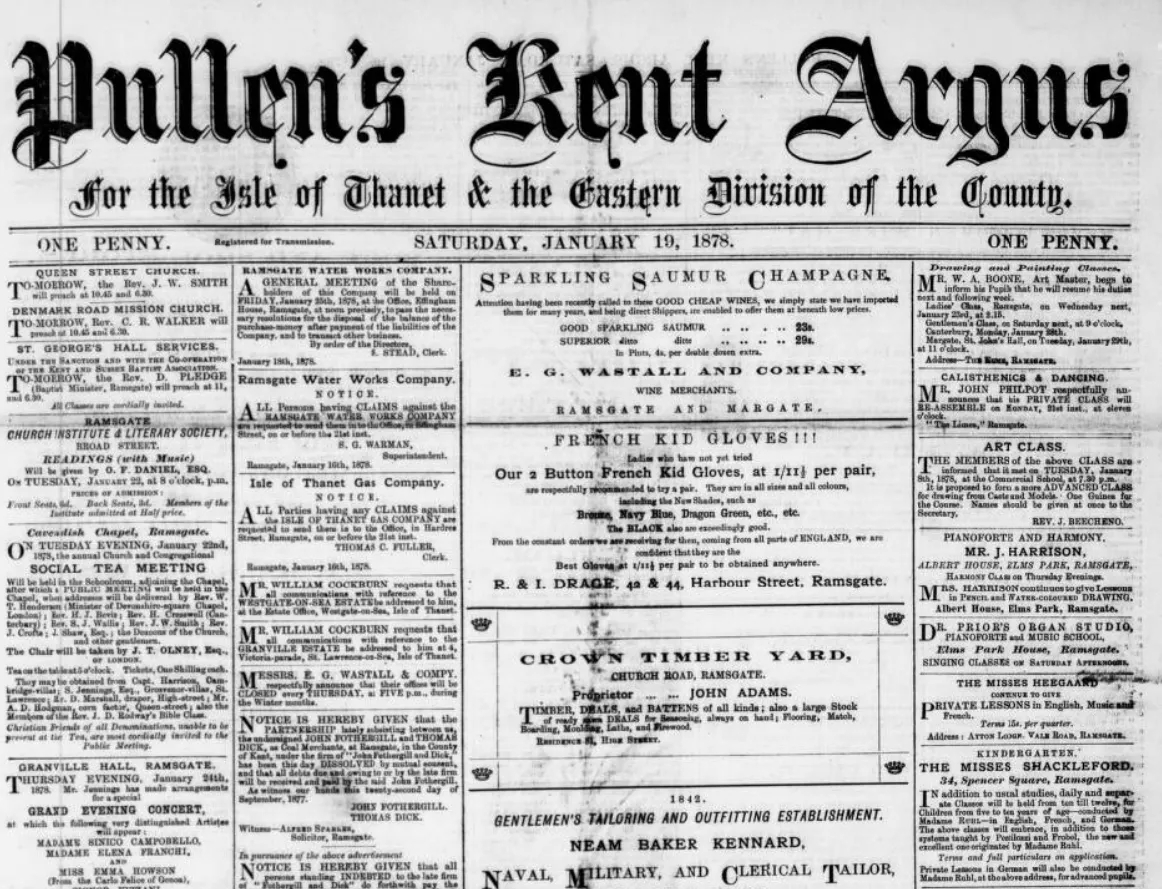
Our penultimate title of the week is Pullen’s Kent Argus, which was established in the Kent seaside town of Ramsgate in 1873. Serving the ‘Isle of Thanet and the Eastern Division of the County,’ Pullen’s Kent Argus was said to have ‘the largest circulation in the district.’
Independent in its politics, it reported fully ‘on the local meetings and occurrences,’ as well as presenting a ‘good selection of the general news of the week.’ Appearing every Saturday at the cost of just one penny, Pullen’s Kent Argus reported from the Ramsgate Police Court and the Ramsgate Local Board, as well as giving updates from the likes of Dover, Faversham, Whitstable and Rochester.
Filling a total of eight pages, Pullen’s Kent Argus also printed a variety of international and national news, correspondence from its readers, ‘jottings’ from American papers, railway timetables and notices of births, marriages and deaths.
The Wedding Bells
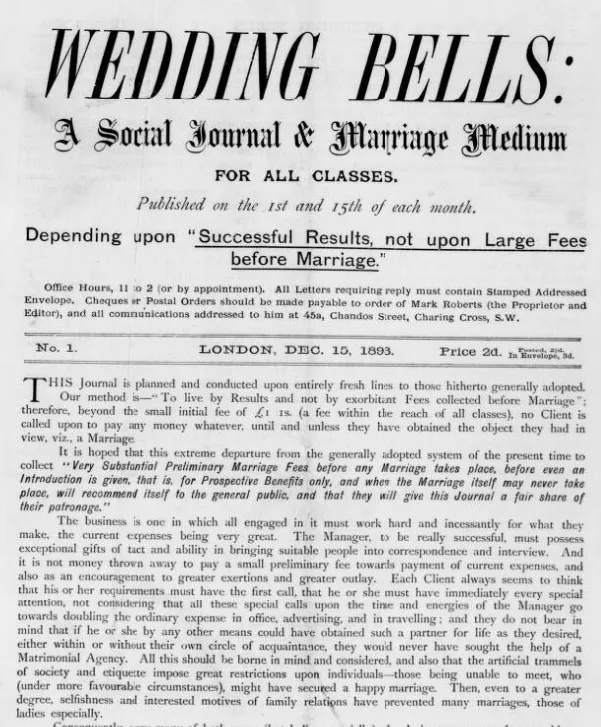
Our final new title of the week, before we get on to that Blackpool bathing scandal, is Wedding Bells. A ‘Social Journal & Marriage Medium For All Classes,’ Wedding Bells was first published on 15 December 1893. Published in London on the 1st and 15th every month, Wedding Bells was aimed at both ‘ladies and gentlemen’ who were ‘seeking a partner for life.’
The first edition of Wedding Bells explained the need for matchmaking services like itself:
Consequently very many of both sexes (but ladies especially) who desire to marry, and are unable to find a partner for life, agreeable to their wishes, amongst their own circle of acquaintance, have begun to rely upon one or other of the many Matrimonial Agencies now doing business throughout the United Kingdom, supplying the national requirement, which is increasing greatly year by year.
Fifty years ago, according to Wedding Bells, there were no such services existing, but gradually, these services, through the means of journals like itself, began to spring up. And there were rules about seeking a relationship through such means. For Wedding Bells, potential suitors must ‘give their correct name and address, together with the most precise particulars of their age, incomes, social position, and general appearance, &c., and with such description to forward their photograph.’
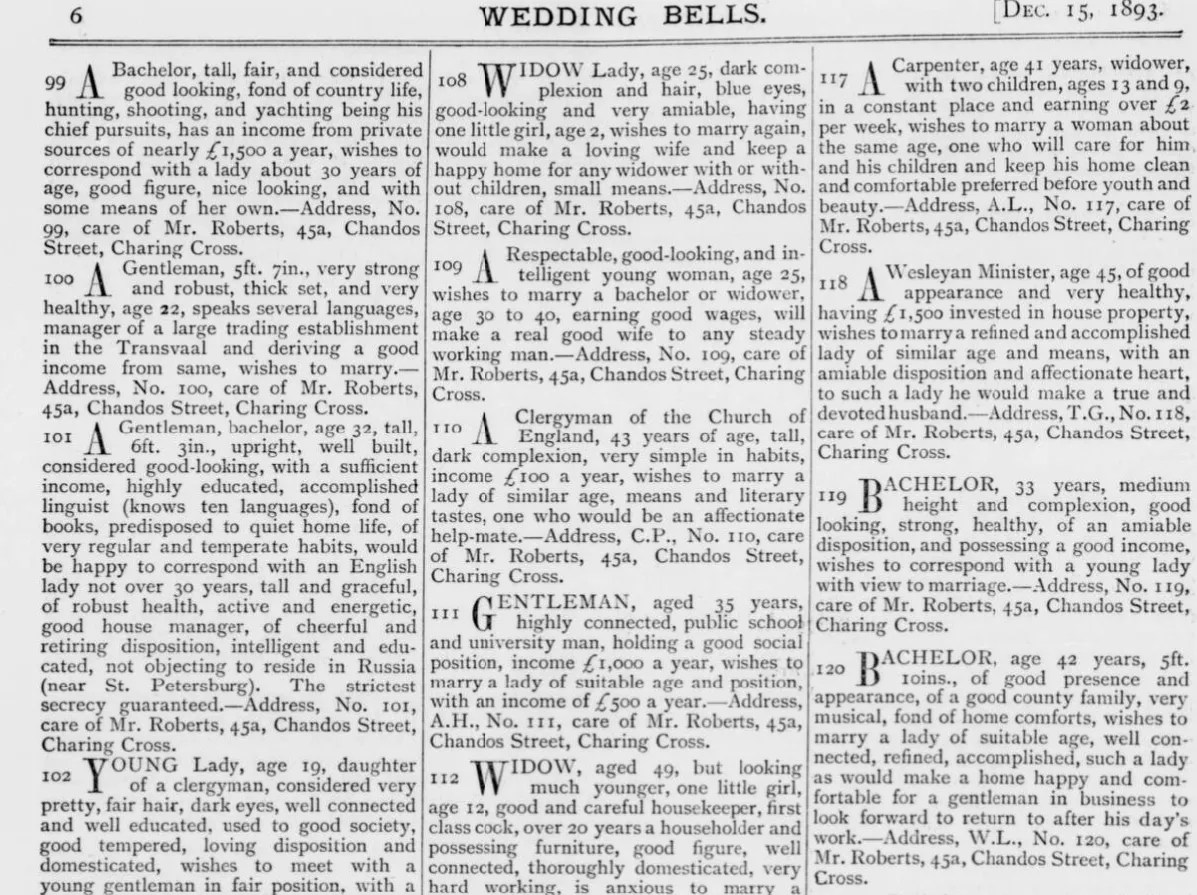
Judging from the adverts published by Wedding Bells, the publication was unfair in gendering the need for matrimony as being highest amongst women. There are many adverts penned by men, as well as by women, and some are curiously specific. Take these examples from the 15 December 1893 edition of the title:
Business Gentleman, age 38 income £150, would like to correspond with a view to early marriage with lady from 20 to 30. Widow with one child not objected to, or superior domestic servant with some money.
A Gentleman, an officer on a steamboat, income £120 per annum, age 34, dark, below the middle height, would like to meet a lady between 18 and 23, of lady-like appearance, fair, and of medium height, one with few relations preferred.
We can’t help but paint suspicion into that final sentence. Meanwhile, other ads were plain in their intent. Marriage here is transactional, a method to survive, as per the below advertisement:
Young Lady, age 28, well educated and accomplished, can sing, ride, drive, and understands several languages, dark complexion, medium height, but no income, would like to hear from gentleman about 40 or 50.
Costing 2 d., Wedding Bells filled eight pages.
Our updated titles
This week sees the addition of over 153,000 brand new pages to the Belfast Telegraph, spanning the years 1986 to 1999. Meanwhile, we’ve added new pages to one of our Scottish titles, the Kilsyth Chronicle.
A Blackpool bathing scandal
And now on to the bit you’ve all been waiting for – the Blackpool bathing scandal of 1879. Our attention was first drawn to this Victorian scandal through the pages of the Blackpool Magpie, via a paragraph published in its ‘Local Telegrams’ by Rooter section, 26 July 1879.
The paragraph runs as follows:
The ‘Sporting Chronicle’ has indulged in a bit of indecency anent the bathing proclivities of visitors to Blackpool. Whilst I am of the opinion that bathers may not draw the line exactly where they ought sometimes, I have, however, no faith in the substance of the paragraph referred to, as we have a number of inspectors stationed about the beach to see that a fair amount of decorum is observed by both males and females. I cannot therefore sufficiently express the disgust I felt on finding that the ‘Gazette’ had copied the nasty paragraph ad captandum vulgus, as Alderman Hall would say.
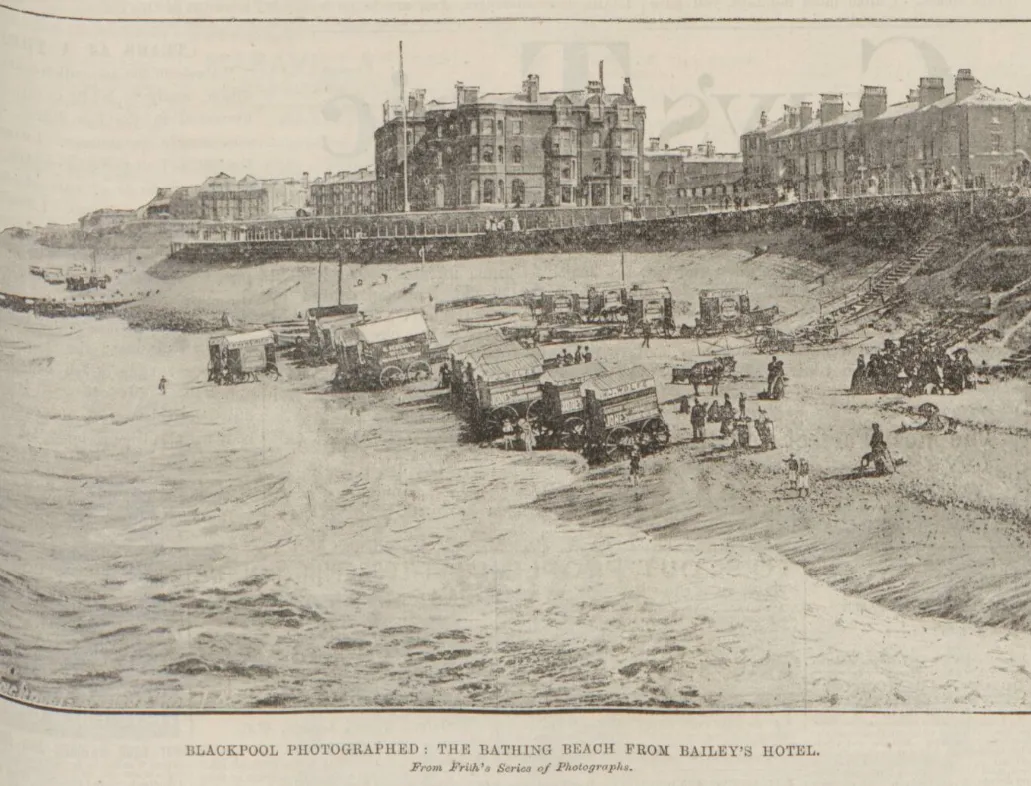
So what was this Blackpool bathing scandal all about? On 19 July 1879 the Manchester based Sporting Chronicle published a piece in its ‘Echoes of the Day’ section about Blackpool being ‘surely the most free-and-easy watering-place in the world.’ Free from ‘starchy notions of propriety,’ the writer describes how, on 18 July 1879, he witnessed a woman in the town ‘bathing about midway between the north and south piers, and close to the shore, as naked as was our Mother Eve before the fall.’
The writer expresses their shock, whilst also describing the scene at length, clearly enjoying his voyeurism:
Certainly a more brazen exhibition of the female form divine has never been seen, not even in those now suppressed shows which had the Anatomical Venus for their chief attraction. If this sort of thing is to continue – and the lady may repeat her performance this morning for all I know to the contrary – the authorities of Blackpool ought to announce the fact and run cheap trips to the town, which sadly wants visitors this season.
This was, then, the Blackpool bathing scandal that the Blackpool Magpie was referring to. However, the Sporting Chronicle writer clapped back at the paper on 1 August 1879. Dubbing the title as ‘that omnipotent journal,’ the Sporting Chronicle journalist expressed how he found the Blackpool Magpie’s ‘disgust, under these circumstances…rather amusing, as is the censure passed upon me by other Blackpool papers…’
The tensions around the Blackpool bathing scandal are rather fascinating. On one hand, we have the stereotyped Victorian notion of modesty, coupled with the Sporting Chronicle journalist’s rather unashamed delight at such a scene. Then we have the Manchester metropolis mocking the smaller town of Blackpool, in the Sporting Chronicle making fun of the Blackpool Magpie.
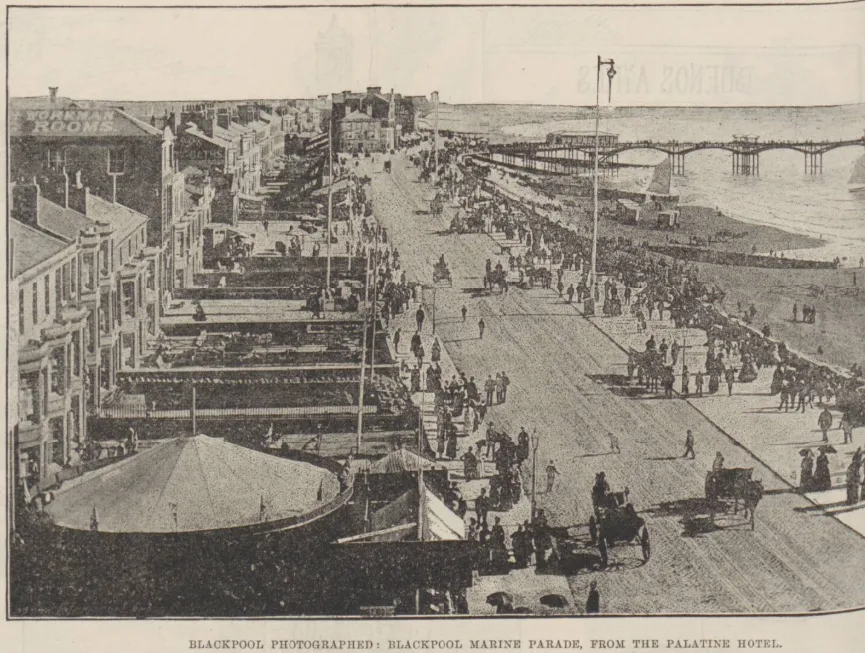
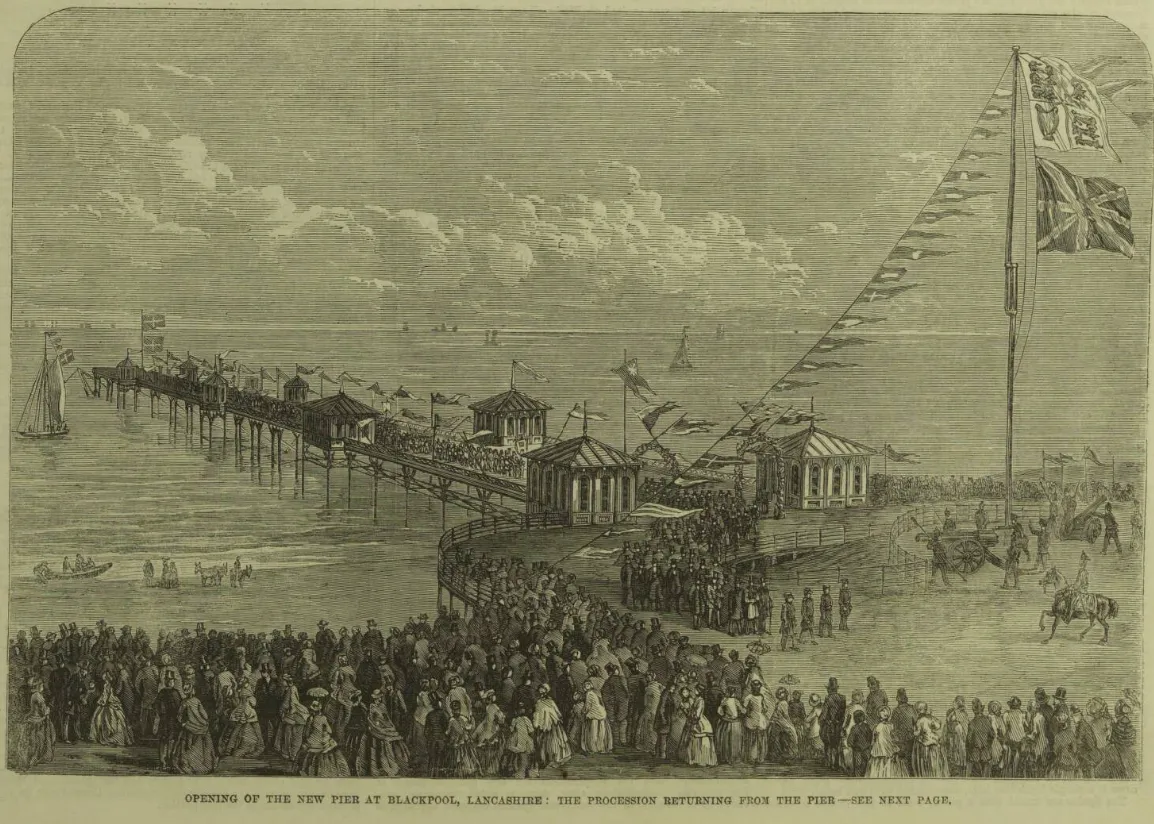
Read more about the Blackpool bathing scandal, the history of Blackpool as a resort, and much more besides, in the pages of our Archive today.
New Titles
Title | Years Added |
1879 | |
1890-1891 | |
1895-1896, 1907-1909 | |
1844-1850 | |
1986-1987, 1990-1995, 1999-2004 | |
1878-1887, 1889, 1893 | |
1893 |
Updated Titles
This week we have updated 6 of our existing titles.
You can learn more about each of the titles we add to every week by clicking on their names. On each paper’s title page, you can read a free sample issue, learn more about our current holdings, and our plans for digitisation.
Title | Years Added |
1944-1945, 1948 | |
1888-1891, 1909-1911, 1913 | |
1910-1913, 1919 | |
1969 | |
1962 | |
1986-1999 |
You can keep up to date with all the latest additions by visiting the recently added page. You can even look ahead to see what we’re going to add tomorrow.
More on this topic:
Share this article
About the author

Rose Staveley-Wadham
Newspaper Licensing Manager
Published on Mon, 9 February 2026.