
A Life on the Stage: Discovering My Performing Ancestors at the British Newspaper Archive
Published on 16 January 2013 by The BNA
We love hearing stories about what you’re up to in the Archive. Truly, we feel extremely privileged to hear your tales. So when professional genealogist, Matt Ball, tweeted us about his research on his music hall ancestors we were keen to hear his story.
Through his research in The Era and other papers in the Archive, Matt has discovered some terrific stories about his theatrical ancestors. Matt very kindly agreed to be a guest blogger for us, and we’ve published his fascinating article below.
*********************************
Introduction and Background
The only downside I can find to being a professional genealogist is that you can find yourself neglecting your own tree and becoming obsessed instead with those of clients. So, over Christmas, I was determined to take some time to look again at a couple of brick walls in my own research and see what I could find.
One of the families in my tree that fascinate me is the Dwights, who have a long and proud history in the Music Halls in the 19th and early 20th centuries. Having found information on them in the BNA archive before, I settled down to see what, if any, new material I could find.
My GGG Grandmother’s sister, Sarah Eleanor Gale had married Henry Charles Dwight in Liverpool in 1847. She was the daughter of a solicitor’s clerk, worthy of his own blog post and he, son of a wheelwright, calling himself a Professor of Music. Fascinated by this profession a few years ago, I began to dig a little deeper.
Wandering Minstrels
To my surprise and initial consternation, Henry Charles Dwight founded and led, until his death in 1889, Dwight’s Male and Female Ethiopian Troupe of Maryland Minstrels. He was, for most of his career, along with his wife and children, a Black and White Minstrel. This sort of performance now seems so alien and inappropriate to us, making it even more fascinating and I was keen to find out more.
The British Newspaper Archive is an incredible resource for genealogists searching for Music Hall ancestors largely due to the availability of The Era. Not only is it full of theatre listings, reviews and gossip, if you’re lucky it carried obituaries of the more prominent entertainers, with an occasional portrait and other family information. This is invaluable with my family, who often used their stage names rather than their birth names for marriage and censuses, making the hunt for them even trickier and so the names given as attendees at family events, whether as bridesmaids or mourners, can be the key to unblocking another wall in the research.
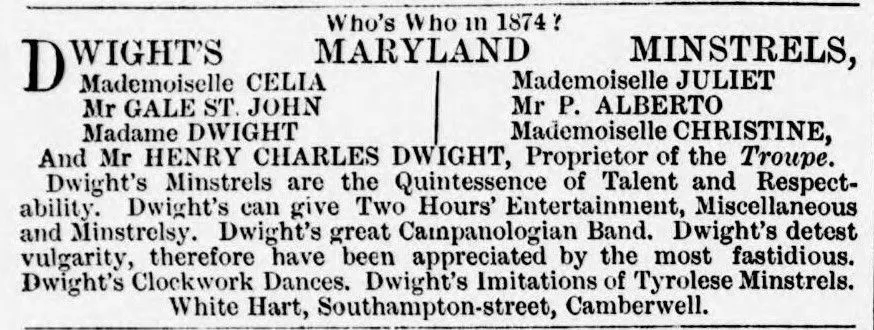
Henry Dwight was clearly a man with the theatre in his blood, two of his children were called Romeo and Juliet, though sadly Romeo died aged only three. His siblings however, thrived. Henry junior, Celia, Juliet, Gale, Albert, Ellen and Christina, all took to the stage in one form or another.
Favorable Reviews
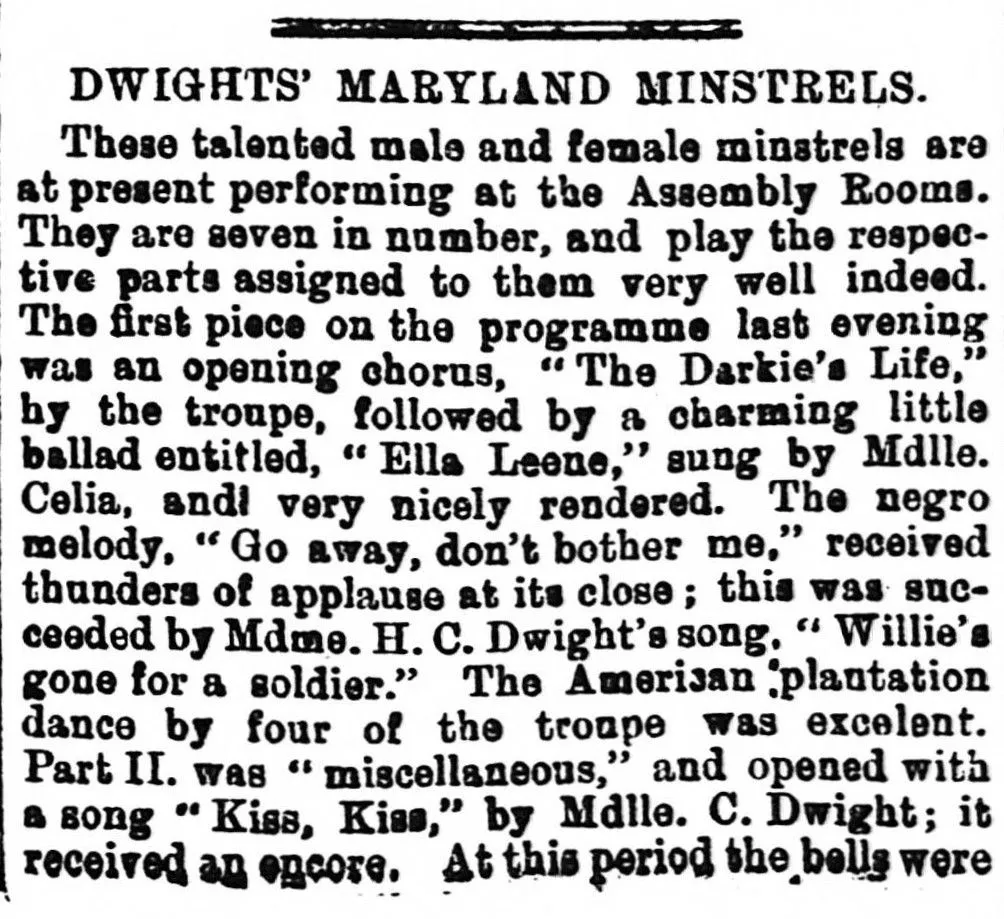
And the British Newspaer Archive didn’t disappoint! In 1876, The Guernsey Star reviewed the troupe, which had been playing at The Assembly Rooms on the island. Although such songs as The Darkies Life seeming staggeringly inappropriate with the distance of time, the whole performance was well received by the audience. Following an impersonation of Tyrolese Minstrels, a rendition of ‘Willies Gone for A Soldier’ and the mystifying act with handbells, they concluded with a Burlesque Extravaganza: The Negro Blacksmiths.
Despite my modern day concerns about the material, in advertisements of the day, the troupe billed themselves as “…the quintessence of talent and respectability…Dwight’s detest vulgarity, therefore have been appreciated by the most fastidious’!
Thanks to The Era newspaper, I know that this troupe was active in one form or another from the 1850s until Henry’s death at the age of 62 in 1889. Of his children, both Juliet and Celia married into established theatrical families; Juliet became wife to William Revill, a famous theatre manager from Stockport, and Celia to the Glasgow theatre manager, Frank Sephton. The family often lived and worked in Liverpool and so I watched John Bishop’s recent Who Do You Think You Are? with bated breath as he looked for his Minstrel ancestor in the same city. Sadly the programme didn’t reveal any connections but the Dwights’ must have known or worked with John’s ancestor, Charles, at some point in the City.
Gale Dwight became a star of the Music Hall and The Era is invaluable in following his career. He acted first with his siblings and later with his own children and step children. The Era carried an interview with when he looked back at his career and his various partners from within his family. Gale married twice and his step granddaughter, Vera Smart married James Enrique Carreras, a founder of Hammer films and was mother to Sir Michael Carreras who was involved with Hammer until his death. A childhood fan of the Hammer Horror films I was thrilled to find this connection and later discovered from Sir Christopher Lee’s autobiography that he started his honeymoon with a few nights visiting the Carreras family.
An Untimely End
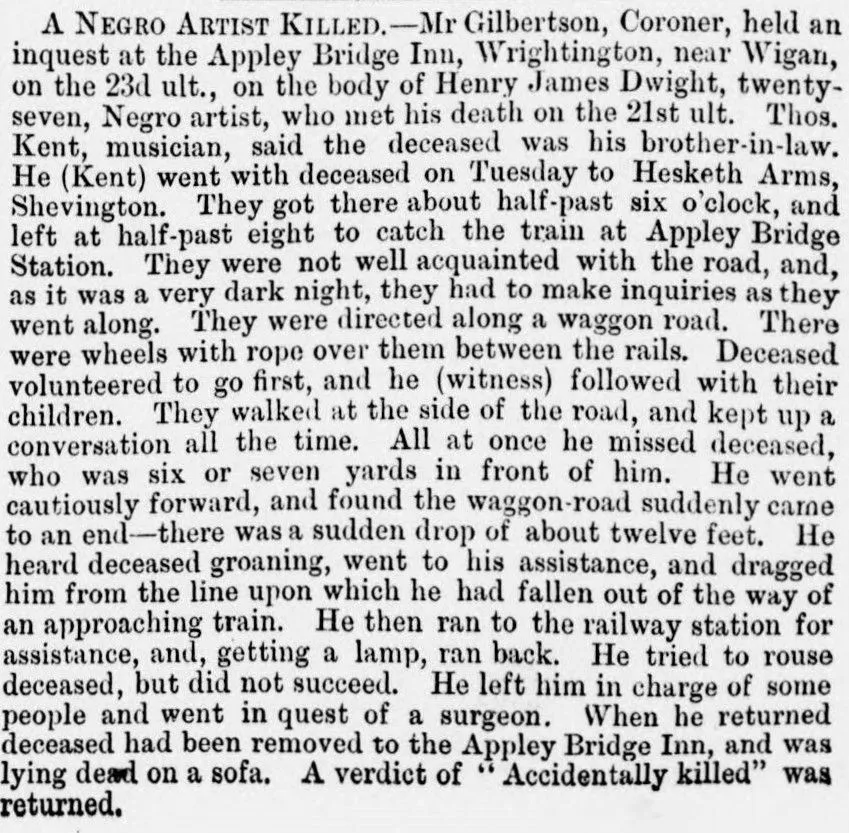
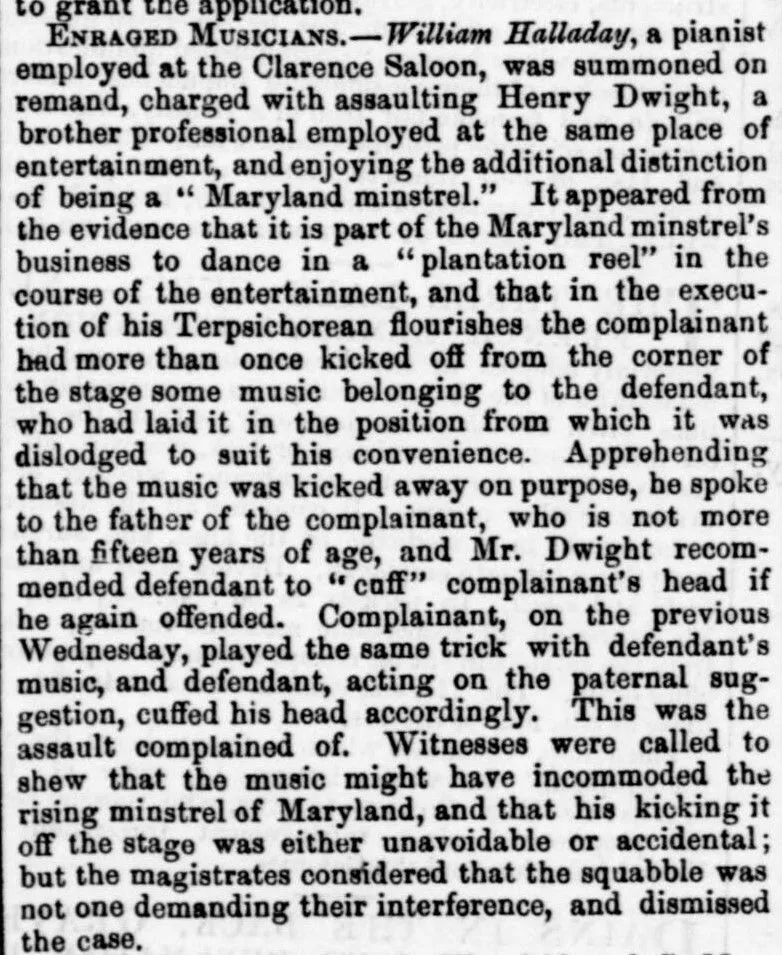
The eldest of all the siblings, Sarah, married Thomas Browning and founded another theatrical family. Thomas was a musician and composer and took the stage surname of Kent, probably as a Dover man the county name was an easy choice. Thomas featured in an article in The Era from 1875 regarding the sad death of his brother in law, Henry James Dwight, described as a ‘negro artist’ who died in an accident and the paper records the fateful events as they were later described to the Coroner who held his court at the local inn. As a boy, Henry had featured in another article, accused of kicking away the music sheets of a fellow performer, but the magistrates dismissed the case as unworthy of their time!
A Victorian Parachutist!
It’s the children of Thomas and Sarah that I was particularly trying to trace over Christmas. Daughter Beattie, who married prominent comedian Tom Collins, Cora, who married another comedian, Bert Burrows and best of all, Miss Cissie Kent; a Victorian parachutist, Cissie would launch herself from hot air balloons at a height of up to 12,000 feet. Jumps were made with no reserve chute with a free fall of around 200 feet before the chute would open! The Archive has numerous reports of her dare devil antics, including one descent made in 1892, when, ascending on a trapeze at the side of the hot air balloon, the parachute remained stuck and she drifted further up, eventually managing to untangle herself before landing in a timber yard, having narrowly avoided ‘the iron point of a church spire’ as she later told a reporter!
Last Act
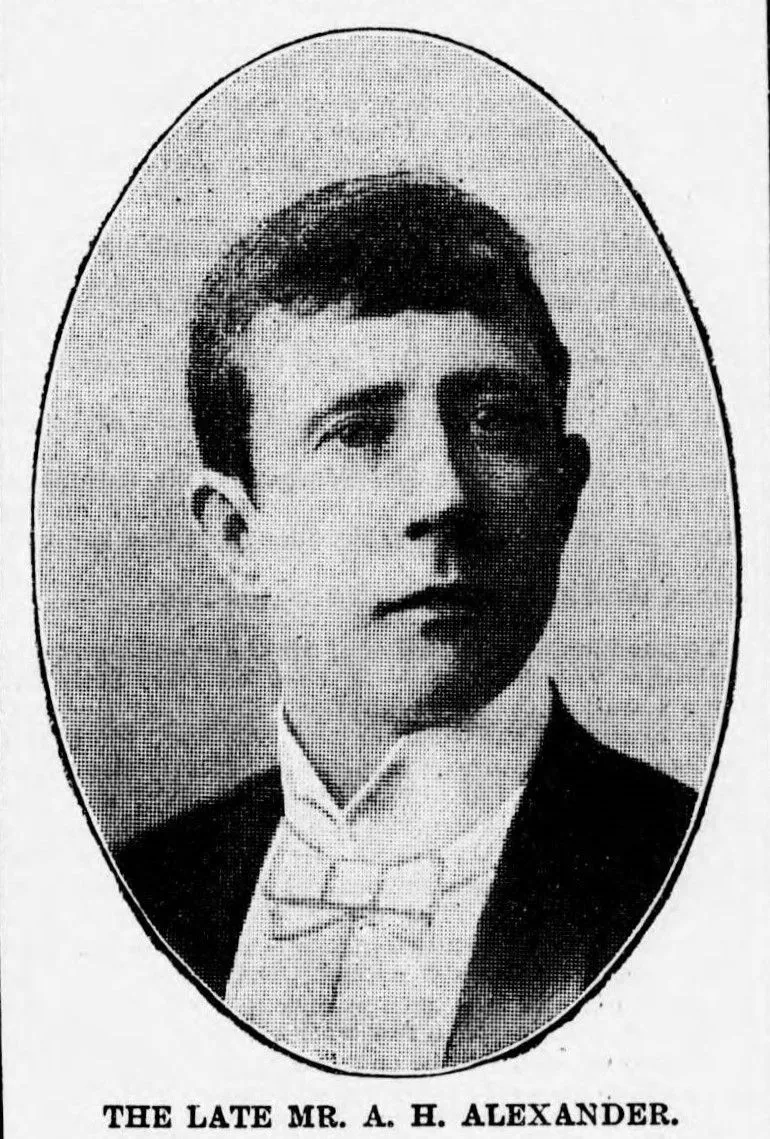
I was also looking for Julia Kent and her husband, Arthur Alexander, who himself came from a famous family of performers. Thanks to the Archive, I was punching the air as I struck gold. In September 1895, The Era carried A Chat with Arthur Alexander, including an outline of his father’s career, his own early career and current successes. At forty, he was very much the rising star, married to a highly successful comedienne and performer.
Sadly, within four years, The Era was carrying his obituary. Arthur died aged only forty four, following a short battle with pneumonia. But what an obituary it is – packed with information and, best of all, and carrying a studio photograph of a performer in his prime! Not only does the piece give his address but also the cemetery he was buried in and the names of mourners who attended and those who sent wreaths. A clue to his status and success might be found in that a wreath was sent by the young George Robey, one of the giants of the Music Hall era, later to be knighted and known universally as the Prime Minister of Mirth.
All of this material certainly made my search worthwhile. The coverage for The Era runs from 1838 until 1939, and I know I’ve only just scratched the surface in looking at the resources the British Newspaper Archive holds for my music hall ancestors. Being able to bring them to life in this way over several decades of their lives is a wonderful experience; I just wish it were possible for everyone one in my tree!
************************************
Matt Ball is co-founder and director of The Great British Ancestry Company. You can follow Matt and the GBAC team on twitter at @tgbac.
Discover your performing arts ancestors for yourself in our Performing Arts Newspapers.
More on this topic:
Share this article
About the author

The BNA
News from the British Newspaper Archive
Published on Wed, 16 January 2013.