Skip to content

Search the blog

At the Theatre Royal, Drury Lane, on 15 May 1800, James Hadfield tried to shoot King George III while the national anthem was being played, and the king was standing to attention in the royal box.It’s reported that after missing his target, Hadfield then said to the king:‘God bless your royal highness; I like you very well; you are a good fellow.’Hmm, we’re thinking that his words might be a very good examples of quick thinking…Hadfield went on
We’re always interested in new digitisation projects, so were very interested to see this news story about the start of the ‘Lives of the First World War’ website project.– http://www.1914.org/news/new-digital-centenary-project-lives-of-the-first-world-war/And here’s the URL for the ‘Lives of the First World War’ website – the archive content isn’t yet on the site, but there’s a video explaining what this fascinating website will eventually contain.– http://www.livesofthefirstworldwar.org/
On 11 May 1857, the mutiny by Indian Sepoy soldiers at Meerut started.The mutiny at Meerut was the start of the Indian Rebellion of 1857, as it acted as a catalyst for other mutinies as well as uprising by citizens to take place.Included below is a letter written by an officer stationed in Meerut, who describes the terrible events that took place at this time.And here’s another very moving letter written by an army officer – this time, based at Sebastopol
‘That was but a prelude; where they burn books, they will ultimately burn people also’ – Heinrich Heine (1797 to 1856)In most university towns of Nazi Germany on the night of 10 May 1933, Nazi-supporting students burned over 25,000 books that were deemed to be ‘un-German’.This bonfire of books followed on from the proclamation of ‘Action against the Un-German Spirit’, which had been declared on 6 April 1933.To mark this very dark day, here are two newspaper reports about this funeral pyre of ‘un-German’ books.
John Stuart Mill, one of the giants of philosophy during the nineteenth century, died in Avignon on 8 May 1873, aged 66.Stuart Mill is probably most famous for his writings on liberty and the freedom of the individual against control by the state. He was also an advocate of utilitarianism, an ethical theory developed by Jeremy Bentham.To commemorate the day and to remember the life of John Stuart Mill, here is a newspaper tribute to Mill, which was published four days
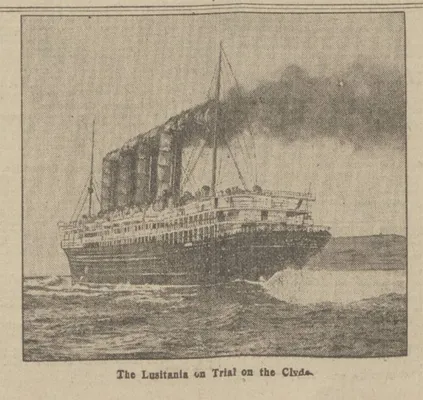
Historical newspaper reports on the sinking of the LusitaniaOn 7 May 1915, the Lusitania was hit by torpedoes fired by the German U-boat U-20, and sank in 20 minutes with the loss of 1,198 lives.To mark the day, here are some newspaper reports about the tragedy.
An obituary of Napoleon from 1821 and a also report of the autopsyNapoleon Bonaparte died at Longwood, Saint Helena, on 5 May 1821 – he was aged 51.As you can imagine, the obituaries carried in the UK newspapers in 1821 were less than complimentary to the former emperor.This first clipping shows the obituary that ‘The Cambridge Chronicle and Journal’ published on Friday 10 August 1821.Below that is a short newspaper clipping from the time when the news started to filter back to the UK,
We do love the quirky stories in the Archive!Here is a wonderful description of a bicycle accident in 1895 between George Bernard Shaw and Bertrand Russell, while on a  cycling trip with Sidney Webb to Tintern Abbey.Their minds were taken up with loftier concerns and they ended up crashing into one another – happens to the best of us, that.Sheffield Independent – Friday 20 September 1895Image © THE BRITISH LIBRARY BOARD. ALL RIGHTS RESERVED.http://www.britishnewspaperarchive.co.uk/viewer/bl/0000181/18950920/085/0008Derby Daily Telegraph – Wednesday 05 August 1931Image © Northcliffe
Derby Daily Telegraph – Monday 30 April 1945Image © Northcliffe Media Limited. Image created courtesy of THE BRITISH LIBRARY BOARD.http://www.britishnewspaperarchive.co.uk/viewer/bl/0000521/19450430/006/0001Western Daily Press – Monday 30 April 1945Image © Northcliffe Media Limited. Image created courtesy of THE BRITISH LIBRARY BOARD.http://www.britishnewspaperarchive.co.uk/viewer/bl/0000513/19450430/029/0003Hull Daily Mail – Tuesday 01 May 1945Image © Northcliffe Media Limited. Image created courtesy of THE BRITISH LIBRARY BOARD.http://www.britishnewspaperarchive.co.uk/viewer/bl/0000324/19450501/011/0001
Alfred Hitchcock, ‘The Master of Suspense’, died in Bel Air, California, on 29 April 1980.As Hitchcock was born in Leytonstone and lived in London till 1939, the Archive contains scores of stories about his life in the UK – indeed, it’s very interesting to follow his life and career via newspaper reports contained in the BNA.Included below are two reports from the 1920s that offer a snapshot of Hitchcock’s life as a film director when he lived in England.Western Morning News –