Skip to content

Search the blog

Tag: newspapersTag: blitz
‘A Wonderful Telephonic Invention – Preserving Speeches’On 29 November 1877, Thomas Edison gave the world a demo of his phonograph invention – thereby paving the way for generations of teenagers to lock themselves away in their bedrooms and madden their parents by playing their records way too loud.To celebrate this wonderful achievement by ‘the Wizard of Menlo Park’, we’ve posted a newspaper story that reports on Edison’s wonderful new invention – and how it will magically preserve the speeches by politicians like Mr
On 23 November 1910, the physician and salesman Dr Crippen was hanged at Pentonville Prison in London.The first criminal to be arrested via wireless communication (Crippen was apprehended on the SS Montrose as it arrived in the St Lawrence River), Crippen was found guilty of murdering his wife, Cora – although doubts as to his guilt have recently been aired.Back in October, we posted two stories on the blog about the trial of Crippen and his alleged accomplice, Ethel ‘Le Neve’
‘There are millions of people on the earth and many suffer. Why, then, are you all around me?’ – Leo Tolstoy to his doctorsOn 20 November 1910, Leo Tolstoy died of pneumonia at Astapovo Railway Station.We thought we’d mark the day by posting two articles from the Archive about Tolstoy. The first story is a report on Tolstoy’s death, while the second article is a summary of his life which suddenly segues into an advert for ‘Willow Blend, the Master Tea’.
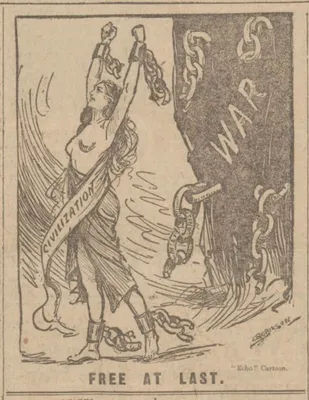
Armistice Day free at last image
To mark the hundred years since the signing of the Armistice on Monday 11 November 1918, which ended the First World War, we take a look at the poignant images published that historic day across our various publications.A significant theme running throughout, of course, is that of peace, and freedom, at last, as featured in the Nottingham Evening Post and the Liverpool Echo.Nottingham Evening Post | 11 November 1918Liverpool Echo | 11 November 1918Other newspapers, such as the Evening Despatch and the Sheffield Independent
It happens to the best of us…We do love the gossipy stories in the Archive that report on the passing moments of people’s lives – especially if it involves somebody famous.A wonderful example of such a brief encounter, is this story about Albert Einstein arguing with a Berlin tramcar conductor regarding the change given to him. We think this conductor sounds a rather formidable character. And we also love thinking about how this story managed to find its way
To celebrate the birthday of Abraham ‘Bram’ Stoker, born on 8 November 1847 in Dublin, we’ve posted some newspaper reviews of his classic novel, ‘Dracula’.The novel was published in May 1897, so the reviews below were the first reactions to Stoker’s brilliant gothic horror.The Archive contains 100s of interesting stories about Bram Stoker and the ‘Dracula’ novel – just type the author’s name or the book title into the seaech box to find these stories.The Archive also contains 100s of historical
The ‘Evening Standard’ published a news story from the British Newspaper Archive this week about a tragedy that took place in London in October 1814, when 8 people were drowned by a wave of beer in the Tottenham Court Road.We thought that people might like to read this story, so we’ve posted it below.**************************A huge wave of beer swept through London’s streets almost 200 years ago, killing 8 people including a 3 year old child, records at the British Newspaper Archives have revealed.
As the Battle of Balaclava took place in October 1854, we’ve been reading some newspaper stories about this famous episode in the Crimean War.We were especially struck by some of the eye-witness accounts of the battle. In particular, we were fascinated by this account of the Light Brigade’s charge, as described by an officer.The Archive contains 1000s of stories about the Light Brigade and the Battle of Balaclava – with some amazing reports by people who witnessed the event.  Just
Dr Hawley Harvey Crippen (known simply as Dr Crippen) was found guilty of murder at the Central Criminal Court in the Old Bailey on 22 October 1910. He was later sentenced to death and hanged at Pentonville Prison in London.Famously, Dr Crippen was the first criminal to be arrested thanks to the new invention of wireless telegraphy.As the Crippen case represents a famous episode in criminal history, we’ve posted below two stories that report on the court case and its
We’re looking forward to learning about Celia Imrie’s family ancestors in Who Do You Think You Are? tonight.Judging by the brief details posted on the BBC website, it sounds like this programme will feature some fascinating tales of political intrigue from the 17th Century.And we’ll be keeping a sharp eye out to see if any historical newspapers are used for the research on Celia’s ancestors.– BBC1, Wednesday 10 October, 21:00.– www.bbc.co.uk/programmes/b01n7m49