Skip to content

Search the blog

Tag: blitzTag: newspapers
At the Berlin Observatory on 23 September 1846, Johann Galle and Heinrich d’Arrest discovered the planet, Neptune – after receiving an urgent letter from Frenchman, Urbain Le Verrier, telling them where to look.After the discovery was made public, there was some wrangling between France and the UK regarding who should be credited with the discovery of the new planet.To mark this historic day, here is a newspaper story from October 1846 that reports on the discovery of Neptune.Inverness Courier – Wednesday 28 October 1846
We like this thoughtful article from 1905 about the causes and cures for women’s wrinkles, and also this advertorial from 1909 about the anti-wrinkling cures discovered by Harriet Meta of Paris and London.Although we do like our many ‘laughter lines’, we are greatly enthused by the £250 challenge issue by Mademoiselle Meta.Taunton Courier, and Western Advertiser – Wednesday 27 September 1905Image © THE BRITISH LIBRARY BOARD. ALL RIGHTS RESERVED.http://www.britishnewspaperarchive.co.uk/viewer/bl/0000527/19050927/072/0006Cheltenham Looker-On – Saturday 07 August 1909Image © Local World Limited. Image created courtesy of THE BRITISH
On 17 September 1908 at Fort Myer, Virginia, Lieutenant Thomas Selfridge became the first person to die in a powered airplane crash – he was 26.Read newspaper reports about the accidentSelfridge was a passenger on a plane (‘the Wright Flyer’) that was piloted by Orville Wright – reports say that the cause of the crash was a broken propeller.To mark this sad day, here is a newspaper story – published on 19 September 1908 – that reports on the accident.Manchester Courier and Lancashire General Advertiser –
John Thomson, the Kirkcaldy-born goalkeeper for Celtic and the Scotland, died on 5 September 1931, after suffering a fractured skull in an accidental collision with Sam English of Rangers – Thomson was 22 years old.Around 30,000 people attended Thomson’s funeral in Cardenden, Fife – many of whom had walked the 55 miles from Glasgow.To mark one of the saddest days in the history of Scottish football, here are some photos of John Thomson.Quem di diligunt, adulescens moritur.Dundee Courier – Monday 07 September 1931Image © D.C.Thomson & Co.
Edward Grieg, the Norwegian composer famous for composing the music for Ibsen’s Peer Gynt, died in Bergen on 4 September 1907 – he was 64.To mark the day, here is a fascinating newspaper story that reports on Grieg’s death and also highlights the composer’s Scottish ancestry.Evening Telegraph – Thursday 05 September 1907Image © D.C.Thomson & Co. Ltd. Image created courtesy of THE BRITISH LIBRARY BOARD.http://www.britishnewspaperarchive.co.uk/viewer/bl/0000563/19070905/025/0002The Graphic – Saturday 02 March 1889Image © THE BRITISH LIBRARY BOARD. ALL RIGHTS RESERVED.http://www.britishnewspaperarchive.co.uk/viewer/bl/0000057/18890302/024/0013
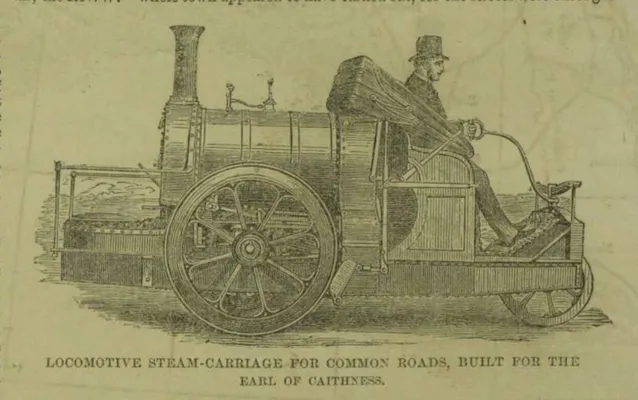
Locomotive steam carriage for common roads 1860
On 31 August 1869, Mary Ward (nee King) became the first person to die in a car accident in Ireland and Great Britain. The terrible accident occurred in County Offaly in Ireland.  Mary Ward, along with Captain the Honourable Henry Ward, Honourable Randal and Clare Parsons, were travelling on a road locomotive steam-engine when it turned a sharp corner leading to Cumberland Street near Parsonstown.  The sharp turn caused Mrs Ward to fall forward to the ground and the vehicle drove over
On 29 August 1782, HMS Royal George sank with the loss of more than 800 lives, while undergoing routine maintenance work at Spithead, by Portsmouth.HMS Royal George was the largest warship in the world at the time of her launch in 1756, and her sudden sinking remains one of the worst disasters ever to take place in UK waters.To mark the day, here are two newspaper articles from August 1782 that report on the tragedy – the second article is a letter written by