Skip to content

Search the blog

Tag: blitzTag: newspapers
The slave trade was abolished in the British Empire on this day in 1807.The Bury and Norwich Post reported that the Bishop of Landaff thought slavery was ‘so barbarous and inhumane that the abolition of it would be recorded in Heaven.’Bury and Norwich Post – Wednesday 01 April 1807Image © THE BRITISH LIBRARY BOARD. ALL RIGHTS RESERVED.View the whole newspaper page
The 30 mph speed limit was introduced in built-up areas of Britain on 18 March 1935.Not everybody appreciated the new signs – newspapers reported that eight signs were fished out of a pond a week later!View the whole newspaper pageNottingham Evening Post – Friday 29 March 1935Image © Local World Limited. Image created courtesy of THE BRITISH LIBRARY BOARD.
A 19th-century police officer named Jerome Caminada died 100 years ago today. Angela Buckley, author of The Real Sherlock Holmes: The Hidden Story of Jerome Caminada, explains what newspapers can tell us about the detective’s incredible life.**************On 10 March 1914, just five days before his 70th birthday, Detective Jerome Caminada died at home. Born in the slums of Manchester, he had enjoyed an extraordinary career, earning him a place in history as one of the city’s finest police officers and a real-life
Novelist Victor Hugo was born on 26 February 1802.In this review of Les Miserables, the Dublin Evening Mail stated that he was “almost the only French imaginative writer of the present century who is entitled to be considered as a man of genius.”Dublin Evening Mail – Friday 17 October 1862Image © THE BRITISH LIBRARY BOARD. ALL RIGHTS RESERVED.View the whole newspaper page
Michelle Higgs, author of A Visitor’s Guide to Victorian England, got in touch to share this shocking story she found in The British Newspaper Archive.What have you found in the newspapers? Let us know by [email protected]**************Victorian Britain was a hazardous place to live, and not just because there was a potential accident around every corner. The trading standards and food hygiene we take for granted today simply didn’t exist, so shoppers often risked illness or even death
Pluto was discovered on 18 February 1930, though the Nottingham Evening Post reported that the planet was very nearly given a different name.The article states that Atlas, Prometheus, Tempus, Marconi and even Percival were considered as potential names.Nottingham Evening Post – Thursday 10 April 1930Image © Local World Limited. Image created courtesy of THE BRITISH LIBRARY BOARD.View the whole newspaper page
Writer and historian Denise Bates sent us a message recently to explain what The British Newspaper Archive and the family history records available at findmypast have helped her discover about a nineteenth-century mining family.Denise wrote Pit Lasses: Women and Girls in Coalmining c1800-1914 after discovering her great-great-great-great-grandmother listed as a miner in the 1841 census and wondering what her life would have been like.**************Many people are surprised to learn that until 1842, women and girls worked underground in coal mines.
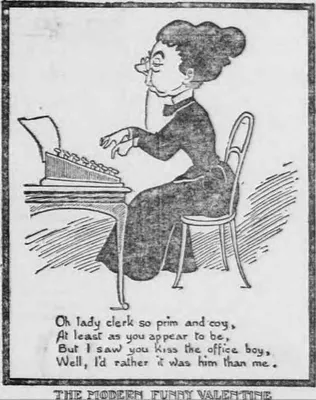
Valentine from 1903
The tradition of sending and receiving Valentine’s Day cards is well documented in The British Newspaper Archive, but not all were as sentimental as you might expect.We’ve found a number of references in our historical newspapers to the unusual Valentines that were exchanged. Here’s a selection of the best for you to enjoy.1) I saw you kiss the office boyThis little rhyme about an office romance was included in the Nottingham Evening Post in 1903:2) With coals at the
Walter Arnold became the first British person to be fined for speeding on this day in 1896.This report from the London Daily News reveals that he’d been travelling at a reckless 8 mph!View the whole newspaper pageLondon Daily News – Thursday 30 January 1896Image © THE BRITISH LIBRARY BOARD. ALL RIGHTS RESERVED.
Gordon Martin recently got in touch to show us what the newspapers have helped him find out about his great-great-uncle Charles Alfred Martin.We love hearing about your finds, so please do let us know what you’ve discovered by emailing [email protected]**************Charles Alfred MartinI had long known the existence of great-great-uncle Charles, the youngest child of a seaman born in Magdeburg, Prussia who served on HMS Achille at the Battle of Trafalgar of 1805. His father had arrived in England