Skip to content

Search the blog

Author: the-bna
Writer and historian Denise Bates sent us a message recently to explain what The British Newspaper Archive and the family history records available at findmypast have helped her discover about a nineteenth-century mining family.Denise wrote Pit Lasses: Women and Girls in Coalmining c1800-1914 after discovering her great-great-great-great-grandmother listed as a miner in the 1841 census and wondering what her life would have been like.**************Many people are surprised to learn that until 1842, women and girls worked underground in coal mines.
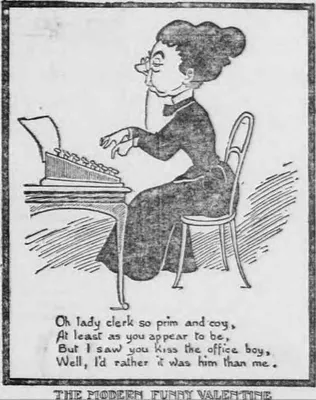
Valentine from 1903
The tradition of sending and receiving Valentine’s Day cards is well documented in The British Newspaper Archive, but not all were as sentimental as you might expect.We’ve found a number of references in our historical newspapers to the unusual Valentines that were exchanged. Here’s a selection of the best for you to enjoy.1) I saw you kiss the office boyThis little rhyme about an office romance was included in the Nottingham Evening Post in 1903:2) With coals at the
Walter Arnold became the first British person to be fined for speeding on this day in 1896.This report from the London Daily News reveals that he’d been travelling at a reckless 8 mph!View the whole newspaper pageLondon Daily News – Thursday 30 January 1896Image © THE BRITISH LIBRARY BOARD. ALL RIGHTS RESERVED.
Gordon Martin recently got in touch to show us what the newspapers have helped him find out about his great-great-uncle Charles Alfred Martin.We love hearing about your finds, so please do let us know what you’ve discovered by emailing [email protected]**************Charles Alfred MartinI had long known the existence of great-great-uncle Charles, the youngest child of a seaman born in Magdeburg, Prussia who served on HMS Achille at the Battle of Trafalgar of 1805. His father had arrived in England
Author A.A. Milne was born on this day in 1882. Take a look at the Aberdeen Journal’s glowing review of ‘Winnie-the-Pooh’ when it was published in 1926:View the whole newspaper pageAberdeen Journal – Thursday 09 December 1926Image © D.C.Thomson & Co. Ltd. Image created courtesy of THE BRITISH LIBRARY BOARD.
The Huddersfield Chronicle reported that John Hetherington wore the first top hat on this day in 1797. The article stated that he was arrested for breach of the peace after ‘several women fainted at the unusual sight’:View the whole newspaper pageHuddersfield Chronicle – Tuesday 24 January 1899Image © THE BRITISH LIBRARY BOARD. ALL RIGHTS RESERVED.
Robert Baden-Powell, founder of the Scout Movement, died on 8th January 1941.The Evening Telegraph reported that his last words to the Boy Scouts were “sleeves up and with tails up, go to it to win the war.”Read the full newspaper snippet below or view the whole newspaper page.Evening Telegraph – 8 January 1941Image © D.C. Thomson & Co. Ltd. Image created courtesy of THE BRITISH LIBRARY BOARDView the full newspaper page
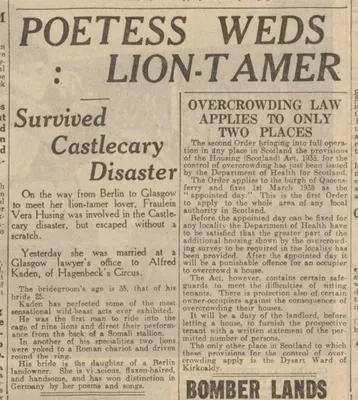
‘He was the first man to ride into a cage of nine lions and direct their performance from the back of a Somalian stallion…’Oh, we think this will likely be our favourite newspaper headline for January.Let’s hope this poetess was an ailurophile, and that the lion tamer was a poetry lover!And we can’t help feeling that this is the sort of news story that sub-editors on newspapers dream about writing headlines for – the lucky sub-editor probably had
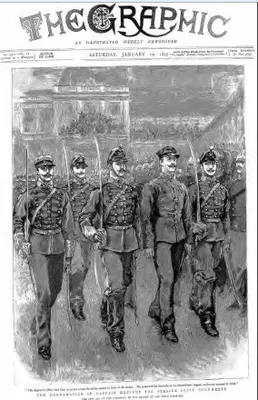
‘Tell all France that I am innocent’ – Alfred DreyfusIn Paris on 5 January 1895, Captain Alfred Dreyfus was stripped of his army rank and sentenced to life imprisonment on ‘Devil’s Island’.Here is a newspaper story published on 7 January 1895 entitled, ‘The Degradation of Dreyfus’, that reports on the utterly humiliating ceremony at the Ecole Militaire to strip Dreyfus of his rank and dignity.The words that Dreyfus shouts immediately after the degradation ceremony are very poignant, moving and truthful.We’ve also
The Siege of Sidney Street (aka the ‘Battle of Stepney’) took place in London on 3 January 1911.The siege resulted in the deaths of two supposed anarchists, Fritz Svaars and William Sokolow, as well as three policemen and a fireman.This newspaper report and accompanying photographs, published on 4 January 1911, provide a fascinating description of the siege, and the report also mentions Winston Churchill’s controversial attendance at the scene – he was Home Secretary at the time.Dundee Courier – Wednesday 04 January 1911Image © D.C.Thomson &