Classic Cars and Their Influence on Agatha Christie’s World
Published on 29 January 2026 by Molly Pearce
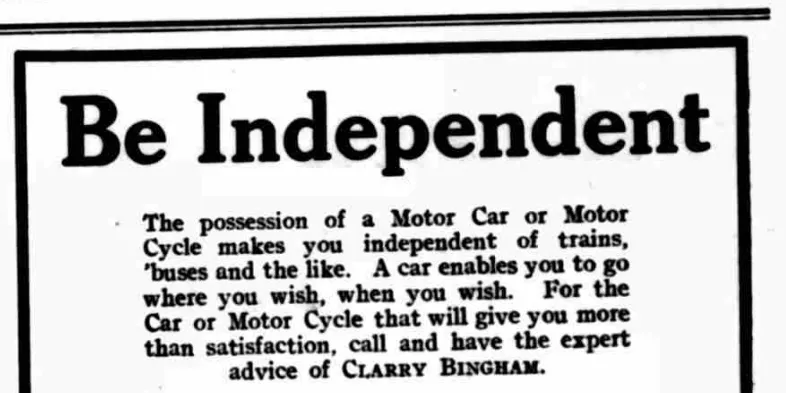
The career of marvellous detective fiction author, Agatha Christie, lasted a total of 50 impressive years. From the creation of her first novel in the height of World War One, to the posthumous publication of her last in 1976, the impact of societal, economic, political and cultural progression on her work cannot be understated. This week’s special blog will focus on a mighty subsection of the developing British climate, a symbol of modernity, grandeur, and personalised independence – the automobile.
Let’s take a look at how newspapers uncover the ways in which transport shifted in not only a practical sense, but also through how these changes were reflected and their symbolism advertised to the curious newspaper consumer. We’ll be paying attention to car advancement in the 1920s to the 1940s more generally, picking out some cult favourites, as well as illustrating how automobiles played a role in Agatha Christie’s own life.
Register now and explore The Archive
Agatha Christie’s Disappearance
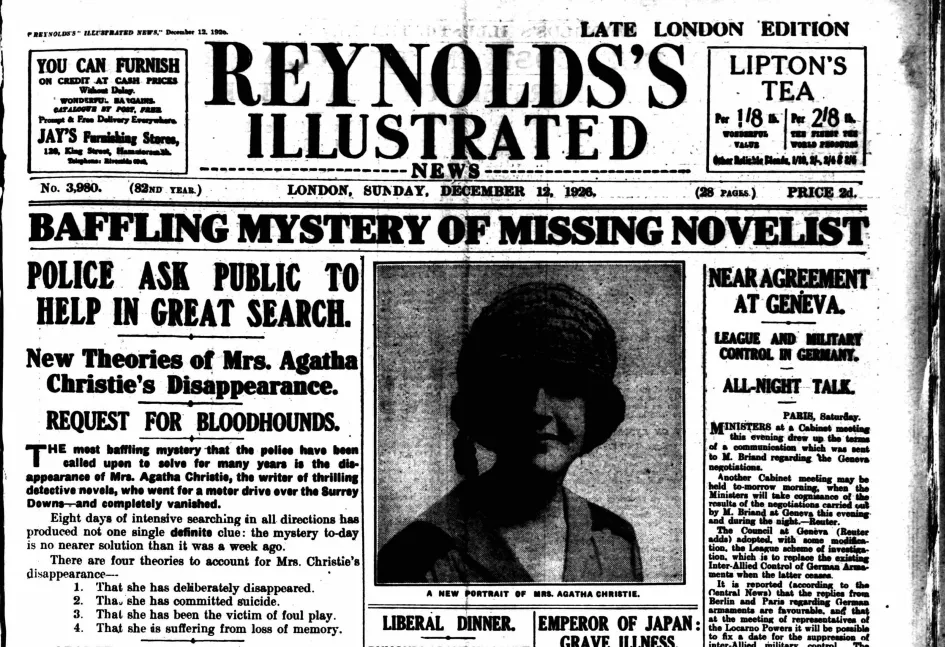
On December 3rd 1926, Agatha Christie went missing for eleven days, causing a hunt that spanned nationwide. She was found, using a different name, 200 miles from her home in Harrogate, Yorkshire. Once it was clarified that she was physically unharmed, the media turned against her. Despite Christie’s attempts at honesty and vulnerability – telling the Daily Mail in an interview after the fact that the cause of the sudden disappearance was due to her fragile mental health – the media continuously clung to the more palatable angle that the ‘murder mystery novelist’ had framed her own demise to promote her books, or to expose her cheating husband. Media outlets focused on deciphering hidden meaning from the ‘clues’ of her disappearance, such as the abandoning of her car the day after she was declared missing. The coverage exposes how dramatic events were reported with the chief goal of keeping the reader closely connected to the story, for that is exactly what Christie’s disappearance swiftly became; a story to tell.
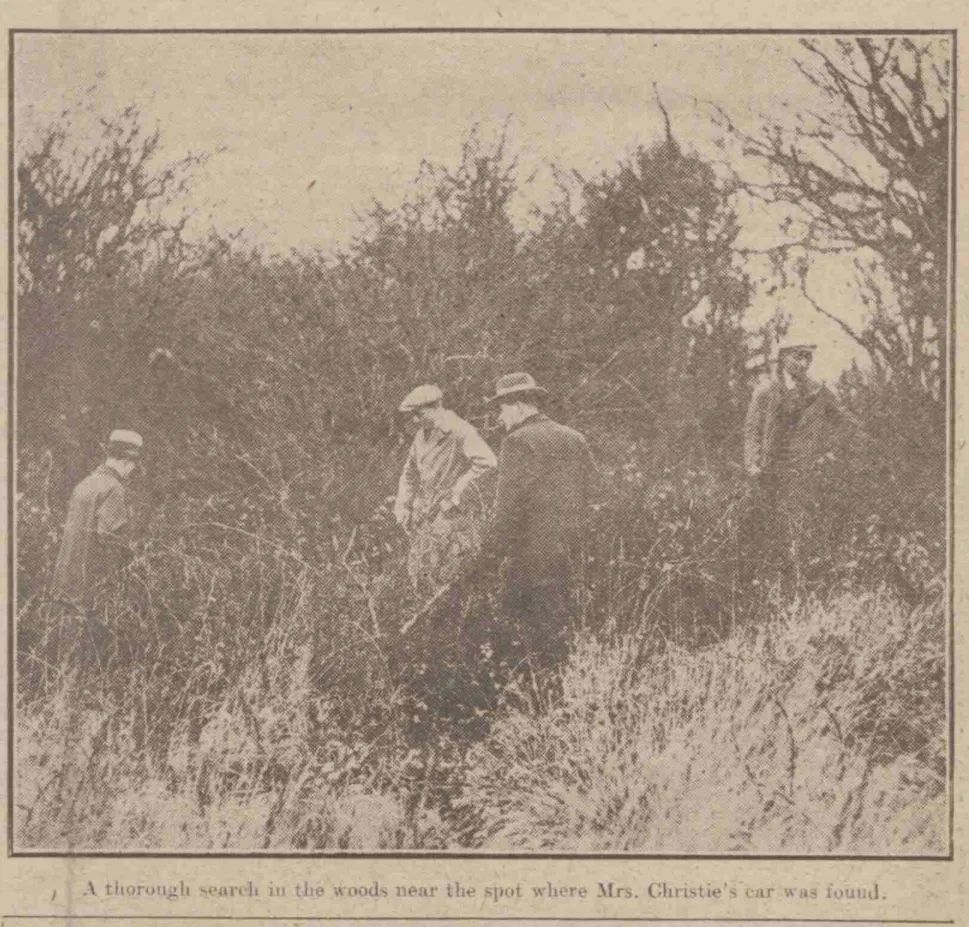
The place in which Christie’s Morris Crowley was located played a key role in newspaper reports of her vanishing, with images of searchers scouring the area featuring on the front page of the Daily Mirror. Although the car itself is not featured, we can easily use our imagination in order to visualise the condition it was found in. Indeed, the absence of the car draws us ever closer to the story, as readers seek more information from within the newspaper pages.
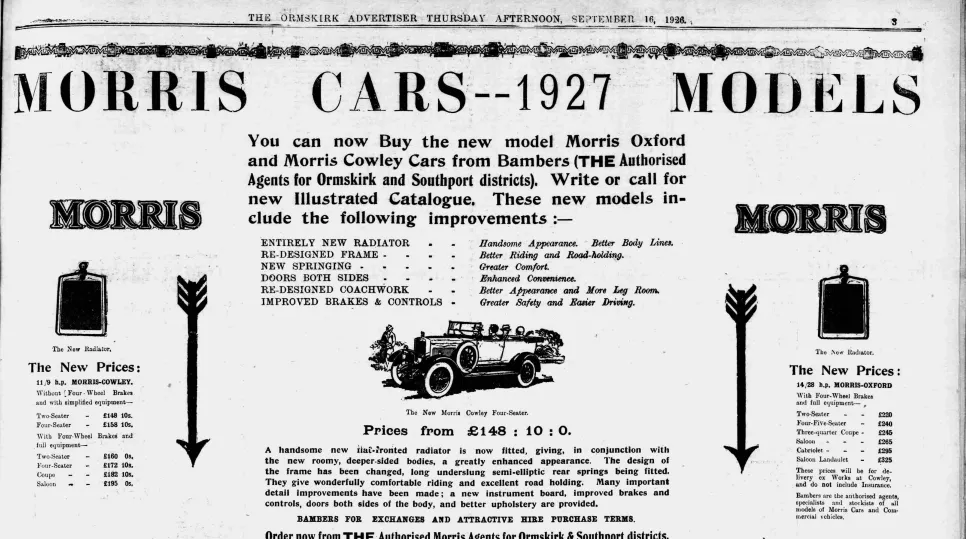
Reports of the time discuss how Christie’s car was found with its wheels hanging over the edge of a chalk pit, dangerously close to plummeting down the quarry. If not for a thick hedge stopping the car from heading any further, the outcome of her disappearance may have been rather different. We can see from the below page, taken from the Ormskirk Advertiser, a visual representation of the infamous car.
Upon looking at these newspapers, it is evident that the car owned by Christie momentarily became an extension of her person in her absence. Whether deliberate and calculated, as many reports claimed, or wholly unintentional, the abandoning of her Morris Crowley became a symbol that the media could grasp onto for Christie’s inner struggle.
Cars Featured in Christie’s Work
The puzzling and quizzical quality that underpins Agatha Christie’s stories have inevitably lead to multiple creative adaptations of her work to the big screen. As is to be expected, TV series and films often deviate from their source material for a multitude of different stylistic, political, or metaphorical reasons. A prime example of this can be seen in the 2017 adaptation of Christie’s novel, Crooked House, originally published in 1949. The novel is set in the autumn of 1947, while the film chose to shift the time frame to the late 1950s. This allowed the socioeconomic climate of the Cold War to influence the film’s physical appearance and its overall tone, which is incorporated in the film’s choice of vehicles.
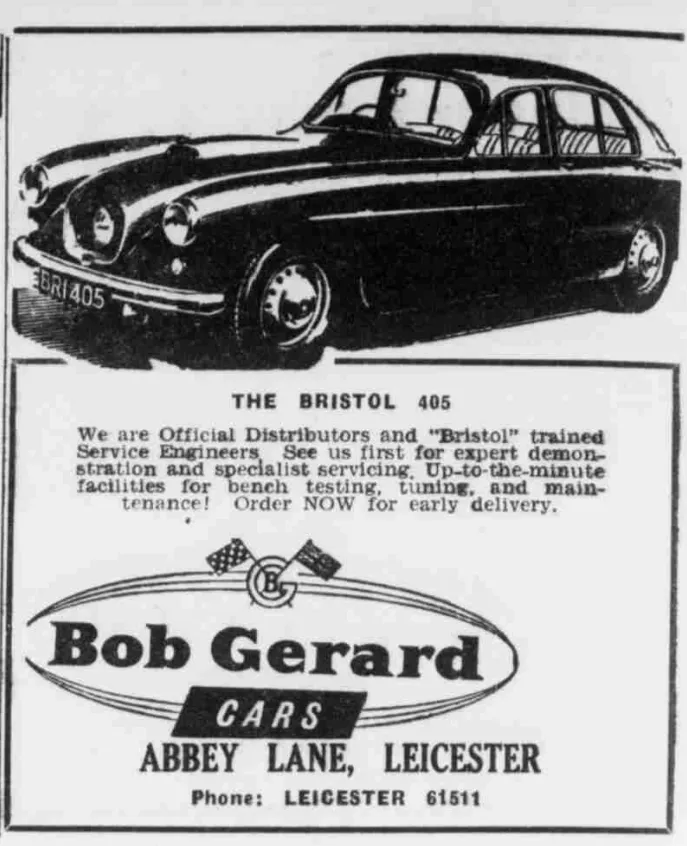
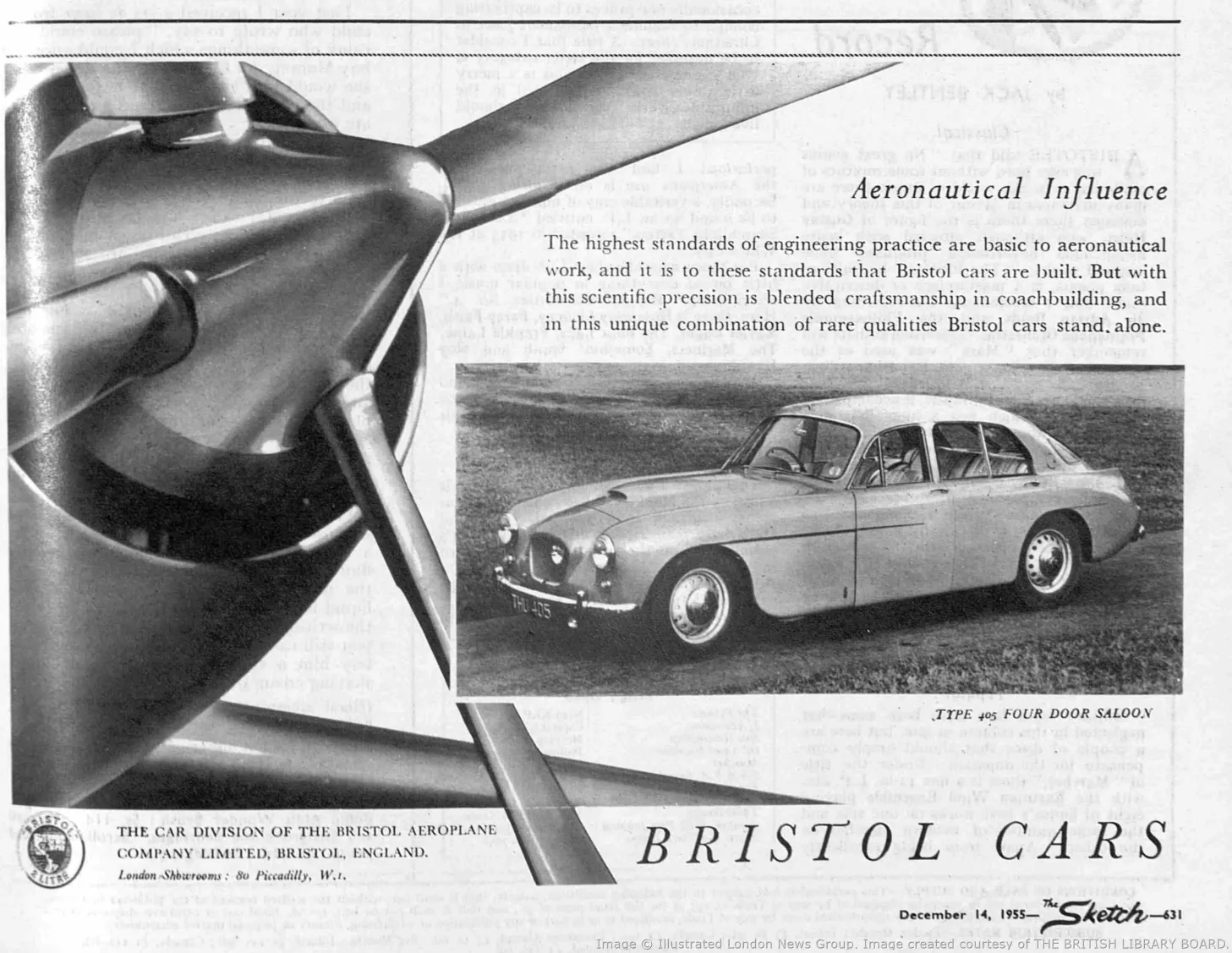
The Bristol 405 features as the car driven by Private Investigator Charles Hayward in the 2017 adaptation. It was first manufactured in 1955, so would not have been the car visualised by readers of Agatha Christie’s original novel. Bristol Cars, a British manufacturer focused on hand-building small amounts of luxury cars, formed as a part of Bristol Aeroplane Company after World War Two.
The four-seater, four-door Type 405 is noted in the Worthing Herald as a superb option for those wanting a modern vehicle, combining ‘high performance with luxury and economy’. Similarly, an article from The Queen in 1954 calls the 405 elegant and dignified, punctuating it as ‘a perfect union of elegant coachwork and aerodynamic engineering.’ The Bristol 405, then, was a well revered choice of automobile with a high reputation for style and comfort. Through diving into the newspapers at the time of manufacturing, we can clearly see why the 405 was selected as the vehicle driven by the esteemed Private Investigator in the film adaptation of Crooked House.
The car has become a recognisable symbol for the film itself, and is an interesting example of how creative liberties influence the stylistic choices of literary adaptations, as we transfer written word into both static and moving picture.
Additional adaptations of Agatha Christie’s work utilise multiple different automobile companies, notable mentions including Bentley, Daimler, Austin and Triumph.
Notable Cars of Impact
Although not directly associated with Agatha Christie and her work, there have been countless automobiles manufactured and developed in the time of her active career. Possession of a car was a sign of economic autonomy and societal progression, a method of transportation that represented shifting family dynamics and social connection. We will pick out two of those cars, produced and sold in the United Kingdom, that have had a significant impact on the cars we know today.
Austin Seven
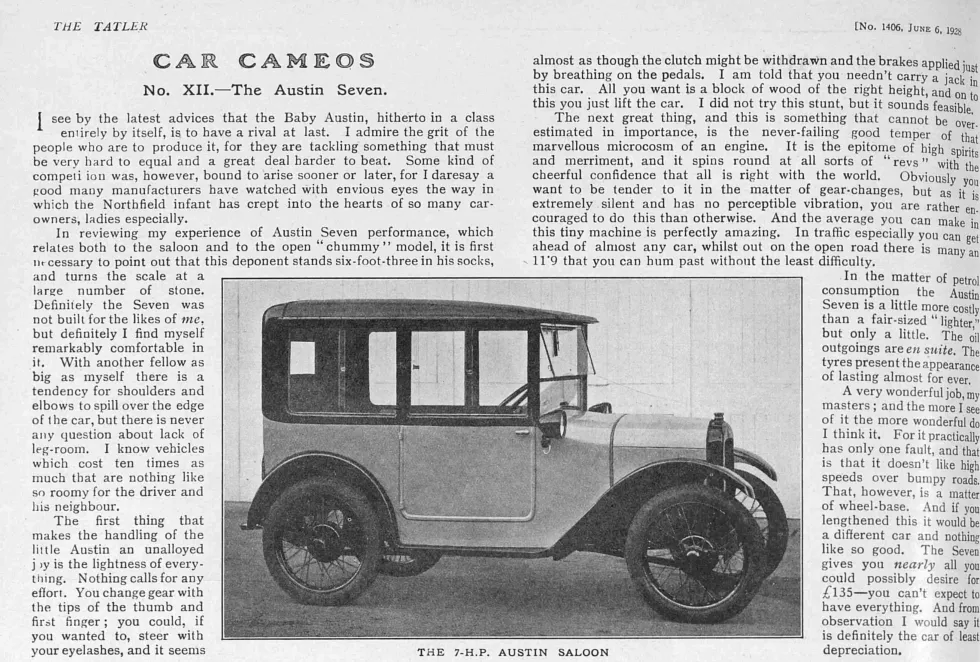
The revolutionary Austin Seven was first introduced in 1922 and continued in production until 1939. Throughout this time, around 300,000 were manufactured and sold, and this covered a two-door tourer, saloon, cabriolet and coupé, and vans. The Austin Seven is thought by some as the British equivalent of the Ford Model T, which was much larger and first came to the market in 1908.
The Seven was a popular and relatively affordable vehicle for those who were given the opportunity to own one. It became so popular that it was also made under license by companies around the world such as BMW and Nissan. Additionally, the Austin Seven was a very small vehicle, at just 6 foot, 3 inch in wheelbase, 40 inches wide and weighing 794 pounds. It was roughly half the size of a Model T, but it was very well suited for navigating Britain’s city streets and country lanes. It’s nicknames were, fittingly, the ‘Baby Austin’ and Britain’s first ‘people’s car’.
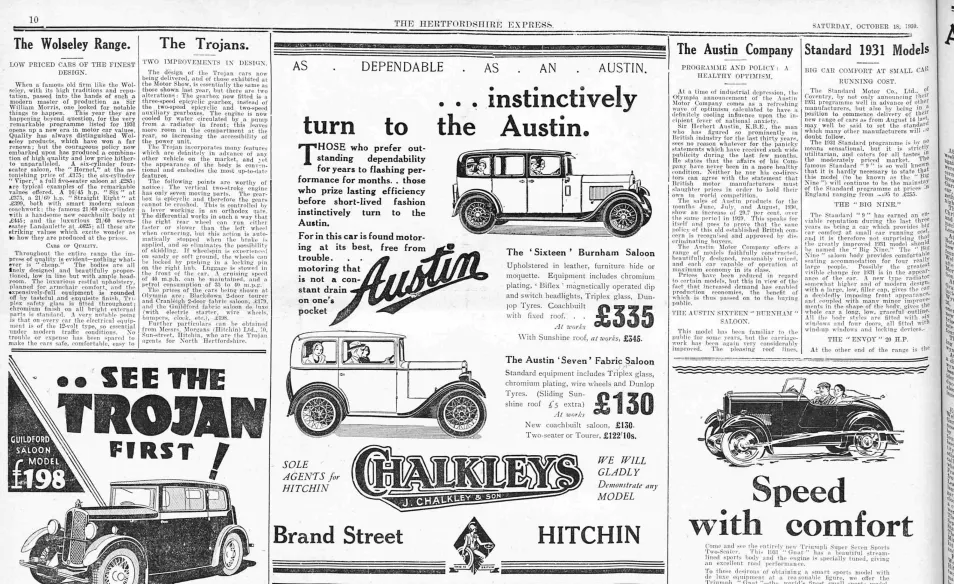
The Austin Seven is the definition of, “if it ain’t broke, don’t fix it!”, with one article from the Hertfordshire Express in October 1930 stating:
The Austin chassis design has proved so satisfactory in service in every part of the world that no alteration has been made to it other than improvement to the brakes.
Apart from upgrading its safety features, the Seven was beloved simply as it was. As of today, less than 10,000 of the almost 300,000 Austin Sevens survive across the world. The number is ever decreasing, and many are slowly but surely rusting and rotting away. However, the Seven will always remain alive and well in the pages of newspapers across the United Kingdom. It will forever be recognised as the car that cemented Austin’s notoriety on the motoring map and mobilised Britain’s families.
Morris Eight
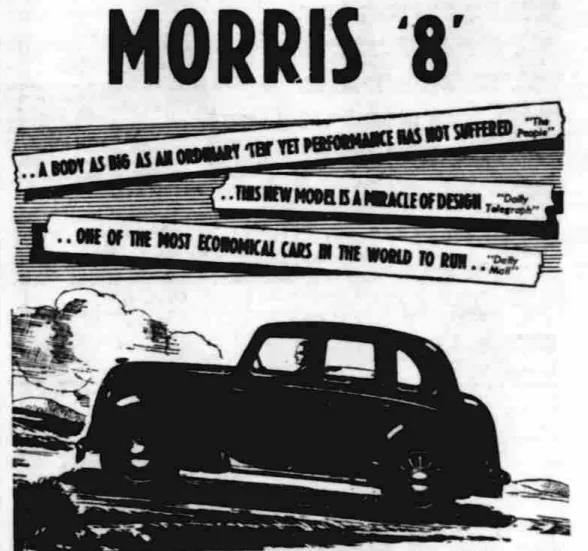
Introduced in 1935 and produced until 1948, the Morris Eight cost £120 new and was built to compete with the Austin Seven. It superseded the Seven in terms of seat quality, improved hydraulic brakes, and was generally better equipped for a calm and stable driving experience. Stylistically, it was inspired by the Ford Model Y and, much like the Seven, dipped its toes into the pool of British motoring.
The Morris Eight was emphasised for its adaptability and suitability for a wide range of users, promising comfort and efficiency to its occupants. Although the figure is largely debated, between 200,000-300,000 Morris Eights were manufactured before the beginning of World War Two, making it an extremely popular option.
The Morris prided itself on its ability to perform everyday functions for any type of owner. One advertisement from the Fife Free Press maintains that Morris products are built to satisfy, ‘not only the owner who can afford to nurse his car but to those in the medical profession, farming, travelling etc., who demand special combined qualities…’
We can uncover, from these advertisements, that the Morris represented a new sort of adaptability; one that made the cars work for you – irrespective of social class – and not the other way around. It is this attitude that had buyers returning to Morris vehicles after the Second World War had ended.
We can see from newspaper pages found in The Archive that British automobiles throughout the 1920s to the 1940s contributed to the shifting sociocultural climate of transport and economic autonomy. We’ve explored how vehicle choices are important within creative expressions such as media adaptations in order to convey a particular climate or tone. We’ve also looked into the symbolic properties of cars and their connection to manufactured narratives and theories in newspapers, as spotted during Agatha Christie’s 1926 disappearance. Finally, The Archive’s pages allow us to see beloved and cherished automobiles in their prime, forever solidifying their reception within historical time frames.
Find out more about Agatha Christie’s disappearance, or search for your favourite vintage automobile in The Archive today.
More on this topic:
Share this article
About the author

Molly Pearce
Data Operations Executive
Published on Thu, 29 January 2026.